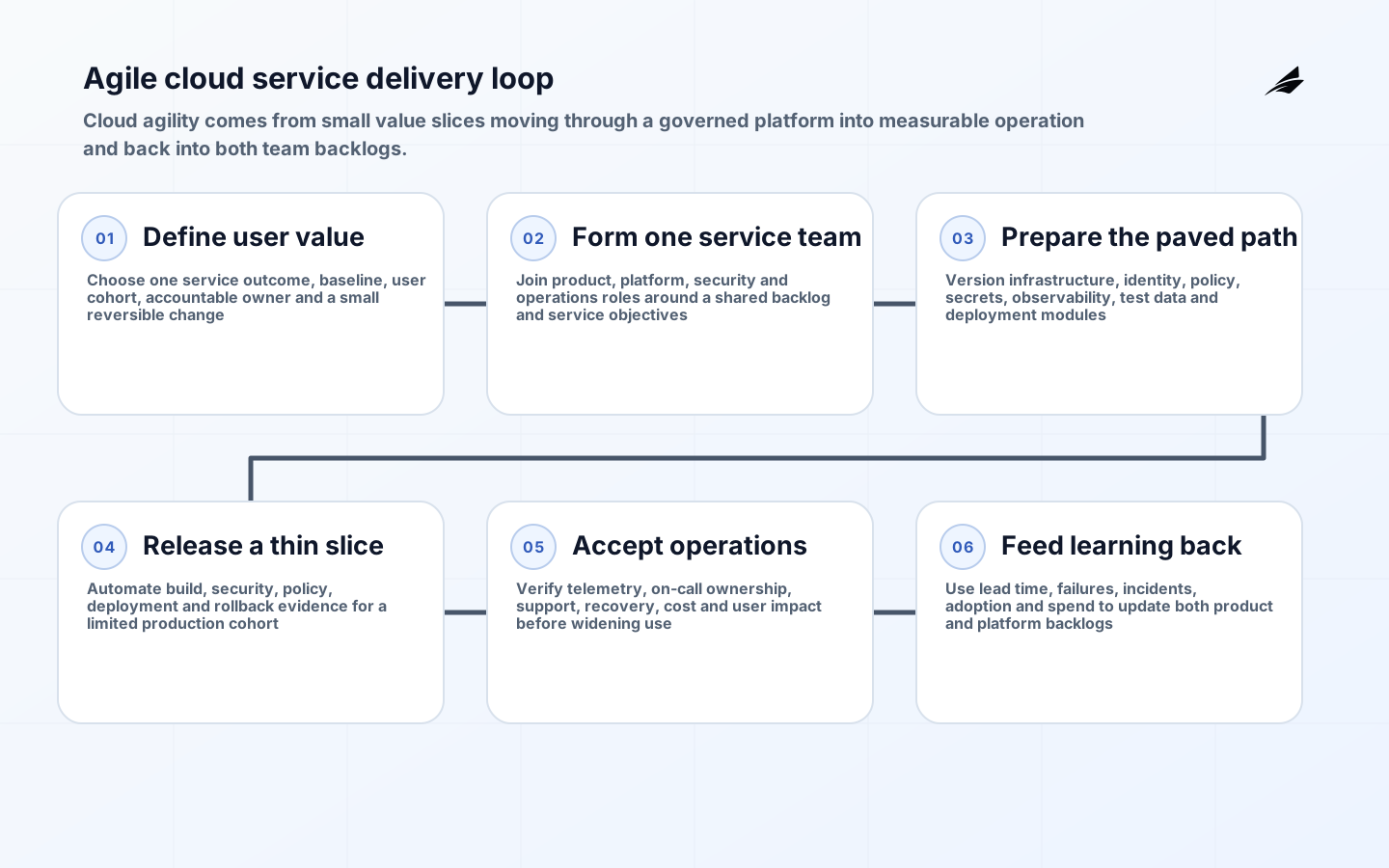
An agile cloud services FAQ should start with a distinction that procurement language often hides: agility is the ability to learn and change safely, not simply the ability to rent infrastructure quickly. A team can create resources in minutes and still wait weeks for access, testing, security review or cost approval. Real agility joins product decisions, automated delivery and production feedback in one manageable service.
This guide answers the operating questions leaders should settle before scaling. For commercial scope and sequencing, use the agile cloud delivery plan and the companion implementation checklist. The focus here is how teams preserve speed after the first workload reaches production.
What makes cloud services genuinely agile?
The practical unit of agility is a small, independently testable service change. The team can move it from an agreed backlog through code, infrastructure policy, verification, release and observation without opening an improvised approval chain. DORA defines continuous delivery as keeping software deployable so changes can be released quickly, safely and sustainably. That capability applies to application code, configuration, database changes and infrastructure.
Cloud APIs help, but they do not supply a product boundary or decision rights. Give one durable team responsibility for user outcomes and service health. Provide a paved platform path for identity, network, secrets, logging, deployment and budgets. Keep exceptions possible, documented and time-bound. A team that owns only deployment speed will externalize reliability, security and spend to somebody else.
| Agility signal | Useful interpretation | Misleading substitute |
|---|---|---|
| Lead time | Elapsed time from accepted change to usable production behavior | Counting tickets closed |
| Deployment frequency | How often valuable, reversible changes reach users | Deploying generated noise |
| Change failure | Changes causing impairment, rollback or urgent repair | Only counting declared incidents |
| Recovery time | Time to restore an acceptable user experience | Time until a technical alert clears |
How should an agile cloud team be organized?
Organize around a service or customer journey rather than a temporary project phase. Product, engineering, security and operations expertise must be available while decisions are still reversible. A platform team should offer reusable capabilities and support, not become a gate that accepts every ticket. Central specialists retain enterprise policy, threat intelligence and assurance responsibilities while product teams implement controls in their context.
Write the responsibility model around decisions: who accepts reliability risk, who may change access policy, who approves an exception, who commands an incident and who owns cloud cost. Include the provider's responsibilities and dependencies on identity, networking, data and vendors. Review this map after reorganizations and acquisitions; an outdated ownership document is worse than an obvious gap because people assume someone else is covering it.
What belongs in the cloud product backlog?
Maintain one ordered backlog for user capability, reliability, security debt, platform upgrades, cost improvement and operational toil. Separate queues invite each function to optimize its own priority. Express technical work in terms of risk or capacity: rotate a weak credential path, reduce restore uncertainty, remove manual deployment steps or lower cost per completed transaction. Reserve capacity for maintenance instead of treating it as optional work after features.
Use short discovery to expose assumptions before implementation. A change proposal should name the affected users, expected outcome, data touched, failure modes, observability and rollback. Thin slices must still be complete enough to operate; postponing access control, backups or support does not make a minimum product, it creates an unpriced obligation. Stop experiments that cannot produce decision-relevant evidence.
How does a change move safely from idea to production?

Store application code, infrastructure, configuration and policy in version control. A change should trigger fast automated checks, produce an attributable artifact and pass environment policy before release. Use progressive exposure where impact warrants it, with a measurable canary and an automatic or rehearsed rollback. Separate deployment from feature exposure so a team can validate production mechanics before enabling behavior for every user.
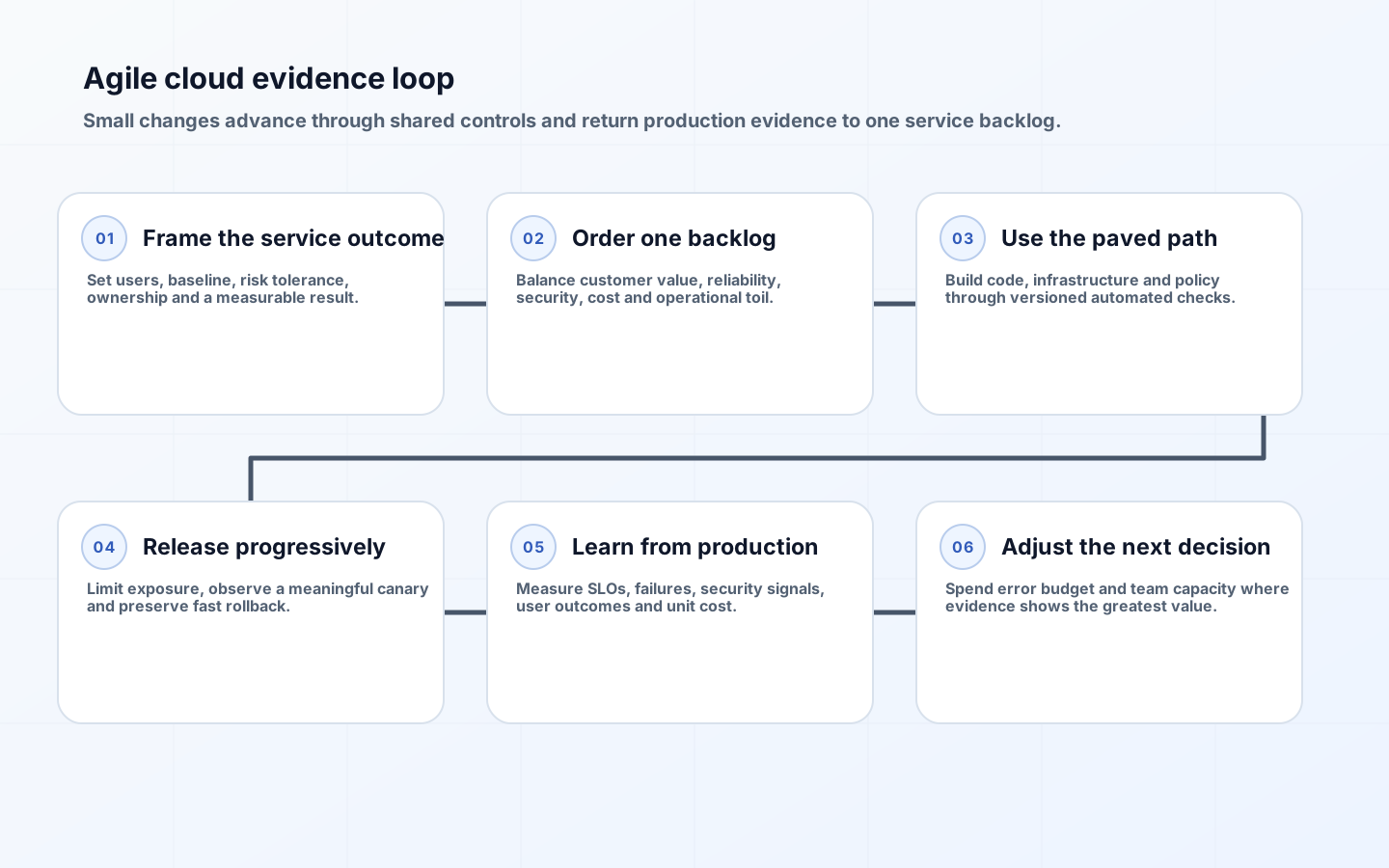
Manual judgment remains useful for exceptional or high-consequence changes, but the reviewer needs concise evidence: test results, risk delta, affected services, recovery action and owner. Repeated approvals should become codified controls. DORA's evidence supports automation, continuous testing, version control and observability as connected capabilities; buying a pipeline product without changing work design will not create continuous delivery.
How do agile teams protect reliability?
Define a small set of service level indicators from the user's experience, then set objectives and an explicit risk tolerance. Google SRE's SLO guidance emphasizes that service objectives support prioritization, not merely reporting. A consumed error budget should change release behavior: pause risky launches, improve detection, remove a failure mode or reduce blast radius until the service returns to tolerance.
Exercise recovery before relying on it. Test restore integrity, failover dependencies, queue replay and reconciliation of transactions completed during disruption. Run incident reviews that explain system conditions and decision context rather than searching for a person to blame. Improvement actions need owners, due dates and verification. A backlog full of unverified incident actions is not organizational learning.
| Decision cadence | Evidence reviewed | Decision produced |
|---|---|---|
| Daily service review | User impact, active incidents, failed changes and urgent threats | Immediate owner and containment |
| Iteration planning | Outcome evidence, toil, risk and platform constraints | Ordered small changes |
| Monthly reliability review | SLO performance, error budget, recovery tests and dependencies | Reliability investment |
| Quarterly value review | Unit cost, adoption, risk posture and roadmap assumptions | Continue, change or retire |
Can security and cost controls keep pace?
Yes, when controls produce feedback inside delivery. Use approved modules, short-lived identity, policy checks, secret scanning, artifact verification and runtime detection. NIST's Cybersecurity Framework makes governance explicit alongside identify, protect, detect, respond and recover. Translate selected outcomes into platform defaults and tests, then retain human risk decisions for exceptions and material residual risk.
Make cost visible at the same granularity as ownership. Tags and account structure help allocate spend, but unit economics explain whether consumption produces value. The FinOps Framework treats engineering, finance and business collaboration as continuous work. Give teams budget alerts and demand signals early; a surprise finance review at quarter end cannot shape an architecture decision already embedded in production.
What should an agile cloud services contract specify?
Buy outcomes and transferable capability, not a large inventory of roles. Define service boundaries, repositories, evidence, access, response times, deliverable acceptance and ownership of automation. Require the partner to work in customer-controlled accounts and documentation systems where practical. Milestones should demonstrate an operable slice, including security and recovery, rather than a presentation about future completeness.
Include exit from the beginning: portable infrastructure definitions, data export, credential revocation, knowledge transfer, open findings and supplier dependencies. Test the handover by having the receiving team deploy, diagnose and recover the service. A contract can be agile while still controlling spend through capacity bands, prioritized outcomes and transparent assumptions; ambiguity is not flexibility.
Treat platform adoption as a product experiment too. Interview teams that abandon the paved path and inspect where it adds waits, hides provider features or cannot express a legitimate requirement. Publish platform usage, support demand, exception age and upgrade health. A standard that wins through demonstrated convenience and evidence will be safer than one enforced only through architecture review. Retire modules that no longer meet provider or workload needs, and migrate their consumers deliberately.
Leaders should also protect team attention. Excessive concurrent migration, reliability and feature commitments create unfinished work and encourage large risky batches. Limit work in progress, make blocked time visible and solve recurring organizational dependencies. The aim is not maximum utilization of every specialist; it is predictable flow of valuable changes through a service that remains within reliability, security and cost tolerances.
Keep evidence understandable outside engineering. A short service brief should show the current outcome trend, reliability tolerance, material risks, unit cost and next trade-off. This lets executives fund enabling work without turning every technical choice into a steering meeting. It also gives delivery teams a stable purpose while implementation details change.
Agile cloud services takeaways
- Measure the complete path from accepted idea to observed user outcome.
- Give durable teams ownership of service health, controls and cost as well as features.
- Automate repeatable evidence and reserve human approval for real risk decisions.
- Use SLOs, recovery exercises and incident learning to bound delivery risk.
- Keep one backlog and make supplier capability transfer an acceptance condition.
Frequently asked questions
Is Scrum required? No. A team may use Scrum, Kanban or another method. The essential properties are small batches, explicit priorities, fast feedback and accountable operation. Can regulated services deploy frequently? Often yes. Automated, traceable controls can provide stronger evidence than infrequent manual releases, although the release design must reflect applicable obligations and consequence.
Should every workload use microservices? No. Independent change and clear ownership matter; a well-structured monolith may be simpler and safer. How soon should metrics appear? Delivery, reliability, security and cost baselines should exist before the pilot so later claims can be compared with reality. Start with a few metrics tied to decisions rather than a decorative dashboard.
Conclusion
Agile cloud services work when the organization shortens the distance between a decision and trustworthy production evidence. Product ownership, paved delivery, SLOs, automated controls and cost accountability must reinforce one another. Start with one service, make the complete change path visible, remove its largest delay and prove recovery. Scale the operating pattern only after it produces safer learning, not merely more cloud activity.