Cloud application management is the discipline of keeping a business application useful, secure, reliable, supportable, and economically justified throughout its life. It joins product ownership with technical operations. The managed service is not only compute, storage, or a vendor subscription; it is the customer or employee journey, authoritative data, integrations, support process, controls, recovery capability, and supplier commitments required to deliver an outcome.
Business teams can use this guide to ask for operating evidence without taking over engineering decisions. The cloud application management implementation checklist turns the model into acceptance tasks, the cloud application management FAQ addresses ownership and cost questions, and the cloud lifecycle management checklist extends governance from adoption through retirement.
Define the application as a business service
Create a service record that names purpose, users, business owner, technical owner, support owner, data owner, security contact, critical journeys, hours, dependencies, environments, suppliers, obligations, and retirement trigger. Distinguish the customer-facing service from its components so a database dashboard cannot declare success while checkout or case handling is broken. Record the minimum viable service for disruption and which decisions require business authority.
Inventory the application estate and reconcile it with billing, identity, network, repository, data, and supplier records. Find unmanaged SaaS, abandoned environments, shared credentials, unsupported runtimes, undocumented integrations, and applications with no accountable owner. Assign a lifecycle state such as discovery, onboarding, active, constrained, replacement, or retiring. An application without an owner should not quietly remain a production dependency.
| Service record field | Business question | Evidence |
|---|---|---|
| Outcome and users | Which work stops if this service fails? | Named journeys and impact tiers |
| Ownership | Who decides priority, risk, spend, and recovery? | Accepted responsibility matrix |
| Dependencies | Which providers, data, identities, and interfaces are required? | Current dependency map and contracts |
| Service objectives | What behavior is good enough for users? | Defined indicators, targets, and review action |
| Lifecycle | Why does the application still exist? | Current state, roadmap, and retirement condition |
Manage service levels through user-visible evidence
Define a small set of service level indicators from user experience: successful task completion, correctness, availability, latency, freshness, and durability. Set service level objectives with a measurement window and response when the target is at risk. Google SRE guidance distinguishes an SLO from an SLA: an SLA adds explicit consequences. Avoid a vendor uptime number as the only indicator; it may exclude the application, client, integration, and business-data failures users encounter.
Combine logs, metrics, traces, synthetic journeys, audit events, support cases, and business events with correlation identifiers. Instrument failure at boundaries such as identity, queues, payment, email, file transfer, and provider APIs. Page only on conditions requiring prompt action and route trends to owned improvement work. Dashboards should show impact by journey, tenant or cohort where permitted, deployment, dependency, and error reason without exposing sensitive content.
Connect support, incidents, and change
Give users one clear route for requests and incidents. Define severity from business impact, not requester seniority. Support needs safe search, event history, known-error guidance, status communication, escalation, and bounded correction actions; direct database edits are not an operating model. Major incidents need an accountable commander, technical operations, communications, a decision log, verified recovery, and a review that funds systemic changes rather than stopping at individual error.
Version application, infrastructure, configuration, schemas, policy, and runbooks. Automate repeatable deployments from reviewed source, separate deployment from feature exposure where useful, and define rollback or forward-repair criteria before release. Classify routine, elevated, and emergency changes by risk. Evaluate whether a rollback preserves writes and external effects. Use incident and change evidence together to find unstable components, fragile approvals, and manual steps that create delay.
| Operating signal | Decision it should drive | Anti-pattern |
|---|---|---|
| Error-budget consumption | Slow risky change or fund reliability | Reporting uptime with no action |
| Repeat incidents | Remove the common contributor | Closing tickets independently |
| Support contact rate | Improve confusing or failing journeys | Treating support as user error |
| Change failure | Strengthen tests, rollout, or recovery | Adding blanket approval meetings |
| Unit cost | Optimize architecture or product policy | Cutting resources without demand context |
| Access exceptions | Repair role and workflow design | Renewing standing privilege automatically |
Maintain security and data controls continuously
Apply least privilege to human and workload identities, separate normal and emergency administration, review access, rotate secrets, patch supported components, and monitor consequential changes. NIST zero trust guidance removes implicit trust based only on network location or ownership; resource access should consider identity and current policy. Track data classification, location, encryption, retention, deletion, legal hold, backup, export, and processor responsibilities through every integration and environment.
Maintain a vulnerability process from discovery through triage, remediation, verification, disclosure where applicable, and lessons learned. Keep dependency and asset inventories current enough to answer exposure questions. Test authorization and tenant boundaries after changes. Supplier assurance must cover incident notification, administrative access, sub-processors, recovery, data return, deletion, support, and exit. Compliance evidence should be generated from operating controls where possible instead of assembled only before an audit.
Manage cost, capacity, and supplier value together
Allocate cloud and SaaS cost to a service, environment, owner, and useful unit such as active tenant, transaction, case, or stored record. FinOps treats financial accountability as collaboration among engineering, finance, and business teams. Review demand, commitment coverage, idle resources, storage growth, data transfer, license utilization, and support burden. A lower bill is not an improvement if latency, recovery, or staff workload violates the service objective.
Forecast capacity from business events and technical limits, then test scaling and throttling before peaks. Understand provider quotas, nonlinear pricing, and concentration risk. Supplier reviews should compare actual service, incidents, roadmap, support, controls, and total switching cost with the business case. Preserve export formats, configuration, documentation, and termination steps. An exit plan is valuable even when the organization intends to renew because it clarifies ownership and prevents avoidable lock-in.
Exercise resilience and govern lifecycle decisions
Define RPO, RTO, degraded service, dependency failure behavior, and recovery authority. Test backup restoration through application correctness, not storage completion. Exercise identity outage, regional failure, corrupt data, expired certificate, lost integration, supplier incident, and unavailable staff. Verify customer communication and reconciliation after recovery. Track manual recovery steps as engineering debt with owners and retest dates.
Hold a periodic service review with business, product, operations, security, finance, data, and supplier evidence. Decide to invest, constrain, replace, consolidate, or retire. Retirement includes user migration, records disposition, data export, integration removal, access revocation, billing closure, monitoring changes, and verified provider deletion. Keep a tombstone record so old identifiers, decisions, and evidence remain explainable without leaving the service running.
Run one accountable management cycle
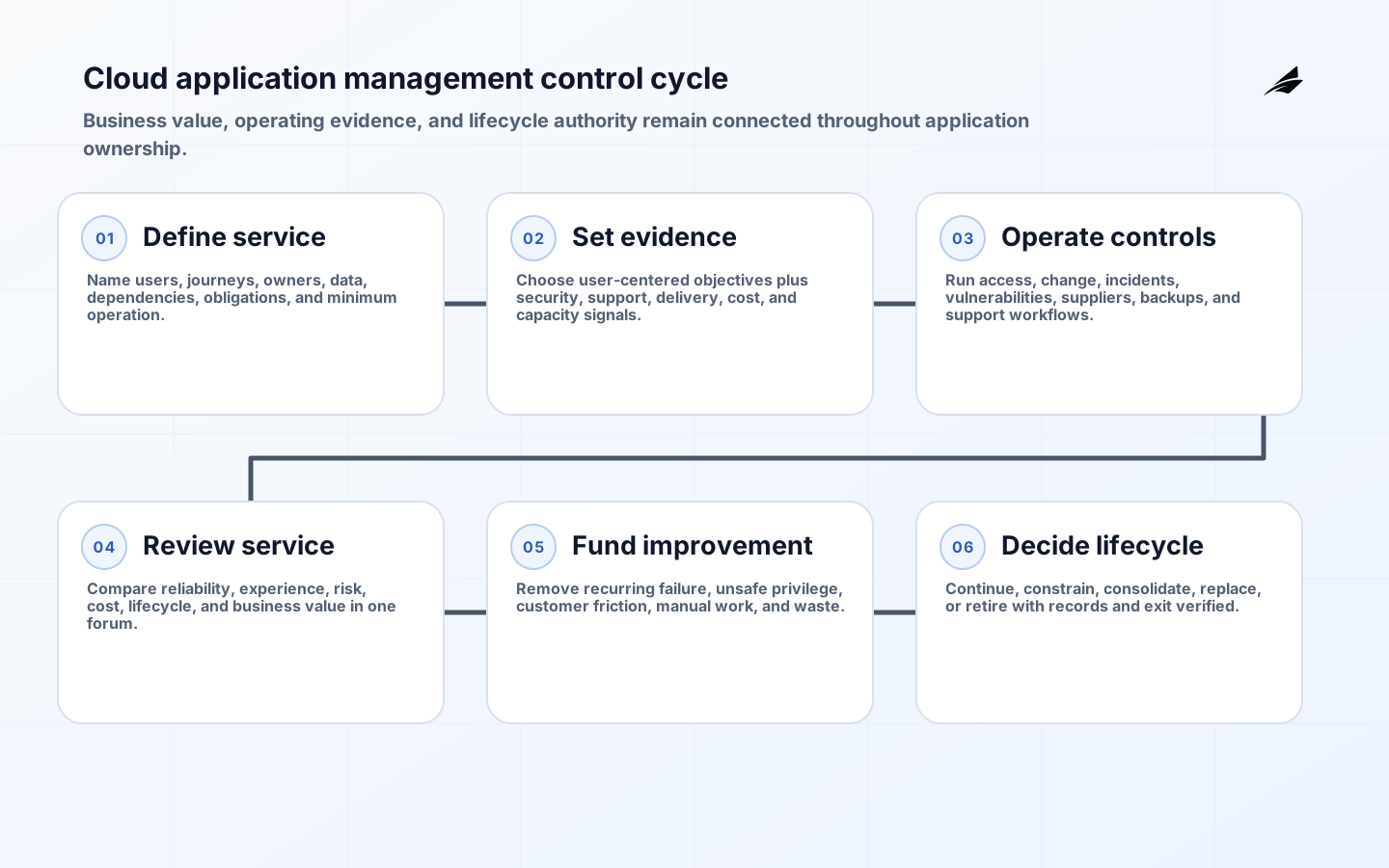
- Define the business service, critical journeys, owners, data, dependencies, and lifecycle state.
- Set user-centered objectives and instrument application, dependency, and business evidence.
- Operate support, incidents, access, vulnerabilities, changes, backups, and suppliers through named workflows.
- Review reliability, security, experience, delivery, cost, capacity, and compliance as one service picture.
- Fund improvements according to impact and verify them through release and exercise evidence.
- Reassess the business case and either continue, reshape, replace, or retire the application deliberately.
Key takeaways
- Manage the user-facing service, not only its cloud resources or vendor contract.
- Give each application explicit business, technical, data, security, and support ownership.
- Use SLOs, incidents, support, change, cost, and risk evidence to drive decisions.
- Test recovery and supplier failure through complete business journeys.
- Treat consolidation and retirement as governed lifecycle outcomes, not cleanup afterthoughts.
Frequently asked questions
Who should own a cloud business application?
A business or product owner should be accountable for outcome, priority, risk acceptance, and funding, while a technical service owner is accountable for engineering and operation. Data, security, support, finance, and supplier responsibilities remain explicit. One person may hold several roles in a small organization, but the decisions and escalation paths should still be named.
Does a managed cloud service remove operational responsibility?
No. It changes the division of responsibility. The provider may operate physical infrastructure, runtime, or software, while the customer still owns configuration, identity, data, integration, user access, service objectives, recovery choices, monitoring, and supplier governance according to the service model. Document the exact boundary for every material dependency.
How often should the service be reviewed?
Operational signals require continuous or frequent review; a cross-functional service review can run monthly or quarterly according to criticality and change rate. Reassess immediately after major incidents, acquisitions, regulatory change, architecture shifts, large cost changes, or supplier events. The cadence should be frequent enough to act before a known trend becomes customer harm.
A useful review pack is compact and decision-oriented. Show the service outcome, objective performance and error-budget trend, major incidents and recurring support themes, material changes, open vulnerabilities and access exceptions, recovery-test status, dependency health, cost and forecast, supplier issues, lifecycle risks, and proposed actions. Each action needs an owner, expected effect, funding decision, and review date. Detailed telemetry remains linked for investigation instead of overwhelming the governance meeting.
Keep product demand and operational health in the same priority system. A feature that adds a critical dependency, new sensitive data, or substantial support volume changes the service’s cost and risk profile. Conversely, reliability and security work should name the user journey or loss it protects. This shared framing helps business leaders compare investment without reducing every decision to infrastructure spend or treating operations as an unlimited background service.
Conclusion
Cloud application management works when business and technical evidence meet in one accountable service model. Define the outcome and owners, measure user-visible behavior, connect support to engineering, control access and change, explain unit cost, and exercise recovery. Then use regular reviews to invest or retire deliberately. Preserve the decisions and evidence so a new owner can understand the service without relying on institutional memory. The result is a cloud estate shaped by business value and operating truth rather than by whatever resources happen to appear on a provider bill.