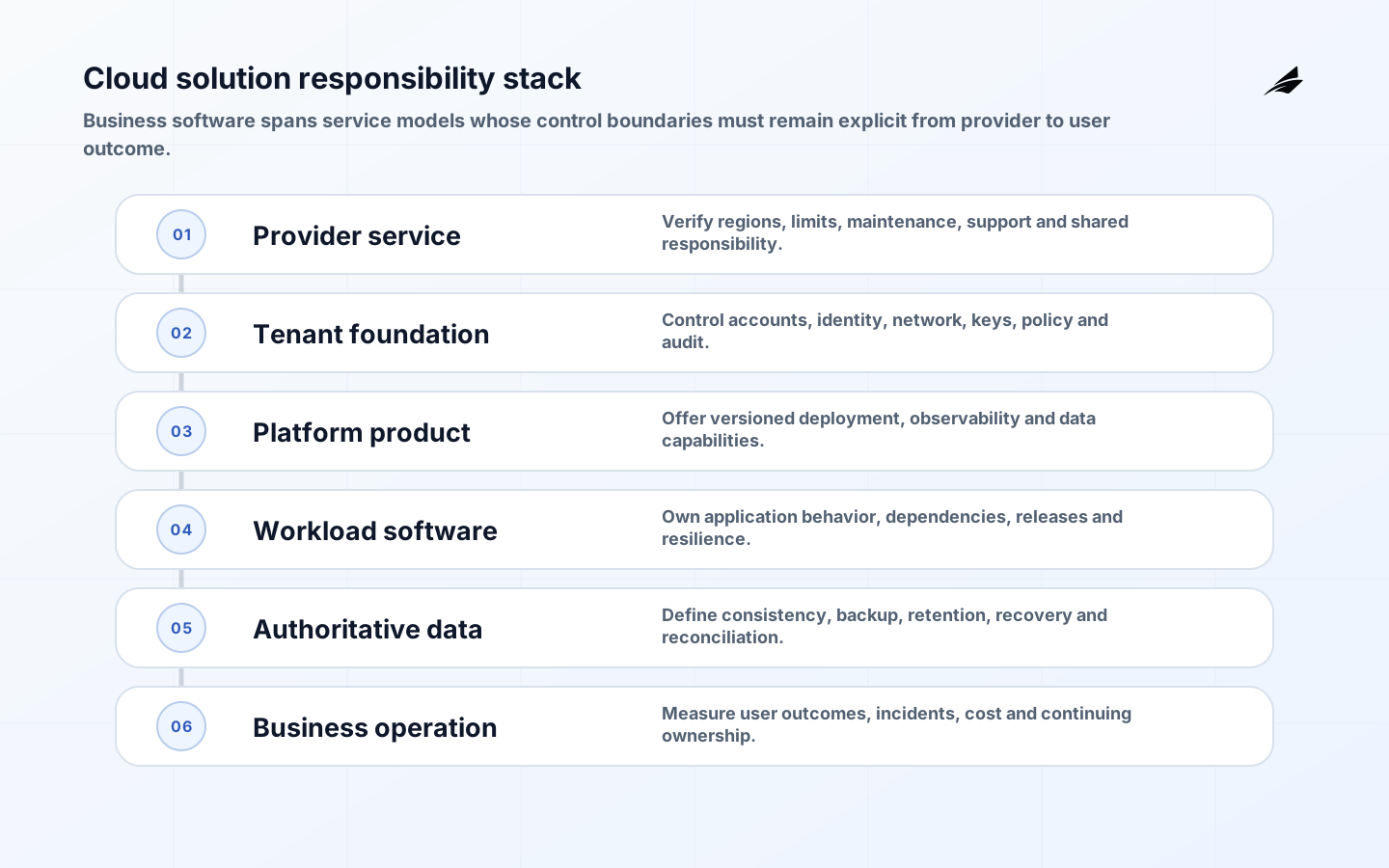
Cloud solutions and software describe a stack of responsibilities, not one product category. NIST distinguishes infrastructure, platform and software service models by the capabilities the customer controls. A business solution can combine all three with on-premises systems and managed operations. Architecture should therefore begin with service outcomes, data, workload characteristics and organizational capability. Choosing a cloud provider or deployment label before those facts are known often creates either unnecessary complexity or hidden operational gaps.
This FAQ complements the cloud solutions scope and delivery plan and production implementation checklist. It uses the major cloud architecture frameworks as primary operational guidance while remaining provider-neutral. Exact service behavior, quotas, regions and commercial terms must be verified in current provider documentation before a design is accepted.
How do service models change responsibility?
With infrastructure as a service, customers usually manage operating systems, runtime, applications and data while the provider operates underlying infrastructure. Platform services move more runtime and availability work to the provider, but customers still own configuration, identities, application behavior and data. Software as a service narrows technical control further, yet the customer remains accountable for access, approved use, records and integration. A managed service partner can operate customer responsibilities without eliminating them.
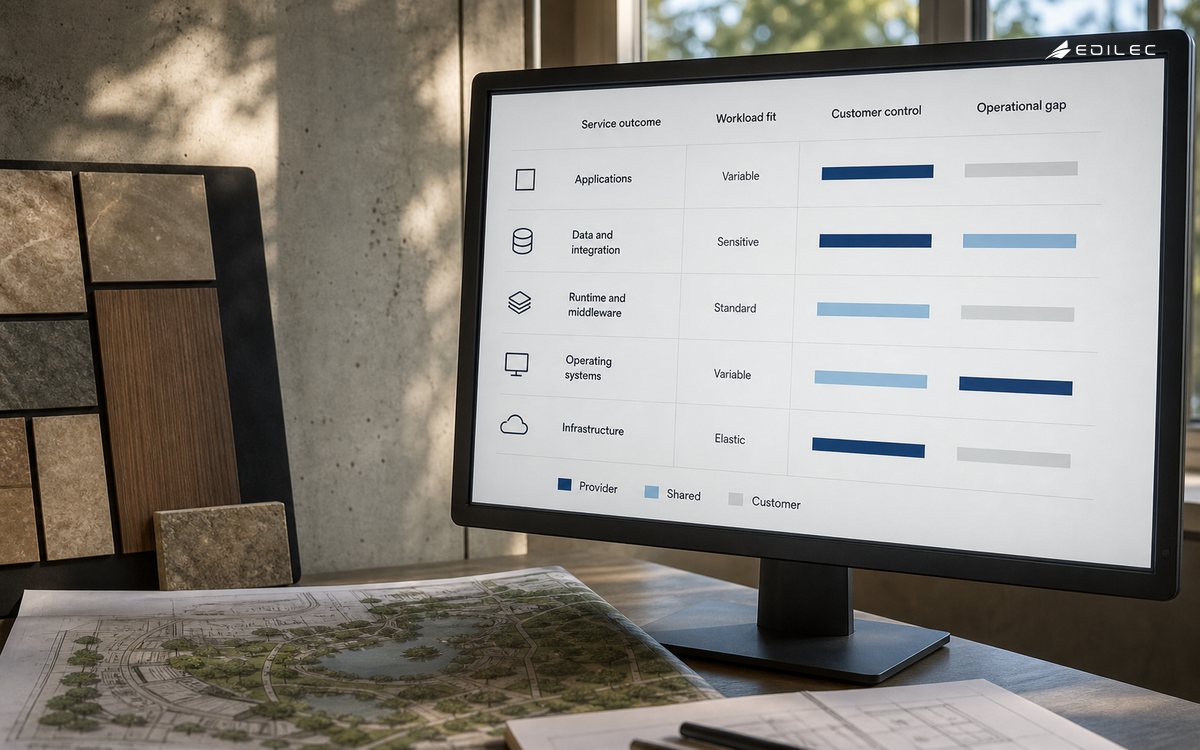
Create a layered responsibility map for every solution. Include provider, tenant, network, identity, platform, application, data and business process. For each layer, state who designs, configures, monitors, responds and verifies. Service models can differ within one application: a managed database, containers, serverless jobs and SaaS identity may coexist. The weakest unowned seam, not the most sophisticated component, often determines reliability and security.
Which workloads fit cloud services?
Assess availability, latency, throughput, state, data gravity, residency, licensing, hardware dependency, recovery, change frequency and team capability. Elastic or globally distributed demand can benefit from cloud services, but steady workloads can also benefit from managed operations and automation. Conversely, extreme latency, specialized equipment, immovable data or unsupported licensing may favor edge, private or retained environments. Cloud suitability is a workload decision, not an enterprise slogan.
Compare feasible dispositions: retain, retire, replace with SaaS, rehost, replatform, refactor or rebuild. Rehosting can meet a deadline but may preserve operational burden. Replatforming can reduce it with controlled change. Refactoring should be justified by measurable constraints, not fashion. Build a dependency map and group migration waves around business services. Retiring a redundant application can create more value than moving it.
| Model | Customer control focus | Common blind spot |
|---|---|---|
| IaaS | Operating system through business process | Patching and resilient architecture |
| PaaS | Application, configuration, identity and data | Limits and shared responsibility |
| SaaS | Users, configuration, data use and integration | Export and access governance |
| Managed operations | Contracted operational tasks | Decision and verification ownership |
What should a shared cloud platform provide?
A shared platform should offer secure accounts or subscriptions, identity integration, network patterns, keys, logging, policy, deployment, observability, data services and cost allocation as discoverable products. Workload teams need clear interfaces, documentation, support and feedback paths. Platform teams should measure onboarding time, successful adoption, reliability and user effort. Mandating an internal platform without treating teams as users creates bypasses and shadow infrastructure.
Separate guardrails from implementation choice. Enforce essential identity, region, encryption, logging and network rules while allowing workload teams bounded flexibility. Version reusable infrastructure modules and test upgrades. Avoid one giant template that couples unrelated services. Microsoft’s Cloud Adoption Framework explicitly describes shared management between platform and workload teams; the exact split should match organizational skill and consequence.
How is a cloud software architecture evaluated?
Start with quality attributes and failure modes. Set measurable reliability, recovery, performance, security, operability and cost requirements. Trace a customer transaction through every synchronous dependency and identify timeouts, retries, idempotency and load shedding. Limit blast radius through account, region, cell or service boundaries proportionate to consequence. A multi-region design adds coordination and testing burden; adopt it only when business objectives justify it.
Design data authority explicitly. Choose consistency and conflict behavior based on business invariants. Backups require restore tests, while replication requires protection from propagating corruption. Instrument user and business outcomes alongside infrastructure. AWS and Google architecture frameworks emphasize operational excellence, security, reliability, performance and cost trade-offs; review these dimensions together because optimizing one can damage another.
How should cloud security be implemented?
Federate identity, enforce strong authentication, minimize standing privilege and use workload identities rather than embedded secrets. Protect control planes and build systems more strongly than ordinary workloads. Apply policy as code where it can prevent unsafe configuration, but maintain an exception process with owner and expiry. Centralize useful security signals while retaining workload context. Encrypt data and govern keys according to classification and recovery requirements.
Threat-model internet exposure, tenant boundaries, APIs, software supply chain, metadata services, event channels and administrative paths. Patch customer-managed layers and understand provider-managed boundaries. Test authorization and incident containment. Compliance attestations from a provider are inputs to assurance; they do not prove the customer architecture, configuration or data use is compliant. Preserve evidence for access, change, vulnerability and recovery decisions.
| Architecture question | Evidence | Trade-off |
|---|---|---|
| Can it recover? | Measured restore and dependency rehearsal | Cost and complexity |
| Can it scale? | Representative load and quota test | Capacity headroom |
| Can it be secured? | Threat model and access tests | Friction and flexibility |
| Can it be operated? | Observed incident and release exercise | Team capacity |
How are cost and performance controlled?
Expose cost by account, service, owner and business unit. Allocate shared platform charges with a transparent method and track unallocated spend. Forecast known events and detect anomalies quickly. Use unit measures such as cost per transaction or tenant when they reflect business demand. FinOps requires collaboration among engineering, finance and business owners; a central cost team cannot optimize services safely without workload context.
Optimization should preserve service objectives. Rightsizing, scheduling, storage lifecycle, commitment discounts and architectural change have different risk and effort. Validate realized savings after performance and labor effects. Define who may purchase commitments and who owns stranded capacity. Cost limits should prevent runaway experiments or loops, but crude shutdown rules can cause incidents. Pair budgets with service criticality and escalation.
What makes migration and operations durable?
Migrate through evidence-based waves. Prove landing-zone controls, deployment, observability, data transfer, performance, security, recovery, support and cutover before increasing scale. Rehearse rollback or forward repair and reconcile state after transition. Keep coexistence authority explicit. Decommission legacy infrastructure, credentials, monitoring and licenses when retention obligations are satisfied; otherwise cloud migration leaves a costly parallel estate.
Assign service ownership and on-call authority. Use service-level objectives, error budgets, incident practice and post-incident learning. Monitor provider quotas, regional dependencies and status, but own customer communication and business recovery. Maintain portability for critical records and automation even when architecture uses provider-native services. Exit readiness means the organization can recover data, configuration and operational history—not that every component runs unchanged elsewhere.
For cloud solutions and software: architecture and delivery faq, maintain an acceptance ledger that links each material requirement to an owner, implementation evidence, test result, residual limitation and review date. Sample the evidence with people who operate the service, not only its builders. Re-open acceptance when a provider, data source, integration, user population or authority boundary changes. This ledger prevents a successful launch label from concealing expired assumptions, incomplete handover or controls that were demonstrated once but cannot be exercised by the permanent team.
Document provider limits as architecture inputs: regional availability, quotas, request size, concurrency, backup behavior, maintenance, support response and recovery commitments. Test the limits that could interrupt the business service and request increases before demand reaches them. Maintain a dependency register for globally shared control planes and third-party SaaS even when workloads are regionally distributed. This evidence keeps a diagram labeled highly available from masking a single identity, DNS, build or supplier dependency that can still stop the complete service.
Review software and service lifecycle at least annually and before major provider changes. Identify approaching runtime end-of-support, deprecated APIs, expiring commitments and services whose replacement affects data or recovery. Fund upgrades as product work. Deferring every lifecycle change eventually turns a routine provider evolution into an urgent migration with weak leverage and limited testing time.
Key takeaways
- Map responsibility across the complete cloud solution stack.
- Select workload disposition from evidence, not policy slogans.
- Treat shared platforms as products with guardrails and service measures.
- Evaluate reliability, security, performance and cost together.
- Complete migration with operational ownership and legacy closure.
Frequently asked questions
Is cloud always cheaper than on-premises software?
No. Cost depends on utilization, architecture, commercial terms, staffing, licenses, network transfer and retained facilities. Cloud can improve speed or resilience even when direct infrastructure cost is higher. Compare full lifecycle outcomes.
Does using multiple clouds improve resilience?
Not automatically. It can reduce a specific provider dependency but adds identity, data, network, tooling and skill complexity. Many services gain more from tested multi-zone or multi-region design within one provider. Model the actual failure.
Should every application become microservices?
No. A modular monolith or managed SaaS product may meet quality and change needs with less operational overhead. Use service boundaries where independent ownership, scaling or release provides measurable value.
Conclusion
Cloud solutions and software work when technical service models are translated into business ownership, measurable architecture and tested operations. Provider capability can remove undifferentiated work, but it cannot decide the organization’s data, risk, service and financial responsibilities.
Select the simplest solution that meets the workload’s quality attributes, prove it through representative failure and migration scenarios and maintain cost visibility. Close legacy obligations and keep critical evidence recoverable. That produces a cloud service the enterprise can operate rather than a collection of provisioned resources.