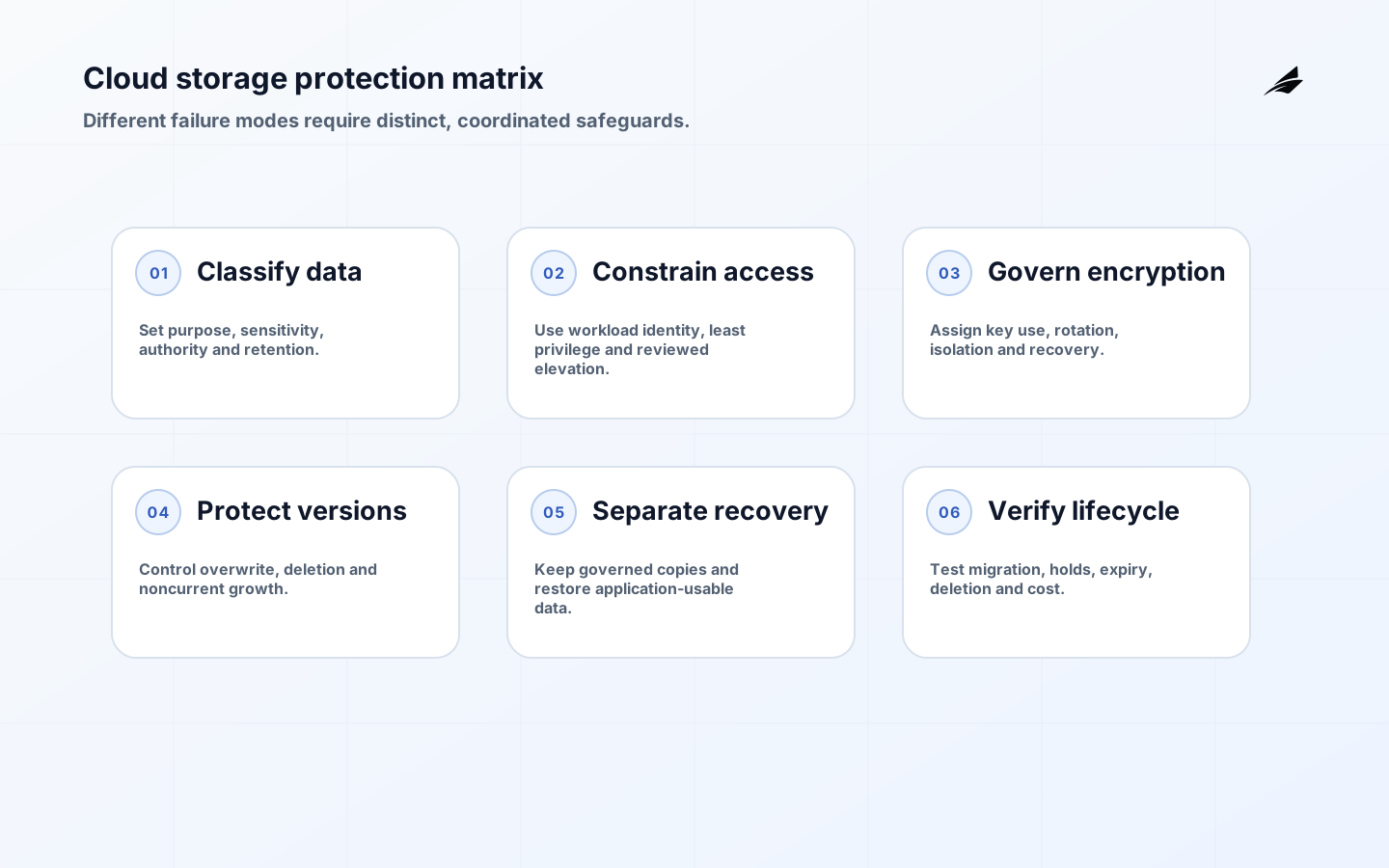
Cloud storage services provide durable capacity through object, file, block and archive interfaces, but the service type alone does not protect business data. Buyers must decide who can read or delete data, how versions are retained, what failures redundancy covers, how quickly data must be restored and how usage becomes cost. This FAQ answers those questions with implementation detail so architecture, security, records and finance teams can make one coherent storage decision.
For project planning, pair this FAQ with the cloud storage scope and cost guide and the cloud storage implementation checklist. Teams building the surrounding platform should also use the cloud DevOps implementation checklist. Storage is an operated data lifecycle, not a bucket created at the end of a project.
What are the main cloud storage service types?
Object storage holds objects and metadata behind API operations. It suits documents, media, logs, backups and analytical data where applications can use object semantics. File storage exposes shared hierarchical paths through protocols such as NFS or SMB and supports applications expecting directories and file locking. Block storage presents volumes to compute instances and suits databases or filesystems needing low-latency random I/O. Archive tiers reduce storage price for data that can tolerate retrieval delay and minimum-duration charges.
Choose from workload behavior, not familiarity. Record object size, operation rate, access pattern, concurrency, latency, throughput, consistency, protocol, durability, retention and recovery. Test with realistic files and request shapes. A service can offer excellent aggregate throughput yet perform poorly with millions of tiny objects or metadata-heavy directory operations. Keep the interface boundary explicit so an application does not rely accidentally on provider-specific behavior.
| Service type | Best fit | Critical questions | Common cost drivers |
|---|---|---|---|
| Object | Unstructured content, backups, logs, analytics | API semantics, lifecycle, versioning, object size | Capacity, requests, retrieval, transfer |
| File | Shared application directories and user files | Protocol, locking, identity integration, throughput | Provisioned capacity, operations, snapshots |
| Block | Databases, virtual machines, transactional filesystems | IOPS, latency, attachment, crash consistency | Volume size, IOPS, throughput, snapshots |
| Archive | Long-retained, rarely accessed records | Retrieval delay, minimum duration, legal hold | Stored bytes, early deletion, restore and egress |
How should a storage protection design be layered?
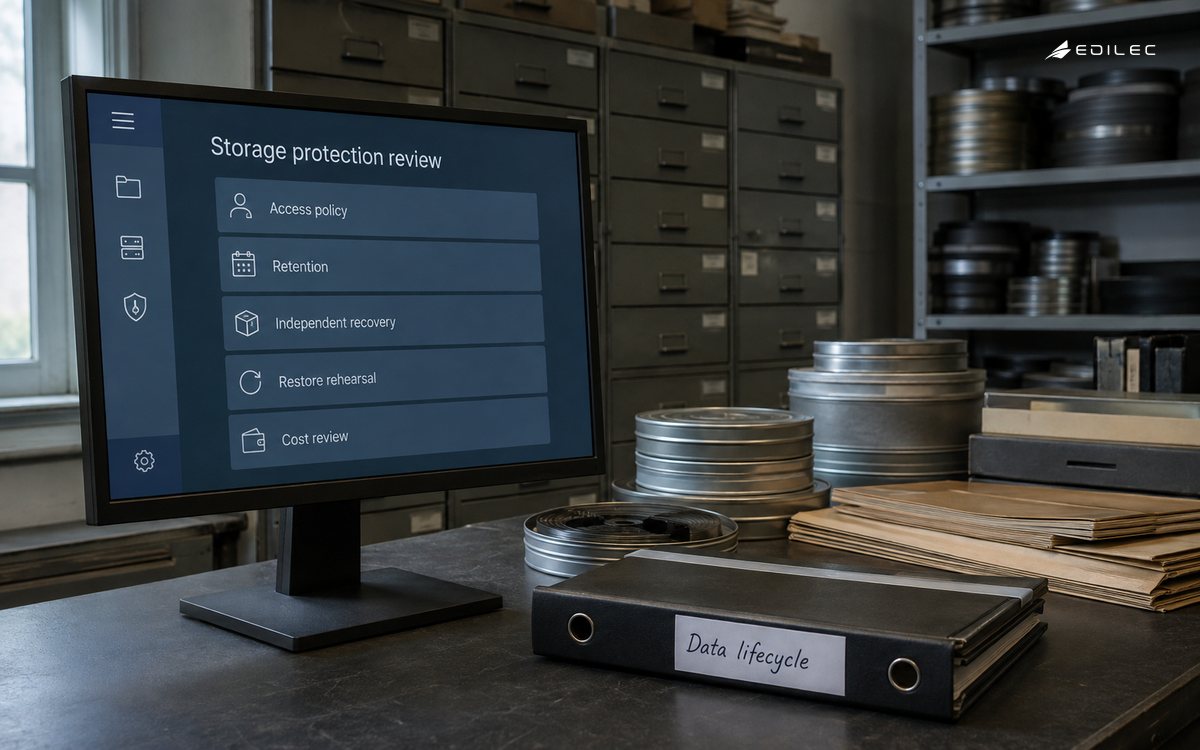
Start with data classification and authorized use, then layer identity, encryption, immutability, redundancy, backup and monitoring. No single feature substitutes for the rest. The NIST storage security guidelines address threats and controls across storage infrastructure and highlight the management complexity that can produce configuration error. Apply controls to management interfaces and automation as well as data access; a privileged lifecycle rule can destroy data without downloading it.
Separate duties for administration, key management, retention changes and recovery. Use workload identities and short-lived credentials, block public access by policy, and log control-plane operations. Define emergency access with strong authentication, time limits and review. Inventory every replication destination, backup account and analytical copy because protection obligations follow the data. Continuously detect storage created outside approved patterns.
Is provider encryption enough?
Provider-managed encryption at rest is a valuable baseline, but the key model must match the threat and compliance context. Decide whether provider-managed, customer-managed or externally controlled keys are required; who may use and rotate them; and what happens when a key is disabled. Encrypt transport and restrict endpoints. Client-side encryption can reduce provider visibility but adds key distribution, search, processing and recovery complexity. Test restored data after key rotation and during a simulated key-service outage.
Encryption does not prevent authorized deletion, overly broad reads or retention mistakes. Pair it with least privilege, network controls, object ownership, versioning, deletion protection and monitoring. Do not put secrets or personal data in object names and tags merely because payloads are encrypted; metadata may appear in inventory, billing and logs. Document key retention relative to data retention so an archived record does not become unrecoverable early.
Are redundancy and backup the same?
No. Redundancy keeps a service available or durable through infrastructure failures by maintaining copies. Backup preserves a recoverable state against deletion, corruption, ransomware, application error or retention mistakes. Replication can copy corruption and deletes. Microsoft’s Azure storage redundancy guidance describes local, zone and geographic options and their availability, cost and read-access tradeoffs. Every provider has distinct semantics; confirm failover authority and replication lag.
Define recovery point and recovery time objectives by dataset. Keep recovery copies in a separately governed account or trust boundary when risk warrants. Restrict backup deletion and test restoration into an isolated location. A successful backup job proves that data was written, not that applications, keys, schemas and dependencies can use it. Recovery evidence should include sampled business records, counts, checksums, permissions and elapsed time.
How do versioning and immutability differ?
Versioning retains variants when an object is replaced or deleted, enabling recovery of a prior generation. AWS explains that S3 Versioning stores complete versions and charges for each; lifecycle rules are therefore essential. Google’s Object Versioning documentation similarly notes that versions accumulate cost and distinguishes versioning from soft-delete protection. Test delete markers, noncurrent versions and bucket-level deletion behavior.
Immutability prevents a protected version from being overwritten or deleted for a period or under legal hold. S3 Object Lock uses a write-once-read-many model with retention periods and legal holds, and requires versioning. Governance and compliance modes have different override behavior. Records and legal owners must approve policy; retaining data too long can conflict with deletion duties. Separate the authority to set retention from the authority to remove ordinary objects.
What makes cloud storage cost unpredictable?
Capacity is only one meter. Include write, read, list and metadata operations; retrieval from cooler tiers; early deletion; replication; snapshots; inventory; key operations; data transfer; acceleration; monitoring and support. Model data growth, object count and access frequency by lifecycle stage. Tiny objects can make request cost and operational overhead dominant. Compression can reduce capacity but increase compute and complicate partial retrieval. Validate estimates with a measured pilot.
Assign owner, purpose, classification, retention and cost center when storage is created. Apply lifecycle policies to transition or delete eligible data, but preview and monitor policy effects. Orphaned snapshots, incomplete multipart uploads and noncurrent versions are common waste. Report unit cost such as storage per active customer or cost per retained case, not only total spend. Savings must preserve recovery and legal obligations.
Add a forecast variance review to storage operations. When actual spend differs from plan, attribute the change to retained volume, request mix, replication, retrieval, transfer or protection copies instead of applying an indiscriminate deletion target. For example, a support platform may discover that thumbnail requests, not customer uploads, drive the increase. It can then add caching and object packaging while leaving required case records and recovery copies intact. This makes cost correction technically precise and auditable.
| Control | Configuration evidence | Operational test | Metric |
|---|---|---|---|
| Access | Policy denies public and cross-tenant reads | Attempt unauthorized read and administration | Denied requests and privilege exceptions |
| Encryption | Approved key and rotation policy | Restore data after rotation and key isolation | Unapproved keys and rotation age |
| Versioning | Versions and lifecycle policy enabled | Recover overwrite and accidental delete | Noncurrent bytes and restore success |
| Immutability | Retention mode and authority documented | Attempt protected delete with relevant roles | Protected coverage and override events |
| Backup | Separate copy meets RPO | Restore application-usable dataset | Recovery time and reconciliation delta |
| Lifecycle | Retention maps to records policy | Preview transitions and sampled deletion | Expired data and policy failures |
How should data be migrated into cloud storage?
Profile volume, object count, names, ownership, permissions, age, duplicates, invalid files and network capacity. Choose online transfer, offline appliance or a hybrid according to time, bandwidth and sensitivity. Copy immutable history first, then synchronize changes and schedule a final cutover. Preserve timestamps and metadata only where their meaning is understood. Avoid carrying obsolete permissions into a new identity model.
Reconcile source and destination using manifests, counts, byte totals, checksums and representative business retrieval. Test application behavior, not only copy completion. Define what happens to writes during cutover and how rollback handles new destination data. Retain the source for an approved validation period, then delete or archive it with evidence. A migration is complete when the old risk and cost are retired.
What should teams monitor after launch?
Monitor capacity and object growth, request errors, latency, throttling, replication lag, version growth, lifecycle failures, backup status, unusual access, public exposure, key errors and recovery tests. Set alerts against service objectives and data risk. Review provider changes and quotas. Keep runbooks for accidental deletion, permission exposure, corrupted uploads, key loss, regional interruption and legal hold. Name who can declare each incident and who communicates with data owners.
Perform quarterly or risk-based access review and sampled restore. Reconcile storage inventory with the data catalog and cost allocation. Remove stale identities and unused endpoints. Track exceptions with expiry. Storage is quiet infrastructure until an incident; regular recovery and access exercises keep the knowledge current enough to act when needed.
Key takeaways
- Choose object, file, block or archive from measured access behavior.
- Layer identity, encryption, versions, immutability, backup and monitoring.
- Treat redundancy and backup as different controls.
- Model requests, retrieval, transfer and versions alongside capacity.
- Reconcile migration with business-readable data.
- Prove recovery and lifecycle policy on a recurring schedule.
Additional cloud storage questions
Does multicloud storage improve resilience?
Only when applications, identity, keys, synchronization and recovery are designed and tested for it. A second provider can reduce concentration risk but adds consistency, transfer, security and operating complexity. Compare it with a separate account or region first.
Should cloud object storage ever be public?
Only for an intentional public dataset or asset pattern with approved content, isolated write authority and monitoring. Default-deny public access at organization level and create narrowly governed exceptions. Public delivery can often use a controlled content layer rather than public origin access.
Conclusion
Cloud storage services are dependable when protection and retrieval are designed as one lifecycle. Classify the data, select the right interface, limit authority, control versions and retention, and restore into a usable state. Cost then becomes a governed consequence of business purpose rather than an unexplained monthly total.