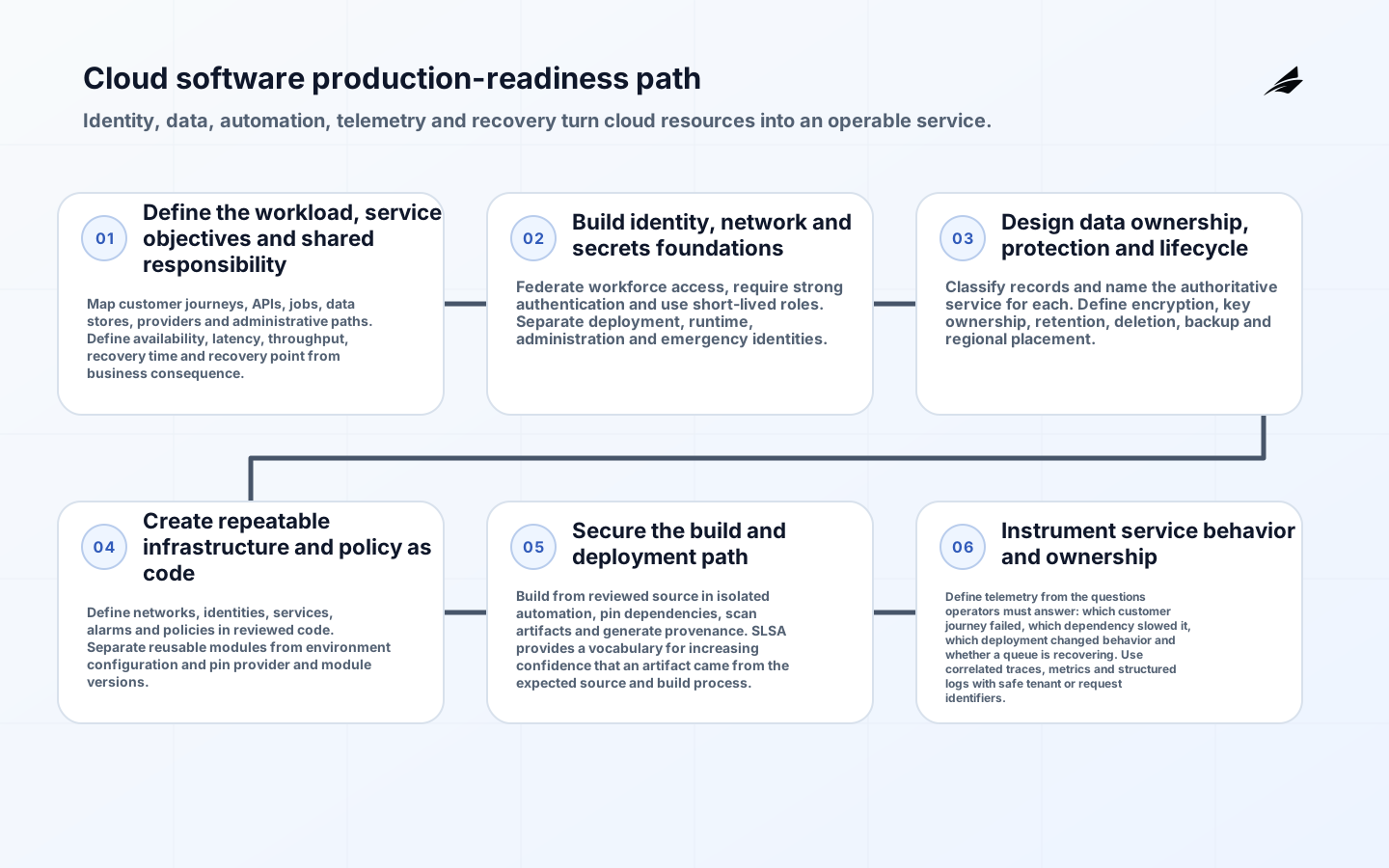
This cloud solutions implementation checklist treats architecture, security, delivery and operations as one production system. Cloud solutions and software reach production safely only after workload boundaries, identity, network paths, data ownership, deployment provenance, service objectives, recovery and cost accountability are explicit. The checklist applies to a new cloud-native service, a replatformed application or a hybrid solution that depends on managed cloud capabilities.
The provider operates parts of the stack, but the customer remains responsible for application authorization, data use, configuration and many resilience decisions. Well-architected frameworks from major providers organize reliability, security, performance, cost and operations, while SLSA and OpenTelemetry address software provenance and telemetry. The practical task is to convert those principles into testable controls for the selected service and team. A generic cloud diagram is not enough.
Use the cloud solutions scope guide, the cloud solutions FAQ, and the cloud application development checklist for adjacent procurement and engineering decisions.
Define the workload, service objectives and shared responsibility
Map customer journeys, APIs, jobs, data stores, providers and administrative paths. Define availability, latency, throughput, recovery time and recovery point from business consequence. Identify which components the provider manages and which configuration, data and code the team owns. A managed database reduces engine operations but does not choose authorization, retention, schema changes or restore acceptance.
Record regions, residency, contractual limits, peak demand and degraded behavior. Set an error budget or equivalent reliability policy that influences release decisions. Avoid making every component multi-region by default; apply redundancy where the business objective justifies its cost and complexity. Draw external and internal trust boundaries and identify the minimum service that must remain available during dependency failure.
| Concern | Implementation decision | Acceptance evidence |
|---|---|---|
| Availability | Redundancy and dependency policy | Failure exercise meets objective |
| Recovery | Backup, replication and restore path | Timed restore with reconciled data |
| Shared responsibility | Provider and team ownership by service | Control matrix and runbooks |
| Degraded mode | Functions retained during outage | Customer behavior is tested |
Build identity, network and secrets foundations
Federate workforce access, require strong authentication and use short-lived roles. Separate deployment, runtime, administration and emergency identities. Give workloads managed identities instead of static access keys where supported. Restrict each role to required resources and actions. Test revocation and emergency access. Keep production access auditable and time-bounded, including vendor support.
Design ingress, egress, private service access, DNS and firewall policy around explicit flows. Default-deny sensitive paths and inspect internet exposure continuously. Store secrets and keys in managed systems with rotation and access logs. Do not put secrets in images, repositories, CI variables visible to broad projects or telemetry. Network isolation complements authorization; it does not replace it.
Design data ownership, protection and lifecycle
Classify records and name the authoritative service for each. Define encryption, key ownership, retention, deletion, backup and regional placement. Use transaction and idempotency boundaries for retried commands. For asynchronous flows, include schema version, event identity, source and timestamp. A queue improves decoupling only when consumers handle duplicates, poison messages and replay.
Plan schema changes for mixed software versions. Use backward-compatible expansion, migration and cleanup stages. Test large backfills, throttling and failure recovery. Protect backups independently and verify restoration to an isolated environment. Reconciliation should compare business totals or invariants, not only row counts. Data recovery is incomplete until applications and integrations can use the restored state.
| Data path | Control | Failure case |
|---|---|---|
| API command | Authorization and idempotency | Client retries after timeout |
| Event stream | Version, replay and dead-letter handling | Consumer unavailable during deployment |
| Database migration | Compatible staged change | Old and new versions overlap |
| Backup | Independent protection and restore test | Primary credentials compromised |
Create repeatable infrastructure and policy as code
Define networks, identities, services, alarms and policies in reviewed code. Separate reusable modules from environment configuration and pin provider and module versions. Store state securely with locking and recovery. Validate plans for destructive or public changes and apply through controlled automation. Manual console repair should be captured back into code or explicitly removed after the incident.
Use policy checks for approved regions, encryption, public exposure, logging and tagging. Test modules in disposable environments. Keep production changes small and observable. Drift detection should lead to investigation rather than automatic overwrite of an emergency fix. Document bootstrap dependencies such as state storage, CI identity and key management because they determine whether the platform can be recovered.
Secure the build and deployment path
Build from reviewed source in isolated automation, pin dependencies, scan artifacts and generate provenance. SLSA provides a vocabulary for increasing confidence that an artifact came from the expected source and build process. Sign artifacts where the environment can verify them. Protect deployment credentials and require stronger review for identity, network, data or policy changes.
Promote the same immutable artifact through environments. Use automated unit, contract, integration, security and infrastructure tests. Deploy progressively with health checks and rollback or feature-disable paths. Database changes need compatibility and recovery planning. A green pipeline is not sufficient if tests omit authorization, dependency failure and production-scale data.
Instrument service behavior and ownership
Define telemetry from the questions operators must answer: which customer journey failed, which dependency slowed it, which deployment changed behavior and whether a queue is recovering. Use correlated traces, metrics and structured logs with safe tenant or request identifiers. OpenTelemetry can standardize instrumentation, but teams still need semantic conventions, sampling, retention and sensitive-data controls.
Create service-level indicators and alerts that require an action. Route each alert to a named owner with a runbook. Monitor deployment health, saturation, errors, job age, certificate expiry, backup status and cost anomalies. Test alert delivery and escalation. Avoid dashboards that look complete while omitting stale data or failed collectors.
| Signal | Operational question | Response |
|---|---|---|
| Request trace | Where did latency or error begin? | Inspect dependency and deployment correlation |
| Queue age | Is asynchronous work falling behind? | Scale, pause producers or repair consumer |
| Service objective | Are users receiving acceptable reliability? | Use error budget to balance release and repair |
| Cost anomaly | Which product or change caused spend? | Owner investigates demand and configuration |
Exercise failure, recovery and incident response
Identify failure domains for zones, regions, identity, DNS, provider APIs, data stores and third parties. Use timeouts, bounded retries, circuit breakers and back-pressure. Test dependency slowdown, not only complete outage. Ensure retries cannot multiply load or duplicate business effects. Document what customers see and what support communicates during degraded service.
Run restore, failover and incident exercises with realistic permissions and data volume. Measure detection, decision, recovery and reconciliation times. Verify backups against ransomware and account compromise scenarios. Capture improvements in code and runbooks. High availability is not proven by an architecture diagram; it is proven when the team restores service and trusted state within the agreed objective.
Control cost and complete operational handover
Tag and allocate resources to product, environment and owner. Set budgets and anomaly alerts, then review unit cost alongside service objectives. Rightsize with demand evidence and account for transfer, logs, backups, support and idle non-production environments. Do not trade away recovery or performance for isolated savings. Architecture decisions should show their recurring cost before approval.
Place accounts, repositories, pipelines, domains, keys and vendor contracts under organizational ownership. Deliver architecture decisions, threat models, data contracts, dashboards, objectives, runbooks and unresolved risks. Prove handover through deployment, secret rotation, restore and incident exercises by the receiving team. Decommission temporary access and old environments after evidence and retention requirements are satisfied.
Key takeaways
- Define user-visible objectives and shared responsibility before selecting services.
- Use short-lived identity, explicit network flows and managed secrets.
- Treat data migrations, retries and restoration as business-integrity problems.
- Deliver reviewed infrastructure and immutable artifacts through controlled automation.
- Prove observability, recovery, cost ownership and handover through exercises.
Frequently asked questions
Do managed services remove operational work?
They remove specific infrastructure tasks, but teams still own configuration, access, data, application behavior, monitoring, cost and provider escalation. Responsibility changes rather than disappears.
Should every cloud service use multiple regions?
No. Use multi-region designs when business recovery objectives justify added consistency, testing and cost. Many workloads can meet requirements with multi-zone service and tested regional recovery.
Is infrastructure as code required?
For repeatable governed environments it is strongly advisable. It creates reviewable intent and recovery capability, but state, modules, policy and emergency changes still need disciplined operation.
What proves production readiness?
Evidence includes objective tests, security controls, deployment provenance, load and failure results, restore exercises, active telemetry, runbooks, cost ownership and a team that can operate the service.
Conclusion
Cloud solutions and software are production-ready when the organization can explain, deploy, observe, recover and pay for them under clear ownership. Managed services and automation create leverage only when identity, data, delivery and failure behavior are engineered together. The final gate is not successful provisioning; it is demonstrated operation by the team that will own the service. Production acceptance should leave a recorded baseline for reliability, security and unit cost, so later changes can be judged against evidence rather than recollection. That baseline also makes ownership visible when a provider incident, deployment regression or demand spike crosses team boundaries. Teams should preserve that evidence through handover and revisit it after material architecture, traffic, provider or regulatory changes.