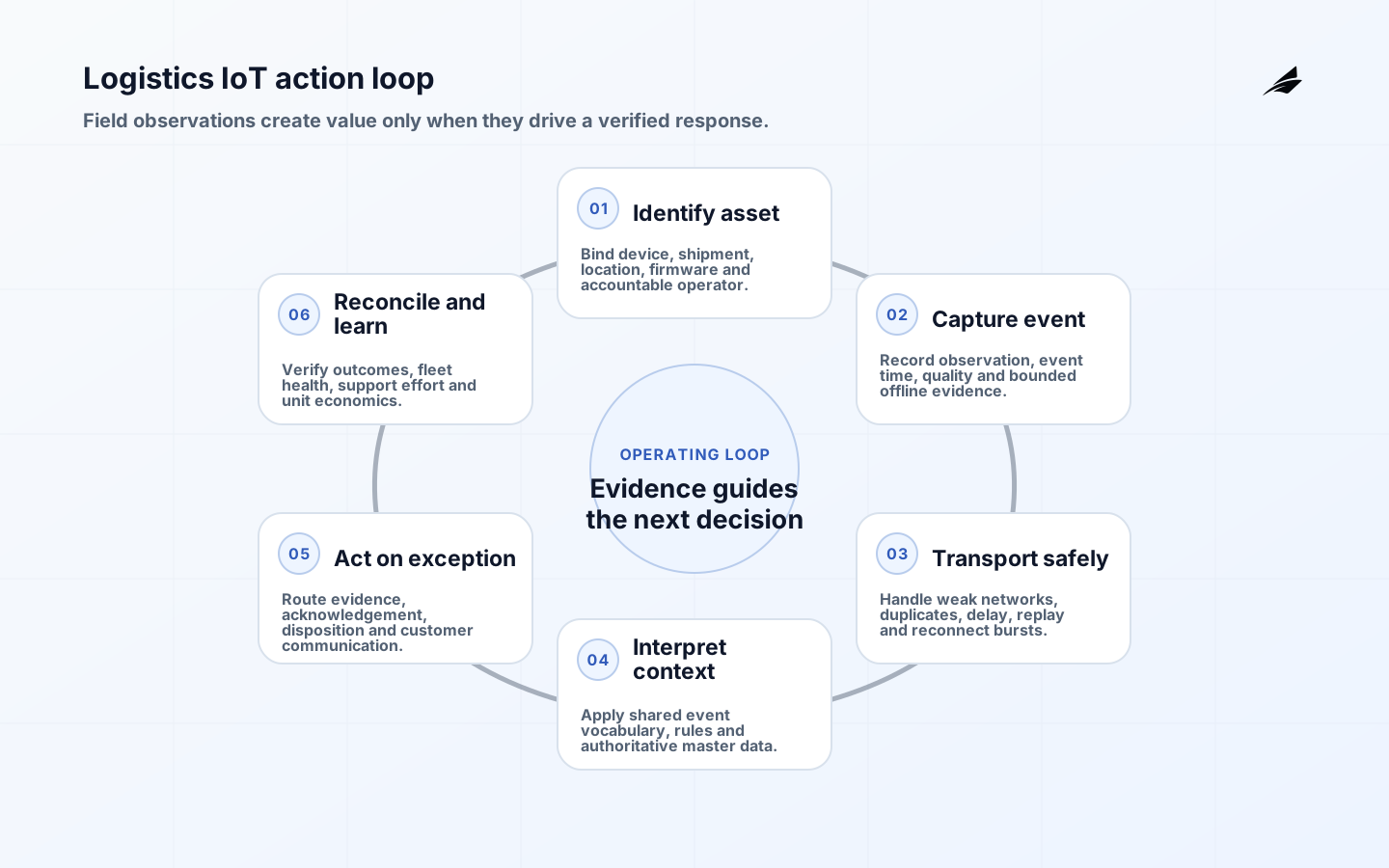
An IoT software development company for logistics should be evaluated on whether it can turn imperfect field observations into reliable operational decisions. The job spans trackers, sensors, gateways, networks, event semantics, workflow integration and fleet support. This guide serves commercial search intent: it defines buyable scope, cost drivers, delivery stages and risk controls without pretending that one price fits every route, asset or service level.
Compare the proposal with Edilec's logistics IoT implementation checklist, logistics IoT architecture FAQ and IoT software delivery for startups. Keep the buying decision anchored to a measurable logistics exception such as missed handoff, temperature excursion or unplanned dwell.
Key takeaways
- Scope the operational decision and event chain before selecting devices or dashboards.
- Price hardware, connectivity, installation, cloud, support and replacement over the fleet lifecycle.
- Use shared logistics identifiers and event vocabulary when data crosses organizations.
- Design for gaps, duplicates, clock error, battery failure and asset reassignment as normal conditions.
- Pilot on difficult routes and handoffs, then expand by evidence rather than demonstration appeal.
Define a result-oriented scope
Start with actor, object, place, event and required response. For cold-chain monitoring, specify assets, sensor placement, sampling interval, permitted range, excursion duration, alert recipient, acknowledgement and disposition workflow. For yard visibility, define arrival, dock assignment, movement and departure events plus the source of authoritative location. Avoid a scope such as “real-time tracking dashboard”; it omits accuracy, action and integration.
A complete engagement may include device and carrier selection, firmware, mobile provisioning, gateway software, ingestion, registry, event model, rules, maps, workflow integration, analytics, support tools and field rollout. State who buys and owns hardware, SIMs, certificates, cloud accounts, source code and app-store identities. Require export formats and an exit plan so operational history and device control are portable.
| Workstream | Typical deliverable | Acceptance evidence |
|---|---|---|
| Discovery | Process map, event taxonomy and value baseline | Observed workflow and agreed exception metrics |
| Edge and device | Hardware profile, firmware and provisioning | Battery, radio, accuracy and update tests |
| Platform | Registry, ingestion, rules and storage | Load, replay, isolation and recovery tests |
| Applications | Operations view, alerts and mobile workflows | Role-based journey tests with real users |
| Integration | TMS, WMS, ERP and partner contracts | Reconciliation across representative handoffs |
| Operations | Fleet support, incident and replacement procedures | Pilot support record and trained owners |
Choose architecture for field reality
Model intermittent connectivity explicitly. Devices need a bounded buffer, event identifiers, timestamps and quality indicators. Ingestion should be idempotent and distinguish event time from receipt time. MQTT 5.0 is a standardized publish-subscribe option for constrained messaging, but delivery mode must be paired with application-level deduplication and business reconciliation.

Use edge gateways where local protocols, bandwidth, vehicle systems or site control justify them. Central services should manage identity, policy, cross-fleet analysis and integration. The W3C Web of Things architecture can help describe heterogeneous things through common properties, actions and events. Keep the operational event contract stable even when a tracker model or carrier changes.
Make logistics events interoperable
When events cross shippers, carriers, warehouses and customers, shared semantics prevent expensive bilateral mappings. The GS1 EPCIS and CBV implementation guideline describes a common approach to supply-chain visibility events. Adopt the portions that match the ecosystem; do not add standards vocabulary without clear ownership of identifiers, locations and business steps.
Create a data contract for each event: identifiers, event time, location, business context, sensor metadata, quality, source and schema version. Define correction and late-arrival behavior. Separate master-data errors from telemetry defects, and maintain lineage from raw observation to alert and operational action. This is essential when a claim or compliance decision depends on the record.
Build a whole-life cost model
Development cost varies with device diversity, field constraints, integrations, map and mobile complexity, safety or compliance requirements and support hours. Budget discovery and pilot separately from fleet rollout. Avoid unsupported market-price claims; ask bidders to estimate effort by deliverable and list assumptions, dependencies, contingency and customer responsibilities.
| Cost category | Main driver | Control question |
|---|---|---|
| Hardware | Sensor grade, enclosure, certification and volume | What failure and replacement rate is assumed? |
| Connectivity | Countries, carriers, payload and roaming | What happens outside coverage and across borders? |
| Installation | Asset access, calibration and technician time | Can installation be verified and repeated? |
| Platform | Messages, storage, maps, rules and retention | Which cost scales per device, event or user? |
| Integration | Partner count and contract stability | Who owns mapping and reconciliation after change? |
| Operations | Support window, spares, updates and incident volume | What is included after the warranty or project period? |
Compare unit economics per active asset, monitored shipment or actionable exception, not only monthly cloud spend. Include support labor, false-alert handling, device retrieval, damaged hardware, carrier changes and data egress. Model normal, peak and disruption scenarios. A solution that is inexpensive in steady state but cannot absorb a reconnect storm or seasonal volume is not economical.
Control the material delivery risks
Security risks include shared credentials, exposed management interfaces, unsigned updates and excessive command authority. The NIST IoT cybersecurity baseline offers procurement-ready categories for identification, configuration, data protection, interface access, updates and state awareness. Require a device-specific answer for each category and a support period.
Operational risks include sensor placement, calibration drift, dead batteries, device-to-asset reassignment, border coverage, clock skew, tampering and staff bypass. Cyber-physical systems also need secure remote access and network boundaries; CISA publishes industrial control system recommended practices. Convert every high risk into an owner, preventive control, detection signal, response and pilot test.
Use a phased delivery plan
- Frame: observe work, quantify the baseline and agree one bounded operational outcome.
- Prototype: validate device, radio, battery, event and user assumptions without production dependence.
- Pilot: deploy on representative difficult routes with limited users and explicit stop conditions.
- Integrate: connect authoritative systems, reconcile identifiers and automate exception workflows.
- Scale: expand by device, geography or customer cohorts while monitoring support capacity.
- Operate: manage updates, credentials, calibration, replacements, supplier changes and retirement.
Each gate should have evidence. A prototype gate may require acceptable sensor accuracy and offline buffering. A pilot gate should require event completeness, alert precision, workflow adoption, support response and unit cost. Scale only after the team can replace a device, revoke it, replay delayed events, reconcile a journey and recover the platform without the development company improvising.
Select a company on evidence and transferability
Ask for architecture reasoning, not a generic platform diagram. Review representative firmware, infrastructure and application code; automated tests; threat model; event contracts; field runbook; update strategy; observability and incident report. Meet the people responsible for edge engineering and fleet operations, because these skills are distinct from dashboard development.
Contract for repositories, build instructions, infrastructure definitions, device keys under controlled custody, documentation, test equipment, third-party licenses and transition support. Tie milestones to accepted outcomes rather than code volume. Define warranty, vulnerability handling, service levels and ownership of reusable components before work begins.
Build a logistics pilot scorecard
A pilot scorecard should combine field reliability, workflow quality and economics. Track active devices, observation completeness, location or sensor accuracy, median and tail latency, battery consumption, reconnect recovery, alert precision, acknowledgement time and unresolved support cases. Segment by route, facility, carrier, hardware and firmware because a fleet average can hide a commercially important failure.
Measure user behavior as well as platform output. Confirm whether dispatchers, warehouse staff or customers act on alerts, dismiss them or maintain a parallel spreadsheet. Interview users about false urgency and missing context. Record the final disposition of exceptions so the team can determine whether an alert was useful, merely correct or operationally distracting.
At the scale gate, compare expected benefit with device, installation, connectivity, platform, mapping, integration and support cost per active asset or shipment. Include replacement and failed-install effort. Approve expansion only when the support team can absorb the projected exception volume and when difficult cohorts meet minimum thresholds, not because the easiest route performed well.
Define evidence retention according to commercial, claims and regulatory needs. Preserve the raw observation, normalized event, rule version, alert, acknowledgement and final disposition for consequential exceptions. Control access to location and driver-linked data, document permitted use and delete records after the approved period. More telemetry is not automatically more defensible.
Prepare an incident playbook that separates device, carrier, gateway, platform, integration and data-quality failure. Include supplier escalation, customer communication and manual continuity. Run a tabletop with a regional connectivity outage and a false temperature campaign; both can overwhelm operations through different paths. Capture decisions and improve routing before scale.
Review customer and partner interfaces as products. Publish schema versions, test examples, change notice and support contacts. Monitor rejection and reconciliation by partner. A fleet platform can remain healthy while one partner silently drops events, so partner-level contract evidence belongs in operational reporting and release acceptance.
Frequently asked questions
What belongs in a logistics IoT MVP?
One asset class, one difficult operational journey, a small device cohort, secure enrollment, reliable event capture, one actionable workflow, one system integration and basic fleet support. An MVP should test the riskiest field assumption. A broad dashboard fed by simulated data does not validate logistics viability.
Does logistics IoT need real-time data?
Only where decision latency demands it. Seconds may matter for theft or unsafe temperature; minutes may suit yard dwell; daily data may suit utilization. Define maximum useful age and degraded behavior. Higher frequency increases battery, connectivity, storage and alert costs, so buy latency that changes an action.
How long should a pilot run?
Long enough to encounter representative routes, weather, facilities, handoffs, coverage gaps and staff patterns. Calendar length alone is weak. Set an event and scenario threshold, including failures and replacement, then stop, extend or scale according to evidence.
Conclusion
The right IoT software development company for logistics can connect field engineering, event semantics and operations. Give it a bounded outcome, whole-life cost model, explicit risks and staged evidence gates. The resulting system should remain useful through network gaps, supplier changes and device failures, and it should be transferable to the team that will operate it.