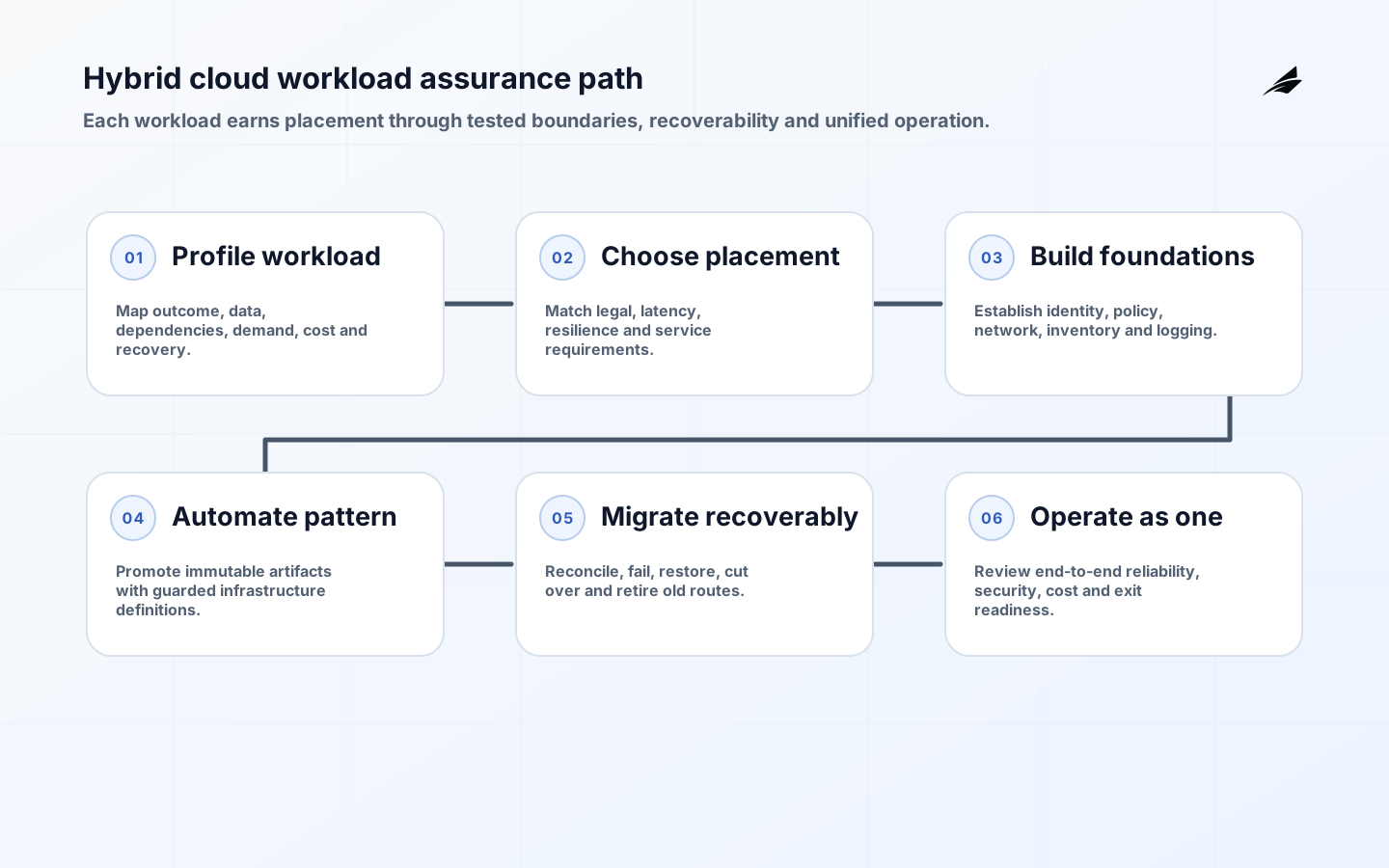
Hybrid cloud solutions connect distinct private, community or public cloud environments so applications and data can operate across a governed architecture. NIST's definition requires the component clouds to remain distinct while being bound by technology that enables portability. A conventional data center plus an unrelated cloud account is therefore not automatically a hybrid cloud. The implementation value comes from a deliberate workload placement model, consistent identity and policy, dependable connectivity and one operating view.
Use this guide with the hybrid cloud delivery plan and hybrid cloud FAQ. The cloud innovation checklist provides a broader transformation view. This checklist assumes the team has a business reason for retaining multiple environments; if every workload can meet its requirements on one supported platform, added hybridity may be avoidable complexity.
1. Define outcomes and inventory the workload estate
State why hybrid operation is needed: regulated data location, edge latency, acquisition constraints, legacy dependencies, resilience, cloud-service access or a staged migration. Convert each reason into a testable requirement and expiry where appropriate. 'Avoid lock-in' is not sufficient because applications can become dependent on identity, network, data and managed services even when containers are portable.
Build a workload record that includes owner, users, business criticality, data classification, interfaces, identity flows, latency, demand pattern, current cost, licensing, recovery objectives and operational support. Discover actual network and data dependencies rather than relying on architecture diagrams alone. Baseline transaction time, failure rate, deployment lead time and incident burden so the program can later distinguish a successful move from a change of hosting location.
| Placement factor | Question | Evidence |
|---|---|---|
| Data and law | Where may data be stored, processed and supported? | Classification and jurisdiction review |
| Performance | Which interactions have hard latency or throughput limits? | Observed dependency and load profile |
| Resilience | What failures must the service survive? | Business impact and recovery objectives |
| Service dependency | Which proprietary or local capabilities are essential? | Interface and substitution analysis |
| Economics | What is the full steady-state and transition cost? | Demand-based unit-cost model |
2. Design the target architecture and responsibility model
Select a placement for each component and make cross-environment interactions explicit. Define authoritative data stores, consistency model, ingress and egress, service discovery, encryption boundaries, keys, secrets and administrative paths. Avoid synchronous chains across a wide-area link where a brief network impairment can stop the whole service. Use asynchronous events, local caches or bounded replication only when their consistency and recovery behavior fit the business process.
Document responsibility across application teams, platform teams, facilities, carriers, cloud providers and managed-service suppliers. NIST SP 800-145 describes service and deployment models, but contractual responsibility still depends on the selected services. Assign patching, backup, identity, monitoring, vulnerability response and restore testing at component level. Name an end-to-end service owner because provider availability does not resolve failures at integration boundaries.
3. Build identity, policy and connectivity foundations
Federate workforce identity where practical, use workload identities for services and minimize long-lived credentials. Keep emergency access independent enough to work during an identity outage and review every use. Apply policy as code for approved regions, network exposure, encryption, ownership and logging. Test policy denial and exception expiry. Common labels and resource records are essential, but they must be enforced rather than requested in a tagging document.
Engineer connectivity for measured capacity, route control, DNS, certificate lifecycle, segmentation, denial-of-service conditions and carrier failure. NIST's zero trust implementation guide demonstrates access patterns across on-premises and cloud resources; zero trust is not a product overlay or a reason to ignore network controls. Authenticate and authorize each access based on identity and context, and observe east-west as well as north-south flows. Rehearse failover before application migration depends on it.
4. Standardize platforms and deployment evidence
Create supported patterns for runtime, data, integration and observability rather than promising universal portability. A container platform can standardize packaging and deployment APIs, yet storage, load balancing, identity and upgrade behavior may still differ. Define the minimum environment versions and compatibility matrix. Use version-controlled infrastructure definitions, policy tests and artifact promotion so the same reviewed release can move through environments without rebuilding from mutable source.
Protect the automation supply chain: review modules, constrain versions, scan configuration, isolate runners and secure state. Every deployment should produce a correlation ID, artifact identity, configuration version, approvals and resulting inventory. Test idempotent retries and partial failure. A central management plane must not become an unrestricted path into every environment; separate administrative domains and use narrowly scoped automation identities.
5. Migrate in recoverable waves
Choose a pilot that represents the architecture without carrying the highest consequence. Establish data reconciliation, user acceptance, performance, security and recovery criteria before moving it. Prefer techniques such as parallel read, shadow traffic or bounded canaries when they fit the application. Dual write requires explicit conflict handling and is often riskier than it appears. Freeze only the minimum necessary change window and keep rollback authority with a named person.

Run load, dependency loss, credential expiry, link failure, restore and region or site recovery scenarios. NIST's hybrid IaaS practice guide is an example architecture, not a universal blueprint, but it usefully illustrates how workload, policy and trusted infrastructure concerns intersect. After cutover, reconcile records and data, observe for an agreed period, then retire the old route. Indefinite parallel operation preserves cost and ambiguity.
- Approve the workload record, placement rationale and target service levels.
- Deploy identity, policy, connectivity and logging through production paths.
- Validate application behavior and data reconciliation under representative load.
- Exercise link, provider, credential and recovery failures with operators.
- Cut over progressively with explicit rollback signals and authority.
- Observe, close migration exceptions and decommission superseded components.
6. Operate reliability, security and cost as one service
Build an end-to-end service view that combines metrics, logs, traces and change events from all environments. Standardize service, environment, owner and release attributes. The OpenTelemetry primer explains telemetry signals, but usefulness depends on questions and retention design. Monitor consumer journeys, cross-environment latency, saturation, policy denials, replication lag and restore proof. Route alerts to a team with authority across the boundary.
Allocate complete cost to workloads, including facilities, hardware depreciation, licenses, carriers, cloud consumption, support and shared platforms. The FinOps Framework emphasizes collaboration among engineering, finance and business roles. Model data transfer and idle failover capacity before architecture approval. Optimize against service objectives: consolidating a resilient copy or delaying patches may lower a bill while increasing business risk.
| Operating signal | Decision supported | Warning sign |
|---|---|---|
| Cross-boundary latency | Placement or interface redesign | Cloud average hides network path |
| Recovery exercise | Whether stated RTO and RPO are achievable | Backup completion only |
| Policy exception age | Remove or renew residual risk | Permanent temporary rules |
| Unit cost by transaction | Architecture and demand efficiency | Provider invoices in isolation |
| Deployment and rollback result | Release safety across environments | Environment-specific manual release |
7. Create acceptance and exit evidence
For each workload, assemble an acceptance record with placement rationale, architecture and data-flow diagrams, responsibility assignments, inventories, service objectives, test results, residual risks, operating owners, cost baseline and decommission decision. Include versions of infrastructure definitions and the exact network and policy configuration used in recovery tests. A generic platform accreditation cannot replace workload-specific evidence at application and data boundaries.
Run a handover exercise in which an on-call engineer diagnoses a cross-environment failure without help from the migration team. Confirm access to dashboards, provider support, network escalation, certificate ownership, restore instructions and communication templates. Close temporary administrator roles and migration firewall rules. Record capacity assumptions and the date they must be revisited. If a managed provider operates part of the service, test joint escalation and evidence delivery rather than merely reviewing contact lists.
Maintain exit evidence while the service operates. Track portable data formats, artifact repositories, infrastructure definitions, licensing dependencies, current restore copies and the sequence for moving or retiring workloads. Test a limited export or rebuild periodically. Exit readiness does not mean every workload can move instantly; it means leaders understand time, cost, data and service consequences before a supplier or facility decision becomes urgent.
Schedule a placement review when contracts, regulations, demand, managed-service maturity or recovery needs change. Recalculate cross-environment transfer and support burden rather than assuming the original hybrid rationale remains true. Some components may move closer together; others may require stronger separation. Treat simplification as a valid architecture outcome. Reducing an unnecessary boundary can improve reliability and cost without weakening a deliberate hybrid strategy.
Key takeaways
- Adopt hybrid cloud only for explicit workload and business requirements.
- Map dependencies and responsibilities before selecting placement or migration sequence.
- Build identity, policy, connectivity and deployment evidence as shared foundations.
- Test wide-area, provider, credential and recovery failures before cutover.
- Manage user reliability and full unit cost across environments as one service.
Frequently asked questions
Is hybrid cloud the same as multicloud?
No. Hybrid cloud binds distinct deployment types, commonly private and public cloud, to support portability or coordinated operation. Multicloud means using services from more than one cloud provider. An architecture can be hybrid, multicloud, both or neither.
Do containers make a workload portable?
They standardize part of packaging and runtime behavior. Portability still depends on data services, identity, network, storage, platform versions, operational tooling and licensing. Prove portability by deploying and operating a representative workload in the intended environments.
Should critical systems run active-active across cloud and on-premises?
Only when the business requirement justifies the data-consistency, networking, testing and operating complexity. Active-passive or recoverable rebuild patterns may meet the objective more safely. Select from measured failure scenarios and recovery targets, not from an assumption that active-active is always more resilient.
Conclusion
Reliable hybrid cloud solutions come from disciplined placement and shared operating evidence. Define why each workload spans environments, design boundaries and responsibilities, establish identity and connectivity, standardize deployment, migrate in recoverable waves and run reliability, security and cost together. Hybrid cloud then becomes an intentional service architecture rather than a permanent collection of disconnected platforms.