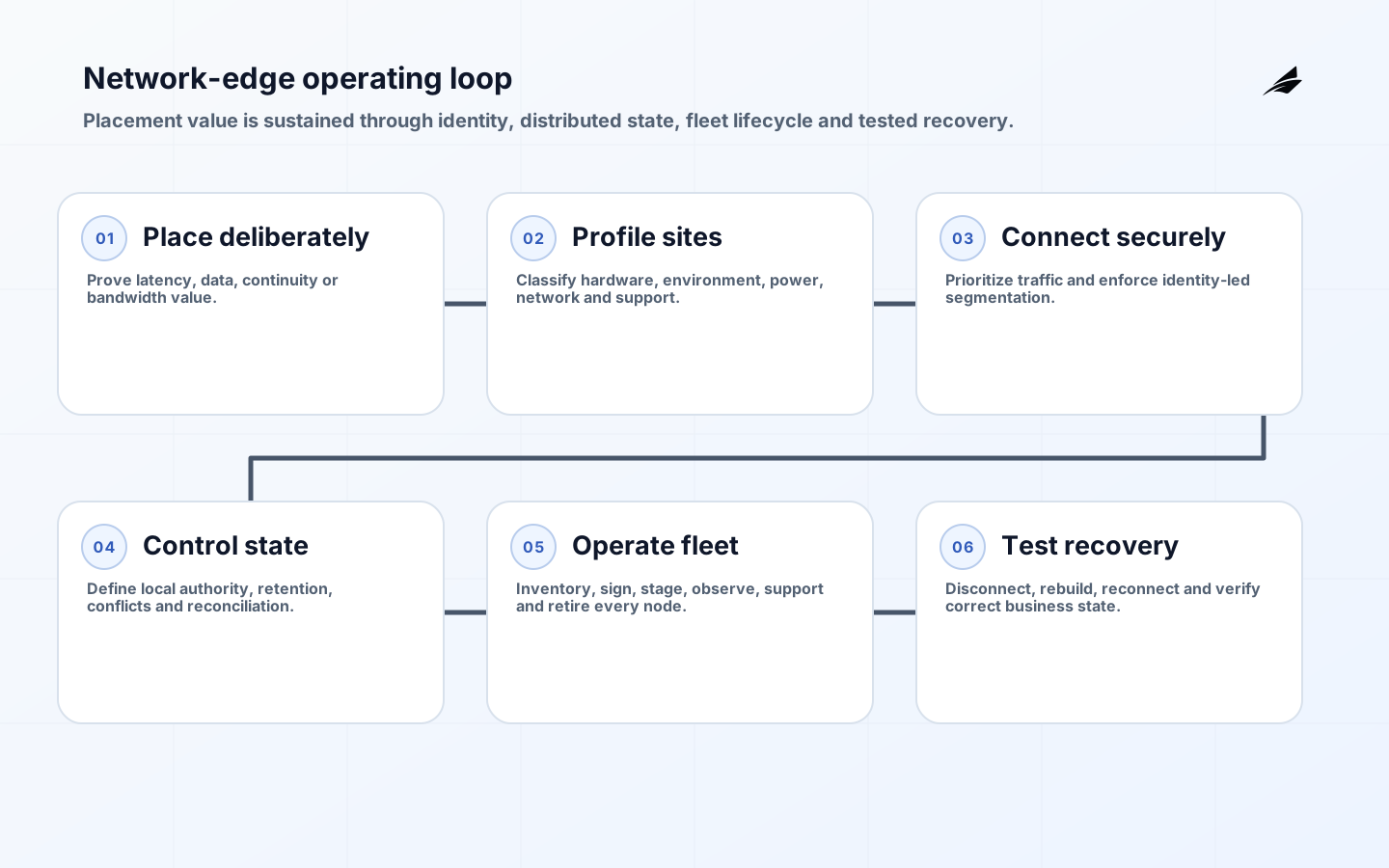
A network and edge implementation checklist must treat sites as a distributed production fleet, not small cloud regions. Edge nodes may operate with limited power, bandwidth, physical protection, support skills and connectivity. The design should explain why a workload belongs near the user, device or data source; what happens when the central cloud is unavailable; how identity and policy are enforced; and how thousands of changing locations are observed, updated and recovered. Low latency alone is not a complete architecture.
Use this checklist after identifying a bounded use case and accountable service owner. It complements the network and edge practical guide and network and edge FAQ. ETSI describes MEC as cloud-computing capability and an IT service environment at the network edge, while CNCF edge-native guidance highlights constrained compute, connectivity, storage and power. Translate those conditions into measurable placement, security, resilience and fleet-management requirements.
1. Justify workload placement and service boundaries
Document the decision that edge placement improves: local safety response, machine control, privacy-preserving processing, bandwidth reduction, content latency or continuity during wide-area loss. Measure current latency, data volume, outage effect and operating cost. Define what executes on device, site edge, network edge, regional platform and central cloud. Keep state and authority close enough to continue safely, but avoid duplicating services without evidence. State which decisions may occur locally and which require central confirmation.
Set eligibility for site classes rather than assuming identical infrastructure. Record environmental conditions, power, cooling, physical access, hardware, accelerator, storage, network paths, maintenance window and local support. Define the minimum viable local service and degraded modes. Establish data ownership and tenancy. A store, factory, vehicle and telecom edge have different consequence and connectivity patterns; reuse the management platform while allowing controlled profiles. Reject sites that cannot meet the approved physical, power or recovery baseline.
| Placement question | Edge evidence | Cloud alternative | Decision gate |
|---|---|---|---|
| Latency | Measured end-to-end deadline | Regional response distribution | Edge materially improves outcome |
| Connectivity | Offline duration and local continuity need | Multi-link or cached cloud | Safe degraded operation defined |
| Data | Volume, sensitivity and locality | Filtered transfer or regional storage | Retention and transfer approved |
| Operations | Fleet support and recovery capacity | Central managed service | Lifecycle cost is supportable |
2. Design resilient connectivity and naming
Map user, device, site, partner, management and cloud traffic. Define addressing, naming, discovery, time synchronization, DNS and certificate behavior during partial failure. Use independent paths where business consequence justifies them and verify that they do not share one hidden carrier or power dependency. Set quality classes and bandwidth budgets for control, telemetry, software update and bulk data. Apply backpressure and prioritization so an update or log surge cannot starve an operational flow.
Specify session, queue and retry behavior under high latency, loss, reordering and extended disconnection. Avoid indefinite retry storms. Use idempotent commands and durable correlation. Establish local caches with version and expiry, and expose stale state to applications. Test network transitions rather than only complete outage: primary to backup, public to private, intermittent packet loss and captive conditions. Monitor path quality from the service perspective. Interface availability at a router does not prove that the business transaction completes.
3. Apply identity-led access and segmentation
Give each user, device, workload and management component a verifiable identity with scoped authorization. Secure enrolment is critical: record manufacturing or inventory identity, ownership, approved software and site assignment before trust. Rotate credentials and define recovery for expired certificates during disconnection. Do not rely on physical network location as proof. NIST zero-trust implementations focus on protecting access to resources regardless of user or resource location; edge policy should evaluate identity, device or workload state and requested action.
Segment management, operational technology, user, guest, partner and workload traffic according to least function. CISA’s microsegmentation guidance emphasizes reducing attack surface and lateral movement while improving visibility. Start with application communication profiles and explicit dependencies. Enforce ingress and egress at practical boundaries and log material decisions. Protect administrative interfaces through separate paths, phishing-resistant authentication and time-bound privilege. Test that one compromised site or tenant cannot reach unrelated fleet control or data.
| Control plane | Required control | Failure test | Evidence |
|---|---|---|---|
| Device enrolment | Attested identity and approved owner | Unknown or cloned device | Denied enrolment and alert |
| Workload | Signed artifact and scoped service identity | Tampered image | Verification failure |
| Network | Application-profile segmentation | Unauthorized east-west connection | Denied policy event |
| Administration | Separate, time-bound privileged access | Expired and offline credential | Safe denial or approved recovery |
4. Govern local data and distributed state
Classify data at creation and define what is processed locally, summarized, transferred, retained and deleted. Encrypt sensitive data and protect keys against physical theft. Limit local retention to continuity and evidence needs. Specify ownership and access when sites are operated by partners. For sensor or video workloads, document sampling, filtering and model assumptions. Record clock quality and source identity because event order can become uncertain. Prevent diagnostic bundles from exporting unrelated sensitive data.
Choose state ownership deliberately. Central authority with local cache is simpler until disconnected operation must accept changes. When local writes are allowed, define conflict resolution, sequence, replay, deduplication and reconciliation. Some conflicts require human review rather than last-write-wins. Preserve command acknowledgement and version. Test split brain, restored connectivity, full disk, clock drift and duplicate devices. The system must make provisional and authoritative state visible to users and operators.
5. Build a secure platform and fleet lifecycle
Standardize hardware and software profiles, secure boot where supported, operating-system baseline, container or process isolation, local storage, time, telemetry and remote management. Maintain an inventory linking serial, site, owner, hardware, firmware, software, certificates and support status. Use immutable or declarative configurations where practical. Detect drift and preserve a local last-known-good state. Keep management dependencies small so a broken central service does not make the entire fleet unmanageable.
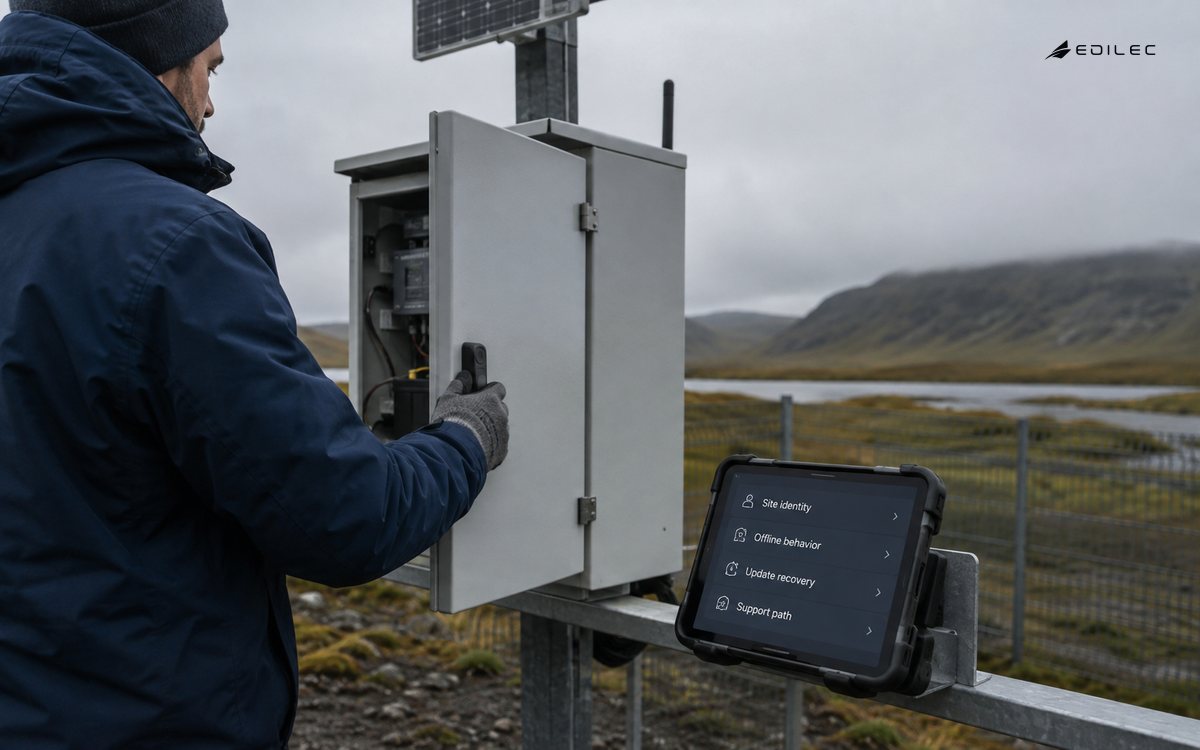
Sign and verify software updates, stage them by site class and preserve rollback. Respect bandwidth and business windows. Validate compatibility with hardware and local data before broad rollout. Use canary sites that represent real constraints, not only a well-connected lab. Define replacement, reimage, return and secure disposal. Unsupported hardware and expired certificates should appear in an owned lifecycle queue. Measure update coverage, failure, rollback and age by profile. A fleet is secure only if operators can change it safely.
6. Design observability and remote support for constrained sites
Collect service, resource, network, security and business signals with local buffering and priority. Use bounded cardinality and sampling to fit bandwidth. Preserve enough local evidence for outages that prevent central export. Dashboards should show fleet inventory, software version, connectivity, certificate health, storage, workload status, update state and business heartbeat. Distinguish missing telemetry from healthy state. Set alerts that lead to a remote or site action, and suppress storms caused by one common upstream failure.
Create runbooks that identify safe remote checks, escalation, local contact, parts, access and recovery. Remote shells should be exceptional, attributable and time limited; prefer auditable commands and desired-state remediation. Train support to recognize physical and environmental failure. Maintain out-of-band contact and a secure method to transfer evidence when normal management is unavailable. Track mean time to recognize, remote resolution rate, site visit rate, recurring hardware failure and unresolved drift. Feed those results into platform profiles.
7. Test degraded operation, recovery and safety
Define failure responses for power loss, link degradation, central-cloud outage, identity outage, local disk failure, corrupt update, expired credential, device theft and environmental limit. State whether the workload stops, continues locally, reduces features or transfers to another site. Protect safety functions from nonessential load. Use watchdogs and health checks carefully so automatic restarts do not repeat destructive actions. Exercise local shutdown and startup order with dependent equipment.
Run fault tests in a production-shaped environment and selected pilot sites. Measure continuity, data loss, command duplication, reconciliation, alert delivery and recovery time. Restore an edge node from approved inventory and verify identity, policy, software and data before service. Test central loss for the maximum planned interval, then reconnect and reconcile. Document residual risk where the environment prevents cloud-like redundancy. Recovery evidence should include both technical health and correct business state.
8. Roll out by site profile and govern operations
Pilot with representative sites and real support constraints. Establish baseline outcome and cost. Progress from lab to controlled site, small cohort, diverse cohort and fleet only when placement value, security, connectivity, support and recovery thresholds hold. Expand one profile or geography at a time. Keep a remote disable or rollback method that does not create unsafe operation. Train site staff on visible state, escalation and prohibited workarounds. Record local acceptance and ownership.
Operate governance across product, network, platform, security, data, facilities and field support. Review fleet health, vulnerabilities, unsupported assets, incident patterns, update coverage, connectivity cost, site visits and business outcomes. Reassess placement as networks and cloud regions change; workloads may move inward or outward over time. Contract suppliers for lifecycle, vulnerability notice, replacement, data handling and transition. Retire sites by revoking identities, exporting required records, wiping media and updating inventory.
Key takeaways
- Place workloads at the edge only for a measured outcome or constraint.
- Design identity, segmentation and enrolment without trusting location.
- Make disconnected state, conflict and reconciliation explicit.
- Treat updates, credentials, hardware and disposal as one fleet lifecycle.
- Scale by site profile only after degraded operation and recovery are demonstrated.
Frequently asked questions
Is edge computing the same as an on-premises server?
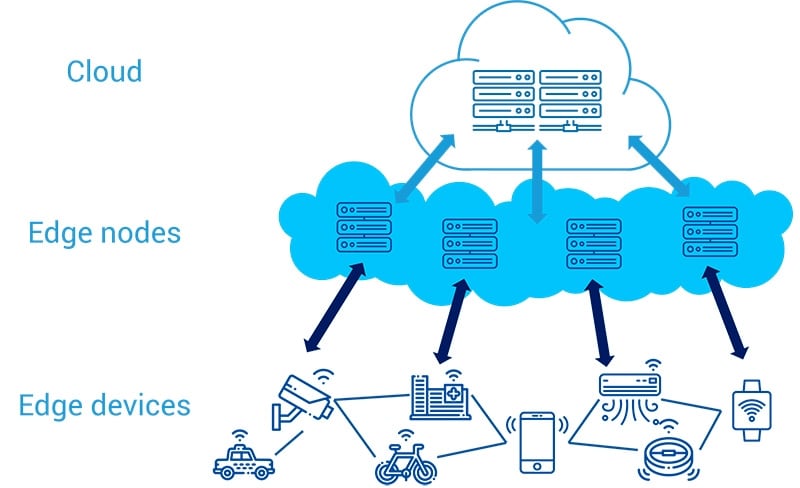
Not necessarily. Edge describes placement near users, devices or data sources for a defined outcome. It may include on-premises, network-provider or distributed infrastructure. Fleet operation and constrained connectivity are common concerns.
Should edge sites run Kubernetes?
Only when workload, hardware and operating capacity justify it. A smaller runtime may reduce resource and management burden. Choose the simplest platform that provides required isolation, updates, observability and recovery.
How much offline time should be supported?
Set it from measured connectivity and business consequence. Define behavior and test up to that interval, including credential, storage and reconciliation limits. Unlimited offline operation is rarely a defensible requirement.
Conclusion
A dependable edge platform makes placement, trust, state and recovery explicit across a diverse fleet. It earns its complexity by improving a measurable outcome that central infrastructure cannot meet alone. The implementation is therefore as much about lifecycle and field support as compute and network design.
Before expanding beyond the pilot, disconnect a representative site, rotate an identity, deploy and roll back software, fill local storage and rebuild a node. Reconcile the resulting business state. When the operating team can complete those scenarios from controlled tools and records, the edge service is ready for measured scale.