Agile managed cloud services use short, evidence-led increments to improve a live operating system. Agility here does not mean turning incidents into sprint tickets or weakening control. It means selecting a bounded service problem, changing architecture or practice, proving the effect and incorporating what operators learn. The managed service remains responsible for reliability, security and continuity while it evolves. A useful delivery plan therefore combines product ownership, workload-specific scope, safe automation, operational measures and commercial terms that support improvement rather than rewarding ticket volume.
The method works for internal cloud operations, an outsourced provider or a blended team. It is especially valuable when a large transition would otherwise hide unknown dependencies and postpone operational feedback. DORA studies capabilities associated with software delivery and operations performance; its work supports a systems view in which culture, flow, reliability and technical practices interact. The objective is not a branded ceremony. It is a cloud service that can change frequently with a controlled failure rate and recover quickly when a change does not behave as expected.
Scope agile managed cloud services by outcome and workload
Start with a service outcome such as reducing time to qualified incident ownership, increasing successful restores or shortening a compliant environment request. Baseline the current journey and define guardrail measures so a local gain does not move work elsewhere. Choose a representative workload slice with a named business and technical owner. Capture architecture, critical transactions, dependencies, support window, data class, recovery objectives, deployment route and cost allocation. Avoid beginning with every account or a technology-wide tool rollout; broad scope delays the feedback that makes iterative delivery useful.
Define the minimum operable service for the slice. It should include ownership, inventory, identity, logging, alert routing, deployment, vulnerability handling, backup, restore, incident communication, cost visibility and runbooks. Record exclusions and temporary risks. The next guide in the series, the agile managed cloud implementation checklist, can turn these capabilities into acceptance tests, while the agile managed cloud FAQ helps align buyers and operating teams.
| Planning element | Useful definition | Poor substitute |
|---|---|---|
| Outcome | A measurable improvement in a customer or operator journey | Complete migration or tool installed |
| Slice | One workload and its end-to-end operating path | One horizontal team or technology layer |
| Acceptance | Receiving operators demonstrate routine and failure scenarios | Documents delivered |
| Backlog | Risk, toil and value items with owners and evidence | Undifferentiated ticket queue |
| Increment | A reversible change with a hypothesis and observation window | A calendar sprint containing unrelated tasks |
Organize the service as a product, not a project
Name a service owner accountable for outcomes across platform, security, operations, finance and suppliers. Give a stable cross-functional team authority within explicit guardrails. Platform specialists should provide reusable products such as account vending, identity integration, deployment pipelines, observability and backup; workload teams retain application context and business decisions. A project can create those capabilities, but only persistent ownership can maintain them as cloud services, threats and demand change. Define decision rights for standards, exceptions, production access, risk acceptance and improvement priority.
Build one service backlog from reliability risk, incidents, repetitive toil, security findings, cost anomalies, consumer demand and strategic change. Prioritize using consequence, frequency, effort and learning value. Reserve capacity for urgent operational obligations while protecting planned improvement. Review whether completed items changed the target measure; closure alone is not value. AWS frames operational excellence around organization, preparation, operation and evolution in its Well-Architected guidance, a useful reminder that operating feedback belongs in design.
Use a controlled discovery-to-operations delivery model
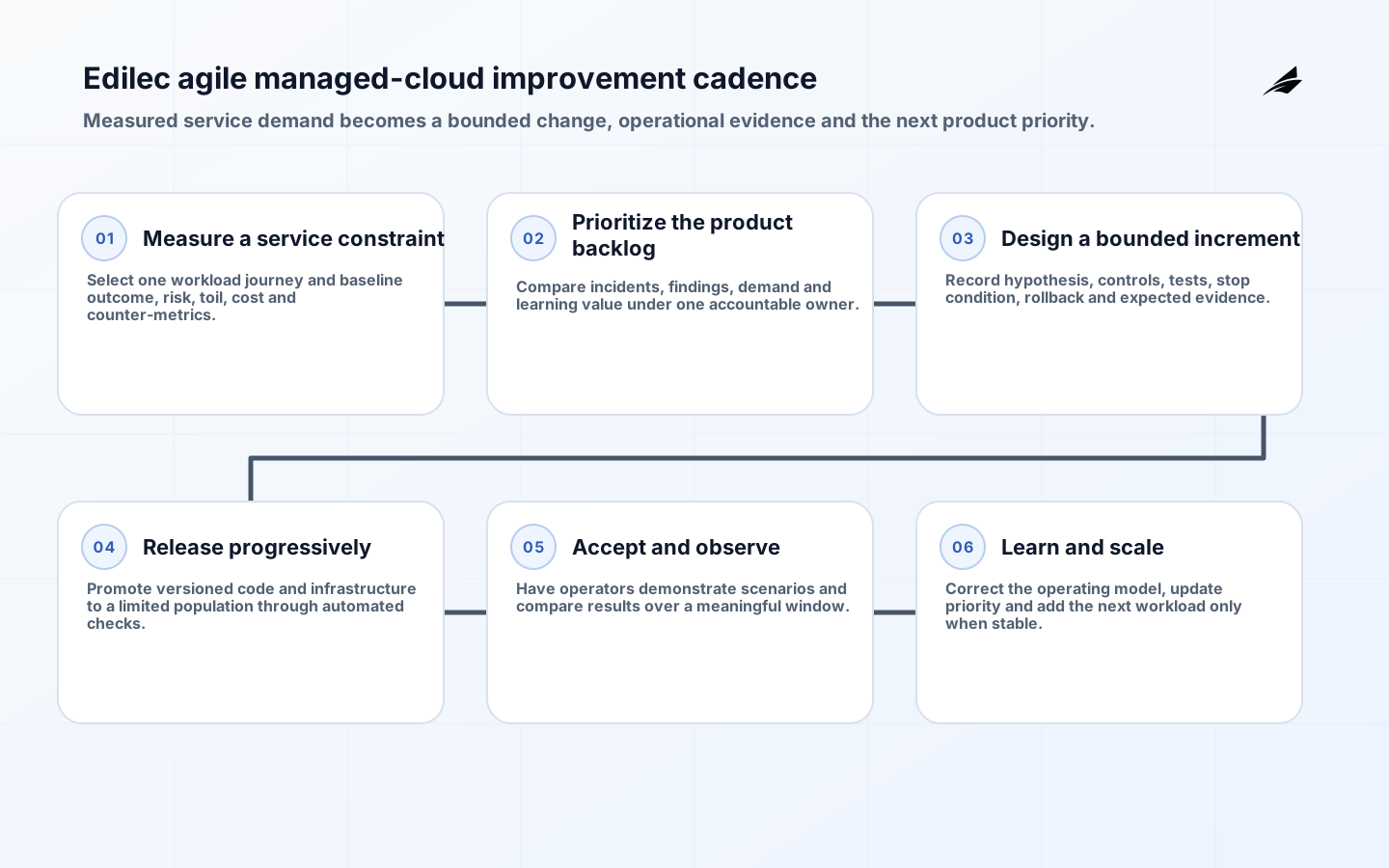
Each increment should move through discovery, design, build, validation, limited release and operational review. Discovery verifies the actual workflow and constraint. Design records the hypothesis, affected controls, rollback and measures. Build uses version-controlled code and infrastructure definitions. Validation tests function, security, resilience and operability. Release begins with a bounded population and explicit stop conditions. Review compares outcomes and counter-metrics after a meaningful observation period. High-risk changes can require stronger approval without forcing every standard change through the same delay.

Automate repeatable controls inside delivery paths: policy checks, security scans, test evidence, change records, artifact provenance and deployment reconciliation. Preserve emergency access and change procedures, then inspect their use. Microsoft recommends version control, deployment pipelines, staged tests and infrastructure as code in guidance for administering a cloud estate. The Edilec six-stage agile managed-cloud cadence at this heading connects measured service demand to a reviewed change, bounded release, operational evidence and backlog learning.
Integrate reliability, security and recovery into every increment
Define service-level indicators around user journeys and operational control, then set objectives that guide priority. Track deployment frequency, lead time, change failure and recovery, but interpret them with workload context and customer impact. A faster pipeline that increases unresolved risk is not progress. For each increment, update monitoring, alerts and runbooks with the behavior being introduced. Test observability by asking operators to diagnose an unfamiliar failure. Bound alert volume and include ownership so new telemetry does not simply create more noise.
Security work should flow through the same product system. Map controls to platform patterns, make secure defaults easy to consume and route exceptions into a visible risk queue with expiry. Threat-model changed interfaces, privileges and data flows. Test backup and recovery as application behavior, including identity, keys, configuration and reconciliation. Google Cloud's operational excellence pillar includes incident, problem, change, capacity and continuous improvement practices; these concerns should appear in the definition of done rather than in a later hardening phase.
| Signal | Review question | Likely action |
|---|---|---|
| Repeated incident | Which system condition allows recurrence? | Change architecture, detection or ownership |
| High change failure | Are changes too large, environments unlike production or tests weak? | Reduce batch size and strengthen progressive delivery |
| Slow recovery | Is diagnosis, authority, restoration or reconciliation the bottleneck? | Exercise the constrained step and update the runbook |
| Security exception aging | Is the platform missing a usable compliant path? | Build a product capability or retire the exception |
| Cloud cost anomaly | Did demand, price, configuration or waste change? | Assign cause-specific product and engineering action |
Model cost and contracts for continuous improvement
Separate transition cost, steady-state service cost, variable consumption and discretionary improvement. Transition includes discovery, remediation, automation, knowledge transfer and parallel support. Steady-state cost covers defined service levels and recurring controls. Consumption belongs to workloads and should remain visible even when consolidated on an invoice. Improvement funding protects the service from becoming a static ticket operation. Forecast ranges using workload count, criticality, technology diversity, event volume and support coverage, then reconcile assumptions during early slices.
Commercial measures should reward outcomes the provider can influence without encouraging concealment. Ticket reduction can reflect better automation or discouraged reporting; cost reduction can reflect efficiency or deferred maintenance. Pair measures such as successful standard requests, recovery evidence, change quality, aged risk and unit economics. The FinOps Framework emphasizes collaboration among engineering, finance and business stakeholders. Define how savings are baselined, who approves commitments and how benefits are shared while preserving reliability and security obligations.
Deliver the transition in evidence-led waves
A practical roadmap begins with two to four weeks of service discovery and baseline work, followed by a foundation increment and representative workload pilot. The pilot should include a routine change, realistic incident, security finding, restore and cost review. Correct the operating model before adding a second wave. Group later workloads by shared dependencies and risk, not simply department. Set entry and exit criteria for each wave and cap concurrent transitions so the receiving team can absorb knowledge and resolve defects without accumulating unmanaged work.
Close the transition only when the steady-state team can operate independently within the agreed responsibility model. Reconcile inventories and access, transfer open risks and problems, verify supplier routes, complete recovery evidence and confirm dashboards with owners. Retire old monitoring, credentials and contracts deliberately. Review outcomes at 30, 60 and 90 days, distinguishing migration effects from persistent design problems. The first roadmap ends at stable service ownership; the product backlog continues with evidence from actual operation.
Agile managed cloud takeaways
- Start with a measurable service outcome and one end-to-end workload slice.
- Give a persistent product owner and cross-functional team explicit decision rights.
- Prioritize one backlog of risk, incidents, toil, demand, cost and strategic change.
- Move each increment through validation, bounded release and operational observation.
- Fund transition, baseline operations, consumption and continuous improvement transparently.
- Expand in waves only after receiving operators demonstrate control of the previous slice.
Frequently asked questions
Can regulated cloud operations use agile delivery? Yes. Risk-based approval, traceable evidence and role separation can be built into small increments. Regulation does not require large batches; teams must understand applicable controls and preserve objective evidence for each change.
How long should an agile managed-cloud transition take? Duration depends on estate size, unknown dependencies, operating maturity and remediation. Plan using workload waves and acceptance capacity, not a universal sprint count. A pilot should be long enough to observe normal change and at least one meaningful failure or exercise.
Does agile eliminate service-level agreements? No. Agreements define commitments and accountability. Agile practices help teams improve the architecture and operating system behind those commitments. Pair contractual measures with engineering objectives and customer-outcome indicators.
Conclusion
Agile managed cloud services turn operations into a product that learns. The approach succeeds when scope is small enough to expose feedback, control is automated and testable, operators accept real scenarios and commercial terms support durable improvement. An evidence-led transition reduces the risk of a large handover while giving leaders a clearer view of cost, reliability, security and delivery progress at every wave.