An IDC MarketScape managed cloud report can accelerate market orientation, but it cannot select a provider for a specific estate. The assessment has its own market definition, inclusion criteria, evidence period and evaluation dimensions. A buyer still needs to translate business services, regulations, cloud platforms, operating maturity, geography and exit needs into a defensible selection. The deliverable is not a ranking slide; it is an operable service boundary and a tested transition.
This guide explains that buyer process. The managed cloud implementation checklist covers execution, and the managed cloud buyer FAQ addresses interpretation. Read the licensed report and its methodology directly where available. Do not assume that a provider’s placement, quotation or badge describes performance for your workload.
Use this IDC MarketScape managed cloud buyer guide to create an evidence register before procurement begins. For every material claim, record the report reference, buyer-specific question, proposed provider evidence, evaluator, confidence and resulting decision. This keeps analyst context, sales responses and observed demonstrations distinct. It also gives security, finance, operations and service owners one traceable record when they disagree about fit or when a shortlisted provider changes its team, tooling or commercial assumptions.
Understand what MarketScape can and cannot answer
IDC describes MarketScape in its research methodologies as a consistent assessment of supplier offerings and strategy intended to support shortlisting and risk mitigation. That is valuable comparative context. It does not replace due diligence on named personnel, subcontractors, delivery location, contract terms, tooling access, service-level design or customer references that resemble your scale and constraints.
Confirm the report title, publication date, geography, service category and providers included. “Managed cloud” can cover public-cloud operations, private infrastructure, applications, security, FinOps, migration or transformation in different combinations. Record which report statements are general findings and which are provider assertions. Treat omissions as unknown, not negative or positive evidence. The current IDC MarketScape catalog also shows why category and year matter.
| Research input | Buyer use | Required supplement |
|---|---|---|
| Market definition | Confirm the service category matches the need | Buyer workload and responsibility scope |
| Provider capabilities | Create initial evidence questions | Demonstration on representative scenarios |
| Strategy assessment | Explore roadmap and investment direction | Contracted commitments and change rights |
| Customer feedback | Identify themes for references | Comparable references selected by the buyer |
| Relative position | Support a long list or short list | Weighted fit, risk, cost and transition evidence |
Define the managed cloud service boundary
Map business services and divide responsibilities for cloud account ownership, architecture, platform engineering, operating systems, containers, databases, applications, identity, network, backup, monitoring, vulnerability response, incidents, cost, compliance evidence and supplier management. NIST’s cloud synopsis helps distinguish IaaS, PaaS and SaaS responsibilities. Add a RACI only after describing the actual decision and handoff; a broad “shared” label is not actionable.
State service hours, languages, countries, data locations, regulated workloads, technology versions and expected change volume. Distinguish standard operations from projects and transformation. Define which tools and records remain in customer-controlled tenants. List exclusions and prerequisites. A low managed-service price can depend on standardization that the estate cannot meet, while a bespoke service can preserve complexity indefinitely. Make that tradeoff explicit.
Turn requirements into scenarios and evidence
Replace generic questions with scenarios: onboard a new account under policy, patch a critical exposure, investigate identity compromise, restore a database, support a failed release, explain a cost anomaly and transfer service to another provider. For each scenario, specify trigger, participants, systems, authority, evidence, time objective and success. Require providers to demonstrate their workflow with named proposed tools and teams, then score observations consistently.
Weight criteria from business consequence. Security, recovery and key skills may be gates rather than point-tradeable features. Separate capability, contractual commitment and demonstrated delivery. A provider may own excellent tooling that is not included in the proposed tier. Ask reference customers about transition accuracy, staff continuity, escalation, automation ownership, invoicing, major incidents and exit, not simply satisfaction.
Use a six-stage MarketScape evaluation process
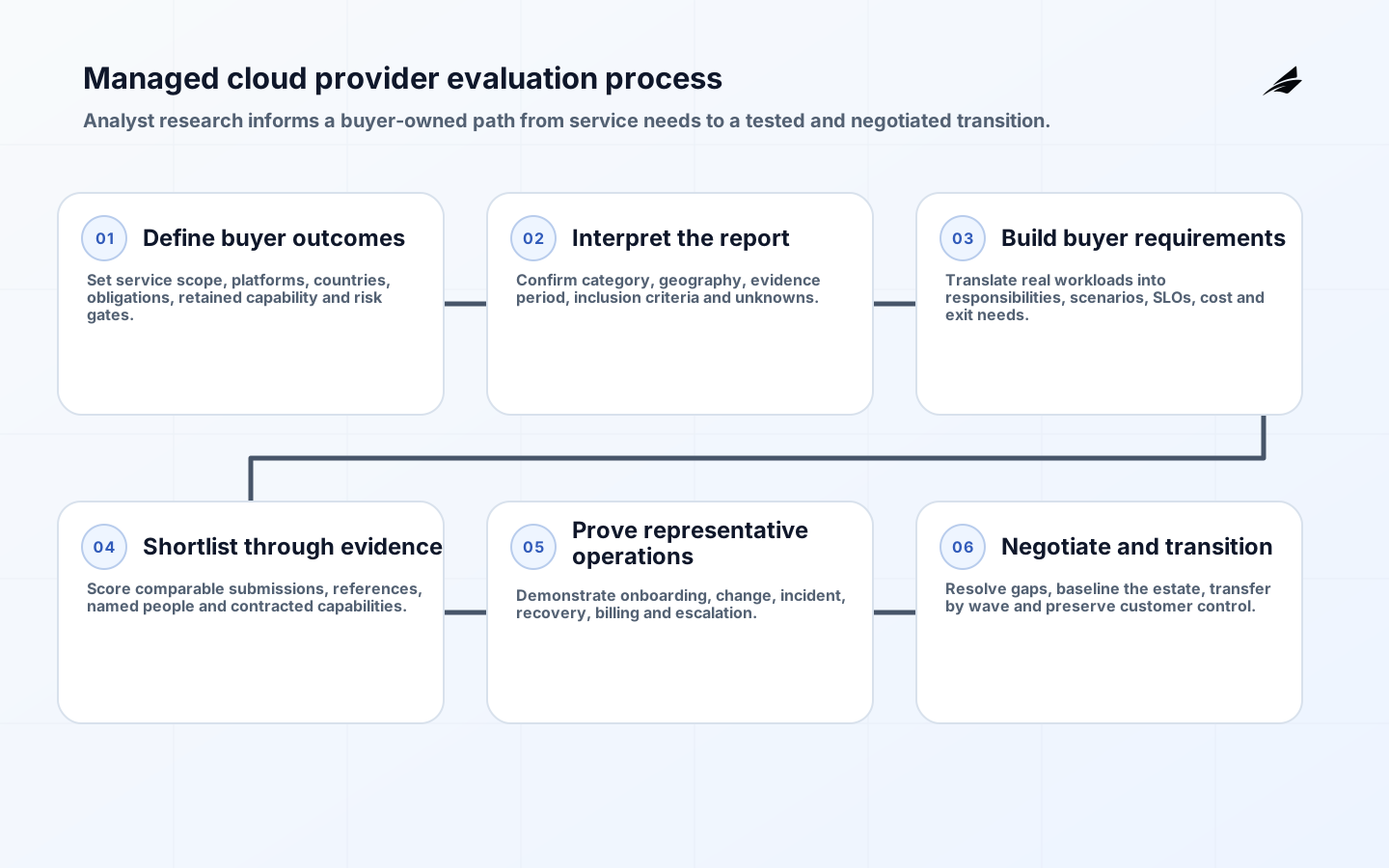
Proceed through outcome definition, report interpretation, buyer-specific requirements, evidence-based shortlist, representative proof and negotiated transition. Maintain a decision log and conflicts register. Give providers the same core scenarios and data room. Control clarification and score changes. Record confidence where estate data is incomplete. The goal is a traceable decision, not false mathematical precision.
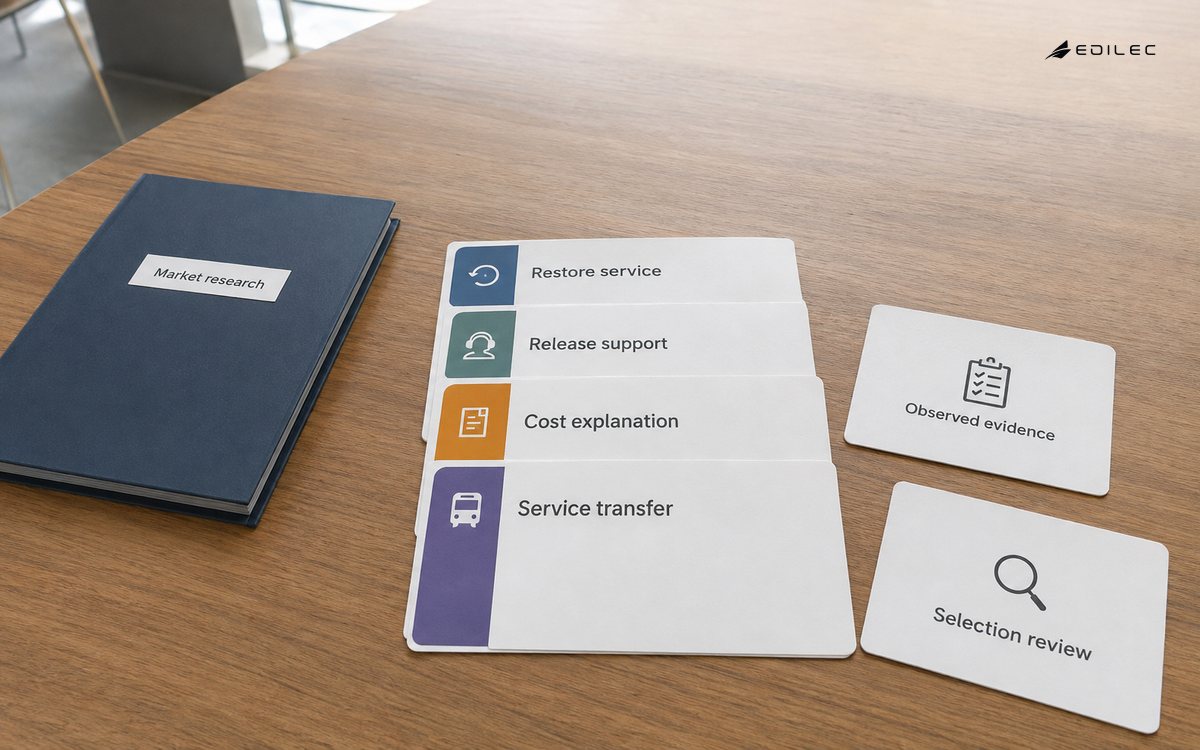
A proof should exercise the operating model, not become unpaid production. Use a bounded workload and sanitized or controlled data. Test access provisioning, observability, change, incident escalation, recovery evidence and cost reporting. Include day and off-hours contacts. Confirm which people participated and whether they are committed to delivery. Findings should alter scope, price, risk treatment or selection.
Evaluate security and resilience as service outcomes
Map the provider’s controls to the buyer’s target outcomes using the NIST Cybersecurity Framework or the organization’s chosen framework. Verify privileged access, segregation, device security, logging, vulnerability response, software supply chain, subcontractors, incident notice and evidence access. Ask who can make emergency changes, how those actions are reviewed and how provider compromise is contained.
Define SLOs around business transactions and decision times, not only ticket acknowledgement. Require recovery objectives, protected-copy design and exercises. Test loss of the management platform or provider identity, not merely workload failure. Include continuity if provider staff or a delivery location is unavailable. Service credits may price a miss but do not restore customer trust; governance should drive corrective action and termination rights for persistent material failure.
Model price, retained cost and incentives
Compare total cost across transition, run and exit. Include minimum commitments, per-resource or consumption fees, tooling, projects, after-hours work, cloud consumption, licenses, travel, inflation, currency, subcontractors, retained governance, service integration and migration overlap. Normalize proposals against a common demand model and show sensitivity to growth, ticket volume and architecture change. Avoid a five-year total that hides incompatible assumptions.
The FinOps Framework emphasizes shared accountability for technology value. Define whether the provider can recommend, approve or execute optimization and who benefits from savings. A percentage-of-spend fee can conflict with reduction; a fixed fee can discourage additional effort. Use transparent allocation, unit cost, verified savings and reliability guardrails. Preserve customer access to raw billing and commitment data.
| Commercial area | Question | Risk control |
|---|---|---|
| Transition | Which discovery errors and remediation are included? | Baseline, tolerance and priced change process |
| Run fees | What unit drives price and how can it change? | Scenario model and audit right |
| Projects | Where does standard work end? | Catalog, rates and approval authority |
| Optimization | Who owns decisions and savings evidence? | Shared metric with service guardrails |
| Exit | What artifacts, assistance and fees apply? | Tested plan, formats and capped rates |
Plan transition without losing operational knowledge
Baseline assets, owners, incidents, changes, monitoring, vulnerabilities, backups, costs, contracts and known risks before transfer. Reconcile provider discovery with customer records. Transition by service wave, pairing incoming staff with incumbents. Require runbook walkthroughs and live tasks. Do not declare knowledge transfer complete from document delivery; incoming operators should diagnose, change and recover representative services under observation.
Define entry and exit criteria for stabilization. Track access, monitoring coverage, backup tests, unresolved incidents, documentation defects and staffing. Preserve customer authority during transition and prevent simultaneous uncontrolled tool migration. Close outgoing access only after responsibilities and evidence transfer. Communicate support changes to users and suppliers. Accept each wave jointly with the business service owner.
Govern performance, change and exit
Use operational meetings for incidents, changes, SLOs, risks and actions; use executive forums for outcomes, material risk, roadmap and commercial decisions. Keep one action and decision record. Measure automation quality, staff continuity, problem recurrence, recovery, security control health, unit cost and user impact. Ticket volume without context can reward avoidable work. Apply service-improvement obligations to root causes rather than perpetual manual handling.
Maintain exit from the first day: customer-controlled accounts, current architecture, configuration and automation, data export, credential ownership, knowledge records and a transition plan. Test a sample export and provider handoff. Monitor concentration and subcontractor changes. Renew from measured value and risk, not transition fear. The ability to exit improves governance even when the relationship continues.
Managed cloud buyer takeaways
- Use MarketScape research to inform questions and shortlisting, not to replace buyer evidence.
- Define an explicit service and responsibility boundary before requesting price.
- Score demonstrated scenarios, named teams and contracted capability separately.
- Model retained governance, transition overlap and exit as real costs.
- Keep customer-controlled evidence and test the ability to transfer service.
Frequently asked questions
Should buyers select the highest-positioned provider? No; determine fit against the buyer’s scope, constraints and evidence. Can a provider outside a report be considered? Yes, if it meets requirements and due diligence. Is the analyst report enough for procurement? No. Use demonstrations, references, contract review, security assurance, cost normalization and transition planning.
How many providers should reach proof stage? Enough to preserve choice without making evaluation unmanageable, often two or three after gating. What is the most important SLA? No single SLA; prioritize user service, incident decisions and recovery. How long should transition take? Estimate by service complexity, evidence quality, tooling and knowledge rather than a generic calendar promise.
Conclusion
Market research is most useful when a buyer converts it into sharper diligence. Confirm the category, define the operating boundary, test providers against consequential scenarios, normalize economics and preserve exit. The selected managed cloud service should be one the customer can govern through evidence, not one chosen because a comparative graphic made the decision appear finished.