Agile managed cloud services combine continuous prioritization and small changes with the discipline required to operate business-critical infrastructure. Agile does not mean bypassing approval, working without a service contract or treating incidents as interruptions to the real work. It means using evidence from reliability, security, cost and users to select the next valuable improvement, delivering it in a controlled increment and adapting the service as conditions change.
The operating model should balance delivery and stability. DORA’s research measures throughput and instability together, while Google SRE uses service level objectives and error budgets to make reliability tradeoffs explicit. The agile managed cloud scope and cost plan helps buyers establish the engagement, and the agile managed cloud implementation checklist converts it into acceptance evidence.
What does agile mean in a managed cloud service?
The service has a product owner, a cross-functional operating team, a prioritized backlog and a regular review cadence. Work includes reliability, security, compliance, cost, platform capability, migration and user friction, not feature requests alone. The team delivers small, reversible changes through automation and learns from production evidence. Urgent incidents use a separate response flow, then feed corrective work into the backlog without waiting for a ceremonial planning cycle.
A service catalog still defines boundaries, supported configurations, responsibility, support, objectives, maintenance, pricing or allocation and exit. Agile changes how improvements are selected and delivered; it does not make the boundary optional. Keep standard service work separate from bespoke project engineering. Repeated exceptions may reveal a missing capability, while one-off customization can erode the managed model and make every upgrade a negotiation.
| Work type | How it enters the system | Completion evidence |
|---|---|---|
| Incident | Severity process and on-call response | Service restored, timeline recorded and follow-up owned |
| Security finding | Risk triage with required deadline | Control verified and residual risk accepted or closed |
| Reliability improvement | SLO or failure evidence in backlog | Error-budget or service indicator improves |
| Cost optimization | Unit-cost and usage opportunity | Net saving observed without guardrail regression |
| Consumer capability | Product discovery and acceptance criteria | Supported journey works and operations can sustain it |
How should ownership be divided?
Name a customer service owner accountable for outcomes and risk, a provider service manager, technical owners, security and financial partners, and application or consumer owners. Build a responsibility matrix for identity, network, configuration, patching, vulnerability remediation, backup, restore, monitoring, incident communication, capacity, cost and changes. Include cloud provider responsibilities beneath the managed-service contract. Resolve ambiguous shared tasks with runbooks and exercises.
Decision rights belong in the model: who prioritizes, approves standards, accepts risk, authorizes emergency change, declares disaster, communicates externally and terminates the service. A supplier can operate controls but cannot silently assume business risk authority. Keep access least-privileged and individual, with customer visibility into privileged activity. Rehearse break-glass access and remove supplier identities promptly when roles change.
How do SLOs and error budgets guide priorities?
Define service level indicators from consumer experience: successful deployment, application request, restore, provisioning, policy decision or support transaction. Google SRE recommends choosing what users care about before what is easy to measure. State target, measurement point, window, exclusions and response. Provider component availability is an input, not necessarily the managed service outcome.
An error budget is the allowed gap from the objective over a period. Agree a policy before it is consumed: accelerated reliability work, tighter release gates or pause of discretionary change may follow. Do not use an error budget to excuse chronic failure or violate contractual and safety duties. Review burn rate during planning so the backlog reflects current service risk rather than a static annual roadmap.
| Signal | Decision supported | Anti-pattern |
|---|---|---|
| SLO attainment and burn | Whether reliability work should outrank change | Reporting uptime without a user journey |
| Change lead time | Where delivery flow is constrained | Rewarding raw ticket closure |
| Change fail and rework rate | Whether release controls are effective | Hiding hotfixes from deployment counts |
| Unit cost per outcome | Whether demand and design are efficient | Optimizing the provider invoice alone |
| Restore exercise result | Whether continuity is credible | Counting completed backup jobs as recovery proof |
How are changes delivered safely and quickly?
Use version-controlled infrastructure and policy, peer review, automated validation and progressive deployment. Classify changes by consequence and set proportionate review. Standard low-risk changes can use pre-approved automation; high-impact identity, network, data or recovery changes require explicit evidence and authority. Emergency change remains logged, reviewed and tested afterward. Small batches help only when state, dependencies and rollback are understood.
Define acceptance beyond pipeline success: configuration is applied, telemetry and inventory identify the version, security controls work, backup remains restorable and the consumer journey is healthy. Attach release identifiers to logs, metrics and traces. OpenTelemetry supports common observability signals, while the operating team must supply service context and ownership. Keep a rollback or roll-forward path and test partial automation failure.
How are security and compliance kept continuous?
NIST Cybersecurity Framework 2.0 organizes outcomes across Govern, Identify, Protect, Detect, Respond and Recover. Map the managed service’s controls and evidence into that lifecycle or the organization’s chosen framework. Integrate vulnerability, configuration, identity, logging, backup and supplier findings into the same prioritized system, with required deadlines and risk authority. Compliance evidence should be generated from operation where possible rather than assembled annually from memory.
Threat-model the management plane and automation because provider credentials can affect many workloads. Separate tenant and environment authority, protect secrets, restrict network paths and review dependencies. Define notification, investigation and evidence-sharing duties among customer, managed provider and cloud provider. Run incident scenarios that cross those boundaries, including compromised admin identity, region loss, destructive automation and provider API failure.
How does FinOps fit the agile cadence?
The FinOps Framework describes a collaborative practice that maximizes the business value of technology through timely data and shared accountability. Require allocation metadata at provisioning, reconcile billing, forecast demand and expose unit cost alongside service outcomes. Product, engineering and finance should prioritize optimization together. The cheapest resource is not valuable if it breaches latency, recovery or security requirements.
Separate usage, rate and architecture opportunities. Remove idle resources with safeguards, rightsize from observed demand, manage commitments against credible forecasts and redesign only where recurring value justifies risk. Put each action through the normal change path and measure net savings after implementation, including licenses, labor and performance effects. Update templates and quotas so waste does not return.
How should the supplier relationship be governed?
Review service outcomes, reliability, security, cost, change, incidents, exceptions, staffing and roadmap on a fixed cadence. Use shared evidence rather than supplier activity reports. Contract for telemetry and configuration access, audit support, subcontractor changes, skill continuity, knowledge artifacts, price adjustment, service credits where useful, transition assistance and data deletion. Maintain customer capability to challenge decisions and act during supplier failure.
Avoid measuring the provider by ticket volume or utilization. Reward resolved outcomes, automation, prevented recurrence and transparent risk. A healthy managed service may reduce routine tickets. Preserve architecture decisions, runbooks, inventories, code, credentials, dashboards and training so knowledge is not trapped with individuals. Test transition by having a customer or alternate team perform selected operations from the supplied evidence.
How is transition or exit kept credible?
Maintain a current asset and dependency inventory, customer-controlled repositories, configuration exports, privileged-access register, data portability method and named transition roles. Identify which licenses, marketplace contracts, support plans and commitments belong to the provider or customer. Estimate the overlap period and test whether a replacement team can obtain logs, restore data, deploy a standard change and contact the cloud provider without informal relationships.
Exercise one exit element each quarter rather than waiting for termination: export an inventory, rebuild a non-production environment, rotate provider-held credentials or restore through customer-owned procedures. Track gaps as backlog items. At actual transition, use dual control for privilege transfer, reconcile open incidents and changes, preserve records and revoke old access promptly. Service continuity and evidence integrity are acceptance conditions for the outgoing provider.
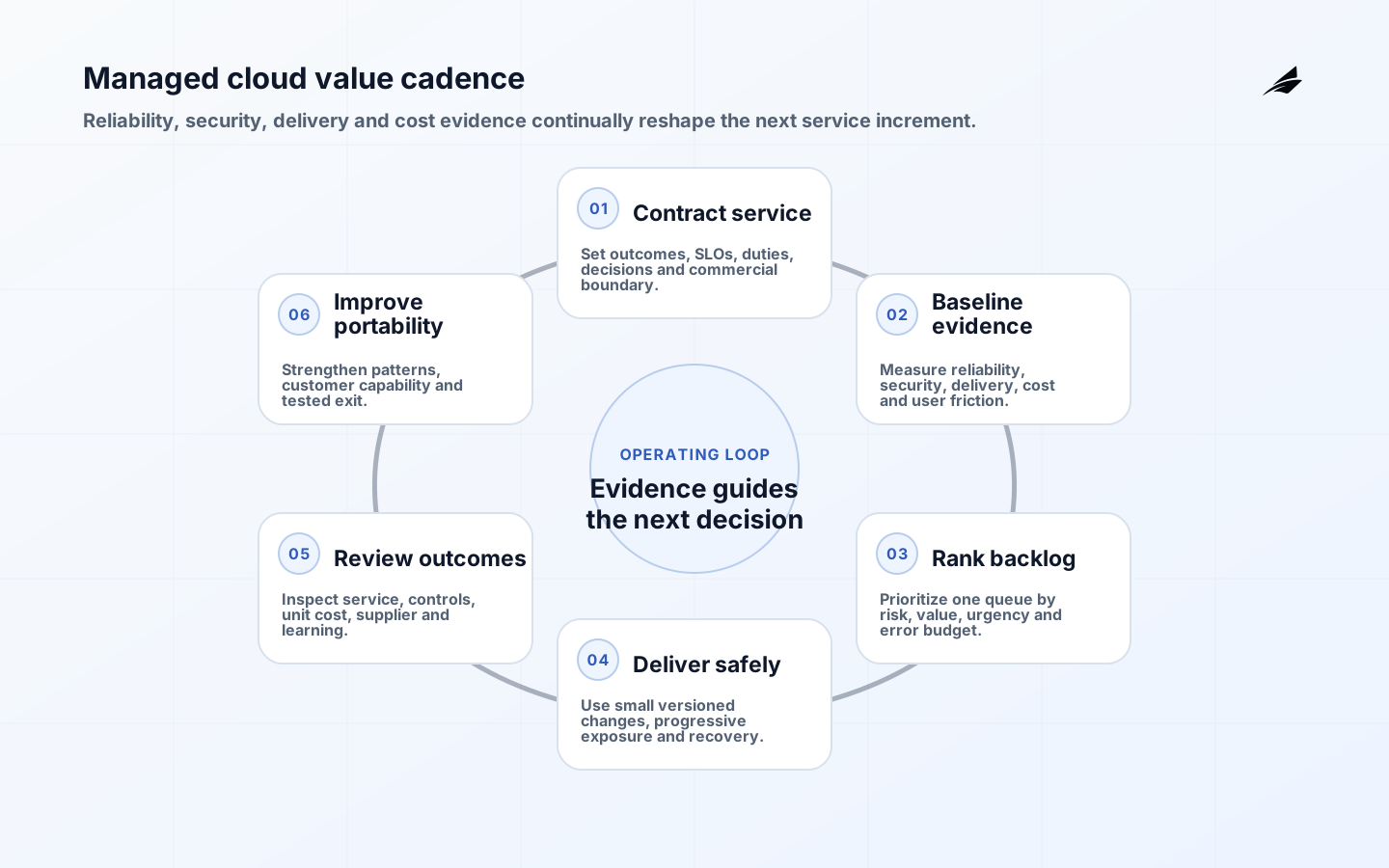
What six-stage operating procedure works?
- Define the service boundary, consumer outcomes, supported patterns, SLOs, responsibilities, decision rights and commercial model.
- Baseline reliability, security, delivery, cost, capacity and consumer friction; create one evidence-ranked backlog.
- Deliver small controlled changes through versioned automation, proportional review, progressive exposure and recovery paths.
- Operate with actionable telemetry, on-call ownership, incident coordination, continuous control evidence and tested restore.
- Review outcomes, error-budget position, unit cost, supplier performance and team learning; reprioritize the next increment.
- Improve standard patterns and capability, rehearse supplier transition and maintain a funded retirement or exit route.
Key takeaways
- Agility operates inside a clear service contract, responsibility model and risk authority.
- Prioritize one backlog from user, reliability, security, cost and operational evidence.
- Use SLOs and error budgets to guide tradeoffs without weakening mandatory duties.
- Accept changes through consumer and recovery evidence, not deployment completion alone.
- Govern suppliers for outcomes, knowledge portability and a rehearsed exit path.
Frequently asked questions
Do cloud operations need two-week sprints?
No. Use a cadence that supports planning and learning, with continuous flow for suitable work and immediate incident response. The essential practices are visible priorities, bounded work, fast feedback and outcome review. Do not delay urgent security or reliability work to fit a sprint boundary.
Is an SLA enough to manage the provider?
No. An SLA defines selected commitments and remedies. Governance also needs user-centered indicators, controls, cost, change quality, incident learning, capacity, knowledge and exit evidence. Service credits rarely compensate for mission impact or an unrehearsed recovery.
Can the managed provider own all cloud risk?
No. The provider can implement controls and accept contractual liabilities, but the customer retains accountability for business purpose, data, risk decisions and supplier oversight. Assign every shared responsibility and keep informed authority inside the customer organization.
Conclusion
Agile managed cloud services work when rapid learning and disciplined operation reinforce each other. A user-centered service contract, shared evidence backlog, controlled automation and continuous reliability, security and cost review create sustainable value. The broader managed cloud implementation checklist and managed cloud buyer FAQ support teams comparing or transitioning service models.