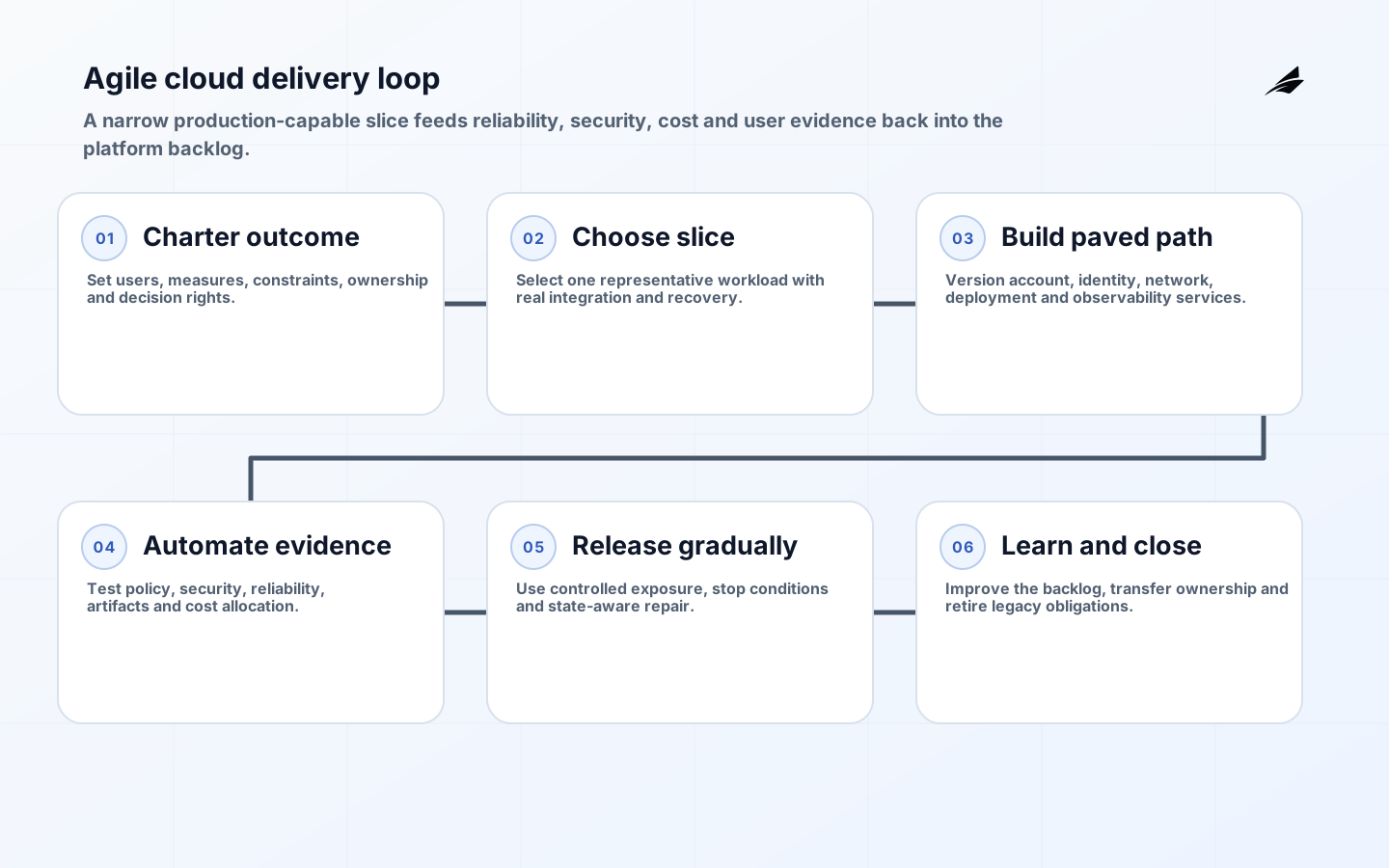
Agile cloud services combine short feedback cycles with the operational discipline required for shared infrastructure and production workloads. Agile does not mean provisioning without architecture, controls or service ownership. It means delivering the smallest useful cloud capability, observing real outcomes and adapting while reliability, security and cost constraints remain explicit. Platform foundations, application migration and operations should evolve together; a long platform build that receives workload feedback only at the end is neither agile nor low risk.
This delivery plan connects to the agile cloud implementation checklist and agile cloud services FAQ. It uses cloud architecture frameworks, DORA delivery measures and FinOps practices without treating any metric as a target by itself. Scope is organized into end-to-end slices that prove account setup, identity, network, deployment, observability, recovery, cost and workload behavior.
1. Define outcomes, constraints and product ownership
Write a product charter naming users, business outcomes, service boundaries, executive sponsor and product owner. Baseline environment lead time, deployment performance, incident recovery, policy exceptions, cost allocation and user effort. Define non-negotiable constraints for identity, data location, recovery and regulated workloads. A backlog item should connect to a user or control outcome; “build landing zone” is too broad to prioritize or accept.
Assign ownership across platform and workload teams. The platform team provides reusable account, network, identity, deployment and observability capabilities; workload teams own application behavior and service health within guardrails. Security, finance and operations contribute policy and feedback continuously. Publish decision rights for standards, exceptions, production access and major cost commitments. Agile delivery stalls when every increment waits for an unspecified central approval.
2. Plan vertical slices and migration waves
Choose a representative workload and deliver a thin path from repository to production-like environment. Include real identity, policy, logging, cost tags and recovery rather than creating a disposable demonstration. The first slice should reveal interfaces between platform and workload teams. Capture user friction and revise the platform contract before many teams depend on it. Add capabilities when demand is observed, not merely because a reference architecture lists them.
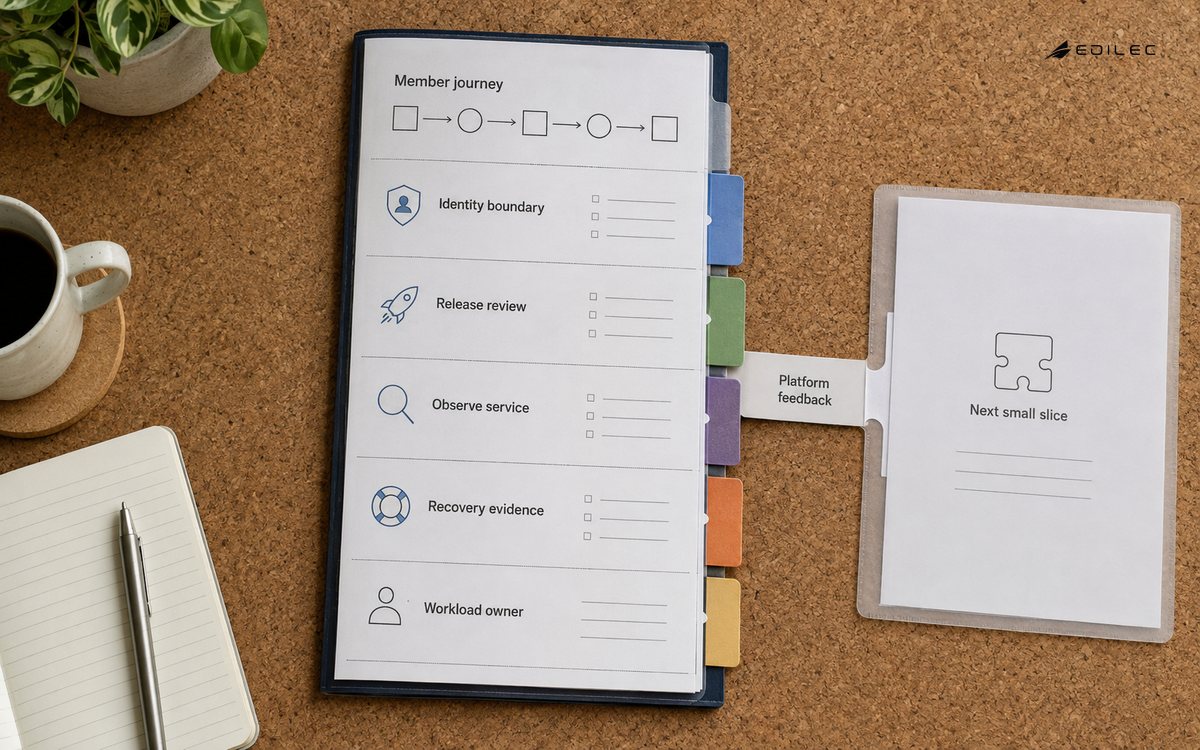
Group migrations by dependency, business calendar, data, risk and team capacity. Each wave needs entry and exit evidence. Limit work in progress to review, testing and operational capacity; starting more workloads does not increase completed value when they wait for the same network or security team. Use discovery spikes for uncertain data transfer, service limits or licensing, with a decision and evidence as the output.
| Slice element | Minimum proof | Feedback user |
|---|---|---|
| Account and identity | Least-privilege access and lifecycle test | Workload and security teams |
| Deployment | Repeatable artifact promotion and rollback | Developers and operations |
| Observability | User outcome and dependency signals | On-call team |
| Cost | Owner, forecast and anomaly visibility | Engineering and finance |
3. Build the cloud platform as a product
Create discoverable, versioned services for account vending, identity, connectivity, keys, policy, deployment, observability, data and cost allocation. Provide paved paths through reusable modules and templates while allowing governed exceptions. Measure time to first safe deployment, support demand, adoption and failure. An internal platform succeeds when teams can accomplish important work with less cognitive load, not when every workload uses identical technology.
Automate repeatable controls in the delivery path: source review, dependency checks, infrastructure validation, policy tests, artifact integrity and environment promotion. Keep manual approval where judgment and accountability require it, but give reviewers complete evidence. Test platform changes against representative consumers and publish compatibility. Versioning and deprecation policy prevent a shared module update from becoming an unplanned enterprise-wide event.
4. Integrate reliability and security into each increment
Define service-level objectives and error budgets for real user outcomes. Instrument latency, errors, saturation and dependencies before production exposure. Test failure modes, restore data and rehearse incident roles. Reliability work remains in the product backlog and competes transparently with features. A sprint marked complete without production diagnostics or support ownership moves work rather than finishing it.
Threat-model the slice, apply least privilege and workload identity, protect administrative planes and validate policy. Security acceptance should cite tests and open risk. Use short feedback from code and infrastructure scanning, but do not confuse tool output with exploitability or control coverage. Include incident containment and secret rotation in rehearsal. Shared guardrails reduce repeated review when their limits and exception route are clear.
5. Make cost part of product feedback
Attach ownership and allocation at provisioning, then provide teams with timely cost and usage data. Forecast each wave, set anomaly alerts and identify variable drivers. Use business unit measures where meaningful. Cost review belongs in design and operations, not a quarterly cleanup. Developers need enough context to understand how architecture, data transfer, retention and scaling affect spend.
Prioritize optimizations by realized value and engineering effort. Scheduling, rightsizing, storage policy, commitment purchases and architecture changes carry different reversibility. Protect reliability and security objectives while testing savings. DORA delivery measures and cloud cost measures should be read together: faster deployment that increases change failures or runaway consumption is not better delivery. Avoid metric quotas that invite gaming.
| Measure | Diagnostic question | Avoid |
|---|---|---|
| Lead time | Where does a safe change wait? | Rewarding unreviewed speed |
| Change failure | Which changes cause remediation? | Hiding rollback as success |
| Recovery time | Can teams restore service quickly? | Averages masking severe events |
| Unit cost | Does spend scale with value? | Reducing resilience blindly |
6. Release with evidence and learn from production
Use small batches, automated deployment and progressive exposure where the workload permits. Define pre-release evidence, cohort, monitoring, rollback or forward repair and stop conditions. Database and message changes need compatibility plans because application rollback alone may not restore state. Rehearse the procedure and keep feature flags safe by default. Production approval should identify the exact artifact and residual risks.
Observe customer outcome, service health, delivery flow, security and cost after release. Hold blameless incident reviews that examine system conditions and create owned improvements. Track DORA measures—deployment frequency, lead time, change failure and recovery—as diagnostic signals, not league tables. Segment by service type and criticality. A batch platform and a customer API have different safe delivery profiles.
7. Scale ownership and close transformation work
Scale through federated capability. Platform teams provide products and standards; workload teams operate services; communities share practices; central functions examine systemic risk. Invest in training through paired delivery and incident exercises. Watch review queues, environment capacity and specialist dependencies as system constraints. Improve those constraints before adding more migration starts or governance meetings.
A wave ends when the target service operates under permanent ownership and old obligations close. Decommission infrastructure, credentials, interfaces, monitoring and licenses; preserve records according to policy. Compare outcomes to baseline and revisit architecture assumptions. Keep the platform roadmap tied to observed workload needs. Agile cloud services remain a product capability after the migration program ends.
For agile cloud services: scope, cost, risks and delivery plan, maintain an acceptance ledger that links each material requirement to an owner, implementation evidence, test result, residual limitation and review date. Sample the evidence with people who operate the service, not only its builders. Re-open acceptance when a provider, data source, integration, user population or authority boundary changes. This ledger prevents a successful launch label from concealing expired assumptions, incomplete handover or controls that were demonstrated once but cannot be exercised by the permanent team.
Keep discovery visible inside delivery. At the beginning of each wave, list uncertain assumptions about data movement, quotas, performance, recovery, licensing and team skills. Turn high-risk assumptions into time-bounded experiments whose outputs are measurements and decisions, then update estimates and sequencing. Discovery is not a separate phase that must predict every future workload; it is disciplined learning that prevents teams from building large shared capabilities on untested assumptions. Archive results with architecture decisions so later teams understand both the chosen path and the rejected alternatives.
Maintain a single improvement backlog across platform reliability, security, developer experience and economics. Give recurring operational pain a measurable cost and compare it with new capability. Reserve capacity for reducing toil and removing unsafe exceptions. Otherwise sprint planning favors visible features while recurring incidents, manual access and slow onboarding steadily consume the delivery capacity the program intended to create.
Key takeaways
- Anchor agile cloud work in users, outcomes and explicit constraints.
- Build shared platform services through representative workload slices.
- Keep reliability, security and cost inside the definition of done.
- Use delivery metrics diagnostically and segment them by service.
- Close legacy obligations and transfer permanent ownership wave by wave.
Frequently asked questions
Can architecture be emergent in enterprise cloud work?
Some design should evolve from feedback, but high-cost boundaries such as identity, data authority, residency and recovery need deliberate decisions. Record assumptions, validate them early and preserve room to change less consequential details.
How long should a cloud delivery iteration be?
Use a cadence short enough to receive useful feedback and long enough to produce integrated evidence. The exact duration matters less than completing small batches and avoiding long-lived work that never reaches a representative environment.
Does agile remove the need for change approval?
No. It should make approval faster and better informed through automated, traceable evidence and clear decision rights. High-consequence changes may still require human authorization; routine low-risk changes can use pre-approved paths.
Conclusion
Agile cloud services make learning part of enterprise delivery without discarding control. They connect platform engineering, workload change, security, reliability and economics through small production-capable slices. The result is faster evidence, not merely faster activity.
Start with a representative service, automate repeatable assurance and let observed demand shape the platform roadmap. Scale only as operational capacity grows, and finish each wave by closing legacy obligations. This creates a cloud delivery system that can continue improving after the transformation program ends.