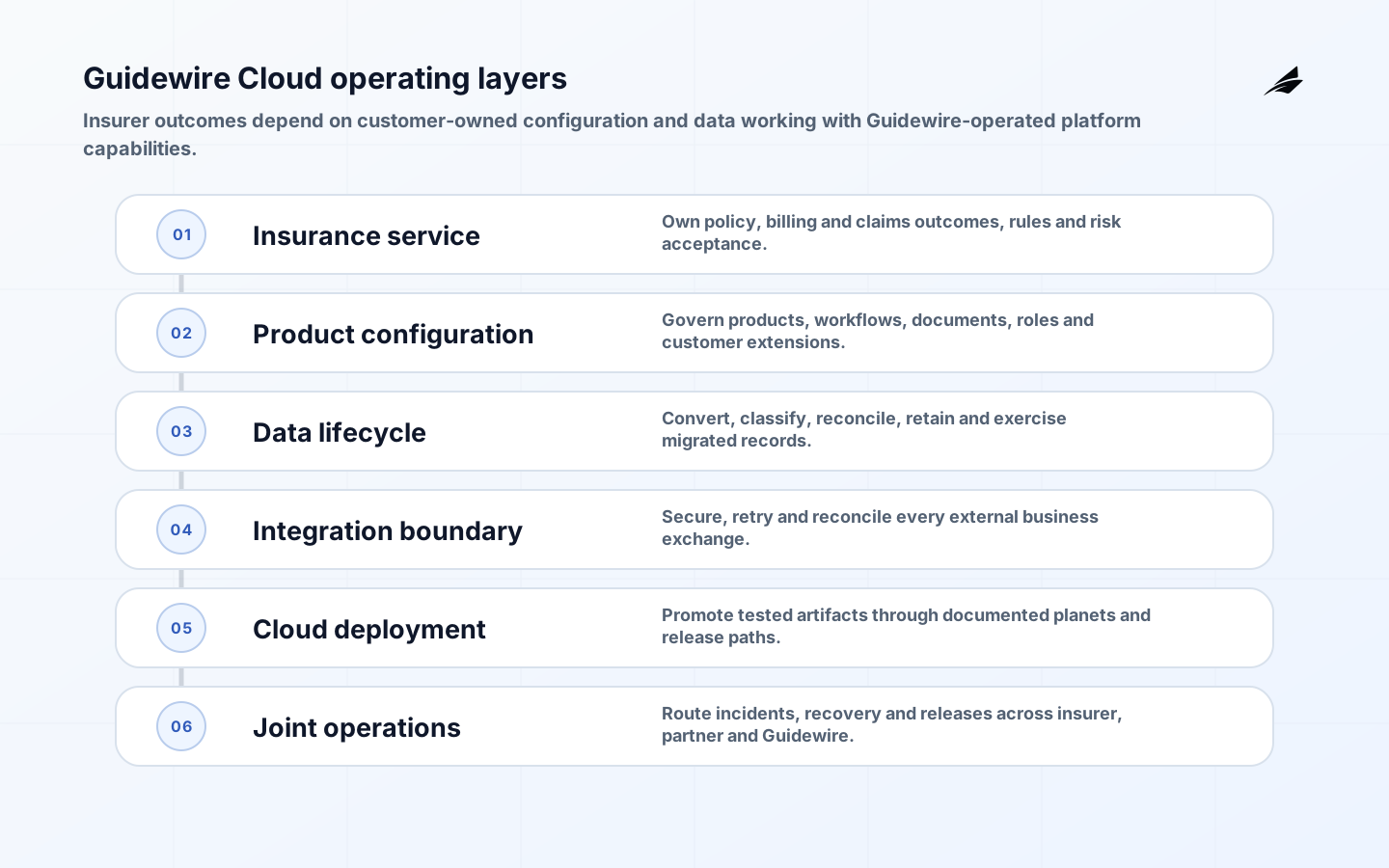
An insurance core system cloud migration is not simply an on-premises installation hosted elsewhere. Cloud platforms are generally described as environments used to build, deploy, access and observe applications, with some operational responsibilities moving to the provider. For an insurer, the migration still includes product configuration, insurance data, integrations, identity, testing, operating readiness and organizational change. The platform changes which technical capabilities the supplier operates, but the insurer remains responsible for business rules, data governance, access decisions and safe use of the resulting service.
This FAQ supports teams evaluating or delivering a migration. It should be read with the scope and delivery plan and the implementation checklist. Cloud providers and product suppliers use their own terms for regional boundaries, company presence, business-unit grouping and environments, such as region, tenant, account, subscription or workload group. Teams should learn those meanings, then map them to their own legal entities, lines of business, release process and control ownership.
What does the target cloud environment provide?
Cloud platform documentation typically presents capabilities for application build and deployment, environments, databases, identity integration, monitoring and access to applications and services. Core insurance applications can coexist with integration services, web front ends and other platform services. Product availability and behavior vary by release and contract, so architecture decisions should cite the exact documentation version and contracted capability rather than a sales category. Establish which components are supplier-operated, customer-configured or independently hosted.
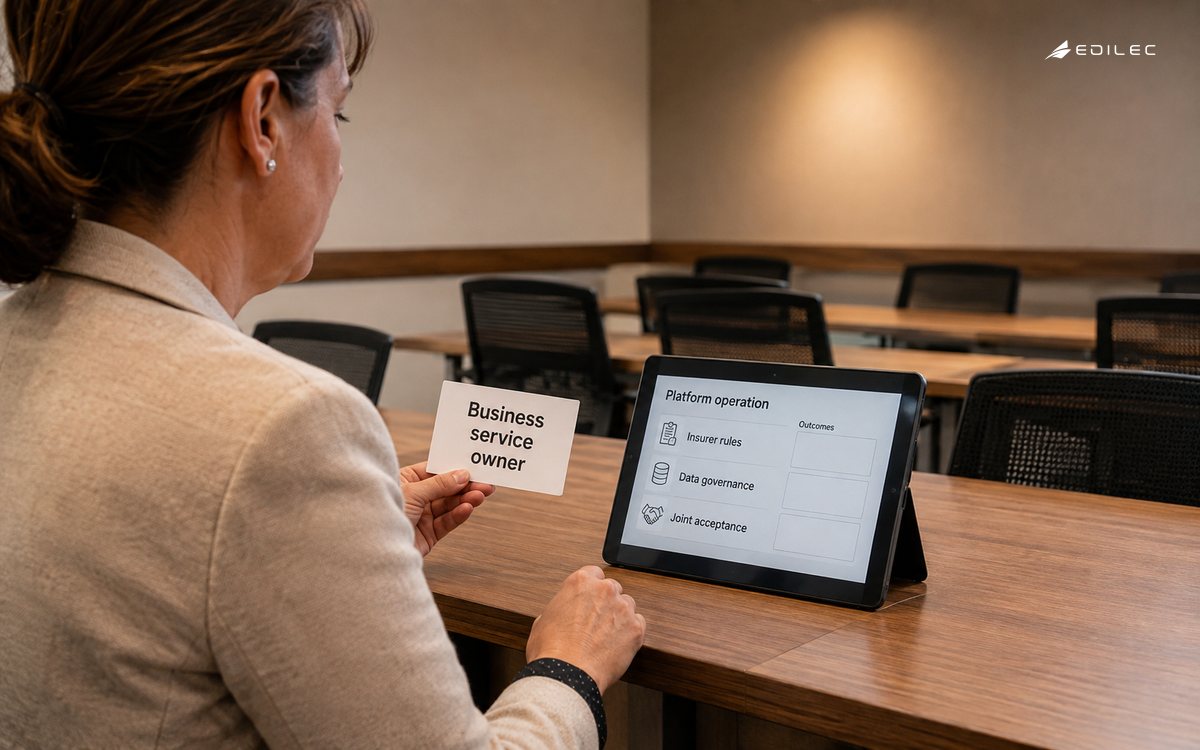
Translate platform features into an insurer service model. Policy administration, billing and claims outcomes depend on configured products, rules, workflows, documents and integrations that the insurer controls. A healthy platform does not prove that premium, coverage, payment or claim decisions are correct. Name business service owners beside technical owners and set joint acceptance measures. Retain an inventory of cloud applications, add-ons, accounts, environments, interfaces, identities, data uses and operational contacts.
What belongs in migration scope?
Scope starts with business capabilities and lines of business, not a count of configuration files. Inventory core application modules and versions, product models, custom code, batch processes, documents, forms, rating dependencies, reports, integrations, security roles, reference data and operational jobs. Classify each item as retain, redesign, replace, retire or defer. Unsupported customization should not be recreated automatically; determine the business need and prefer supported configuration or extension patterns where they meet it.
Sequence migration around dependencies and policy or claim lifecycle, including in-force conversion, open claims, billing activity and financial reconciliation. Decide whether historical data moves, remains in a governed archive or is exposed through another service. Define coexistence authority: which system may write each record during transition, how changes synchronize and how conflicts resolve. Include downstream warehouses, payment providers, document systems, agent portals and regulatory reporting in cutover design.
| Cloud concept | Planning interpretation | Decision to record |
|---|---|---|
| Region or residency zone | Geographic and regulatory boundary | Approved data residency and service availability |
| Tenant or account | Insurer presence within a provider's service | Legal and organizational scope |
| Workload group | Grouping often aligned to business needs | Ownership and deployment topology |
| Environment | Stage such as development, pre-production or production | Data, access and promotion controls |
How should integrations be redesigned?
Create an interface catalog with business purpose, owner, source and target, data contract, authentication, volume, latency, retry, ordering, reconciliation and support path. Separate synchronous user-path dependencies from asynchronous events and batches. Use stable identifiers and idempotent consumers. A successful HTTP response is not business reconciliation; confirm that the expected policy, claim, billing or document state exists downstream. Preserve rejected messages and make replay controlled and observable.
Use supported platform integration patterns for the contracted release and validate service limits, network connectivity and data residency. Avoid recreating an on-premises network assumption in the cloud through broad tunnels or shared credentials. Each integration service needs its own lifecycle, least-privilege identity, monitoring and deployment evidence. Test dependency degradation so an unavailable ancillary service does not corrupt a core transaction or leave users with a misleading success message.
What security responsibility remains with the insurer?
Shared-responsibility guidance from cloud providers and product suppliers generally describes the provider securing the underlying cloud platform while customers remain responsible for their data, configurations and access. The insurer must classify sensitive information, approve identity and role design, govern third-party flows, control lower-environment data and review privileged access. Federate with the approved identity provider, define joiner-mover-leaver behavior and test emergency access. Business roles should reflect separation required across underwriting, claims, billing and administration.
Threat-model custom code, integrations, documents, user interfaces and operational access in addition to the hosted platform. Apply secure coding and dependency controls to customer-delivered components. Decide where secrets and encryption keys reside and who can rotate them. Establish logging that reconstructs material configuration, access and business events without unnecessarily duplicating personal data. Confirm incident notification, customer investigation access and evidence retention in the applicable contract and runbooks.
How should configuration and migration be tested?
Build scenario packs from real insurance lifecycles: quote, bind, endorsement, renewal, cancellation, reinstatement, billing, payment, first notice of loss, reserve, payment, recovery and closure as applicable. Include jurisdiction, product, role, date boundary, catastrophe volume, correction and partial integration failure. Test configured behavior and downstream accounting or reporting, not only screens. Platform suppliers may provide test automation capabilities, but the insurer must define the business assertions and representative data.
Migration testing needs record counts, financial totals, field-level samples, relationship integrity and business execution against converted records. Reconcile multiple times with production-like volume and measure the cutover window. Protect test data and mask production information unless explicitly authorized. Performance tests should cover peak quoting, billing cycles, renewals, catastrophe claims and batch contention. Accessibility, document correctness and role-based access belong in acceptance alongside functional results.
| Acceptance area | Evidence | Business owner question |
|---|---|---|
| Configuration | Lifecycle scenario results | Are products and decisions correct? |
| Migration | Counts, totals and sampled relationships | Can operations trust converted records? |
| Integration | Retries, reconciliation and degraded-mode tests | Can dependent services fail safely? |
| Operations | Incident, downtime and release rehearsal | Can assigned teams run the service? |
How do releases and operations work?
Cloud platforms usually provide development, pre-production and production environments and one or more deployment paths. Map these platform mechanisms to internal change policy, test evidence and business approval. Establish branch, build, configuration and environment-promotion practices that identify the exact artifact deployed. Rehearse platform release adoption with regression tests for insurer configuration and integrations. Do not assume a supplier-managed platform removes the need for customer release ownership.
Operate with combined signals: platform status, application logs, integration health, batch completion, business queue age and financial reconciliation. Define contacts and escalation for the cloud provider, product supplier, implementation partners, insurer technology teams and business operations. Runbooks should distinguish platform incident, customer configuration defect, integration failure and incorrect business rule. Maintain downtime and recovery procedures for critical policy, billing and claims work, including reconciliation after service returns.
How should cost and supplier dependency be evaluated?
Build a multi-year cost model with subscription and usage terms, implementation, data conversion, integration change, environments, testing, partner services, internal teams, training, dual running and retirement of legacy infrastructure. Separate committed charges from variable consumption and record assumptions about policy, claim, user, data or platform usage drivers. Compare options over the same business scope and risk horizon; cloud value may come from release currency and reduced infrastructure work, not merely lower hosting expense.
Preserve insurer control over architecture decisions, source and configuration repositories, data definitions, test assets, operational records and production approvals. Clarify partner deliverables and knowledge transfer. Verify export, retention and termination support for data and artifacts. Product-specific expertise is necessary, but concentrating all knowledge in a supplier makes future releases and incidents expensive. Develop internal product, integration, data and operational capability throughout delivery.
Maintain an acceptance ledger that links each material requirement to an owner, implementation evidence, test result, residual limitation and review date. Sample the evidence with people who operate the service, not only its builders. Re-open acceptance when a provider, data source, integration, user population or authority boundary changes. This ledger prevents a successful launch label from concealing expired assumptions, incomplete handover or controls that were demonstrated once but cannot be exercised by the permanent team.
Key takeaways
- Treat the migration as a business-system transformation, not a hosting move.
- Map supplier terminology to insurer entities, environments and controls.
- Redesign and reconcile integrations instead of copying network assumptions.
- Test complete insurance lifecycles and converted records.
- Retain insurer ownership of data, configuration, decisions and operational acceptance.
Frequently asked questions
Is a vendor-hosted core platform multi-tenant?
It depends on the product. Tenancy models range from dedicated single-tenant stacks to shared multi-tenant and hybrid designs, and suppliers organize resources with their own terms. Ask each supplier to describe isolation of compute, data and keys in writing, and confirm the exact architecture and service behavior for the contracted products and region.
Can all on-premises customizations move unchanged?
Do not assume so. Inventory each customization, identify the business outcome and assess supported configuration, extension or replacement patterns for the target release. Rebuilding obsolete behavior increases cost and future release burden.
Who handles production incidents?
Responsibility depends on the failure domain. The provider and supplier operate platform capabilities; the insurer and its partners retain responsibilities for configuration, integrations, data and business operations. A joint incident model must route evidence quickly and name decision authority.
Conclusion
A core insurance migration to the cloud is ready when an insurer can prove business correctness, controlled deployment, reconciled integration, secure access and operational ownership on the target platform. Platform capability enables those outcomes but does not substitute for product, data and process decisions.
Keep scope and acceptance tied to exact insurance scenarios and the current contracted release. Use the supplier's authoritative documentation for platform behavior, preserve insurer-owned evidence and rehearse cross-party operations. That approach turns migration into a sustainable core-platform service rather than a one-time technical cutover.