Modernizing a policy administration system is an insurance operating-model change, not a technology swap. Quoting, rating, underwriting, issuance, endorsement, renewal and cancellation depend on product definitions, authority rules, forms and documents, billing and financial interfaces, distribution partners and regulated data. Moving them successfully requires a business release scope, a disciplined configuration and extension strategy, repeatable data conversion, controlled integration changes and an operating team prepared to own the new system after launch.
This delivery plan is for insurers and implementation leaders evaluating scope, cost drivers and risk. Use it with the policy administration configuration, conversion and cutover checklist, the policy administration modernization FAQ and the managed cloud services planning guide for insurance core platforms when moving from business case to executable work packages.
Define the policy outcome and release boundary
Begin with the capability that must improve: time to launch a product or rate change, straight-through issuance, underwriter effectiveness, endorsement accuracy or agent and customer self-service. Identify the affected line of business, jurisdiction, distribution channel and book of business. Then map the quote, bind, issue, change, renew and cancel transactions that cross the release boundary. A platform-wide transformation slogan cannot tell teams which products, rules, interfaces and controls must be ready at cutover.
Separate minimum cutover scope from later optimization. Minimum scope includes every function needed to transact, service, bill, reconcile and report the selected business safely, including exceptions and manual fallback. Later scope may include additional channels, analytics or workflow automation. Record explicit coexistence with the legacy system: which system owns new business and which owns each in-force policy during transition, and how staff determine where a transaction must be completed.
| Scope domain | Decision required | Evidence before build |
|---|---|---|
| Product model | Lines, coverages, forms and jurisdictions in release | Approved product inventory and rule owners |
| Rating | Algorithms, tables, factors and effective dates to reproduce | Expected-premium cases agreed with rating owners |
| Operations | Roles, authority, referrals, exceptions and service levels | Observed workflows and exception samples |
| Data | In-force policies, term history, documents and retention | Source profile and conversion acceptance rules |
| Integrations | Systems, direction, frequency and failure behavior | Interface catalog with owners |
| Cutover | Cohort, coexistence and rollback boundary | Business transition map |
Control product configuration, extensions and technical debt
Inventory current product configuration, custom code, rating logic, batch processes, reports and integrations. Classify each item as retain, redesign, replace with a standard capability of the target system or retire. Do not carry a customization forward merely because it exists. Trace it to a current business or regulatory requirement, then test whether the target's standard configuration meets that need. Every retained customization increases regression, security and future upgrade work, so the owner and justification should remain visible.
Define an extension architecture with approved APIs, events, integration services and ownership boundaries. Keep rating and eligibility rules in the product or rules layer and avoid duplicating authoritative logic in portals, spreadsheets or downstream systems. Establish source control, code review, dependency policy and automated tests for customer-owned components. Whether a vendor hosts the platform or the insurer runs it, the insurer remains responsible for secure configuration, data, access and connected services.
Engineer data conversion as a repeatable product
Profile source databases and document stores before finalizing conversion waves. Identify duplicates, invalid references, inconsistent codes, obsolete products, missing term history and records under legal hold. Decide how in-force policies, mid-term endorsements, pending renewals, open quotes and cancelled or lapsed policies will be represented in the target. Define transformation rules with business data owners and preserve lineage from source to target. Conversion acceptance should combine structural validation, business reconciliation and representative user review. A technically loaded database is not accepted if premiums, taxes and fees, coverage terms or transaction histories cannot be explained.
Build an automated, restartable conversion pipeline and run it repeatedly with production-scale volumes. Measure extraction, transfer, load and validation time to size the cutover window. Protect production data in lower environments through masking or approved controls. Test capacity, security, ownership and exception handling against the actual topology, including how records that fail validation are corrected and reloaded without duplicating policies.
Redesign integrations around explicit contracts
For each billing, document generation, agent portal, customer portal, identity, rating-data, fraud, claims or partner connection, record direction, trigger, schema, authentication, latency need, volume, retry policy, duplicate protection and support owner. Decide whether interaction is synchronous, asynchronous or batch. Use correlation identifiers across boundaries. An interface is complete only when failure, replay, reconciliation and version change have been tested, not when one successful message reaches a test endpoint.
Plan network routes and allowlists early, but keep business continuity independent of a single connection. Queue work where an immediate response is unnecessary, set bounded timeouts and surface failed transactions to operators. Version contracts and run consumer tests before deployment. For critical external providers, such as a rating-data or payment service, define degraded behavior and a reconciliation procedure so staff can continue safely without creating duplicate financial or customer effects.
Apply security and data governance responsibilities
Map workforce, agent, service and privileged identities to least-privilege roles. Separate routine administration from emergency access, review high-risk permissions and remove shared credentials. Classify policyholder, payment, health-related and identity data by purpose and jurisdiction. Translate the split of responsibility between the insurer, the platform provider and the integrator into named controls and evidence rather than assuming any one party covers every obligation.
Define encryption and key responsibilities, environment data rules, audit events, retention, vulnerability handling and security monitoring. Integrate relevant logs with the insurer's detection process without copying unnecessary sensitive content. Threat-model customer extensions, portals and interfaces. Test authorization at the server and confirm that support tools cannot cross business-unit or data boundaries. Compliance interpretation and legal retention decisions should be confirmed with qualified specialists for the insurer's jurisdictions.
| Risk | Preventive control | Release evidence |
|---|---|---|
| Uncontrolled customization | Standard configuration first and design review of every exception | Extension inventory with disposition |
| Rating mismatch | Expected-premium cases and side-by-side comparison | Signed comparison within agreed tolerance |
| Conversion defect | Repeatable mapping, lineage and reconciliation | Signed business reconciliation |
| Interface outage | Timeouts, queues, idempotency and fallback | Dependency failure exercise |
| Excess privilege | Role design, approval and access review | Positive and negative permission tests |
| Cutover overrun | Timed rehearsals and decision checkpoints | Dress rehearsal within approved window |
Run the modernization sequence
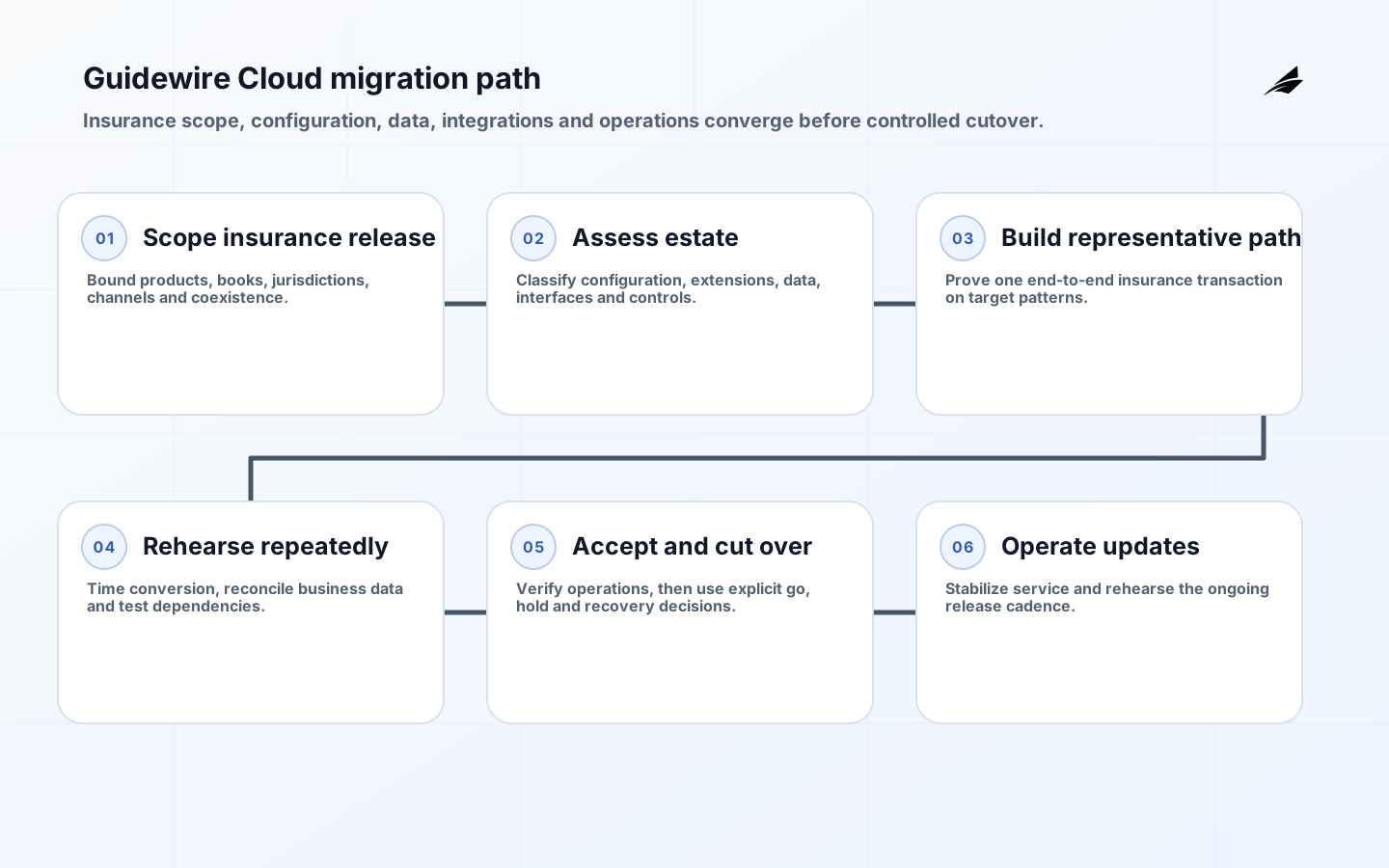
- Approve the business release, coexistence model and measurable outcomes.
- Assess configuration, extensions, data quality, integrations and operating readiness.
- Build a thin production-like path for one representative product from quote to renewal.
- Iterate conversion and integration rehearsals with business reconciliation.
- Compare results in parallel, then complete security, performance, resilience and operational acceptance.
- Execute a timed cutover with explicit go, hold and recovery authority.
- Stabilize production and adopt a regular release rhythm.

Use multiple dress rehearsals with the same tools, access and sequence expected in production. Record elapsed time, defects, manual steps and decisions. The final plan should name checkpoints for source freeze, extraction, load, reconciliation, integration enablement, user validation and communication. Rollback may be limited after new transactions occur, so define the point of no return and a forward-repair model for post-cutover defects. After go-live, rehearse a representative change so the receiving operations team proves it can release and recover, rather than merely receiving documentation.
Parallel running is usually the most expensive form of assurance, so decide what it must prove. A rating and transaction comparison, in which the same quote, endorsement and renewal inputs run through both systems and premiums, forms and effective dates are compared, is usually lighter than operating two systems for live business. Full dual operation can still be justified for a high-value book, but it adds manual work, reconciliation and training. Define the population, tolerances, who adjudicates differences and the exit criteria.
Estimate cost from workload and change drivers
A defensible estimate decomposes discovery, product and rating configuration, extension remediation, data conversion, interfaces, environments, testing, security, organizational change, parallel running, cutover and stabilization. Major multipliers include lines of business, jurisdictions and rate filings, source-data quality, historical depth, integration count, custom-code complexity, parallel operations and non-functional requirements. Separate one-time transformation cost from recurring subscription or license, partner support, connectivity, observability and internal operating costs.
Price uncertainty as explicit discovery or contingency tied to a risk, not as an unexplained percentage. Use range estimates until data profiling and extension disposition are complete. Govern scope through a decision log that records business value, regulatory need, upgrade impact, test burden and operating owner. Track conversion defects, automated test coverage, interface exceptions, cutover readiness, user task success and post-release incidents alongside budget.
Test insurance behavior and prepare people for change
Build scenario packs from real policies, including mid-term endorsements, cancellations, reinstatements, renewals, rewrites, premium audits, payment plans and the jurisdictional exceptions in scope. Verify rated premium, taxes and fees, documents and accounting outcomes as well as screen behavior. Maintain regression coverage for retained extensions and interfaces so future releases can be assessed against the insurer's critical transactions.
Train by role using the configured process and seeded exceptions. Confirm that underwriting, agency support, contact-center, billing, finance and operations teams know the new source of truth, escalation path and coexistence rules. Measure task success and error patterns during pilot. Change readiness is a production control when misunderstanding can create incorrect coverage, premium or customer communication.
Key takeaways
- Frame the modernization around a policy outcome and a bounded book of business.
- Retain custom behavior only when a current requirement justifies its lifecycle cost.
- Treat product and rating configuration, conversion and integrations as repeatable, reconciled products.
- Decide what parallel running must prove, and what it costs, before committing to it.
- Rehearse cutover and the first post-launch release with production-like evidence.
Frequently asked questions
Can existing customizations move unchanged?
Some may be retained, but each should be assessed against the target's standard configuration and supported extension patterns. Confirm the current business requirement, remove obsolete behavior and account for future upgrade testing. An unchanged code move is not automatically the lowest-risk or lowest-cost option.
How much policy history should be converted?
Base the decision on servicing, renewal, claims lookup, reporting, audit, legal and analytics needs. Full history is not always necessary in the transactional system, but archived records must remain accessible, governed and linked to the policy. Profile volume and quality before selecting a conversion boundary.
Can a cutover always be rolled back?
Not safely after every point. Once users and integrations create new policies, endorsements or payments in the target, returning to the legacy system may require reverse conversion and reconciliation. Define early recovery checkpoints, the point of no return and the forward-repair process during rehearsal.
Conclusion
A policy administration modernization succeeds when insurance operations, data, integrations and ownership move as one controlled system. Bound the release, reduce unsupported customization, rehearse conversion and cutover, and prove the insurer's own side of security and operations. That evidence produces a credible business transition rather than a new platform carrying unresolved legacy risk.