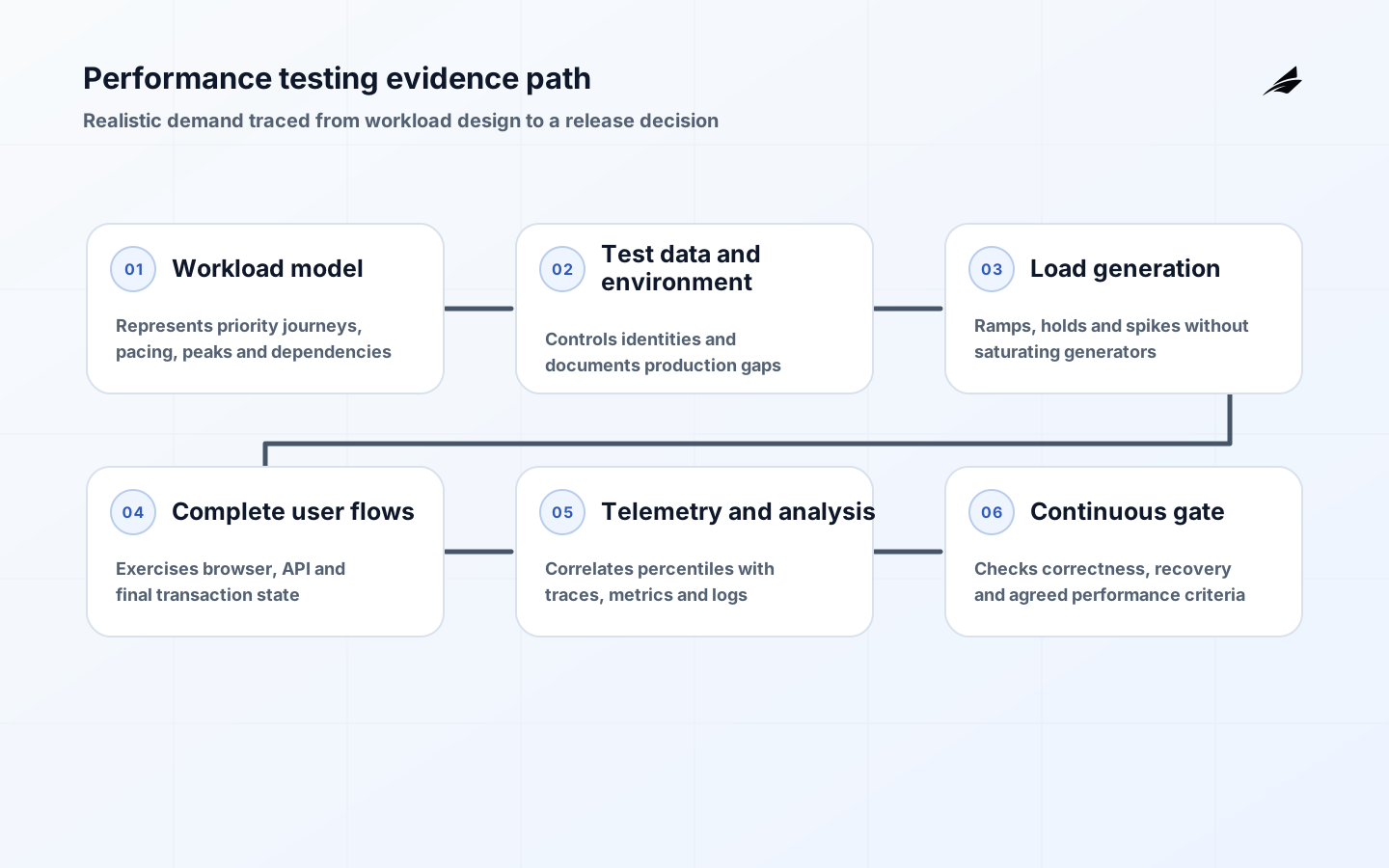
Performance testing services should be planned as an operating capability, not a procurement label. The objective is evidence that priority user flows meet agreed performance and reliability criteria under relevant demand. A credible initiative connects business ownership, design, controls, people, transition and measures before broad rollout. It also states what will not change, because a clear boundary protects teams from uncontrolled scope and makes acceptance possible.
Define the service and its boundary
Map the end-to-end scope across workload modeling, test data, environments, scripts, load generation, browser and API measures, telemetry, analysis, tuning and continuous gates. Start with priority journeys and name the accountable outcome owner. Describe demand, current failure modes, manual work, dependencies and obligations. Validate the inventory with people who perform and support the work; repositories and contracts rarely capture exceptions or informal handoffs.

For each test flow, specify user intent, request sequence, data state, arrival pattern, correctness checks, external dependencies and performance objective. Identify which production telemetry informed the model and where assumptions remain. Keep the first campaign focused on flows whose business volume and final state can be verified, rather than generating broad traffic without diagnostic value.
| Scope area | Decision | Evidence |
|---|---|---|
| Outcome | What result must improve? | Baseline, owner and acceptance measure |
| Workflow | Which normal and exception paths are included? | Journey and exception map |
| Information | Which records are authoritative and sensitive? | Classification, lineage and retention |
| Technology | Which components and providers participate? | Dependency and interface inventory |
| Controls | Which requirements must remain effective? | Control owner, test and evidence |
| Operation | Who supports, recovers and improves it? | Runbook, roles and service objectives |
Turn requirements into an operable design
Test complete user flows and critical dependencies, not endpoints alone. Correlate generator results with traces, metrics and logs. Separate correctness from timing, use percentiles rather than averages, verify the generator is not saturated, protect test identities and isolate risky tests.
A performance test must fail safely. Isolate synthetic accounts and data, coordinate partner limits, define abort thresholds, and monitor both load generators and the system under test. Design scripts for realistic retries and think time without accidentally amplifying failures. Protect credentials and ensure test traffic can be distinguished in traces, logs and business reports.
Build a cost model from measurable drivers
A universal price would be misleading. Material cost drivers include flow count, protocols, environment fidelity, test data, scale, distributed generation, observability gaps, analysis, tuning and automation. Estimate a range from observed scope and expose assumptions. Discovery should reduce the largest uncertainties before a fixed commitment. Compare options across transition and useful operation, not only the implementation quote.
| Cost group | Include | Control question |
|---|---|---|
| Discovery | Observation, inventory and design | Which unknowns change the approach? |
| Delivery | Build, integration and environments | What is reusable or custom? |
| Assurance | Security, testing and remediation | What evidence is required? |
| Transition | Migration, training and parallel work | How long will coexistence last? |
| Operation | Consumption, licenses, people and suppliers | Who owns demand and unit economics? |
| Exit | Export, replacement and decommission | Can continuity survive departure? |
Separate initial scripting and environment preparation from recurring execution, result storage, observability and maintenance. Include test-data reset, distributed generators, third-party coordination, environment parity work, analysis and retesting after tuning. Reforecast after calibration shows script resource use, achievable request rates, telemetry volume and the number of iterations required to isolate bottlenecks.
A bounded example
For online checkout, model browse, cart, authentication, inventory, payment authorization and confirmation with realistic pauses and controlled data. Verify responses and final order state. Ramp ordinary traffic, hold load, introduce a bounded spike and observe recovery, correlating slow traces with database, queue and dependency signals.
Baseline production throughput, latency percentiles, error categories, saturation and priority-flow completion before setting regression gates. For checkout, verify successful final orders in addition to HTTP responses. Compare test and field behavior by flow, dependency and data condition. A faster average can hide worsening tail latency or a larger number of incorrect transactions.
Manage risks as delivery inputs
| Risk | Early signal | Practical treatment |
|---|---|---|
| Unrealistic workload | One easy endpoint dominates | Model from production events |
| False success | Fast errors count as good | Check correctness and final state |
| Generator limit | Load hosts saturate first | Monitor and calibrate generators |
| Environment mismatch | Test differs from production | Document and validate gaps |
| Poor diagnosis | Thresholds fail without causes | Instrument traces, metrics and logs |
| Unsafe testing | Load harms users or partners | Use isolation and stop conditions |
Assign workload-model risk to product and analytics owners, environment risk to platform teams, and unsafe test execution to the test lead with operational approval. Use triggers for generator saturation, data exhaustion, partner errors and production impact. Abort when the run no longer represents its intended condition, because continuing produces persuasive but invalid graphs.
A staged implementation plan
- Frame: confirm owner, outcome, boundaries, obligations, risk tolerance and funding.
- Discover: observe work; inventory data, systems, providers, controls, demand and failures.
- Design: select architecture, roles, security, recovery, migration and acceptance together.
- Prove: build a representative slice and test the hardest dependency, control and failure.
- Pilot: limit exposure while increasing monitoring, support and feedback.
- Expand: add waves only while quality, risk, operations and cost remain within thresholds.
- Retire: remove obsolete access, jobs, copies, contracts and procedures after verification.
Before a baseline is accepted, calibrate scripts, validate data, observe generators and correlate application telemetry. Introduce load shapes one at a time, analyze against stated thresholds and retest any tuning. Promote a test into continuous delivery only after repeatability is understood. Retire obsolete scripts when their user flow or protocol is no longer supported.
Build workload models from business events, concurrency, production telemetry, seasonality, cache state, retries, background jobs and third-party limits.
Use smoke, baseline, load, stress, spike and endurance tests for different questions; give every run a hypothesis, stop conditions and analysis plan.
Encode correctness, tail latency and error-rate thresholds for named flows, but stabilize tests and understand variance before making them release gates.
Record workload, versions, environment, data state, bottleneck evidence, changes and residual risk; retest so optimization does not move failure elsewhere.
Workload realism begins with business events, not virtual-user counts. Derive transaction mix, concurrency, think time, cache state, retries and background activity from production evidence where possible. Document seasonality and forecast assumptions. A model for ordinary traffic should not be presented as proof for a promotion, deadline or recovery surge.
Use distinct tests for distinct questions. Smoke runs validate scripts; baselines establish comparison; load tests check expected demand; stress tests explore degradation; spikes test rapid change; and endurance runs expose leaks or accumulation. Give each run a hypothesis and stop condition so teams know why it exists and what decision follows.
Test data affects both correctness and speed. Provide enough accounts, products and records to avoid artificial cache concentration or lock contention, while protecting personal information. Define reset and cleanup. Verify that generated orders, messages or files do not trigger real fulfillment, partner billing or operational reporting.
Observability must span the path under test. Correlate requests with application traces, infrastructure and runtime metrics, logs, database waits, queue age and dependency timing. Check sampling under load. Without this evidence, a breached latency threshold identifies a symptom but cannot support a defensible tuning decision.
Continuous tests should be proportionate. Run small stable checks on frequent changes and reserve expensive scale or endurance campaigns for material releases and scheduled capacity reviews. Track trends by version and environment. Quarantine flaky scenarios with an owner and deadline instead of allowing unreliable gates to normalize ignored failures.
Make governance, acceptance and adoption practical
Performance governance should join product, architecture, development, operations, database or platform specialists and the test lead. Product owners define important flows and acceptable experience; engineers own diagnosis and treatment. Record workload assumptions and threshold changes so a release cannot quietly pass by reducing demand or relaxing criteria without review.
Acceptance requires correct results under a named workload, not a high request count. Demonstrate that generators have headroom, test data remains valid, external limits are controlled and traces explain the dominant latency. Repeat the run to understand variance, then document environment differences and what production behavior the result can and cannot predict.
Teach delivery teams to read percentiles, throughput, errors and saturation together. Script maintainers need domain knowledge to detect fast failures and invalid state. Developers and operators should practice moving from a breached threshold to traces, database waits, queue depth or dependency evidence, avoiding premature hardware changes based only on a summary chart.
Key takeaways
- Anchor performance testing services in an accountable outcome and bounded first service.
- Map authoritative records, decisions, dependencies and failure behavior first.
- Estimate assurance, transition, operation and exit with implementation.
- Use a representative proof and limited pilot to turn assumptions into evidence.
- Scale through explicit gates while retaining ownership of risk, quality and economics.
Frequently asked questions
Where should planning start?
Start with one revenue, safety or productivity-critical flow and its service objective. Use production events to model arrival rate, concurrency, mix and data conditions, then run a low-load calibration that verifies correctness and telemetry. Expand only after the team can explain the result and distinguish application behavior from generator or environment limitations.
How should cost be estimated?
Estimate performance testing from flow count, protocol and browser coverage, workload scale, environment fidelity, data preparation, generator distribution, telemetry gaps, analysis and tuning cycles. Include maintenance as interfaces and behavior change. Reforecast after the first calibrated run reveals generator sizing, reset effort and the diagnostic work behind each threshold failure.
What should be checked when using a provider?
Check a testing provider's ability to model your business flows, protect data, run distributed load, monitor generators, integrate telemetry and explain bottlenecks. Review script ownership and portability, tool licensing, result retention and subcontracted cloud regions. Ask for a calibrated example where response correctness and final business state are both validated.
How long should implementation take?
Duration depends on workload discovery, script complexity, test-data reset, environment readiness, observability and tuning cycles. A simple API baseline may take days, while an end-to-end seasonal campaign can require several iterations and partner coordination. Schedule time for analysis and retest; executing load is usually the shortest part of serious performance work.
What proves success?
Success means priority flows remain correct and meet agreed latency, error and throughput criteria without uncontrolled saturation. Report tail percentiles, completed business events, queue behavior, resource limits, recovery after spikes, repeatability and unresolved bottlenecks. A green tool summary is not sufficient when the workload or environment differs materially from the release risk.
Conclusion
A professional plan for performance testing services makes ownership, boundaries, design, controls, economics and transition visible. It replaces broad promises with a representative proof, measurable acceptance and reversible rollout. This exposes uncertainty early enough to make informed decisions while changing direction is still manageable.