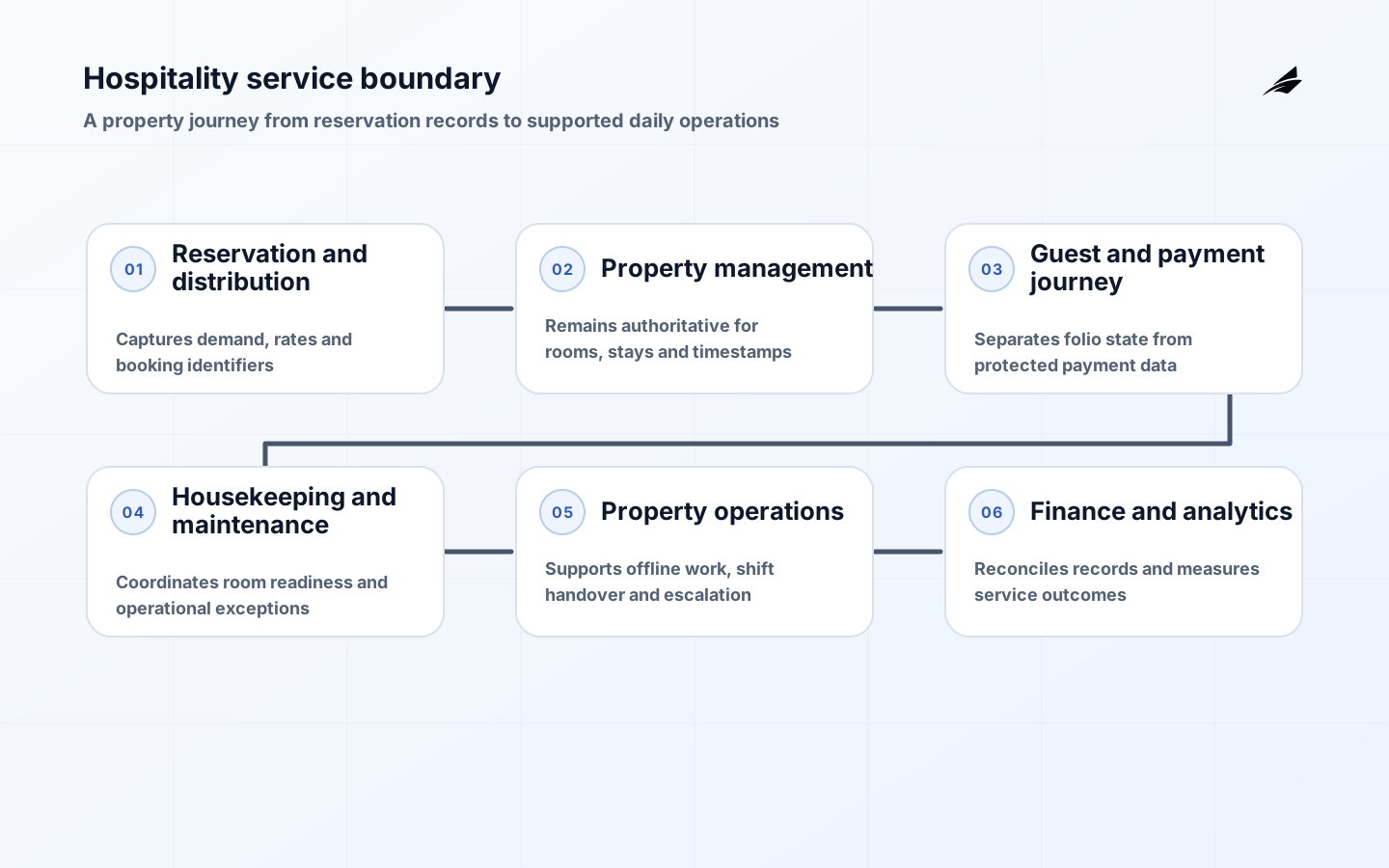
Hospitality technology services should be planned as an operating capability, not a procurement label. The objective is a dependable guest journey and workable property operations. A credible initiative connects business ownership, design, controls, people, transition and measures before broad rollout. It also states what will not change, because a clear boundary protects teams from uncontrolled scope and makes acceptance possible.
Define the service and its boundary
Map the end-to-end scope across reservation, distribution, property management, point of sale, payments, housekeeping, maintenance, loyalty, finance and analytics. Start with priority journeys and name the accountable outcome owner. Describe demand, current failure modes, manual work, dependencies and obligations. Validate the inventory with people who perform and support the work; repositories and contracts rarely capture exceptions or informal handoffs.
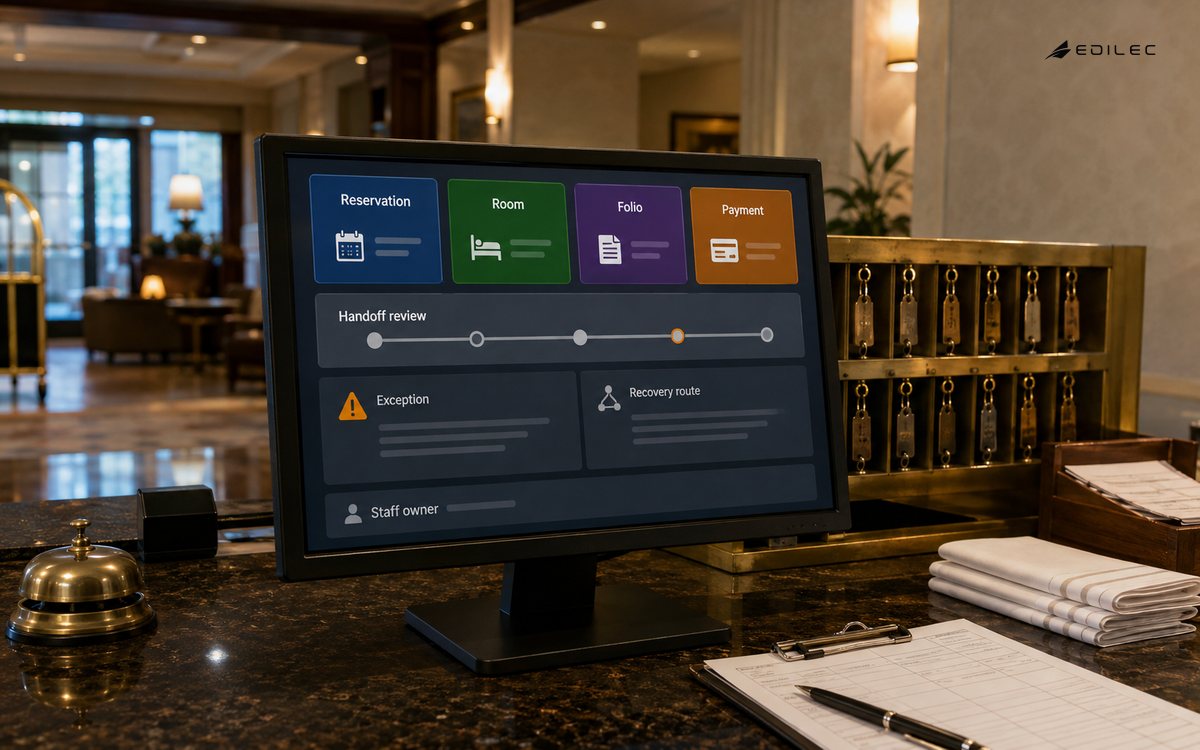
Catalog each exchange among booking engines, channel managers, property systems, point of sale, payment gateways and loyalty services. Specify which system owns rates, inventory, guest identity and folio state, how updates are sequenced, and who resolves mismatches. Keep the first property wave narrow enough that failed messages can be traced and reconciled by shift teams.
| Scope area | Decision | Evidence |
|---|---|---|
| Outcome | What result must improve? | Baseline, owner and acceptance measure |
| Workflow | Which normal and exception paths are included? | Journey and exception map |
| Information | Which records are authoritative and sensitive? | Classification, lineage and retention |
| Technology | Which components and providers participate? | Dependency and interface inventory |
| Controls | Which requirements must remain effective? | Control owner, test and evidence |
| Operation | Who supports, recovers and improves it? | Runbook, roles and service objectives |
Turn requirements into an operable design
Treat reservation, stay, folio and payment as related but distinct lifecycles. Define property, room, rate, guest and transaction identifiers; API versions; retries; duplicate behavior; offline operation; time zones; and correction ownership. Keep card data out of unnecessary components.
Hospitality systems must degrade without abandoning the guest. Define what front desk, housekeeping, food service and night audit can continue during internet, device or vendor outages. Queue only operations that are safe to replay, protect local credentials, and give staff an approved manual path. Alerts should describe affected properties and guest journeys, not merely failed endpoints.
Build a cost model from measurable drivers
A universal price would be misleading. Material cost drivers include property count, interface certification, hardware, networks, payment scope, migration, training, seasonal cutovers and parallel operation. Estimate a range from observed scope and expose assumptions. Discovery should reduce the largest uncertainties before a fixed commitment. Compare options across transition and useful operation, not only the implementation quote.
| Cost group | Include | Control question |
|---|---|---|
| Discovery | Observation, inventory and design | Which unknowns change the approach? |
| Delivery | Build, integration and environments | What is reusable or custom? |
| Assurance | Security, testing and remediation | What evidence is required? |
| Transition | Migration, training and parallel work | How long will coexistence last? |
| Operation | Consumption, licenses, people and suppliers | Who owns demand and unit economics? |
| Exit | Export, replacement and decommission | Can continuity survive departure? |
Separate property setup and migration from continuing subscription, connectivity, device, payment and support costs. Budget for interface certification, representative test properties, staff backfill during training, onsite coverage at cutover and dual operation through a complete business cycle. Reforecast after the first property because local integrations and operating practices often expose costs hidden by a central inventory.
A bounded example
A hotel can pilot a read-only housekeeping operations view at one property. The property-management system remains authoritative; supervisors handle exceptions; room identifiers and timestamps are reconciled. The bounded pilot tests identity, wireless coverage, device support and shift handover without changing reservations or folios.
Baseline reservation confirmation, check-in completion, room-status freshness, folio corrections, payment exceptions and support calls before the pilot. During the housekeeping example, compare system timestamps with supervisor checks and track how often staff resort to calls. Measures should reveal whether guest-facing work improved without shifting unresolved exceptions to night audit or finance.
Manage risks as delivery inputs
| Risk | Early signal | Practical treatment |
|---|---|---|
| Guest disruption | Staff revert to calls or paper | Design offline procedures and rehearse recovery |
| Integration mismatch | Room, rate or folio states diverge | Use contracts, idempotency and reconciliation |
| Payment exposure | Card data appears in connected tools | Reduce data paths and validate PCI scope |
| Property variation | Local workflows are missed | Observe representative properties |
| Weak adoption | Teams bypass the workflow | Pilot by role and shift |
| Vendor lock-in | Data cannot be exported | Test export and exit paths |
Assign guest-service disruption to an operations executive, payment exposure to the responsible security and compliance owners, and interface mismatch to named system owners. Define triggers such as stale inventory, unmatched folios or excessive manual overrides. Stop a property rollout when these indicators exceed its approved tolerance, even if the technical deployment itself completed successfully.
A staged implementation plan
- Frame: confirm owner, outcome, boundaries, obligations, risk tolerance and funding.
- Discover: observe work; inventory data, systems, providers, controls, demand and failures.
- Design: select architecture, roles, security, recovery, migration and acceptance together.
- Prove: build a representative slice and test the hardest dependency, control and failure.
- Pilot: limit exposure while increasing monitoring, support and feedback.
- Expand: add waves only while quality, risk, operations and cost remain within thresholds.
- Retire: remove obsolete access, jobs, copies, contracts and procedures after verification.
A hospitality gate should reflect the operating calendar. Before a property pilot, rehearse front-desk fallback, payment handling, device replacement and reconciliation. Expand only after day, evening and night shifts complete representative work and a full night audit closes cleanly. Retire old interfaces after every channel, property report, archive and finance extract has a confirmed replacement.
Monitor business events, not only endpoint availability: a booking can be accepted while inventory, confirmation or payment fails downstream.
Document what each property can do during wide-area, wireless, device or vendor failure, how queued work is protected and how records reconcile.
Train around pressure points such as arrival peaks, night audit, housekeeping handover and finance reconciliation, using realistic exceptions.
Test accessibility for guest and employee journeys, including keyboard use, focus, labels, errors, contrast and assistive technology.
Distribution changes require end-to-end inventory controls. Compare room and rate availability across direct and intermediary channels, record update latency, and define how oversell or stale-rate exceptions are contained. A channel manager's successful response is not proof that every downstream catalogue or reservation state now agrees.
Payment design should minimize the systems and people exposed to card data. Map authorization, token use, deposits, incremental charges, reversals, refunds and chargebacks across booking, property and restaurant flows. Confirm which party performs each PCI DSS responsibility and ensure logs and support screenshots cannot disclose sensitive authentication data.
Guest profiles deserve purpose limits and lifecycle rules. Separate identity needed to deliver a stay from preferences, marketing permissions, loyalty records and security notes. Define duplicate resolution, correction, retention and access by role. A richer profile is not automatically a better service if employees cannot tell why information is present or whether it is current.
Property support must work across time zones and shift changes. Give teams one route for incidents, clear severity definitions, vendor contacts, known-error guidance and visibility into integration health. Handover should identify unresolved guest impact, queued transactions and temporary procedures so the next shift does not restart diagnosis.
Rollout sequencing should group properties by meaningful similarity rather than geography alone. Consider system version, payment setup, outlet complexity, network readiness, local regulation and operating season. Use the first wave to create reusable configuration and training, then preserve explicit exceptions instead of forcing unsuitable properties into the template.
Make governance, acceptance and adoption practical
Govern the program through a forum that includes hotel operations, distribution, finance, payments, security, digital product and representatives from pilot properties. Decisions about rate authority, guest-data use, offline work or brand exceptions need recorded owners. Property teams should be able to escalate issues quickly without turning every configuration choice into a head-office approval.
Acceptance should cover a complete stay lifecycle: search, reservation, modification, arrival, in-stay service, checkout, settlement and correction. Include overbooking, room moves, declined payments, split folios and lost connectivity. Verify that staff can identify the authoritative record and recover without duplicate charges, invisible inventory changes or unsupported edits.
Prepare each role for changed work, not just new screens. Front desk, reservations, housekeeping, food service, finance and support need scenario-based practice for their own exceptions and handoffs. Observe early shifts and record workarounds. A recurring spreadsheet or phone call may indicate missing functionality, poor device placement or an unclear authority rule rather than resistance.
Key takeaways
- Anchor hospitality technology services in an accountable outcome and bounded first service.
- Map authoritative records, decisions, dependencies and failure behavior first.
- Estimate assurance, transition, operation and exit with implementation.
- Use a representative proof and limited pilot to turn assumptions into evidence.
- Scale through explicit gates while retaining ownership of risk, quality and economics.
Frequently asked questions
Where should planning start?
Begin with one guest journey and a representative property, such as reservation-to-check-in for a full-service hotel. Trace it across distribution, property management, identity, payments and operations, including peak and offline conditions. Choose a pilot that tests the riskiest interfaces while leaving an approved fallback available to staff.
How should cost be estimated?
Estimate hospitality technology from properties, rooms, outlets, channels, interfaces, devices, payment environments, data volumes and training shifts. Add certification, migration rehearsals, network remediation, onsite cutover and parallel licenses. Recalculate the later-property forecast after the pilot distinguishes reusable configuration from local rates, taxes, workflows and equipment.
What should be checked when using a provider?
Check a hospitality provider's supported property-system versions, API limits, release policy, payment responsibilities, data locations, uptime evidence, incident support and property-level fallback. Require export of reservations, profiles, folios and configuration in usable formats. Test a real modification, cancellation, payment exception and recovery path in a nonproduction property before contracting at scale.
How long should implementation take?
Implementation duration follows the number and diversity of properties, interfaces, payment changes, data quality and safe cutover windows. Build around occupancy and finance calendars rather than a generic sprint count. A single-property pilot may proceed while later waves wait for interface certification, network work, staff scheduling and evidence from night audit.
What proves success?
Success means guests and staff complete priority journeys with fewer ambiguous states while inventory, folios and payments remain controlled. Review confirmation delivery, check-in completion, room-status age, payment and reconciliation exceptions, manual work, accessibility findings, outage recovery and total property support cost. Deployment count alone says nothing about a hotel's ability to operate.
Conclusion
A professional plan for hospitality technology services makes ownership, boundaries, design, controls, economics and transition visible. It replaces broad promises with a representative proof, measurable acceptance and reversible rollout. This exposes uncertainty early enough to make informed decisions while changing direction is still manageable.