Technology consulting services help an organization make and implement difficult technology decisions when internal capacity, specialist evidence or independence is limited. The useful output is not a large presentation. It is a set of owned decisions, tested assumptions, executable work and an operating capability the client can sustain. This FAQ explains how to define that work, select a consulting partner and judge whether an engagement is creating value.
Consulting can cover strategy, enterprise architecture, cloud, software delivery, data, cybersecurity, procurement, recovery or transformation. The method should fit the decision. A two-week technical assessment, a representative migration pilot and a multi-year transformation office have different evidence and governance needs. Start with the technology consulting scope and delivery guide when the commercial model is still open, and use the implementation checklist once delivery is approved.
What problems should technology consulting services solve?
A good consulting question names a decision and its consequence. Examples include whether to modernize or replace a core application, how to establish a cloud platform, which integration pattern should become standard, whether a supplier proposal is feasible, or how to recover a delayed program. Avoid scopes such as improve technology or deliver digital transformation. They do not identify a decision, a baseline, an owner or a finish condition.
Consultants are most useful when the work needs scarce expertise, cross-functional facilitation, independent challenge or temporary delivery capacity. They are less useful when the sponsor will not provide access, decide tradeoffs or assign internal owners. External analysis cannot substitute for executive responsibility. Name the sponsor, decision forum, people affected, required evidence and deadline before requesting proposals.
| Engagement type | Best used for | Concrete output | Common failure |
|---|---|---|---|
| Diagnostic assessment | A problem exists but its causes or impact are uncertain | Verified baseline, causes, risks and prioritized actions | Generic maturity score without operational evidence |
| Strategy and roadmap | Several investment paths compete | Decision principles, target outcomes, options and sequenced portfolio | Target state detached from capacity and funding |
| Architecture engagement | Systems, data and controls need coherent boundaries | Decisions, models, standards, exceptions and transition architecture | Diagrams without implementation ownership |
| Delivery acceleration | A team needs a working path and specialist coaching | Production slice, platform assets, tests and transferred skills | Consultants become the permanent delivery dependency |
| Independent assurance | Leaders need evidence on risk, feasibility or readiness | Findings tied to criteria, severity, owner and decision | Checklist review too late to change the design |
How should a consulting engagement be structured?
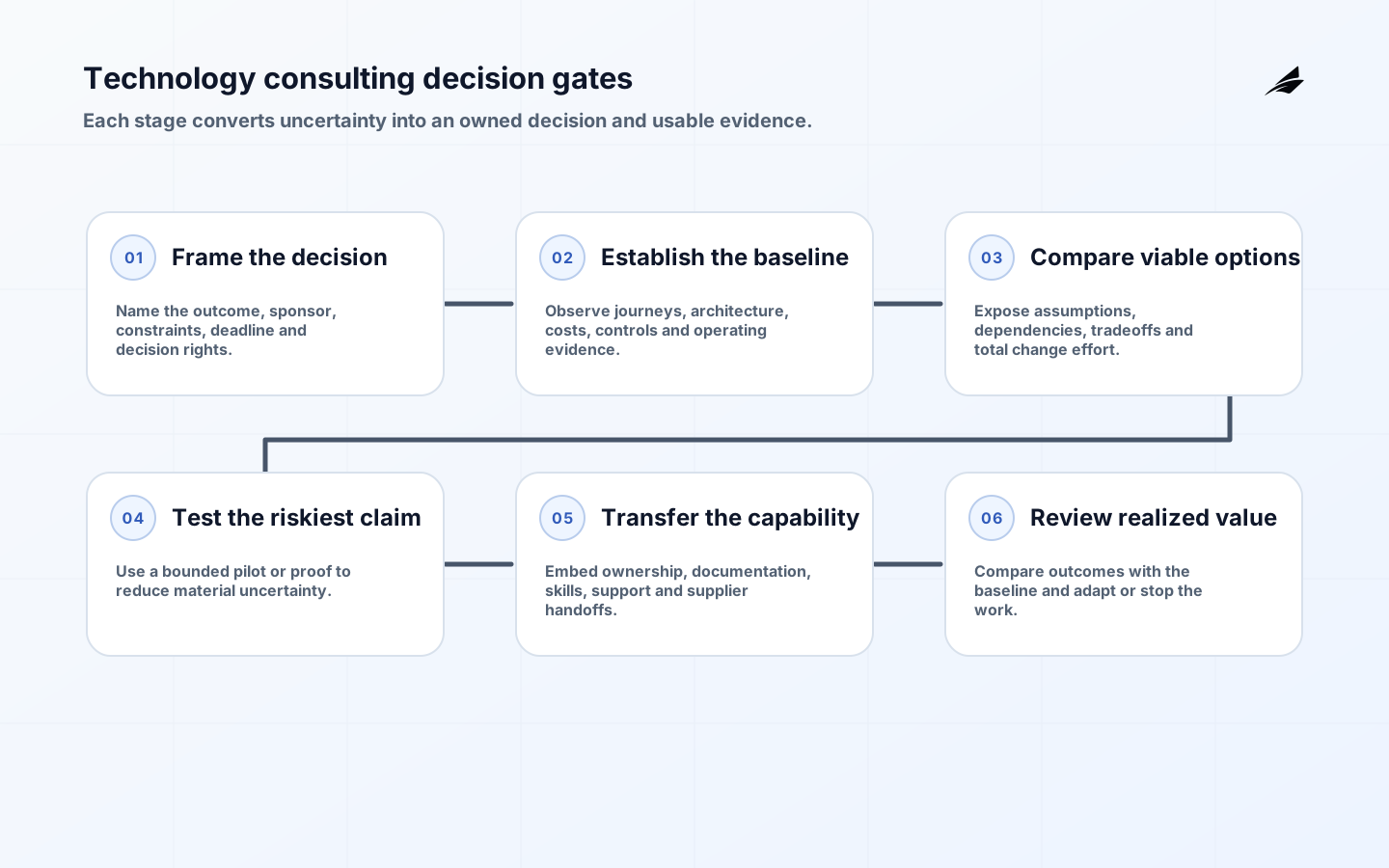
Structure the engagement around decision gates. Discovery verifies the current state; options expose assumptions and tradeoffs; a pilot tests the riskiest claim; delivery scales only after evidence; transition proves internal ownership; and value review compares results with the baseline. Iterative delivery reduces the amount committed before uncertainty is retired. The GAO Agile Assessment Guide describes incremental development, continuous evaluation and program monitoring practices that are useful beyond government work.

What belongs in the statement of work?
Define outcomes, in-scope systems and teams, exclusions, dependencies, client inputs, deliverables, acceptance criteria, governance, staffing assumptions, data access, intellectual property, security duties, expenses, change control and termination. Replace vague deliverables with evidence: not an architecture document, but approved architecture decisions plus a representative implementation and operational test. Identify which outputs must be editable and stored in client-controlled repositories.
How do you select a technology consulting partner?
Evaluate the proposed team and method, not the logo alone. Ask who will do the daily work, how senior review operates, what similar constraints they have handled, how they test assumptions and how they leave clients independent. Give candidates a short scenario and compare their questions. Strong candidates clarify business impact, users, existing evidence, constraints, decision rights and operating ownership before proposing a stack.
Request examples of decisions, implementation artifacts and measurable results with client permission. Check references for collaboration under pressure, transparency about uncertainty and quality of handover. For software acquisition or supplier-led change, CISA's Secure by Demand Guide offers questions about secure-by-design practices, vulnerability handling, authentication, logging and product support that buyers can incorporate into evaluation.
| Selection question | Evidence to request | Concerning answer |
|---|---|---|
| Who owns the outcome? | Named client sponsor and consultant lead with decision cadence | The consultancy will own every decision |
| How will current state be verified? | Interviews plus system, workflow, cost and control evidence | A maturity survey is sufficient |
| How are options compared? | Explicit assumptions, total change effort, risk and exit path | One preferred product is presented immediately |
| How will delivery be tested? | Representative journey, acceptance criteria and failure exercise | Success means completing configured features |
| How will knowledge transfer occur? | Client pairing, editable artifacts and observed handover | Training happens in the final week |
| How are conflicts handled? | Disclosure of partnerships and transparent product criteria | Supplier incentives are confidential |
How should architecture, security and risk be handled?
Architecture should connect business capabilities to applications, data, technology and transition decisions. The TOGAF Standard provides an enterprise architecture method and adaptable guidance, but an engagement should use only the artifacts needed for the decision. Record principles, alternatives, decisions, exceptions and consequences. Validate diagrams against actual configurations, data flows and operational behavior; inventory alone does not reveal reliability or ownership.
Integrate security with governance and design. NIST's current Cybersecurity Framework 2.0 organizes outcomes under Govern, Identify, Protect, Detect, Respond and Recover and is intentionally outcome based. Select relevant outcomes, map them to implementation controls and name evidence. The consultant should identify applicable legal and contractual review without pretending a generic framework determines compliance.
Keep an assumption and risk register that affects decisions, not a decorative log. Each item needs evidence, consequence, owner, response and review date. Test high-consequence assumptions early: data can be exported accurately, the target can meet latency, users can complete the changed journey, operations can detect failure, or a supplier supports the required exit. A short proof should have a decision attached; otherwise it becomes an isolated demonstration.
How do fees, timelines and value measurement work?
Common fee models include fixed price for a well-bounded output, time and materials for uncertain discovery or iterative delivery, and retained advisory capacity for ongoing decisions. Milestone pricing can work when acceptance evidence is objective. Outcome-linked fees need care because outcomes often depend on client actions and may encourage narrow measurement. Compare total cost, including client time, licenses, cloud consumption, migration, assurance, training, support and exit, rather than consultant day rates alone.
Build the timeline from dependencies and decision latency. Access approvals, representative data, supplier responses, architecture forums and user availability often govern elapsed time. Use short work packages with demonstrations and accepted evidence. A credible plan shows when uncertainty is reduced and when the client can stop without losing all value. Treat a date as a forecast with assumptions, not as proof that every unknown has disappeared.
Measure realized outcomes from a baseline. For delivery work, DORA's software delivery performance metrics provide a balanced view of throughput and instability, but they should be paired with customer, service, risk and cost outcomes. For strategy work, track decisions made, investments changed, risks retired and capabilities established. A roadmap delivered on time has little value if it does not alter an owned decision.
What should handover and exit include?
Transfer work continuously. Store source, infrastructure definitions, data models, architecture decisions, test evidence, dashboards, runbooks and backlog in client-controlled systems. Pair client staff on design and operations. Review privileged access throughout the engagement and revoke it promptly at exit. Export project records, resolve ownership of accounts and subscriptions, document open risks and verify that the client can contact critical suppliers directly.
Run an operational acceptance exercise rather than a document walkthrough. The client team deploys a change, diagnoses an injected fault, restores a service or dataset, handles an access request and explains the cost and supplier boundary. Consultants observe and close material gaps. For cloud-specific transition questions, the cloud consulting implementation checklist and cloud consulting FAQ extend this approach.
Key takeaways
- Frame consulting around a consequential decision, measurable outcome and named sponsor.
- Select the actual team and evidence method, not a brand or product partnership.
- Use decision gates so discovery, options and pilots retire risk before broad commitment.
- Make architecture and security outcomes traceable to implementation and operating evidence.
- Price and plan the entire change, including client effort, transition and exit.
- Accept the work only after the client demonstrates ownership of the capability.
Additional technology consulting services FAQ
Consultant or contractor: what is the difference? A consultant is normally engaged to improve a decision or capability, while a contractor may primarily supply delivery capacity. Real engagements can combine both, so define authority, outputs and handover rather than relying on the label.
Can consulting start before requirements are complete? Yes, discovery is often meant to clarify the problem and viable options. It should still have a bounded question, access plan, outputs, time limit and decision gate. Open-ended discovery without a decision becomes expensive observation.
Should the consultant recommend products? Product recommendations are useful when criteria, alternatives, assumptions, conflicts and exit implications are transparent. Require the recommendation to include implementation and operating fit, not only feature comparison.
What is a warning sign during delivery? Repeated demonstrations without accepted user journeys, growing dependence on consultant-held accounts, decisions made outside client governance, and risks described without owners are strong signals to intervene.
How often should progress be reviewed? Review working evidence at least at each decision gate, with a shorter operational cadence for blockers and risks. Steering meetings should decide tradeoffs; they should not recreate status already visible in delivery records.
Conclusion: buy evidence and capability, not activity
Technology consulting services are successful when they reduce material uncertainty, enable better decisions and leave the organization able to operate the result. Define the decision, verify the baseline, test the riskiest claims, transfer ownership throughout and review value after implementation. That standard keeps both client and consultant focused on durable outcomes.