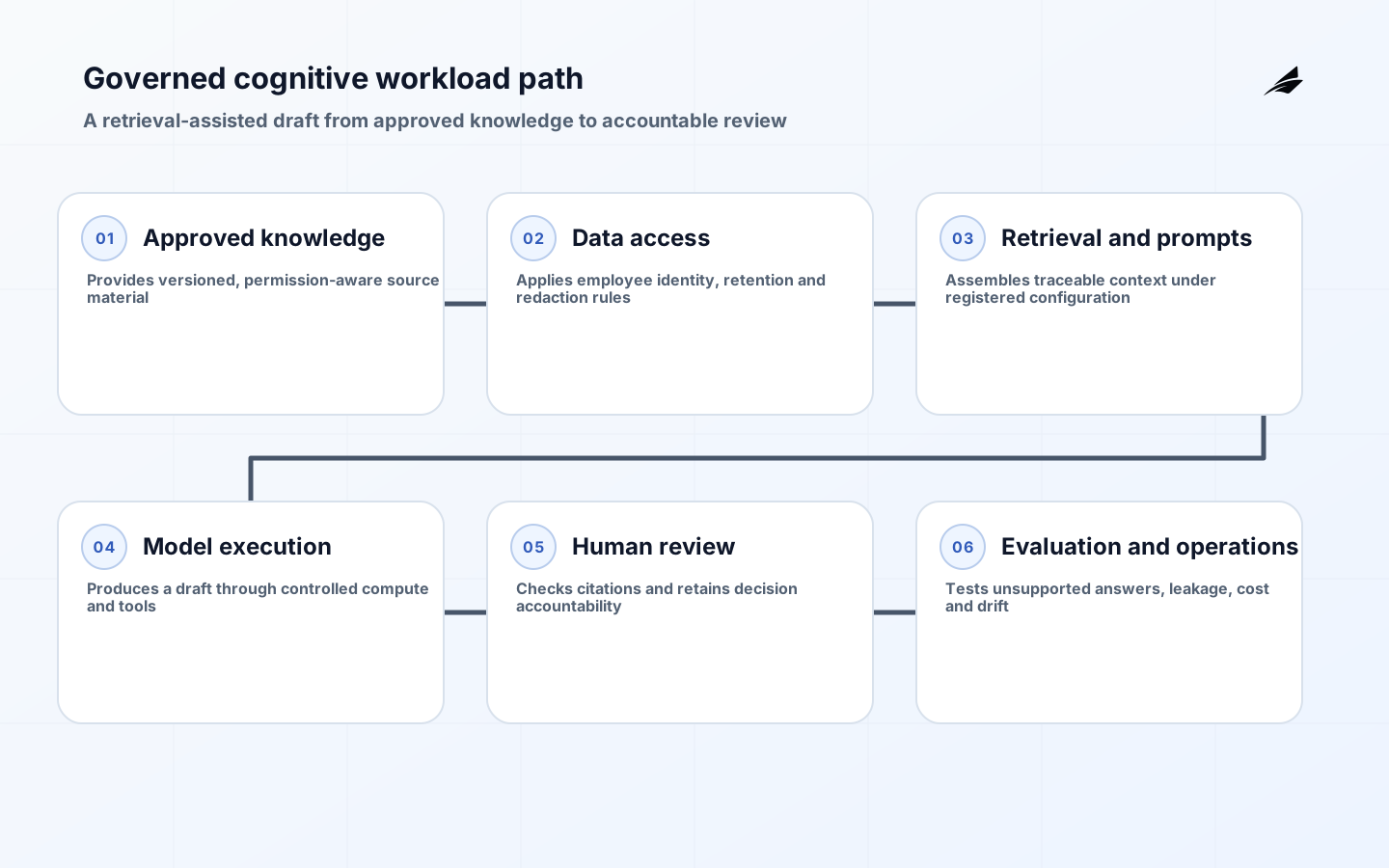
Cognitive infrastructure services should be planned as an operating capability, not a procurement label. The objective is a governed and observable platform for AI-enabled workloads. A credible initiative connects business ownership, design, controls, people, transition and measures before broad rollout. It also states what will not change, because a clear boundary protects teams from uncontrolled scope and makes acceptance possible.
Define the service and its boundary
Map the end-to-end scope across data access, models, prompts, retrieval, compute, deployment, evaluation, observability, security, human review and retirement. Start with priority journeys and name the accountable outcome owner. Describe demand, current failure modes, manual work, dependencies and obligations. Validate the inventory with people who perform and support the work; repositories and contracts rarely capture exceptions or informal handoffs.
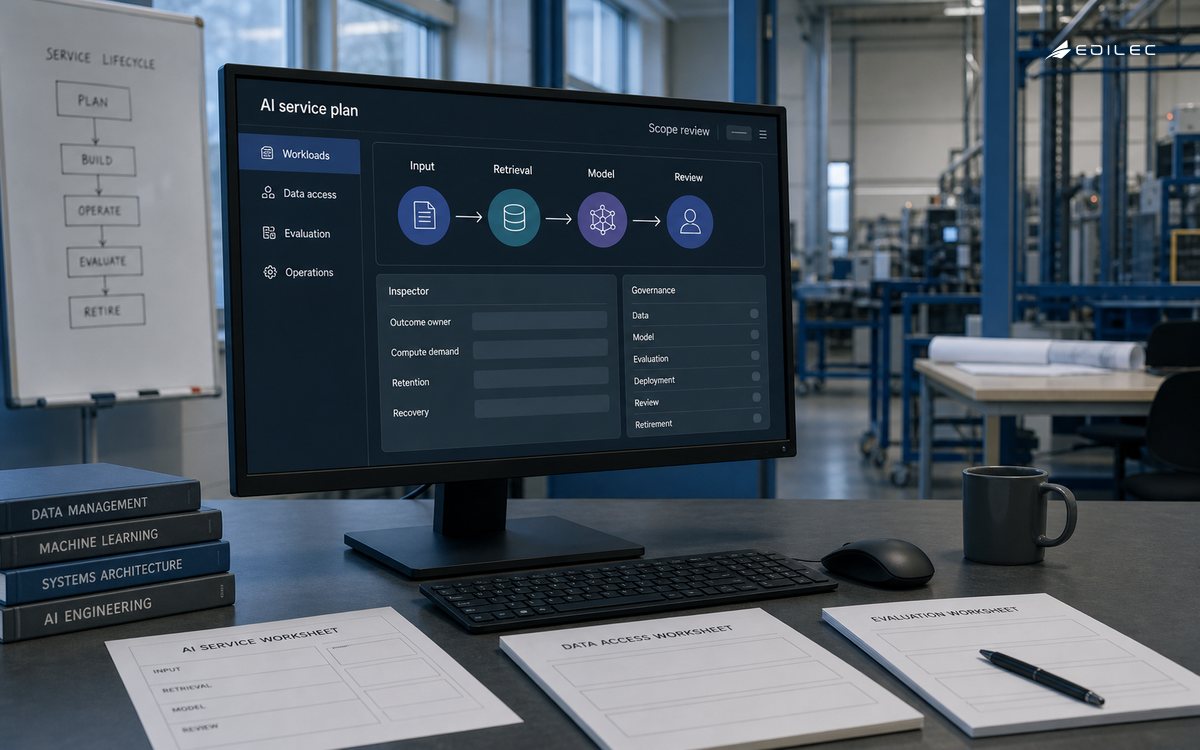
For every AI workload, identify approved data sources, model and prompt versions, retrieval indexes, tool permissions, evaluation sets and the business decision owner. Define which outputs are drafts, recommendations or automated actions. Keep the first release constrained to a use case whose inputs and human review can be observed, reproduced and withdrawn.
| Scope area | Decision | Evidence |
|---|---|---|
| Outcome | What result must improve? | Baseline, owner and acceptance measure |
| Workflow | Which normal and exception paths are included? | Journey and exception map |
| Information | Which records are authoritative and sensitive? | Classification, lineage and retention |
| Technology | Which components and providers participate? | Dependency and interface inventory |
| Controls | Which requirements must remain effective? | Control owner, test and evidence |
| Operation | Who supports, recovers and improves it? | Runbook, roles and service objectives |
Turn requirements into an operable design
Separate experimentation from production authority. Version data references, models, prompts, retrieval indexes, evaluation sets and configuration. Define user and workload identity, permitted tools, network paths, secrets, output handling and human decision points. Preserve release provenance.
Cognitive infrastructure should fail toward bounded authority. When a model endpoint, vector store, policy service or tool is unavailable, stop unsafe automation, preserve request context and present a clear fallback. Limit retries that multiply model consumption, isolate service identities, protect prompts and secrets, and log provenance without retaining sensitive content unnecessarily.
Build a cost model from measurable drivers
A universal price would be misleading. Material cost drivers include accelerator use, storage, data movement, model usage, evaluation, labeling, observability, security, support and idle capacity. Estimate a range from observed scope and expose assumptions. Discovery should reduce the largest uncertainties before a fixed commitment. Compare options across transition and useful operation, not only the implementation quote.
| Cost group | Include | Control question |
|---|---|---|
| Discovery | Observation, inventory and design | Which unknowns change the approach? |
| Delivery | Build, integration and environments | What is reusable or custom? |
| Assurance | Security, testing and remediation | What evidence is required? |
| Transition | Migration, training and parallel work | How long will coexistence last? |
| Operation | Consumption, licenses, people and suppliers | Who owns demand and unit economics? |
| Exit | Export, replacement and decommission | Can continuity survive departure? |
Separate platform build and onboarding cost from recurring model inference, accelerator reservation, storage, retrieval, telemetry and evaluation. Include red-team and domain-review effort, data preparation, idle capacity, model upgrades and provider egress. Reforecast using pilot tokens, latency, cache behavior and reviewer workload rather than a vendor calculator built on optimistic request sizes.
A bounded example
A support team can pilot retrieval-assisted answer drafting on an approved knowledge set. Drafts are not sent automatically; citations point to retrieved passages; access follows employee permissions; evaluation covers unsupported answers and sensitive data. One role and a small queue create evidence before wider access.
Baseline the current task's completion time, error categories, escalation and review burden before introducing AI. For the answer-drafting pilot, measure supported citations, material reviewer corrections, sensitive-data handling, refusal quality, latency and consumption per completed case. Adoption is useful only when reviewed output remains dependable and staff do not create hidden work to verify it.
Manage risks as delivery inputs
| Risk | Early signal | Practical treatment |
|---|---|---|
| Unclear authority | Output becomes an approved decision | Define human accountability |
| Data leakage | Sensitive content enters prompts or logs | Control access, retention and redaction |
| Unreliable output | Unsupported answers pass review | Use representative evaluations |
| Cost volatility | Usage grows without ownership | Allocate unit cost and quotas |
| Platform dependency | One model path becomes mandatory | Use interfaces and test substitution |
| Configuration drift | Versions are not traceable | Register and automate releases |
Assign data leakage, harmful output, model dependency, budget overrun and automation authority to owners who can change the system or accept the consequence. Set triggers for unsupported-answer rates, unexpected tool calls, consumption spikes and evaluation regressions. Pause expansion when a new model or retrieval update fails the approved test profile.
A staged implementation plan
- Frame: confirm owner, outcome, boundaries, obligations, risk tolerance and funding.
- Discover: observe work; inventory data, systems, providers, controls, demand and failures.
- Design: select architecture, roles, security, recovery, migration and acceptance together.
- Prove: build a representative slice and test the hardest dependency, control and failure.
- Pilot: limit exposure while increasing monitoring, support and feedback.
- Expand: add waves only while quality, risk, operations and cost remain within thresholds.
- Retire: remove obsolete access, jobs, copies, contracts and procedures after verification.
Before a cognitive workload reaches users, reproduce the release from registered model, prompt, index, policy and deployment versions; run safety and domain evaluations; test provider loss; and confirm human escalation. Expand by role or decision risk, not raw account count. Retire endpoints, indexes and credentials when a pilot closes, while preserving required decision evidence.
Treat evaluation as a maintained service with versioned cases for ordinary work, edge cases, misuse and affected groups; rerun it when any model, prompt, source or policy changes.
Plan training, batch and interactive inference separately because latency, interruption and accelerator needs differ; test saturation and queue behavior.
Let a platform team provide identity, secrets, deployment, telemetry and evaluation paths while product teams retain accountability for use-case behavior.
Retire models, indexes, datasets, endpoints and credentials when pilots end; preserve required evidence and verify downstream callers are gone.
Evaluation data must represent ordinary cases, rare but consequential cases, misuse and different affected groups. Version expected behavior and reviewer instructions with the dataset. When a model, prompt, retrieval corpus or tool changes, rerun the relevant suite and compare failure categories, not only a single aggregate score.
Capacity design should distinguish interactive inference, background generation, embedding, indexing and model training. Each has different latency and interruption tolerance. Model queues and admission control under saturation so a burst from one workload cannot consume the shared platform or create an unbounded financial surprise.
Observability should connect a business request to model, prompt, retrieval, policy and tool events while respecting privacy. Capture version identifiers, latency, token or accelerator consumption, selected evidence, policy decisions and final disposition. Avoid logging raw sensitive prompts by default merely because the model API makes them available.
Human review needs an explicit purpose. Specify what reviewers must verify, what evidence they see, how disagreements are recorded and when escalation is mandatory. If nearly every output requires reconstruction from source, the workflow may not create value even when the generated text appears plausible.
Portability should focus on the assets that preserve business behavior: evaluation suites, prompt templates, retrieval documents, policy rules, telemetry semantics and workflow contracts. Model substitution is not automatic because tokenization, tool calling and safety behavior differ. Test the alternatives that matter instead of claiming abstract provider independence.
Make governance, acceptance and adoption practical
Use an AI governance forum that joins the use-case owner, platform engineering, data stewards, security, privacy, legal or compliance, finance and affected operations. It should approve automation boundaries and evaluation criteria, not review every prompt edit. Record why a model or provider was selected and when that decision must be revisited.
Acceptance requires more than a fluent demonstration. Use representative and adversarial cases to test groundedness, permissions, harmful content, uncertainty, tool use, latency and fallback. Reviewers should identify the source, model release and action history for a sampled output. Production approval depends on repeatable evaluation and an operable escalation path.
Train users to understand the system's permitted purpose, evidence signals, known limitations and review responsibility. Observe whether they paste restricted data, over-trust polished output or bypass citations. Product teams should treat these behaviors as design feedback and adjust access, interface cues, policy or workflow rather than relying on reminders alone.
Key takeaways
- Anchor cognitive infrastructure services in an accountable outcome and bounded first service.
- Map authoritative records, decisions, dependencies and failure behavior first.
- Estimate assurance, transition, operation and exit with implementation.
- Use a representative proof and limited pilot to turn assumptions into evidence.
- Scale through explicit gates while retaining ownership of risk, quality and economics.
Frequently asked questions
Where should planning start?
Start with a decision inventory: what the AI-enabled workflow may suggest, what it may execute and what remains exclusively human. Select a bounded case with approved data, available reviewers and measurable current performance. Prove retrieval, evaluation, identity, telemetry and shutdown before adding broader tools or higher-consequence actions.
How should cost be estimated?
Estimate cognitive infrastructure from request volume, context and output size, model mix, accelerator needs, retrieval storage, evaluation frequency, telemetry retention and human review. Include experimentation and idle reservations separately from production. Reforecast after the pilot reveals actual cache efficiency, concurrency, retry behavior and cases requiring escalation.
What should be checked when using a provider?
Evaluate model and platform providers for data use, retention, region, isolation, identity, quotas, model change notices, safety controls, telemetry, incident support and export. Test whether the workload can pin or qualify releases and whether prompts, evaluations and indexes can move. Contractual assurances should match technical settings and observed API behavior.
How long should implementation take?
Timing depends on data permission, workflow design, evaluation quality, platform controls and reviewer readiness more than model API integration. A drafting pilot may be available quickly, but production authority should wait for representative evaluation and operations. Tool-using or automated decisions need additional threat modeling, policy enforcement and recovery testing.
What proves success?
Success means the AI-enabled service improves a defined task while risk and economics remain within tolerance. Track grounded outputs, significant reviewer corrections, unsafe or restricted responses, escalation, latency, availability, drift and cost per accepted result. High prompt volume or user sign-ins can coexist with poor decisions and therefore are not success measures.
Conclusion
A professional plan for cognitive infrastructure services makes ownership, boundaries, design, controls, economics and transition visible. It replaces broad promises with a representative proof, measurable acceptance and reversible rollout. This exposes uncertainty early enough to make informed decisions while changing direction is still manageable.