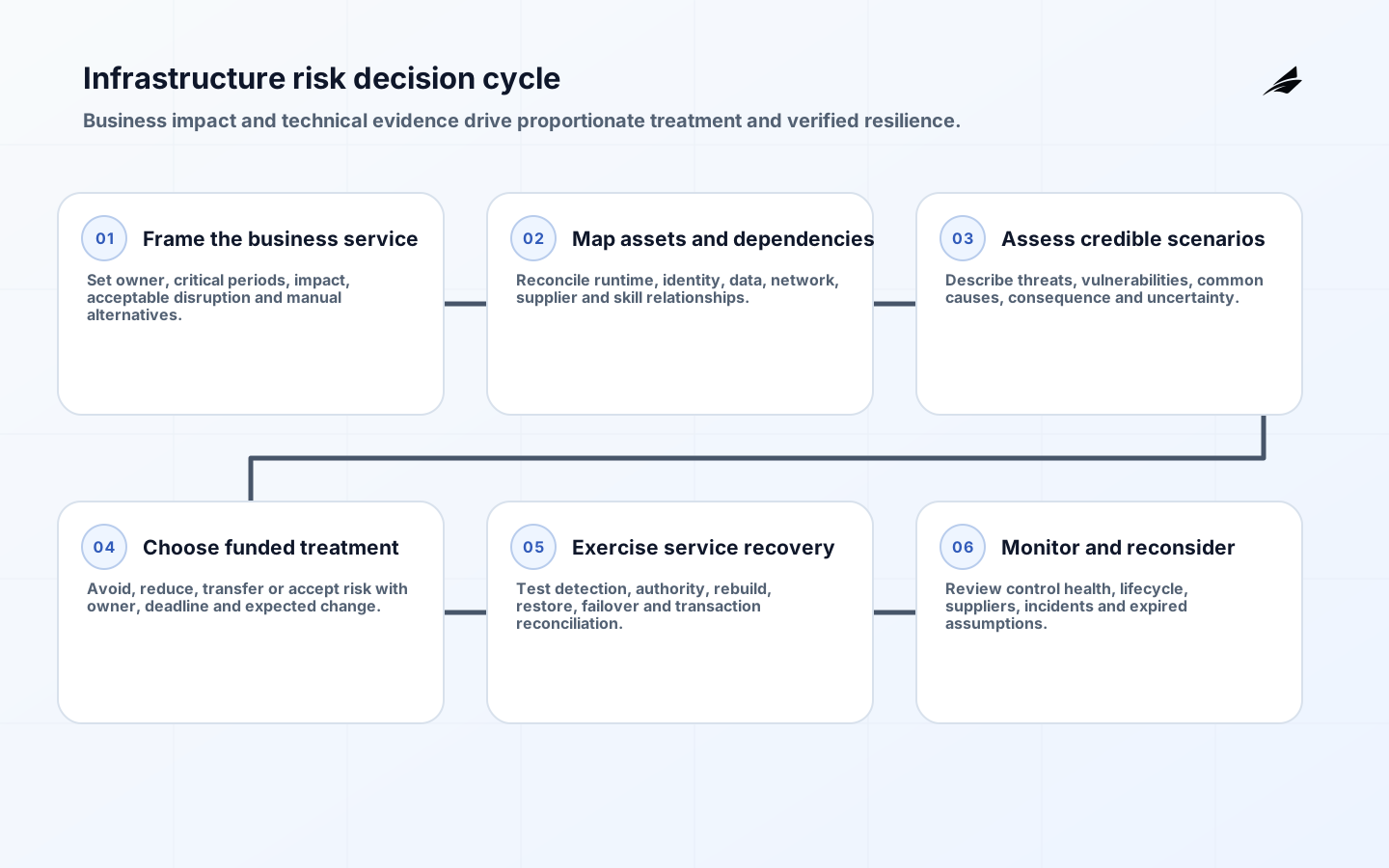
Infrastructure risk management helps leaders decide where service failure, compromise, obsolescence or supplier dependency deserves action. It should not begin with a server spreadsheet or a red-amber-green heat map. Business teams need a traceable view from important services and plausible scenarios to dependencies, controls, recovery evidence, residual exposure and funded decisions.
This practical guide pairs with the infrastructure risk checklist and infrastructure risk FAQ. It covers cloud, data center, network, identity, workplace, platform and critical suppliers. Operational technology and safety-critical environments require specialized engineering and hazard analysis beyond this general approach.
Start with business service context
Identify services whose interruption, manipulation or disclosure could affect customers, safety, revenue, legal duties or strategic commitments. Name an accountable business owner and define critical periods, acceptable disruption, manual alternatives and recovery priorities. Map upstream and downstream services. A payroll application may depend on identity, banking files, name resolution, networking, virtualization, storage and a small specialist team; the application record alone hides most exposure.
NIST CSF 2.0 connects cybersecurity with enterprise risk and organizes outcomes across Govern, Identify, Protect, Detect, Respond and Recover. Use a current and target profile to support conversation, not to generate a universal compliance score. Infrastructure risk also includes capacity, lifecycle, concentration, skills, change and physical failure, so integrate cyber analysis with continuity and financial planning.
| Business question | Infrastructure evidence | Decision supported |
|---|---|---|
| How long can service stop? | Transaction impact, dependencies and manual capacity | Recovery objective and investment |
| What could corrupt trust? | Authority, integrity checks and reconciliation | Protection and detection design |
| Where are single points? | Architecture, suppliers, skills and recovery dependencies | Redundancy or accepted exposure |
| Can we exit? | Data portability, configuration, contracts and knowledge | Supplier and lifecycle action |
Build a decision-grade asset and dependency view
Inventory assets at the level needed to assign ownership and action: devices, virtual resources, cloud accounts, network services, identities, certificates, platforms, data stores and supplier services. Record purpose, owner, service links, location, lifecycle, exposure, configuration source and evidence freshness. Automated discovery improves coverage, but ephemeral resources and SaaS still need logical ownership. Reconcile procurement, runtime and architecture views.
CISA's asset-visibility directive BOD 23-01 is binding only for its defined federal scope, yet its emphasis on discovery cadence, coverage and vulnerability visibility illustrates a general principle: inventory is an operating capability. Track unknown and unmanaged assets as risk, and verify that critical service diagrams match current traffic and configuration.
Assess risk through credible scenarios
Describe a threat or failure, preconditions, affected dependencies, consequence, existing controls and uncertainty. Examples include compromised administrator identity, expired certificate, destructive deployment, region outage, storage corruption, network misrouting, unsupported hardware or supplier insolvency. NIST SP 800-30 provides risk-assessment guidance around threat sources, events, vulnerabilities, likelihood and impact; tailor depth to the decision.
Estimate likelihood as a range or ordered judgment supported by evidence, not a false exact percentage. Separate inherent exposure from residual risk after controls. Consider common-cause failure: redundant services can share identity, software, region, power, carrier or operator. Record confidence and missing evidence. A scenario with uncertain probability but catastrophic, irreversible consequence may justify prevention or recovery work before a better estimate arrives.
Choose and fund proportionate risk treatment
Options are to avoid the activity, reduce likelihood or impact, transfer defined financial consequences, or accept residual risk. Select controls from the scenario and business objective. For identity compromise, treatment may combine phishing-resistant authentication, privileged separation, short-lived access, detection and emergency revocation. For supplier outage, it may combine architecture, contractual support, data export, alternate process and tested recovery.

Write a treatment with owner, funding, due date, expected risk change, dependencies and verification. Acceptance needs an accountable authority, rationale, review date and trigger for reconsideration. Avoid transferring technical ownership to a risk register. Infrastructure teams implement controls, but business owners decide whether residual service exposure is tolerable relative to cost, customer impact and alternatives.
Prove resilience and recovery
Translate business impact into recovery time and recovery point objectives, then design backup, redundancy, rebuild, failover and manual continuity accordingly. NIST SP 800-34 provides contingency planning guidance. Include identity, encryption keys, configuration, DNS, monitoring and people in recovery dependencies. A replicated database is not a recovered service if users cannot authenticate or transactions cannot be reconciled.
Exercise technical restore and organizational decisions under plausible conditions: compromised credentials, inaccessible primary region, unavailable supplier contact or incomplete documentation. Measure actual recovery and degraded capacity. Validate business transactions and data integrity after restoration. Record actions with owners and retest. Tabletop discussion finds coordination gaps; hands-on recovery finds configuration and dependency gaps. Mature programs need both.
| Evidence level | Example | What it proves |
|---|---|---|
| Documented | Current architecture and recovery procedure | Intended design and ownership |
| Observed | Control telemetry and configuration test | Control operates now |
| Exercised | Scenario detection, failover or restore | People and systems perform under stress |
| Outcome | Service restored and transactions reconciled | Business objective was met |
Control change, vulnerability and obsolescence
Infrastructure changes frequently through deployment, patching, scaling and provider updates. Use versioned configuration, peer review, automated tests, policy checks, progressive release and drift detection. Define high-risk changes and emergency authority. Measure failed change and recovery. Review certificates, quotas, unsupported versions, capacity and licensing before deadlines. Planned lifecycle work is usually cheaper and safer than emergency replacement.
Prioritize vulnerabilities using exposure, exploit evidence, asset criticality and compensating controls rather than a severity score alone. Track the time from detection to mitigation and verify completion. Include firmware, appliances, cloud configuration, containers and third-party components. When patching cannot meet the service need, document segmentation, monitoring, reduced access or retirement. Repeated deferral is a business risk decision and should be visible as such.
Manage concentration and supplier risk
Map direct providers and hidden dependencies such as identity, DNS, support tooling, software repositories, carriers and subcontractors. Assess service boundary, financial and lifecycle health, data access, incident notification, recovery commitment and exit assistance. A second provider reduces risk only if the service can actually use it and dependencies are independent. Otherwise multivendor complexity may add failure paths without viable continuity.
Test data and configuration export, administrative revocation and transition support before renewal. Preserve customer-owned domains, repositories and encryption decisions where practical. Coordinate incidents through one command structure. NIST SP 800-61 Rev. 3 places response within risk management, reinforcing that supplier incidents, lessons and improvements belong in the same lifecycle rather than a separate emergency process.
Report infrastructure risk for decisions
Report the service, scenario, consequence, control evidence, residual exposure, confidence, trend and decision required. Pair technical indicators with business measures: critical assets without owners, recovery objectives not demonstrated, unsupported dependencies, expired exceptions, supplier exit untested and control coverage gaps. Avoid averaging away one critical weakness across thousands of healthy resources. Show whether funded treatments actually changed evidence.
Set review cadence from change and consequence. Operational teams may inspect control health daily, service owners review monthly and executives decide material risk quarterly, with event-driven review after incidents, acquisitions or major architecture change. Keep one source of truth linked to current systems, not a parallel spreadsheet recreated for audit. Close risks only when evidence supports the stated outcome or the accepting authority records the residual position.
Connect investment scenarios to the planning cycle. Compare treatment cost with expected reduction in outage, compromise or recovery exposure, but preserve nonfinancial consequences and uncertainty. Fund enabling work such as inventory, testing environments and staff capability that supports several services. Track whether approved funds reached the intended control and whether later exercises changed confidence. A purchased redundant component does not reduce risk until configuration, operation and failover are proven.
Define risk appetite through concrete service examples. Leaders can make better choices when they compare a four-hour degraded customer channel, a day of internal reporting delay and an unrecoverable integrity failure than when they debate abstract labels. Translate those decisions back into architecture and objectives, then revisit them as customer expectations and dependency concentration change.
Infrastructure risk takeaways
- Begin with critical business services and acceptable disruption.
- Maintain asset and dependency visibility as a recurring capability.
- Assess credible failure and attack scenarios with explicit uncertainty.
- Fund treatments with owners, expected risk change and verification.
- Use exercised recovery and outcome evidence for the strongest assurance.
Frequently asked questions
Is infrastructure risk only cybersecurity? No. Availability, integrity, capacity, obsolescence, physical conditions, suppliers and skills matter. Who owns a cloud infrastructure risk? Providers own defined layers, but the customer retains service and configuration accountability. Can risk be eliminated? Rarely; leaders choose and monitor residual exposure. Should every asset have the same control? No. Apply baseline hygiene and risk-based depth.
What is a useful first exercise? Restore a critical transaction service from a scenario that removes normal administrator access. How many risks should executives see? The material scenarios requiring their decision, with aggregation only where it preserves meaning. Is a heat map enough? No. It lacks control evidence, uncertainty, ownership and treatment detail. Use it only as a navigation aid, not the decision record.
Conclusion
Infrastructure risk becomes manageable when business consequence and technical evidence share one decision path. Map a critical service, expose dependencies, test credible scenarios, choose proportionate treatment and prove recovery. Repeat as systems and suppliers change. This turns risk reporting from a periodic color exercise into an operating discipline that protects service, investment and trust.