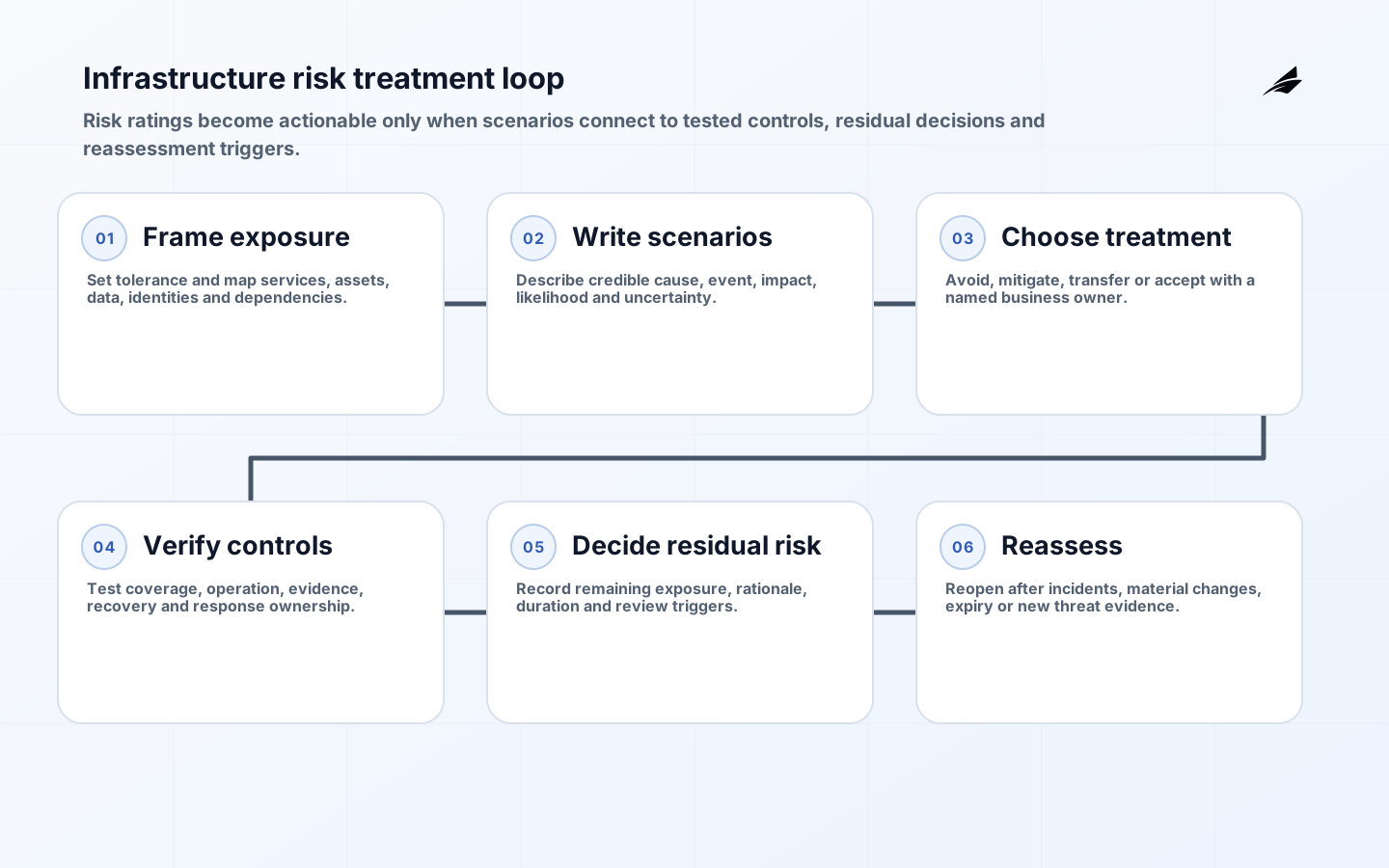
Infrastructure risk management turns uncertain technical failure into owned business decisions. The work is not a spreadsheet of high, medium and low labels. It identifies assets and dependencies, models credible threats and failure scenarios, estimates impact and likelihood, selects proportionate treatment, verifies control evidence and records residual risk. The process must repeat as infrastructure, attackers, providers and business tolerance change.
This implementation checklist complements the practical infrastructure risk management guide and infrastructure risk FAQ. Teams implementing broader controls can use the cognitive infrastructure services checklist to connect risk decisions with platform work.
Establish risk governance and appetite
Name an executive or business risk owner, infrastructure service owners, security lead and decision forum. Define scales for likelihood, business impact and urgency with examples that teams can apply consistently. State tolerances for customer harm, data exposure, service interruption, financial loss, safety, legal duty and concentration. NIST CSF 2.0 adds Govern as a core function, reinforcing that policy, roles, oversight and supply-chain risk inform Identify, Protect, Detect, Respond and Recover.
Create a treatment vocabulary: avoid, mitigate, transfer or accept. Acceptance needs an authorized owner, rationale, duration and review trigger. Insurance or a supplier contract may transfer financial consequences but rarely removes operational responsibility. Set escalation thresholds and exception expiry. Keep the risk method simple enough for workload teams to use while preserving deeper analysis for high-impact systems.
| Governance item | Decision | Evidence | Review trigger |
|---|---|---|---|
| Risk appetite | Impact and tolerance examples | Approved statement | Strategy or obligation change |
| Ownership | Business and technical accountability | Named role record | Reorganization |
| Method | Likelihood, impact and treatment scales | Assessment procedure | Inconsistent ratings |
| Exception | Authority, expiry and compensating control | Signed exception | Expiry or incident |
| Supplier risk | Critical dependency requirements | Contract and assurance evidence | Material provider change |
Inventory assets, data and dependencies
Build an inventory from provider APIs, infrastructure code, identity systems, network data and ownership records. Include accounts, compute, storage, databases, clusters, network edges, keys, certificates, backups, pipelines, observability and administrative tools. Map workloads to business services, data classes, regions, providers and support contacts. Automated discovery shows existence; declared purpose and authority still require owners.
Create dependency maps for critical journeys. Record external identity, payment, DNS, certificate, repository and communication services as well as internal shared platforms. Identify single points of failure and concentration across apparently separate applications. Track unsupported technology, public exposure, privileged paths and assets with unknown owners. Unknown does not mean low risk; route it to investigation with a deadline.
Assess credible scenarios and business impact
NIST SP 800-30 frames risk assessment around threats, vulnerabilities, likelihood and impact. Write scenarios in plain cause-event-impact form: a compromised deployment credential changes production artifacts, causing customer data exposure and service interruption. Include malicious actions, human error, provider failure, demand spikes, configuration drift, expired certificates, data corruption and destructive automation. Use incidents and near misses to calibrate credibility.
Estimate impact across confidentiality, integrity, availability, safety, finance, customer trust, contractual duty and recovery effort. Distinguish inherent risk before controls from residual risk after verified controls. Avoid multiplying arbitrary ordinal numbers and treating the result as precision. Document assumptions, uncertainty and evidence quality. Prioritize active exploitation and exposed paths; CISA describes its KEV catalog as an authoritative source of vulnerabilities exploited in the wild and an input to remediation priority.
| Scenario | Preventive control | Detective evidence | Recovery proof |
|---|---|---|---|
| Privileged credential theft | Strong authentication and least privilege | Sign-in and action alerts | Credential revocation drill |
| Unsafe deployment | Protected pipeline and policy checks | Artifact and change trace | Rollback or forward repair |
| Data corruption | Validation and protected backups | Integrity and reconciliation alert | Timed restore and reconciliation |
| Regional outage | Tested failover or accepted downtime | Regional health view | Failover exercise |
| Cost runaway | Budgets, limits and safe automation | Anomaly alert with owner | Containment without service loss |
Select and implement proportionate controls
Choose controls that reduce a specific scenario and can be owned and tested. Preventive controls include least privilege, network boundaries, hardened images, policy as code and change review. Detective controls include asset drift, identity anomalies, integrity checks and service objectives. Corrective controls include credential rotation, isolation, restore, failover and customer communication. Defense in depth should reduce shared failure, not duplicate tools that consume the same unreliable signal.
Automate repeatable enforcement after testing scope and exceptions. Microsoft cloud-governance guidance recommends starting with a small essential policy set, applying controls at the right hierarchy and using predeployment, runtime and remediation points. Keep break-glass access controlled, logged and reviewed. Every control needs an owner, coverage statement, evidence source, failure mode and review cadence.
Engineer change, resilience and recovery
Use versioned infrastructure, protected repositories, immutable artifacts and automated testing. AWS reliability guidance treats deployments, patches and demand changes as conditions workloads must accommodate. Define timeouts, bounded retries, idempotency, capacity margins and graceful degradation. Progressive delivery reduces blast radius when monitoring can detect meaningful harm. Plan data-safe rollback because infrastructure reversal alone may not undo writes.
Set recovery point and time objectives from business tolerance. Design backups for independence from the failure they cover, restrict deletion and test representative restoration. Rehearse provider outage, identity compromise, data corruption and unavailable personnel. Measure elapsed decisions, missing access, data reconciliation and communication. A backup success message is not recovery evidence until a workload can use restored data.
Collect evidence and monitor residual risk
Link each material risk to control evidence: policy results, access reviews, test reports, objective history, restore exercises, patch records and incident actions. Sample evidence for correctness rather than trusting dashboard color. Track control coverage and age. A green control with no owner or a test last run years ago should not reduce residual risk automatically.
Monitor changes in exposure, threat activity, asset criticality, provider dependency, cost and business volume. FinOps optimization should balance usage and cost against performance and risk; turning off resilience or observability to meet a savings target can increase total exposure. Review accepted risks on schedule and after incidents, architecture changes, new obligations or material supplier events.
Run the infrastructure risk treatment loop
- Confirm business service, owner, tolerance and assessment boundary.
- Inventory assets, data, identities, dependencies and current controls.
- Describe credible scenarios with cause, event and business impact.
- Estimate likelihood, impact, uncertainty and inherent risk from evidence.
- Select treatment and define control owner, test and completion date.
- Implement through controlled change and retain verification evidence.
- Reassess residual risk and obtain authorized acceptance or further action.
- Monitor triggers and repeat after material change, incident or expiry.

Measure risk operations without gaming scores
Useful measures include percentage of critical workloads with owners and tested recovery, age of high-risk exceptions, privileged-access review coverage, time to remediate actively exploited exposure, objective breaches, control-test failure and overdue treatment. Track incident impact and recurrence. Risk counts alone can rise when discovery improves, so explain movement rather than rewarding fewer recorded risks.
Report decisions at the right level. Executives need exposure, tolerance breaches, concentration and treatment choices; service owners need failing controls and dates. Preserve scenario detail beneath summaries. Review whether effort goes to material exposure rather than the easiest ticket. Close risks only when treatment is verified or acceptance is current.
Example: treat an exposed administration path
An inventory review finds an internet-reachable administration interface protected by a shared credential. The scenario is unauthorized access leading to configuration change, data exposure and service outage. Evidence includes access logs, network path, account use and asset criticality. Immediate containment restricts the path and rotates credentials. The planned treatment introduces individual federated identities, strong authentication, least privilege, time-bound elevation and central action logging.
Verification tests that unauthorized networks cannot connect, ordinary administrators cannot exceed their roles, emergency access works under approval and alerts identify a simulated privileged change. The response drill revokes a test identity and traces its actions. Residual risk records the dependency on the identity provider and an accepted recovery window. A follow-up query searches for similar interfaces across the estate so the treatment addresses systemic exposure rather than one discovered asset.
Key takeaways
- Connect technical scenarios to explicit business tolerance.
- Inventory purpose, authority and dependencies, not only resources.
- Prioritize credible exposure and active exploitation with evidence.
- Verify control effectiveness through tests and operational exercises.
- Reassess residual risk whenever infrastructure or context changes.
Frequently asked questions
Should every vulnerability appear in the risk register?
No. Vulnerability systems can manage technical findings at scale. Escalate scenarios that create material business risk, tolerance breaches, concentration or significant treatment decisions. Preserve links to underlying findings so prioritization remains auditable.
Can a small organization use qualitative ratings?
Yes. Clear low, moderate and high definitions with business examples are often more honest than unsupported numeric precision. Record assumptions and uncertainty, and use quantitative analysis where reliable data and decision value justify the effort.
Who may accept infrastructure risk?
An authorized business risk owner with enough context to understand impact, obligations, alternatives and duration. Technical staff should explain evidence and residual exposure, but acceptance authority belongs in the organization's governance model.
At quarterly review, sample one accepted risk and ask whether its assumptions, owner, compensating controls and expiry still hold. Sample one closed risk and reproduce its evidence. These two checks reveal stale governance and premature closure without forcing leaders to reread the entire register, and they create a practical feedback loop for improving the assessment method.
Conclusion
Infrastructure risk management is a continuous decision loop: understand what matters, model credible failure, implement proportionate controls, verify evidence and revisit residual exposure. When owners and tests accompany every material risk, the register becomes a tool for resilient investment rather than a static compliance artifact.