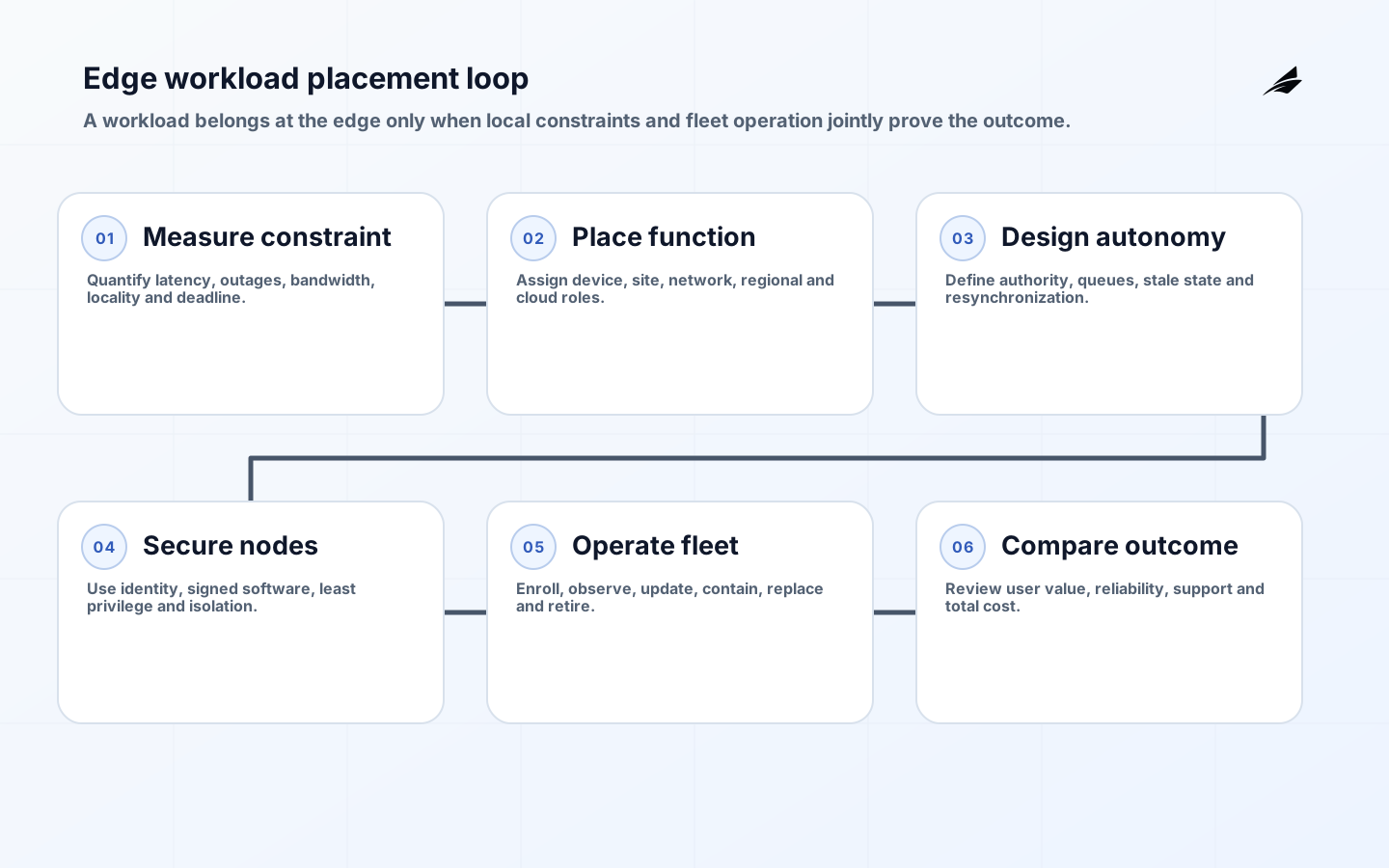
A network and edge computing practical guide begins by moving selected processing, storage or control closer to devices, users or data sources only when evidence supports it. Edge is valuable when latency, intermittent connectivity, bandwidth, data locality or local autonomy changes the business outcome. It also creates a distributed fleet of small environments that must be secured, updated, observed and recovered. The placement decision should therefore begin with workload evidence, not a blanket goal to “move to the edge.”
This guide helps business, product, operations, network and engineering teams evaluate that tradeoff. Continue with the network and edge implementation checklist, the network and edge FAQ and the cognitive infrastructure checklist. Safety-critical and regulated deployments require domain-specific engineering and compliance review.
Choose an edge use case from a measurable constraint
Define the local event, decision or response and the maximum useful latency. Measure current round-trip delay, outage frequency, upstream bandwidth, data volume, privacy constraints and cost. Identify what must continue when the cloud link fails and for how long. Examples include machine protection, visual inspection, local personalization, store operations, media processing and connected-vehicle assistance; each has different safety, freshness and capacity needs.
NIST’s fog computing conceptual model describes decentralized, federated compute complementing cloud systems for IoT challenges including scale, heterogeneity and latency. “Complementing” is important: central cloud services usually remain useful for fleet policy, long-term analytics, model training, cross-site coordination and durable records. Decide which function belongs at device, site, network edge, regional edge or cloud.
| Placement driver | Edge is justified when | Evidence to collect |
|---|---|---|
| Latency | Cloud round trip misses a response deadline | End-to-end percentiles and action deadline |
| Connectivity | Operation must continue through realistic outages | Outage distribution, autonomy duration and resync test |
| Bandwidth | Local reduction materially changes cost or feasibility | Raw versus transmitted volume and quality loss |
| Data locality | Policy or risk favors local processing or storage | Data map, legal basis, retention and access |
| Safety or control | A bounded local decision reduces physical risk | Hazard analysis, safe state and independent protection |
| Experience | Proximity measurably improves user task success | Controlled comparison and fallback behavior |
Design a cloud-edge reference architecture
Separate data plane from management plane. The data plane ingests local signals, executes bounded logic, stores short-lived state and serves local outcomes. The management plane enrolls nodes, distributes signed configuration and software, rotates identity, monitors health and records inventory. Central services maintain durable business records and cross-site policy where appropriate. Every boundary needs a protocol, identity, schema, ownership and failure behavior.
ETSI’s current MEC framework and reference architecture defines system, host and network-level functions and reference points for multi-access edge computing. Use such standards to clarify roles, not to force every use case into telecom MEC. Define node classes, hardware resources, accelerators, virtualization, local services, discovery, traffic routing and federation only to the depth required by the workload.
Engineer offline operation, synchronization and state
Classify functions as cloud-required, delay-tolerant or locally autonomous. For autonomous functions, define cached policy validity, local capacity, safe degradation and what happens when credentials or models expire. Buffer outbound events durably with quotas and priority. Display disconnected and stale states to users or operators. Do not let a full queue consume all disk or block a safety function.
Synchronization needs stable identities, event time, ordering scope, deduplication and conflict rules. Decide whether cloud or edge is authoritative for each record. Use idempotent commands and acknowledgements; distinguish command accepted, executed and reconciled. After reconnection, throttle replay, prioritize critical facts and compare control totals. Conflicting offline changes may require domain rules or human review rather than generic last-write-wins.
| Failure mode | Local behavior | Recovery evidence |
|---|---|---|
| WAN unavailable | Continue approved functions within cached-policy and storage limits | Autonomy duration and ordered resynchronization |
| Node power loss | Enter safe state and preserve durable critical events | Restart integrity and no duplicate effect |
| Clock drift | Use trusted synchronization and bound time-dependent rules | Drift alert and corrected event ordering |
| Disk or queue pressure | Apply priority, quotas and controlled shedding | No loss of mandatory or safety evidence |
| Bad software rollout | Health gate, staged cohort and signed rollback | Fleet containment and restored version proof |
| Compromised node | Revoke identity, isolate traffic and preserve investigation data | Fleet search, replacement and credential rotation |
Secure identity, traffic and physical exposure
Treat location as context, not trust. NIST SP 800-207 states that no implicit trust should arise solely from network location or asset ownership. Give each node and workload a verifiable identity, use least-privilege policy, mutual authentication where appropriate, encrypted transport, secure boot, signed artifacts and protected key storage. Separate management traffic from application data and restrict inbound reachability.
Assume some nodes are physically accessible to attackers. Disable unused ports and services, protect debug paths, detect enclosure or boot anomalies where justified, minimize retained sensitive data and provide secure wipe or decommissioning. Inventory hardware and software components. NIST’s ZTA implementation guide provides example architectures, but edge threat models must additionally cover device theft, counterfeit replacement, radio interference and unsafe actuator commands.
Design connectivity and performance from end to end
Measure device-to-edge, edge processing, edge-to-cloud and action latency separately, including tail behavior under congestion. Size links for ordinary load, replay after outage and software distribution. Apply quality of service where supported and meaningful. Use connection pooling, compression and batching carefully; they trade latency, CPU and failure amplification. Protocol choice should follow device capability, network behavior, intermediaries and security requirements.
QUIC, standardized in RFC 9000, combines secure transport with multiplexed streams over UDP and can reduce some connection and head-of-line constraints, but it is not automatically best for every edge network. Test actual carriers, proxies, packet loss, roaming and firewall policy. Keep protocol fallback or operational diagnostics when the environment is not under one organization’s control.
Operate edge nodes as a controlled fleet
Maintain inventory for node identity, class, location, owner, hardware, software, configuration, certificate, connectivity and lifecycle status. Enroll securely and require attestation where risk justifies it. Roll out by lab, internal, canary and site cohorts with health gates and pause controls. Limit simultaneous updates to preserve local capacity. Support remote diagnosis, replacement and secure decommissioning without shared passwords or undocumented site visits.
Observe fleet coverage, connectivity, resource pressure, software version, certificate expiry, queue age, inference or decision latency, local error and resynchronization. Standard names from OpenTelemetry semantic conventions can improve cross-platform correlation, but avoid device identifiers in high-volume labels without a cardinality plan. Page on actionable local impact; aggregate trends for capacity, hardware reliability and rollout quality.
Pilot network and edge computing safely
- Define the local outcome, latency deadline, autonomy period, safety boundary and cloud alternative.
- Collect network, data-volume, outage and workload measurements at representative sites.
- Assign function and authority across device, edge tiers, region and cloud.
- Build one node class with secure identity, signed software, bounded storage and observable state.
- Test latency, loss, outage, clock drift, queue pressure, power loss, compromise and resynchronization.
- Pilot at varied sites with canary rollout, local support and a disable or rollback path.
- Compare outcome, reliability, bandwidth, support burden and total fleet cost with the baseline.
- Scale only after management-plane capacity, supply chain and site operations are proven.
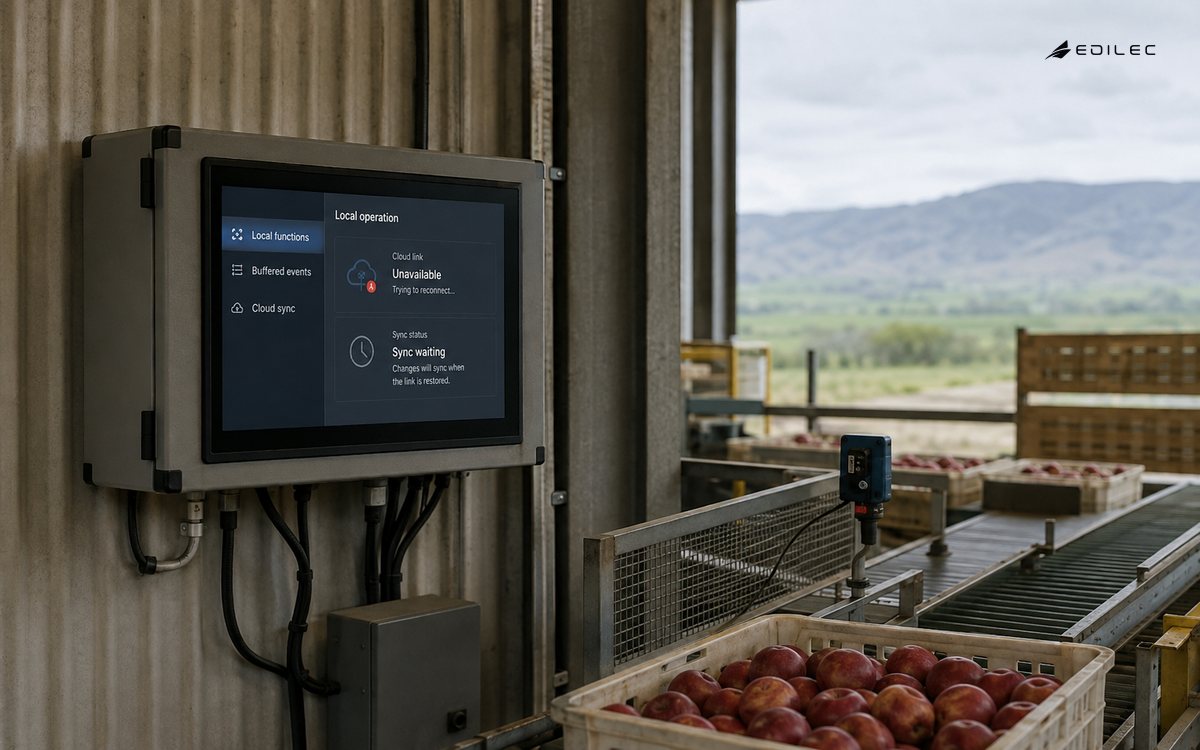
Example: evaluate visual inspection at the edge
A factory visual-inspection pilot should define the defect classes, line speed, maximum decision latency, safe reject behavior and human escalation. Measure camera volume and network conditions before choosing placement. Run preprocessing and inference locally only if it materially improves the decision or limits transmission; retain the cloud for fleet policy, approved model distribution, aggregate analysis and controlled sample review.
Test lighting variation, camera blockage, clock drift, model expiry, disk pressure, power loss and disconnected operation. Record model and configuration version with each decision, while minimizing retained images according to purpose. Roll out by line and site with a manual or deterministic fallback. Compare escaped defects, false rejects, operator overrides, bandwidth, support visits and cost before expanding the fleet. Accuracy alone does not prove operational fitness.
Key takeaways
- Place workloads at the edge only when measured latency, autonomy, bandwidth or locality changes the outcome.
- Separate data-plane operation from fleet management and define authority for every record and command.
- Design offline behavior, bounded queues, conflict resolution and resynchronization before rollout.
- Use workload and node identity rather than trusting network location or physical ownership.
- Prove fleet updates, containment, replacement and total operating cost in a varied pilot.
Frequently asked questions
Does edge computing replace cloud computing?
Usually no. Edge handles selected local constraints, while cloud or regional services often coordinate policy, fleet management, durable records and broader analytics. Design them as complementary tiers and define which functions can operate when either side is unavailable.
Is 5G required for edge computing?
No. Edge deployments can use Ethernet, Wi-Fi, private radio, fixed broadband, cellular or intermittently connected links. 5G and MEC can enable useful mobility, quality and proximity patterns, but the use case should be validated against actual coverage, latency, cost and operational control.
Should every edge site run Kubernetes?
Only when orchestration benefits justify node resources and operating complexity. A single process, appliance or lighter container runtime may be safer for small or constrained sites. Choose the simplest platform that supports deployment, isolation, recovery, observability and lifecycle requirements at fleet scale.
Conclusion
Include node replacement time and field-support capacity in every scale forecast; fleet growth is constrained by recovery logistics as well as compute.
Network and edge computing is a placement strategy with operational consequences. Begin from an expiring local decision, divide authority deliberately, and design for disconnection, compromise and fleet change. A successful edge platform proves the business outcome and the management plane together; low latency at one prototype node is only the beginning.