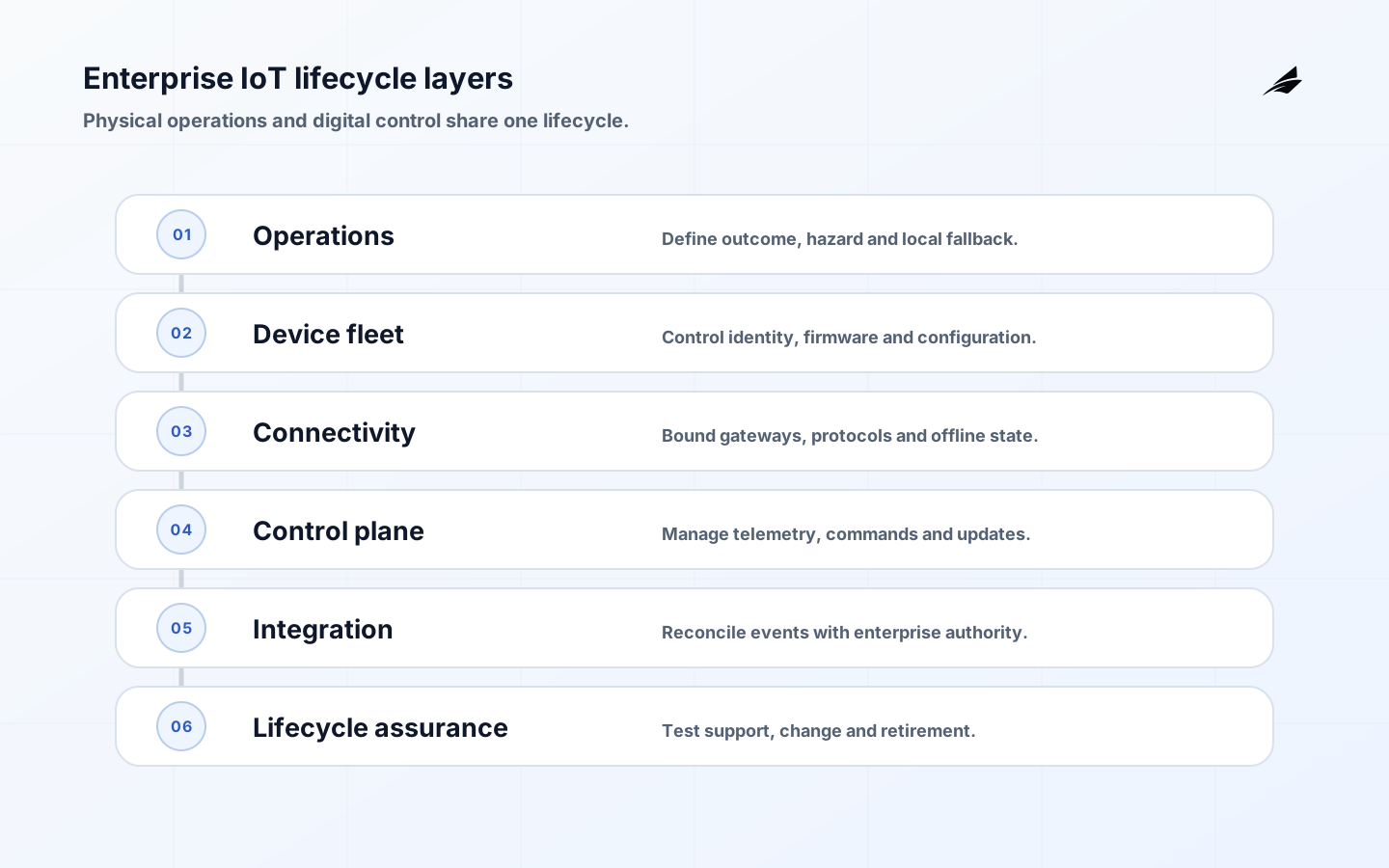
Choosing an IoT software development company for enterprise teams means selecting a partner for a physical and digital lifecycle, not only an application build. Enterprise IoT combines devices, firmware, identity, connectivity, gateways, cloud control, data, business systems, field operations and long-term support. A defect may interrupt a production line, expose a site or require a costly visit. Scope, cost and acceptance must therefore cover commissioning through secure retirement.
The best partner makes uncertainty visible and tests it in representative conditions before fleet scale. The enterprise IoT implementation checklist supplies detailed gates, and the enterprise IoT FAQ addresses operating choices. This guide helps sponsors define the engagement, compare vendors and fund a delivery plan that the enterprise can own.
1. Scope the operational outcome and environment
Begin with an observable operating problem: unplanned equipment downtime, cold-chain excursion, manual meter capture, asset loss or unsafe inspection. Identify who acts on the result, how quickly, and what happens when sensing or connectivity is wrong. Observe installation, power, temperature, vibration, radio coverage, maintenance, cleaning, safety and existing control procedures. Preserve local or manual fallback for consequential functions where the risk assessment requires it.
Define one complete journey: provision a device, bind it to the correct organization and site, collect a qualified observation, trigger an authorized workflow, diagnose a fault, update software, transfer or replace ownership and retire the device. List exclusions and required integrations. A pilot that sends telemetry to a dashboard but omits identity, updates, support and decommissioning does not prove an enterprise product.
| Lifecycle layer | Scope decision | Acceptance evidence |
|---|---|---|
| Device | Sensors, compute, power, storage, identity and physical limits | Environmental and tamper tests |
| Firmware | Boot, configuration, buffering, diagnostics and update | Interrupted update and recovery |
| Connectivity | Network, gateway, protocol, offline window and data budget | Representative coverage and loss test |
| Control plane | Registry, tenancy, telemetry, rules, commands and retention | Cross-tenant and end-to-end trace test |
| Integration | Events, master data, workflows and system authority | Reconciliation and replay evidence |
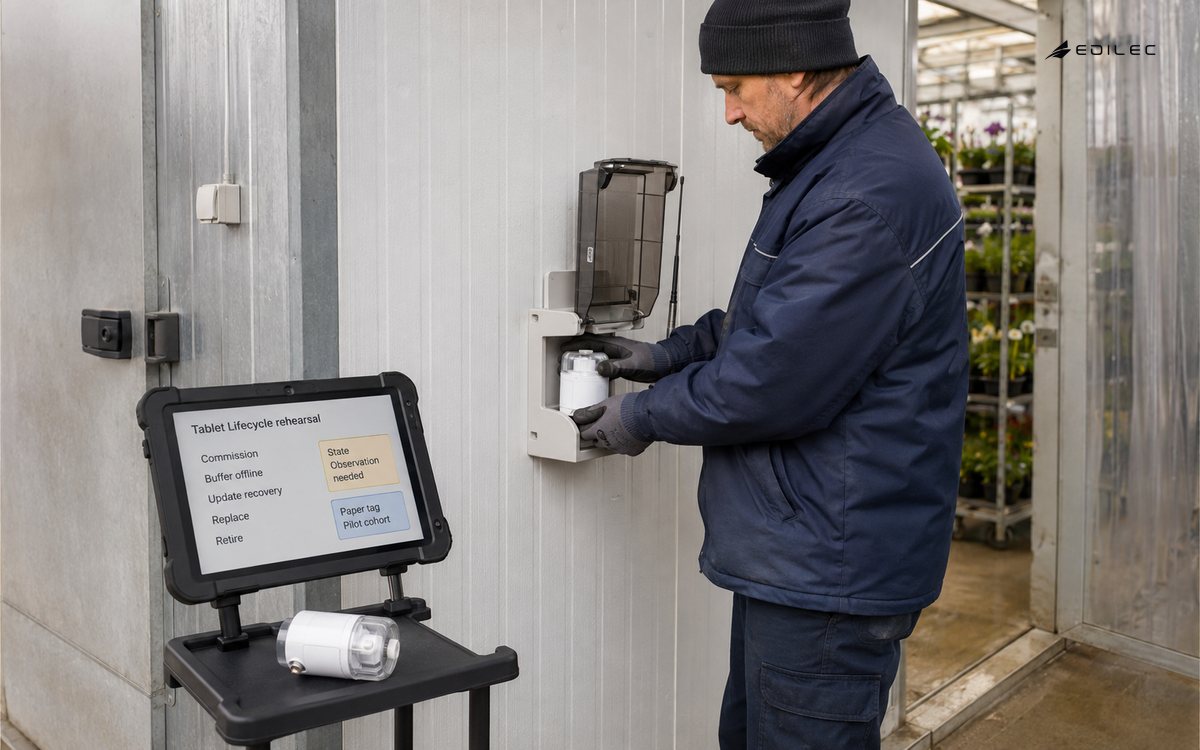
| Operations | Install, support, incident, supplier change and retirement | Observed lifecycle rehearsal |
2. Design the field-to-enterprise architecture
Partition responsibility across device, gateway, cloud and enterprise systems. Keep processing local when latency, safety, privacy, bandwidth or offline operation requires it. Give each device a unique identity, but model customer ownership separately so transfer and replacement are possible. Buffer with bounded storage, preserve event and receipt time, and define conflict behavior when delayed state returns. Commands need authorization, expiry, acknowledgement and idempotency.
Choose protocols after testing product behavior. MQTT 5.0 defines publish-subscribe transport semantics such as sessions, quality of service and reason codes; it does not define the meaning or authorization of a business event. For industrial interoperability, the OPC UA overview describes common information, message, communication and conformance models from sensors and control systems to MES and ERP. Adopt only the profiles the use case needs.
3. Make security and support product requirements
The April 2026 NISTIR 8259 Revision 1 series frames manufacturer activities from understanding customer cybersecurity needs through requirements, implementation planning and communication across support. Require the vendor to show how threat modeling and field context tailor those activities. Security cannot be repaired solely in the cloud if devices share credentials, expose debug interfaces or cannot verify updates.
NIST's device core baseline covers identification, configuration, data protection, logical interface access, software update and cybersecurity-state awareness. The non-technical baseline adds documentation, query reception, information dissemination and education. Translate applicable capabilities into requirements, tests, customer documentation, vulnerability response and supplier obligations.
Protect device credentials according to risk, authenticate both ends, encrypt sensitive data, control local interfaces and sign updates. Define supported versions, update cadence, vulnerability intake and end-of-support communication. Test updates from every supported version under low power, poor connectivity, interrupted transfer and failed verification. The device should remain in a known safe state or expose a documented recovery path available to intended operators.
4. Model build, fleet and lifecycle cost
Separate non-recurring engineering from recurring unit and operating cost. Engineering includes discovery, hardware integration, firmware, cloud, applications, security, testing and certification. Fleet cost includes landed devices, connectivity, cloud, data, licenses, installation, support, replacements and decommissioning. Model low, expected and high fleet volumes because connectivity plans, cloud commitments, support contacts and spare strategy change with scale.
| Cost area | Often missed | Useful planning unit |
|---|---|---|
| Hardware | Revisions, fixtures, spares, certification and scrap | Landed cost per deployable unit |
| Software | Supported profiles, update paths and test rigs | Cost per hardware and firmware cohort |
| Connectivity | Provisioning, roaming, gateways and weak coverage | Monthly cost per active device or site |
| Cloud and data | Commands, retention, egress, backup and observability | Cost per active device and message volume |
| Field operations | Survey, install, travel, training, returns and disposal | Cost per successful lifecycle event |
| Support and security | Cases, vulnerabilities, supplier change and end of life | Annual cost per supported cohort |
A fixed price is credible for bounded work with known hardware and interfaces. Use time-boxed discovery and technical spikes for material uncertainty, then re-estimate from evidence. Require assumptions, third-party fees, procurement, travel, cloud consumption, warranty, support and change control to be explicit. Compare the cost of a representative field failure, not only the happy-path device bill. A cheap unit can be expensive if installation or replacement needs specialist travel.
5. Deliver through evidence gates
Sequence discovery, risk spikes, an end-to-end alpha, a representative field pilot, production readiness and controlled fleet waves. Each stage should retire a named uncertainty and end in a decision. The alpha proves one complete technical path. The pilot varies sites, networks, installers, device cohorts and users. Production readiness proves manufacturing, identity, updates, monitoring, support, security response, recovery, integration and retirement.
Set pilot thresholds before reviewing results. Track first-connect success, installation time, data completeness, battery or power behavior, command outcome, update recovery, support contacts, cloud cost and unresolved high-consequence findings. Segment evidence by site and cohort instead of averaging away failure. One site that requires an engineer with hidden privileges may reveal a launch-blocking operating dependency.
NIST SP 800-213 establishes IoT device cybersecurity requirements in system context. Use the same system view for pilot failures: determine whether device capabilities, gateway, cloud, enterprise integration or operations failed to support the outcome. Inject revoked credentials, duplicate messages, delayed data, full buffers, unavailable cloud, interrupted updates, replacement and retirement. Document the production-permission response.
6. Select the company and retain enterprise control
Evaluate demonstrated depth across embedded systems, cloud, applications, security, data and field operations relevant to the product. Ask candidates to critique the scope, propose the riskiest proof, explain an update failure and show a prior handover artifact. Confirm who owns architecture, source, cloud accounts, device registry, credentials, signing, manufacturing tools, test fixtures and operational data. Product partnerships should be disclosed with portability and exit implications.
Keep source, build definitions, infrastructure, schemas, device identities and evidence in enterprise-controlled systems. Maintain software and hardware component inventories and supplier alternatives. Before acceptance, enterprise staff should commission, update, diagnose, replace and retire devices using production roles. The startup IoT company guide offers a smaller-scale comparison, while the finance IoT guide illustrates stricter transaction controls.
7. Contract for fleet change and exit
Enterprise IoT contracts should address hardware substitutions, component end of life, cloud and connectivity changes, security updates, supported versions, service levels, vulnerability notification, data location, subcontractors and device retirement. Define who pays for a field campaign caused by a software, hardware or supplier defect. Require change notice and compatibility evidence before a component substitution reaches production manufacturing.
Plan exit while the system is healthy. The enterprise needs device and ownership exports, credential and signing transition, source and builds, configuration, schemas, operational history and a method to direct devices to a replacement service where technically possible. Exercise supplier handover on a pilot cohort. A contractual right to data is insufficient when deployed firmware cannot trust a new endpoint or accept a new operator.
Maintain a fleet configuration baseline by hardware, firmware, region and use case. Approved deviations need an owner and expiry. Without that record, a supplier cannot reliably determine update eligibility, reproduce a field fault or estimate the affected population when a component vulnerability or hardware substitution appears.
Review the baseline before every fleet wave and after every supplier change. Preserve representative devices from supported cohorts so regression tests use real power, storage, radio and boot constraints rather than an idealized emulator alone.
Key takeaways
- Scope one complete device lifecycle around an operational action and safe fallback.
- Partition device, edge and cloud behavior according to field constraints and risk.
- Turn security, updates, diagnostics and end of support into tested product requirements.
- Model landed device, connectivity, cloud, field and lifecycle costs together.
- Use representative sites and injected failures before approving fleet waves.
- Retain enterprise control of source, identities, signing, registries and operating evidence.
Enterprise IoT development FAQ
How large should an enterprise IoT pilot be? Large enough to represent meaningful environmental, network, installer and lifecycle variation. Deliberate diversity matters more than a round device count.
Should the edge or cloud make decisions? Place a function where latency, safety, privacy, bandwidth, offline behavior and maintainability require it. Document authority and reconciliation when both retain state.
Can an enterprise outsource IoT operations? Execution can be contracted, but the enterprise retains business risk and supplier governance. Keep authority, evidence and skills sufficient to direct, verify and exit.
What is the most important acceptance test? Run the complete lifecycle with enterprise staff and production permissions, including an interrupted update, connectivity loss, replacement and secure retirement.
Conclusion: scale field evidence before fleet volume
An IoT software development company for enterprise teams should convert physical-world uncertainty into a product the enterprise can operate throughout its lifecycle. Define the operational promise, prove architecture and security under representative failure, model full cost, transfer control and expand only when field evidence supports the next wave.