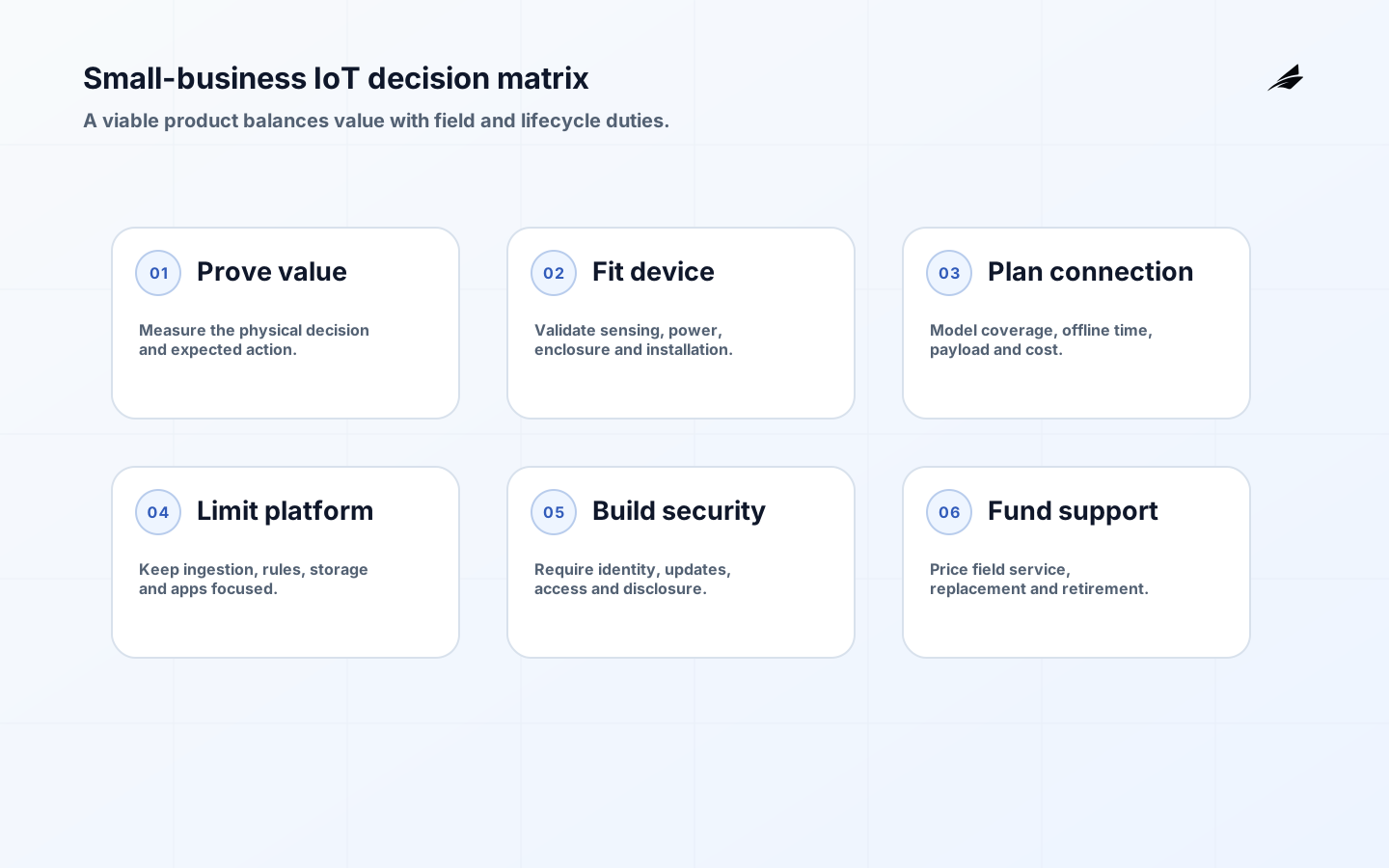
This IoT software development company for small business FAQ is for owners deciding whether a connected product or operational sensor system justifies custom development. IoT combines hardware, firmware, connectivity, cloud software, applications, security and field support. That combination can create useful automation and new services, but it also creates lifecycle obligations that continue after the first device ships.
Buyers comparing small-business IoT options should first align feasibility, scope, cost, delivery risk, and long-term support. The small-business IoT scope guide structures the business case, while the implementation checklist turns an approved concept into delivery gates.
What problems are a good fit for small-business IoT?
Good candidates involve a repeated physical observation or action whose timely result changes a valuable decision: monitoring cold storage, tracking high-value tools, detecting equipment conditions, controlling access or offering a connected customer product. Quantify the current loss, labor, delay or service opportunity. Confirm that a device can observe the condition reliably and that someone or some system can act on the signal. Connectivity alone does not create a business outcome.
Poor candidates have an unclear actor, no affordable installation path, negligible consequence of delay, or a manual process that costs less and works well. Before custom work, compare an off-the-shelf product, a gateway added to existing equipment and a non-IoT workflow change. Include privacy, safety, certification and supplier constraints. A small business benefits from fewer supported variants, so resist hardware customization that does not materially improve the decision.
| Question | Evidence before development | Warning sign |
|---|---|---|
| Value | Measured baseline and expected action | Benefit depends on unspecified future data use |
| Sensing | Field test of accuracy and environment | Laboratory result is treated as deployment proof |
| Connectivity | Coverage, power, bandwidth and offline need | Always-online operation is assumed |
| Installation | Time, skill, mounting and permissions | Every site requires bespoke engineering |
| Security | Identity, update and support requirements | Shared credentials or no patch route |
| Economics | Unit, platform, support and replacement model | Prototype price is presented as lifetime cost |
What should an IoT MVP include?
An IoT MVP should prove the riskiest operating loop with a small number of representative devices. It needs unique device identity, controlled provisioning, the essential sensor or actuator behavior, offline handling, one end-to-end data path, an authorized user action, basic observability and a supported update mechanism. A polished dashboard is secondary if battery life, signal accuracy, mounting or connectivity remains uncertain.
Define pass and stop criteria before field deployment: decision accuracy, missing-data rate, alert usefulness, battery forecast, reconnect behavior, installation time, support effort, security findings and unit economics. Include normal and adverse environments. The related IoT development guide for startups covers product-market and scaling questions when the connected device itself is the new venture.
What architecture does a small deployment need?
Keep the architecture narrow: device, optional gateway, secure connectivity, device registry, message ingestion, rules or processing, operational data store, user application and monitoring. Use managed services where they reduce undifferentiated operations, but document export, limits and recurring cost. Separate device telemetry from administrative commands. Every command needs authorization, expiry, acknowledgement and a safe behavior if it arrives late or twice.
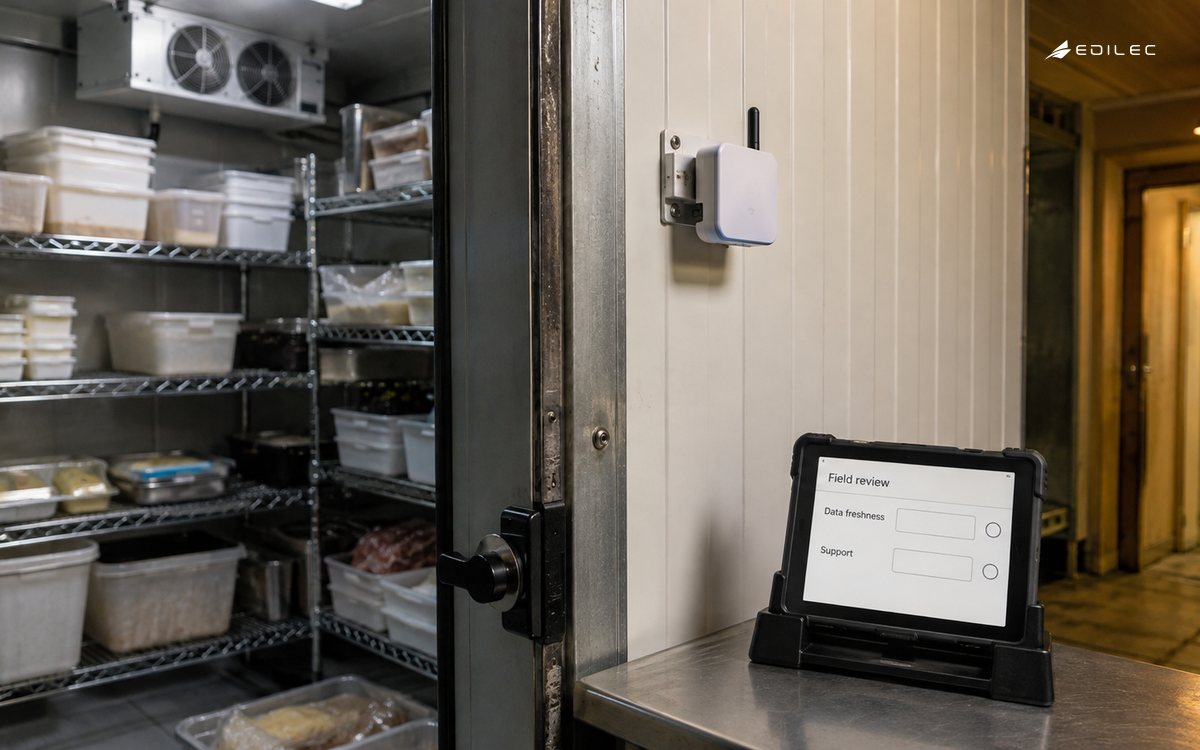
Assume networks and cloud dependencies fail. Define local buffering, maximum offline duration, stale-data indication and recovery. Use stable identifiers and idempotent processing so retries do not duplicate business actions. Store event time separately from receipt time. Retain only data needed for the declared purpose, troubleshooting and obligations. Detailed environmental, location or usage telemetry can become sensitive even when it contains no obvious name.
What security should a small business require?
Require unique identities, restricted interfaces, protected data, secure configuration, verified updates, cybersecurity-state reporting and a documented vulnerability process. NIST IR 8425 describes outcomes for consumer IoT products and can also be a starting point for small-business purchasing. The broader NISTIR 8259 series covers manufacturer activities and technical and non-technical support capabilities.
Avoid default shared passwords and permanent fleet keys. Limit administrative access, use multifactor authentication for management systems, inventory devices and software, protect backups and plan incident contacts. CISA's Cross-Sector Cybersecurity Performance Goals prioritize practical baseline outcomes, and the FTC's small-business cybersecurity guidance offers operational resources. Applicable legal and product requirements still need qualified review.
How much does custom IoT development cost?
There is no responsible universal price. Cost depends on whether hardware already exists, sensor and environmental constraints, prototype iterations, firmware, radio certification, enclosures, installation, connectivity, cloud usage, applications, integrations, security assurance, manufacturing volume and support period. Separate discovery, field prototype, production engineering and rollout estimates. Attach assumptions to device count, message volume, retention, locations and service hours.
Model lifetime unit economics. Include device and gateway, assembly, test, shipping, installation, SIM or network fees, cloud, observability, customer support, replacements, security updates, certificate services, returns and decommissioning. Add contingency for hardware lead times and field failure. A low prototype quote may omit production test fixtures, compliance work, remote update, support tooling or the client's internal time.
| Cost area | One-time items | Recurring items | Cost-control decision |
|---|---|---|---|
| Device | Design, prototypes and test fixtures | Manufacture, replacement and warranty | Minimize variants and qualify components |
| Connectivity | Radio integration and certification | Data plan, roaming and gateway service | Match network to payload and coverage |
| Platform | Architecture, ingestion and application | Compute, storage, logs and support | Set retention and per-device budgets |
| Security | Threat model, hardening and testing | Updates, monitoring and disclosure response | Define support period and ownership |
| Field operations | Pilot, installation design and training | Installation, maintenance and returns | Measure touch time per device |
| Exit | Data export and decommission design | Final retrieval and credential revocation | Contract portability before scale |
How should an IoT development partner be selected?
Look for evidence across hardware, firmware, cloud, mobile or web, security and field operations, with clear limits where subcontractors are used. Ask how the team handles provisioning, failed updates, intermittent networks, version compatibility, device replacement and vulnerability disclosure. Review who will perform the work, which artifacts you own, how source and credentials are controlled and how the partner estimates recurring costs.
Use a paid discovery or field proof before a broad build. Contract for schematics where applicable, bills of materials, source, build instructions, test evidence, device registry export, cloud configuration, design decisions and runbooks. Clarify background intellectual property, third-party licenses, manufacturing files and rights to change suppliers. The provider should remove its access at handover and demonstrate that the client can administer the fleet.
How should field rollout and support work?
Roll out through controlled cohorts: internal devices, a small customer or site group, representative environments and then wider deployment. Track intended and actual hardware, firmware, certificate and configuration. Set stop conditions for failure rate, data quality, battery, connectivity, false alerts and support volume. A staged update should be pausable and recoverable. Keep a known-good version or roll-forward path and test device replacement without losing asset history.
Define support intake, severity, remote diagnostics, spare inventory, response hours and escalation to hardware, network and cloud suppliers. Publish the security-support period and end-of-life process. The FCC's U.S. Cyber Trust Mark program may be relevant to qualifying consumer wireless products, but eligibility and program requirements should be checked for the specific product. A label is not a substitute for secure operation throughout the supported life.
Plan customer communication for setup, degraded service, security updates and retirement. Users need to know what an indicator means, when data is stale, which permissions are necessary and how to reset or transfer ownership safely. Support tools should expose device status without revealing secrets or excessive customer telemetry. Measure time to diagnose, replacement rate and repeat contacts by hardware and firmware version. Those costs often determine whether a small deployment can grow profitably.
Before ordering a production run, test manufacturing and provisioning together. Verify that each unit receives the intended identity, software and configuration, that failed units cannot enter inventory and that production credentials are not visible to factory staff beyond their role. Reconcile manufactured, activated, scrapped, returned and decommissioned identifiers. This control protects both unit economics and fleet security, and it is difficult to retrofit after devices are distributed. Keep a retained sample from each production batch for update and failure investigation.
Key takeaways
- Prove a valuable physical decision before commissioning custom hardware.
- Make the MVP an end-to-end field loop with identity, updates and offline behavior.
- Require secure lifecycle capabilities, not a one-time penetration test.
- Estimate device, connectivity, platform, support and retirement over the supported life.
- Protect ownership of source, manufacturing assets, credentials, data and operational access.
- Expand through measured cohorts only after the client can support and recover devices.
IoT software development for small business FAQ
Can no-code platforms build an IoT product? They can accelerate dashboards and workflows, but device firmware, provisioning, security, offline behavior and lifecycle support still require engineering and ownership.
Should a business build hardware from scratch? Usually only when available devices cannot meet a material sensing, power, form-factor, cost or product requirement. Existing certified hardware can reduce time and risk.
Who owns data generated by customer devices? Ownership, permitted use, access, retention and deletion should be explicit in contracts and customer terms, subject to applicable law. Technical access does not automatically grant unrestricted use.
How long should security updates be provided? Set and disclose a support period aligned with expected product use, risk and obligations. Design update infrastructure and funding before sale, not after the first vulnerability.
Conclusion: buy the supported lifecycle
Choosing an IoT software development company for small business means choosing the lifecycle behind every field device. A strong engagement proves value in representative conditions, limits architecture, builds security and updates in from the start, exposes lifetime cost and transfers real operating control. That discipline lets a small team gain connected capability without inheriting an unsupported fleet.