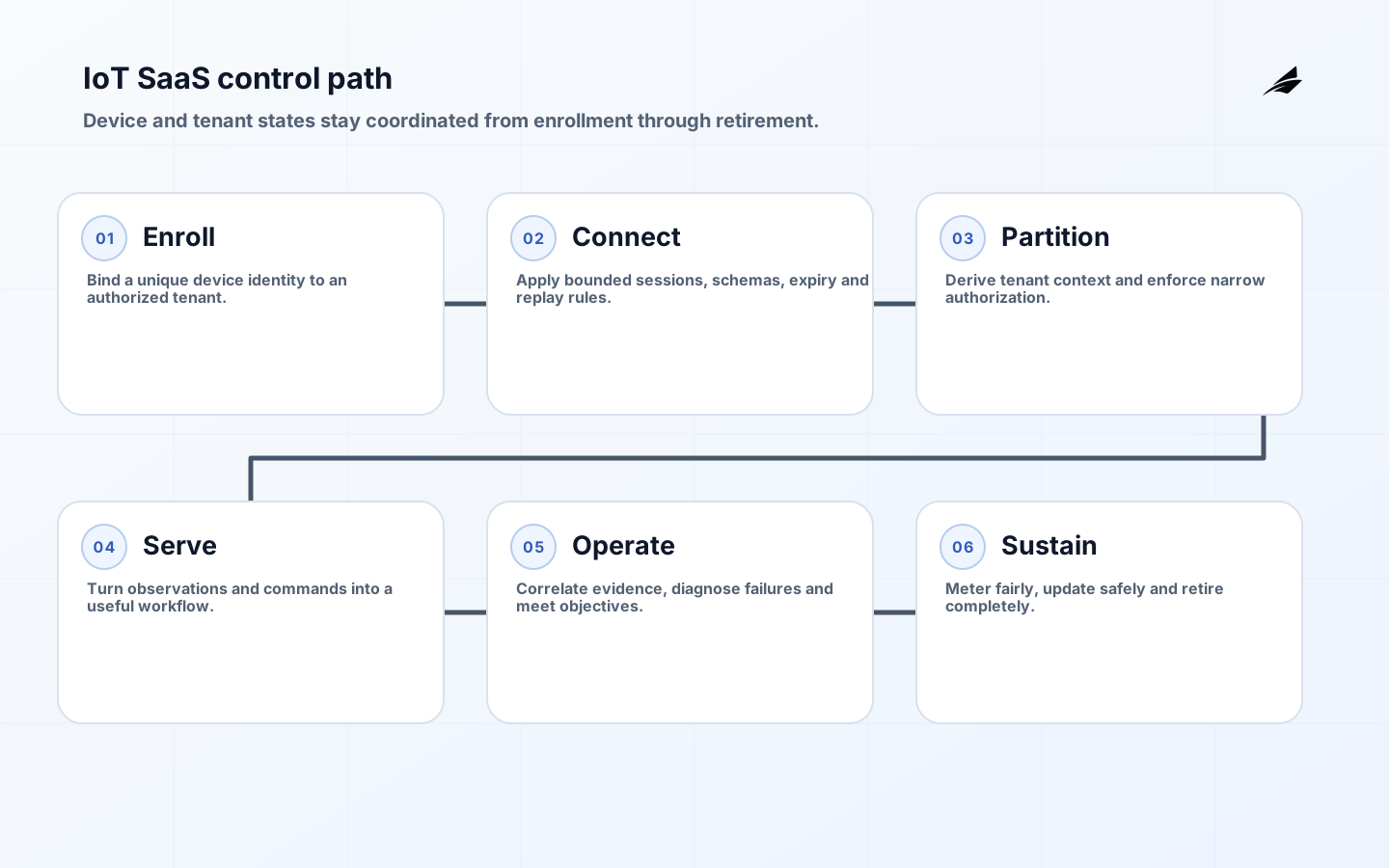
IoT SaaS product development combines two difficult operating models. A SaaS company must isolate tenants, ship features safely, meter usage and support customers continuously. A connected-product company must also provision devices, tolerate unreliable networks, maintain firmware and interpret imperfect physical observations. Joining the two without an explicit boundary produces expensive surprises: a device may remain active after a subscription ends, one tenant may receive another tenant's telemetry, or a reconnect storm may turn a small outage into a platform-wide incident.
The practical first release is not a generic device cloud. It is one complete journey for one device class and one customer segment: enrollment, authenticated connection, useful telemetry, a bounded command, operator feedback, support evidence and decommissioning. This guide explains how to define that vertical slice, estimate the drivers behind cost and choose acceptance gates. It treats the device, edge software, cloud data plane, tenant control plane and customer workflow as one product while keeping their responsibilities testable.
What belongs in the first IoT SaaS scope?
Write the customer outcome and device lifecycle together. If the product promises remote equipment health, define which measurements indicate health, how quickly they arrive, what happens during silence and who can acknowledge an alert. Then trace a device from manufacturing or claim code through tenant assignment, credential issuance, configuration, normal operation, transfer, suspension and retirement. Every state needs an owner and an allowed transition. A device record that only has active and inactive states is rarely enough for support or security.
Keep the first hardware matrix narrow. One supported firmware line, gateway type or protocol profile lets the team learn where physical behavior contradicts laboratory assumptions. Specify browser and mobile experiences only where a user needs them. Administrative pages, fleet views, APIs, notifications and billing should be tied to concrete roles. Defer broad analytics, workflow builders and protocol adapters until the event model and support process survive real customers. Extensibility is useful only after a stable core exists.
| Capability | First-release boundary | Evidence at acceptance |
|---|---|---|
| Enrollment | One approved device and ownership flow | Fresh, duplicate and transferred enrollment tests |
| Telemetry | Named signals with units and expiry | Offline replay, late data and schema validation |
| Commands | One low-risk, authorized action | Audit trail, timeout and idempotency test |
| Tenancy | Organization, role and fleet boundaries | Cross-tenant denial and export test |
| Support | Device health and traceable diagnostics | Representative incident resolved from evidence |
| Billing | One transparent usage measure | Reconciliation against source events |
How should the device data plane and SaaS control plane separate?
The device data plane authenticates connections, receives telemetry, routes commands and absorbs bursts. The control plane manages tenants, users, fleets, policy, subscriptions and support operations. Keep their failure modes distinct. A billing-service problem should not disconnect field equipment, and a broker backlog should not corrupt tenant administration. Use stable internal identifiers rather than customer-visible names as partition keys. Carry tenant context from authenticated device or user identity; do not trust an arbitrary tenant field inside a payload.
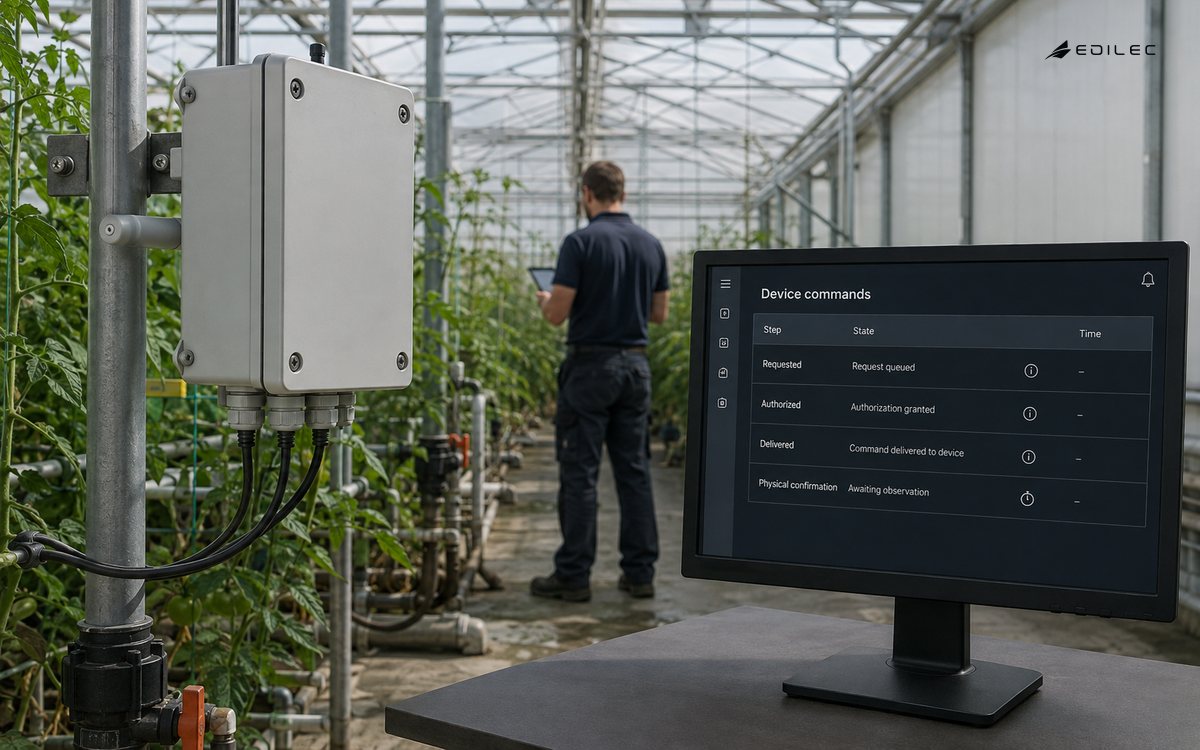
Model raw observations as append-oriented records with source time, ingest time, device identity, schema version and quality flags. Build current state as a derived view so late events do not silently overwrite newer facts. Commands need a lifecycle such as requested, authorized, delivered, acknowledged, expired and failed. If physical actuation matters, a network acknowledgement is not proof of the physical result. Capture a confirming observation or require an operator check. This distinction prevents a green interface from overstating what occurred in the field.
What should the messaging contract guarantee?
MQTT is a strong option for constrained publish-and-subscribe communication, but its quality-of-service levels describe protocol delivery rather than end-to-end business processing. Choose topic structure, authorization, message expiry, session behavior and payload versioning as one contract. At-least-once delivery requires idempotent consumers. Long session retention can create a large replay after an outage. Commands that arrive after their safe window should expire instead of executing unexpectedly. Document maximum payload, publish rate, clock tolerance and disconnect behavior per device profile.
Test a fleet, not only a device. Simulate certificate rotation, broker failover, region impairment, cellular loss, corrupted messages, duplicate command acknowledgement and thousands of simultaneous reconnects. Backpressure must be visible and bounded. Decide which telemetry may be sampled or dropped and which events must remain durable. A safety or billing event deserves different handling from a frequent diagnostic measurement. Keep dead-letter data searchable with reason codes and a controlled replay path; invisible rejection creates support tickets that cannot be explained.
How are tenancy and device security enforced?
Use distinct identities for people, services and devices. Each device receives a unique credential rooted in a documented provisioning process; shared factory secrets create fleet-wide exposure. Authorize device topics or APIs to the narrowest tenant and device resources. User roles should separate fleet administration, routine operation, support and billing. Support impersonation or tenant access needs approval, a visible reason, time limits and an audit record. Export and deletion procedures must cover telemetry, derived data, command history and backups.
Apply the NIST IoT capability baseline as a procurement and design conversation: identification, configuration, data protection, logical access, secure update, security-state awareness and device security. Add product-specific requirements such as recovery from an interrupted update and proof of software version. CISA's secure-by-design guidance reinforces making safe defaults and customer protection product responsibilities. Do not transfer avoidable security burden to customers through undocumented broker rules or optional critical controls.
What observability is needed for support and reliability?
Correlate device connection, message processing, API request, command and notification with stable identifiers. OpenTelemetry can standardize traces, metrics and logs for cloud services, but field telemetry requires additional context such as firmware, radio, gateway and last known configuration. Build support views around questions: why is this device silent, which step rejected this event, did this command expire, and are similar devices affected? A chart of total messages cannot answer them.
Define service indicators at customer and fleet level: usable-event latency, online coverage, command completion, alert delivery and data-export completion. Avoid one global availability number that hides a struggling tenant or device cohort. Alert on error budget consumption and customer impact rather than every transient disconnect. Preserve privacy by excluding secrets and unnecessary payload data from logs. Sampling rules should retain errors and rare state transitions while controlling cost for high-volume normal traces.
What drives cost and commercial risk?
Cost follows connected devices, connection time, message volume, payload size, storage duration, query patterns, data transfer, notifications, support effort and hardware operations. Build a unit model before pricing: monthly cost per active device and per customer at low, expected and burst usage. Include observability, backups, test fleets, certificate services and retained raw data. Multi-year device support can outlive the cloud stack that launched it, so budget firmware maintenance, protocol compatibility and migration rather than treating launch as completion.
Meter a quantity customers can understand and the platform can reconcile. Charging per raw message may penalize healthy diagnostics and invite batching that reduces operational value. Active device, managed asset or outcome-based tiers may be clearer, with fair-use bounds for expensive workloads. Separate commercial suspension from security revocation: a payment dispute should not erase evidence or create unsafe device behavior. Define read-only, grace-period and decommissioning states with product, legal and operational owners.
| Risk | Early warning | Control |
|---|---|---|
| Tenant leakage | Authorization denials or mismatched context | Identity-derived tenant partition and negative tests |
| Reconnect storm | Connection surge and queue age | Jittered backoff, quotas and capacity rehearsal |
| Unsafe command | Expired or duplicate actuation | Authorization, expiry, idempotency and confirmation |
| Runaway storage | Growth exceeds unit forecast | Retention tiers and aggregate derivation |
| Unsupported fleet | Firmware fragmentation rises | Support matrix and enforced update policy |
| Unprofitable tenant | Support and traffic exceed plan | Unit-cost reporting and contract guardrails |
What delivery plan reduces the most uncertainty?
Begin with a bench prototype that proves identity, schema and end-to-end observability. Move to an internal fleet that exercises update, reset and failure. Then run a design-partner pilot in the real network and support environment. Keep a production readiness gate for security review, restore test, on-call ownership, capacity rehearsal, privacy decisions and device replacement. Expand by device and tenant cohorts, using feature flags and firmware rings. Each gate should have a rollback or stop condition.
Acceptance belongs to the receiving team. Give them infrastructure definitions, source and build process, schema registry, device inventory, credential procedures, dashboards, alerts, runbooks, cost model, threat model and test fixtures. Ask them to enroll a new device, diagnose silence, rotate a certificate, replay a late message, restore data and retire a tenant without the delivery team leading. Gaps discovered in that exercise are production work, not documentation polish.
Key takeaways
- Ship one complete device and customer journey before building a general platform.
- Separate the high-volume device data plane from tenant and subscription control.
- Make commands, late data, offline replay and device lifecycle explicit states.
- Measure cost and reliability per tenant and device cohort, not only globally.
- Prove support, security and decommissioning before fleet expansion.
Frequently asked questions
Should an IoT SaaS MVP use a managed broker?
Often yes, because managed connectivity can reduce undifferentiated operations. The team still owns identity, authorization, topic design, schema, quotas, observability, cost and exit. Test provider limits against the real fleet profile.
How much raw telemetry should be retained?
Retain enough to support the defined decision, investigation and regulatory needs. Use hot, warm and aggregate tiers where appropriate. State the duration by data class and test deletion, export and reprocessing.
Can one platform support every protocol?
It can add adapters, but every supported profile creates testing, security and lifecycle obligations. Standardize the internal event contract and add protocols only for validated customer and device needs.
Conclusion
A dependable IoT SaaS product is a lifecycle service, not a cloud endpoint attached to hardware. Its design keeps devices, tenants, data, commands, support and commercial states consistent under failure. Scope the first release around a complete outcome, model unit economics, and require operational exercises before scale. That approach produces a smaller initial platform, but one customers can trust and the SaaS team can afford to run.