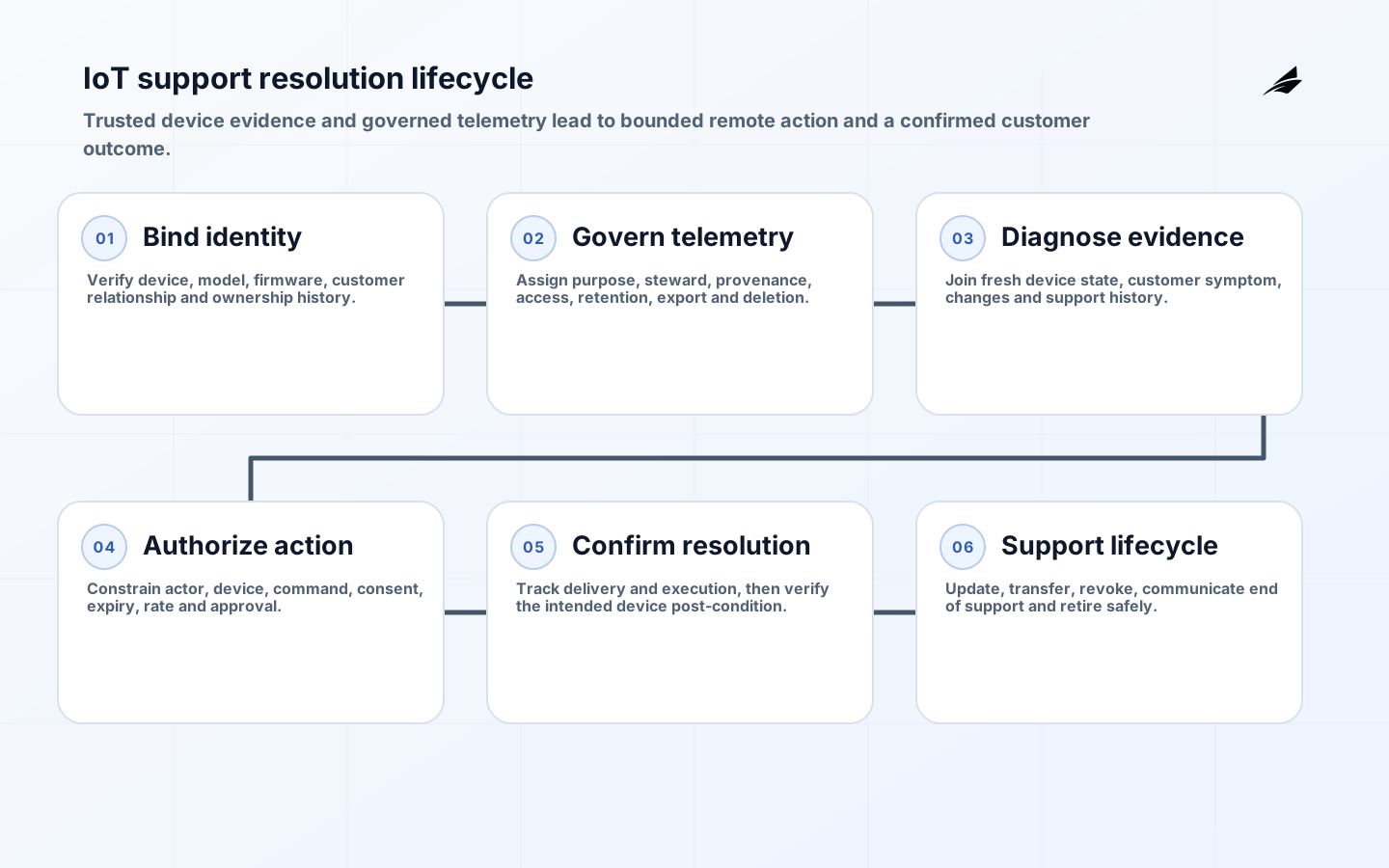
IoT software development for support teams should shorten the path from a customer symptom to a safe, verified resolution. That path crosses a physical device, firmware, local network, cloud ingestion, product state, telemetry, support workflow and sometimes a remote command. A dashboard alone does not solve it. The platform must tell an authorized agent which device is involved, what evidence is trustworthy, what the customer permitted, which action is safe and whether the device actually reached the intended state.
Current NIST guidance makes lifecycle responsibility central. NIST IR 8259 Rev. 1, finalized in April 2026, asks manufacturers to identify customer cybersecurity needs and plan product capabilities and support. IR 8259A covers device capabilities, while IR 8259B covers non-technical capabilities such as documentation, information and update support. NIST SP 1800-36, published in November 2025, demonstrates trusted network onboarding and lifecycle management. A support platform should translate these expectations into product scope, contracts, evidence and operating routines.
Define the support outcome and product boundary
Choose the first support journey: identify an offline device, diagnose a sensor fault, guide network recovery, replace a device, deliver a firmware fix or explain an anomalous reading. Map the journey from customer contact or automated alert to confirmed resolution. Record users, systems, device models, connectivity modes, data, permissions, response targets and failure consequences. Include field service, engineering, security, privacy and product teams; each may own a different part of the resolution.
Separate the product from its components. An IoT product may include the device, companion application, gateway and backend service. Support software may control some components and only observe others. Define eligible models, firmware ranges, regions, connectivity and warranty states. Make exclusions visible. Link this scope to the IoT support implementation checklist so acceptance is based on real device and support boundaries rather than a generic ticketing integration.
Decide data ownership, stewardship and permissible use
“Who owns IoT data?” has no universal technical answer. Rights and duties depend on contracts, privacy law, sector rules, intellectual property and the relationships among customer, operator, manufacturer and service providers. Engineering still needs explicit decisions. For every telemetry class, define the business owner accountable for purpose and policy, the steward responsible for quality and definitions, the authoritative system, permitted users, retention, residency, sharing, export and deletion. Obtain qualified legal advice for the markets and data involved.
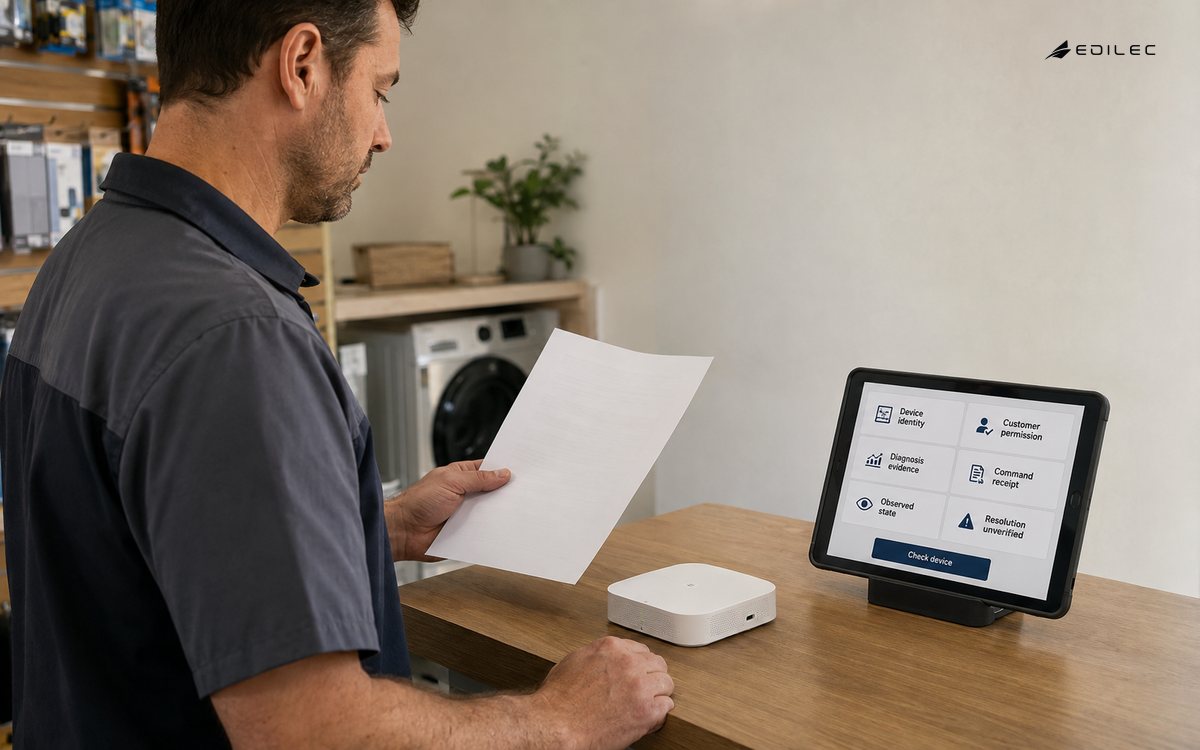
Distinguish device identity, configuration, measurements, commands, diagnostics, location, customer content and derived scores. A support agent may need recent error codes but not continuous location history. State whether data is necessary for service, optional diagnostics or a separate analytics purpose. Capture customer choice and device capability. Preserve provenance: device identifier, firmware, sensor, timestamp quality, units, calibration or transformation and ingestion path. NIST's 2026 Data Governance and Management Profile remains a developing project, not a finalized control standard, but its stated focus on lifecycle roles, provenance, lineage, quality and disposition reflects the decisions a support system must make.
| Data class | Authority decision | Support safeguard |
|---|---|---|
| Device identity | Manufacturer identity versus customer asset record | Verified binding and transfer history |
| Telemetry | Purpose, steward, retention and permitted diagnosis | Minimize fields and preserve provenance |
| Configuration | Desired-state owner and change authority | Version, approval and rollback |
| Remote command | Who may request and consent | Bounded action with receipt |
| Derived diagnosis | Model or rule owner and review route | Explain evidence and allow correction |
Specify device and cloud capabilities together
NIST IR 8259A's baseline includes device identification, configuration, data protection, interface access control, software update, cybersecurity state awareness and device security. Translate each relevant capability into an end-to-end requirement. A cloud button cannot securely reset a device that lacks authenticated commands, and a signed firmware service is useless if a constrained device cannot verify or recover an interrupted update. Record capability by model and firmware version so the support interface never offers an action the device cannot perform safely.
Use unique device identities rooted in a trustworthy manufacturing or enrollment process. Separate customer and fleet identity from network address. Define onboarding, ownership transfer, credential rotation, lost-device handling and decommissioning. SP 1800-36 shows why trust before network access and lifecycle management matter. Segment device connectivity, restrict outbound and inbound paths, authenticate device-to-cloud messages and defend against replay. For intermittent connectivity, represent last-seen time and uncertainty; stale desired state must not look like confirmed device state.
Design support workflows and remote action safety
Give agents a timeline that joins customer reports, device state, firmware, connectivity, recent changes and prior actions. Show source and freshness. Offer diagnoses as evidence-backed suggestions, not unexplained certainty. Route cases by model, risk and customer tier, but keep security and safety escalations distinct from ordinary troubleshooting. Integrate ticket status with device actions using stable identifiers; do not copy sensitive telemetry into free-text notes when a controlled view can reference it.
Remote actions need server-side authorization by tenant, device, action and context. Use least privilege, step-up approval for disruptive commands, clear customer consent where required, rate limits, expiry and idempotency. A request is not success: record command accepted, delivered, executed and post-condition verified as separate states. For factory reset, credential rotation or firmware rollback, require stronger authority and explain data loss or downtime. Provide a manual field-service fallback when connectivity or device integrity is uncertain.
| Delivery stage | Proof | Cost or risk driver |
|---|---|---|
| Discovery | Support journey, fleet and data map | Model diversity and unknown ownership |
| Device proof | Identity, telemetry and safe command on target hardware | Firmware change and lab equipment |
| Platform slice | Case timeline, authorization and ingestion | Volume, retention and integrations |
| Pilot | Resolved cases across real connectivity | Field support and device replacement |
| Scale | Fleet monitoring, updates and lifecycle operations | Regional service, egress and on-call load |
Estimate cost from fleet behavior, not screen count
Model device engineering, hardware labs, certification, cloud ingestion, message brokering, storage tiers, query, data transfer, observability, identity and key services, customer support, security response and field operations. Include firmware and mobile releases, because the backend cannot independently repair every issue. Estimate active and dormant devices, message size and frequency, reconnect bursts, diagnostic sessions, firmware package distribution, retention and regional duplication. A small per-device cost becomes material across a fleet.
Separate fixed capabilities from variable usage. Fixed work includes the first device integration, security architecture, support workflow and update service. Variable cost follows devices, messages, stored history, outbound data, support contacts and field visits. Add contingencies for hardware revisions, supplier end-of-life, certificate replacement and recall. Use unit measures such as cloud cost per active device, successful diagnosis cost and contacts per thousand devices, but never optimize cost by removing evidence required for safety, security or customer commitments.
Plan security support through end of life
IR 8259B emphasizes supporting capabilities that continue after sale: documentation, customer information, vulnerability handling and update support. Publish supported models and periods, secure configuration guidance, data behavior, update method and vulnerability contact. Maintain a component inventory for firmware, gateways and cloud services. Receive, triage and remediate reports; communicate material issues without exposing exploit details prematurely. Monitor update adoption and failures by cohort.
Define what happens when support ends. Notify customers early, disable unsafe cloud functions deliberately, revoke or expire credentials, preserve required records and enable data export or deletion. Ownership transfer must remove the previous customer's access and establish the new relationship. Test fleet-wide emergency changes in rings; a rushed update can brick devices or overwhelm support. Keep an offline recovery route where the product consequence warrants it. The support promise and technical update capability must cover the same period.
Deliver one device family in controlled stages
- Baseline one support journey, device family, data decision and resolution metric.
- Verify identity, telemetry provenance, command authorization and update capability on hardware.
- Build the case timeline, controlled diagnostics and integration with the support system.
- Threat-model device, gateway, cloud, agent and supplier boundaries; test recovery.
- Pilot with selected customers, firmware versions and connectivity conditions.
- Scale by device cohort while measuring resolution, action failure, cost and privacy guardrails.
- Add device families only after lifecycle ownership and end-of-support plans are funded.
Use acceptance scenarios, not feature counts. Disconnect a device mid-command, replay a message, transfer ownership, rotate a credential, interrupt an update, restore cloud state and retire a device. Verify that the support agent sees uncertainty, cannot exceed authority and can confirm the final state. Review false diagnoses and manual work. A mature plan may deliberately keep a high-risk action with trained field service rather than expose it remotely.
Key takeaways
- Scope a complete resolution journey across device, cloud, support and field operations.
- Define data rights with legal advice and assign operational owner, steward and authoritative system.
- Map NIST device and supporting capabilities to each model and firmware version.
- Treat remote actions as authorized, observable state machines with confirmed outcomes.
- Fund security updates, ownership transfer and retirement for the promised product lifetime.
Frequently asked questions
Who owns telemetry generated by a customer device?
The answer depends on contracts, law, product context and the parties involved. Document rights, purposes, stewardship, access, retention and export explicitly. A technical database owner does not by itself establish legal ownership or permissible use.
How much telemetry should support retain?
Retain the minimum needed for defined support, security and legal purposes, with different periods by data class. Validate whether summaries can replace raw high-volume data and ensure agents see freshness and provenance.
Can existing ticketing software be the IoT platform?
It can remain the case system, but device identity, telemetry ingestion, command execution, update management and lifecycle security usually require specialized services. Integrate by stable references and keep sensitive device data in controlled systems.
Conclusion
A support-focused IoT platform earns trust when it can explain device identity, data provenance, authority, action state and lifecycle responsibility. Current NIST guidance strengthens the case for designing manufacturer support and product capabilities together. Begin with one device family and one costly support journey, prove safe resolution on real hardware, and scale only when ownership, update and retirement duties are as clear as the interface.