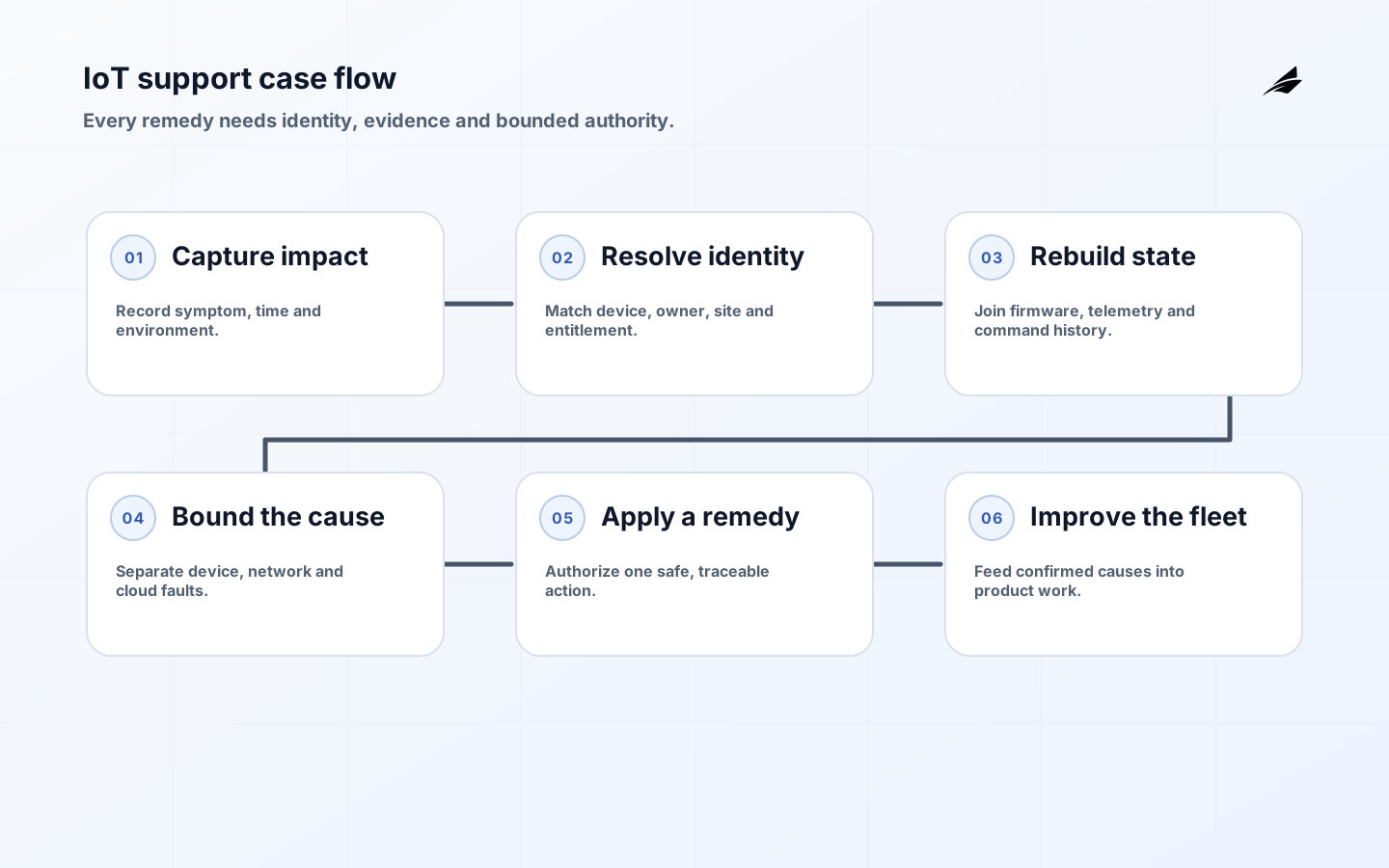
An IoT software development for support teams implementation checklist must cover the path from a customer's symptom to a safe, attributable action across device, network, cloud and account. A ticketing screen alone cannot repair missing identity, weak diagnostics or an update mechanism that fails in the field. Support requirements belong in product architecture before fleet deployment, because a physical visit can be the only fallback when software cannot explain or change device state remotely.
Use this checklist to build one complete support journey and then expand it across models and cohorts. The IoT support scope and cost guide helps define the investment, while the IoT support FAQ addresses operating questions. Startup teams can also use the production IoT checklist for device-lifecycle foundations.
1. Define support journeys and safe outcomes
List the high-volume and high-consequence journeys: failed commissioning, intermittent connectivity, implausible reading, low battery, update failure, command failure, ownership transfer, replacement, suspected compromise and retirement. For each, name customer impact, required evidence, permitted action, escalation and safe fallback. Separate customer support, fleet operations, security response and engineering authority. One case can coordinate those roles without giving every agent unrestricted device control.
Set service promises around outcomes support can influence: time to identify the correct device, time to a bounded diagnosis, percentage resolved without a visit, update recovery, repeat contact and unsafe-action prevention. Avoid targets that reward premature closure. A case closed after a reboot but reopened because the root condition persists is rework. Preserve uncertainty in the status rather than asking an agent to choose a confident but unsupported cause.
| Support journey | Evidence required | Safe outcome |
|---|---|---|
| Failed onboarding | Physical ID, claim history, network and entitlement | Correct owner binding or guided fallback |
| Missing telemetry | Last seen, signal, queue, clock and cloud ingestion | Bound device, network or platform cause |
| Bad reading | Calibration, quality flag, environment and peer behavior | Qualified data or replacement decision |
| Update failure | Version, power, transfer, verification and boot state | Recovered version or safe service mode |
| Remote command | Authorization, precondition, expiry and acknowledgement | One attributable, idempotent action |
| Replacement | Ownership, warranty, data and credential history | Secure transfer and retired old identity |
2. Build a trustworthy device and ownership record
Keep physical identifier, logical identity, customer ownership, site, product model, firmware, gateway, subscription, warranty and replacement relationship distinct. They change at different rates. NIST's IoT device core baseline includes logical and physical identification among capabilities that support asset, vulnerability and access management. Support should be able to resolve a label to current logical state without treating a mutable serial field as proof of ownership.
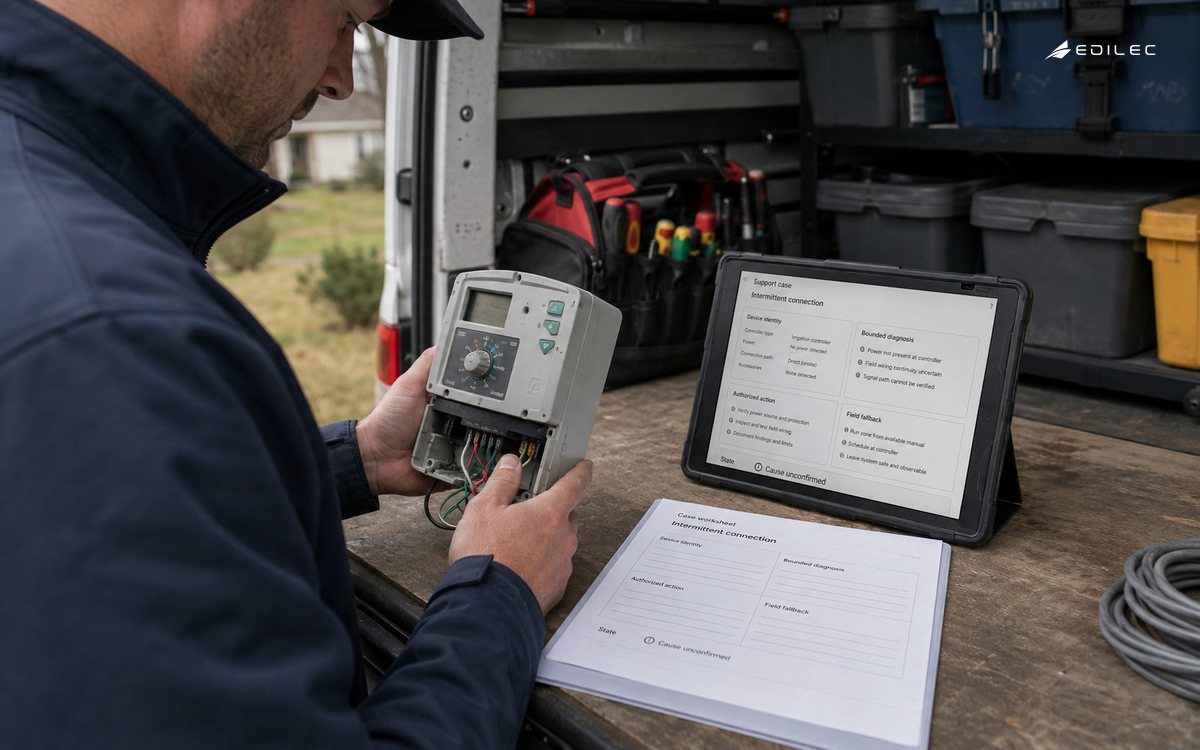
Protect enrollment and transfer. Verify the customer's authority, prevent one device from being claimed by multiple tenants, record transfer history, revoke old credentials and separate factory reset from ownership release. Test copied labels, replaced boards, duplicate records and a returned device that reconnects. Do not display secret material to an agent. Give the workflow a controlled credential rotation or re-enrollment action with approvals proportionate to impact.
3. Implement bounded diagnostics and observability
Define the minimum state needed to diagnose each journey: current and prior firmware, configuration version, boot reason, connectivity, power, storage pressure, sensor quality, last successful update, command history and cybersecurity state. NIST's April 2026 NISTIR 8259 series page reflects Revision 1 of foundational manufacturer activities and links technical capabilities with support across the product lifecycle. Tailor the evidence to product risk rather than collecting every possible field.
Preserve event time, receipt time, sequence and quality. The MQTT 5.0 standard defines transport behavior such as sessions, quality of service and reason codes, but the application must define message semantics, authorization and deduplication. Test duplicates, reordering, delay, clock error, reconnect and a full local buffer. A missing message is not automatically proof that a device failed.
Connect device, gateway, cloud and application telemetry with stable correlation identifiers. OpenTelemetry signals can support traces, metrics and logs in cloud services; constrained devices may publish a smaller domain-specific record. Avoid sensitive payloads in logs, set retention by diagnostic need, and disclose relevant collection. Support views should explain stale or unavailable evidence instead of presenting the last known state as current.
4. Control remote actions and customer data
Create a permission catalog for read, diagnostic, configuration, reboot, update, ownership, credential and destructive actions. Define role, customer consent, device preconditions, rate limit, approval, expiry and audit evidence. Commands should be authenticated, authorized, idempotent where feasible and acknowledged with resulting state. A timeout is an unknown outcome, not permission to repeat a physical action indefinitely.
NIST SP 800-213 shows how organizations can establish IoT device cybersecurity requirements in system context. Apply that system view to support: an update capability is useful only when the service can authorize, deliver, observe and recover it. Test denied roles, revoked agents, cross-tenant search, expired consent and lost connectivity during action. Use masked views and purpose-limited access for customer and location data.
| Action class | Required control | Evidence to retain |
|---|---|---|
| Read state | Role and tenant authorization | Agent, case, fields and time |
| Run diagnostic | Customer notice and bounded command | Request, device response and limits |
| Change configuration | Approved values and reversible plan | Before, after, actor and reason |
| Update software | Signed package, eligibility and recovery | Version path and verification result |
| Rotate credential | Step-up approval and identity check | Old identity revoked and new binding |
| Factory reset | High-impact confirmation and data rule | Authority, completion and ownership state |
5. Detect and coordinate fleet incidents
Group cases and telemetry by model, hardware revision, firmware, supplier component, geography, carrier, installer and release cohort. Define thresholds that create a fleet investigation without automatically exposing unrelated customer data. A cluster should link to affected populations, current containment, owner, customer message and known-good configuration. Preserve individual cases while coordinating the shared cause so customers do not receive contradictory remedies.
Establish security escalation for unusual commands, credential failures, unexpected configuration or vulnerable versions. NIST's non-technical IoT baseline covers documentation, receiving queries, disseminating information and education. Those are product capabilities: publish a vulnerability intake route, supported-version policy, update instructions and end-of-support notice. Support must know when a symptom becomes a security or safety event and stop routine remediation.
6. Prove field operation and ownership
Run acceptance with production roles and representative devices. Onboard a device, move it to poor connectivity, generate stale and duplicate data, interrupt an update, revoke an agent, transfer ownership, issue a safe command, replace the device and retire the old identity. Confirm the customer sees understandable status and support sees enough evidence without privileged engineering access. Record every manual workaround and decide whether intended staff can perform it.
Handover should include source, schemas, command contracts, diagnostic dictionary, device registry ownership, signing and credential procedures, role matrix, test fixtures, fleet dashboards, incident playbooks, retention rules, supplier contacts and end-of-support plan. Link confirmed causes back to firmware, cloud, documentation and manufacturing backlogs. The startup IoT scope guide explains why support and retirement must be funded before hardware volume.
7. Review privacy, quality and support economics
Map each diagnostic field to a support purpose, audience, retention period and deletion rule. Device location, occupancy, audio, network identifiers and usage patterns may reveal people or sensitive operations even when no customer name appears. Test exports, screenshots, search and cross-case access. Give agents a clear explanation of stale, inferred or customer-supplied evidence so they do not present it as an authoritative device observation.
Measure time to correct identity, bounded diagnosis, safe remote resolution, repeat contact, field visit, update recovery and unresolved case age. Segment results by model, firmware and site context. Cost per case is useful only beside customer impact and product quality; suppressing escalation can reduce apparent cost while increasing repeat work. Feed confirmed causes and manual workarounds into release planning with an owner and target cohort.
Review support permissions and diagnostic value quarterly. Remove actions agents no longer need, expire temporary fields and sample cases to confirm that recorded causes match evidence. Compare remote remedies with later device behavior to detect false resolution. This operating loop keeps the platform proportional as the fleet and product change and prevents support access from accumulating quietly across generations.
Keep a small set of known-fault devices and replayable cases for regression testing. They let support, firmware and cloud teams verify that new releases still expose enough evidence and that old remedies remain safe before a fleet update changes the diagnostic contract.
Key takeaways
- Design support journeys with explicit evidence, authority, escalation and safe fallback.
- Separate physical identity, logical identity, ownership and replacement history.
- Expose current, qualified diagnostic state without collecting unnecessary customer data.
- Treat every remote action as an authorized transaction with expiry and outcome evidence.
- Coordinate fleet causes without erasing individual customer cases or tenant boundaries.
- Accept the platform through field failures, ownership transfer, update recovery and retirement.
IoT support implementation FAQ
Should support agents have shell access? Usually no. Build bounded diagnostics and actions for common journeys. Reserve exceptional engineering access for approved, time-limited investigation with complete evidence.
How much telemetry is enough? Collect the minimum state needed to detect, diagnose and support the product according to risk. Validate usefulness during real cases and remove fields that have no justified purpose.
Can a reboot be automated? Only when preconditions, authorization, customer impact, rate limits and outcome are understood. Reboot must not conceal a persistent fault or repeat an unsafe physical action.
What should be built first? Choose one frequent journey such as failed commissioning and implement identity resolution, state, permission, remedy and feedback end to end. It will expose gaps shared by later journeys.
Conclusion: make field support a product capability
IoT software development for support teams works when a symptom can be connected to the correct device, current state and a safe action without breaking tenant boundaries or product accountability. Build that evidence path early, test it under field failure, and use confirmed causes to improve the fleet rather than repeatedly treating isolated tickets.