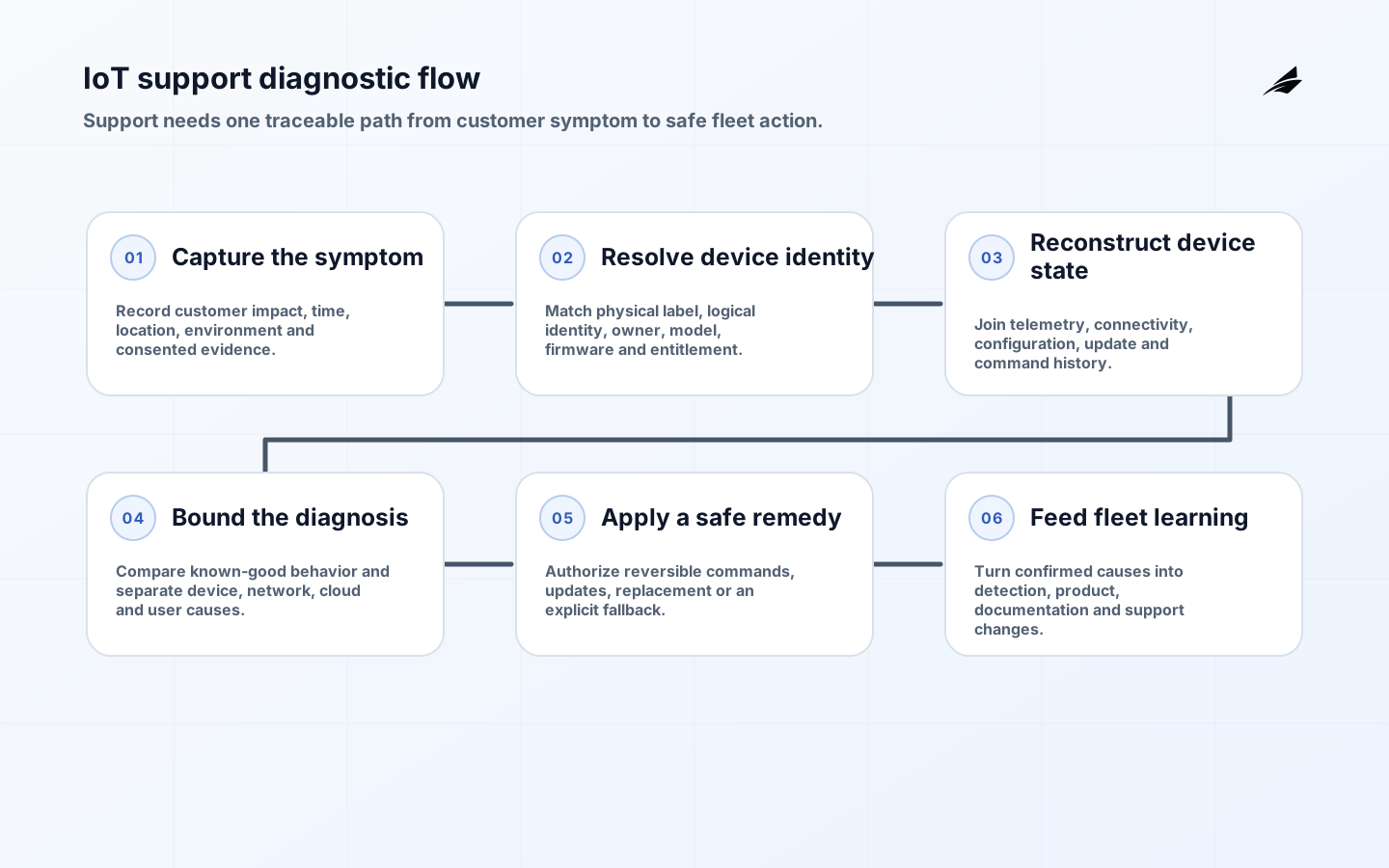
IoT software development for support teams should turn a customer symptom into a safe, traceable action across a device, network, cloud service and account. Conventional ticketing is not enough. An agent may need to resolve a physical label to a logical identity, inspect firmware and configuration, understand missing telemetry, authorize a remote diagnostic and coordinate replacement without exposing another customer's data or making the device less safe.
This FAQ focuses on the operating system around support: evidence, permissions, remote actions, fleet incidents and product learning. The support-team IoT scope guide covers commercial boundaries, and the implementation checklist provides delivery gates. Support requirements belong in product architecture because missing identity or diagnostics cannot always be repaired after devices are deployed.
What should an IoT support platform cover?
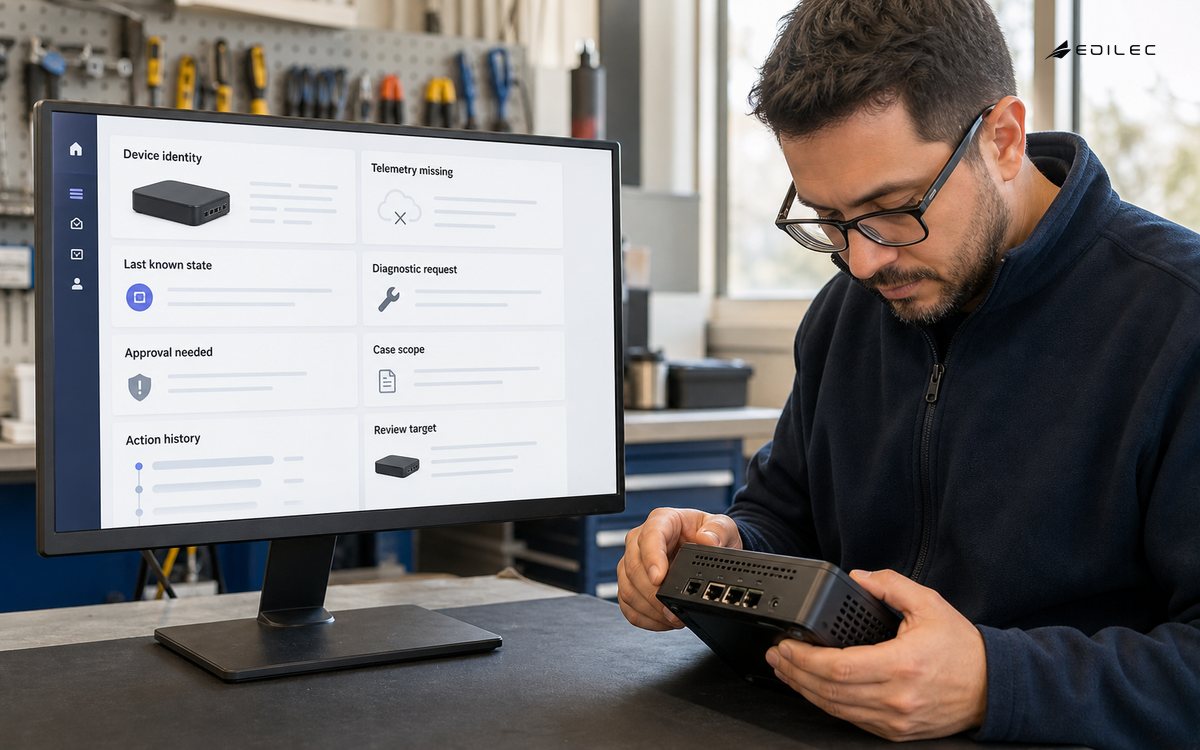
Start with support journeys: failed onboarding, intermittent connectivity, implausible reading, command failure, low battery, update failure, ownership transfer, replacement and retirement. For each journey, identify customer impact, evidence, permitted actions, escalation and safe fallback. Separate customer support, fleet operations, security response and engineering responsibilities. One interface can coordinate them, but each role should see and do only what its task requires.
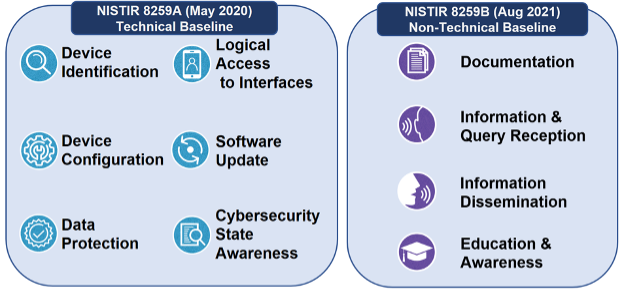
The case record should connect customer, site, product, device, gateway, subscription, warranty and support entitlement without making any one mutable field the permanent identity. Preserve the physical and logical identifiers, ownership history and replacement relationships. NIST's IoT device capability baseline treats unique logical and physical identification as a core capability supporting asset, vulnerability and access management.
| Support journey | Evidence needed | Permitted first action | Escalation trigger |
|---|---|---|---|
| Cannot onboard | Claim state, identity, app version, network result and ownership | Retry a bounded enrollment step or correct approved metadata | Identity collision or prior owner remains |
| Telemetry missing | Last seen, power, signal, buffer, gateway and ingestion state | Guide local checks or request a safe diagnostic | Fleet pattern or possible compromise |
| Reading implausible | Raw value, quality flag, calibration, environment and history | Mark uncertainty and compare known-good range | Safety, billing or automated action affected |
| Update failed | Current and target version, stage, verification and power state | Resume or return to documented safe image | Device cannot recover remotely |
| Command failed | Authority, target, expiry, acknowledgement and resulting state | Retry only when command is idempotent and valid | Physical hazard or state remains unknown |
| Replacement | Failure evidence, entitlement, keys, data and ownership | Issue controlled swap and revoke old identity | Data cannot be reconciled or old device persists |
How should device and cloud observability work?
Design a support timeline that joins device events, connectivity, cloud processing, configuration, commands, updates and account changes. Preserve event time and receipt time because offline devices deliver late evidence. Include software and hardware versions, but avoid collecting customer content merely because storage is available. Mark gaps and uncertainty explicitly. A blank chart must not imply healthy operation when the device has stopped reporting.
Telemetry that answers support questions
Instrument the cloud path with traces, metrics and logs that share service, environment and version context. OpenTelemetry provides common signal concepts, but device telemetry also needs domain state such as boot reason, power, radio, queue, sensor quality and update stage. Use bounded diagnostic modes with consent, expiry and audit. Sampling and retention should follow support value, privacy, bandwidth and cost rather than collecting every possible signal indefinitely.
How should access and remote actions be controlled?
Give agents role-based access to the minimum tenant, device and evidence scope. Require stronger authorization for configuration, command, credential, update and ownership actions. Avoid standing fleet-wide administration. Use time-limited elevation with reason and approval for exceptional support. Log the requesting user, case, target, previous state, command, policy decision, acknowledgement and resulting state. Customer impersonation should be explicit, visible and auditable, never a hidden universal login.
Separate diagnosis from execution. The interface can propose a remedy, but the command service must recheck authorization, target identity, current state, expiry and safety policy. Make commands idempotent where possible and require acknowledgement. A timed-out command has unknown status until the device or physical process confirms it. Provide cancel, compensating action or field escalation based on consequence rather than showing a reassuring success toast before execution is known.
CISA's Secure by Demand Guide encourages software buyers to ask about secure defaults, multifactor authentication, logging, vulnerability handling and support. Apply those questions to support tooling and third-party device platforms. Procurement should verify whether the organization can export audit evidence, revoke provider access and continue critical support if the vendor service is unavailable.
| Action class | Control before execution | Evidence after execution |
|---|---|---|
| Read diagnostics | Tenant and device scope, purpose and data minimization | Fields viewed, actor, case and time |
| Change configuration | Allowed parameter, range, device state and approval | Old and new value plus device acknowledgement |
| Send operational command | Role, physical consequence, expiry and idempotency | Command ID, policy result and confirmed outcome |
| Deploy update | Signed version, compatibility, cohort and stop conditions | Stage history, verification, failure and recovery |
| Transfer ownership | Identity proof, prior-owner policy and data treatment | Revoked access, new binding and retained history |
| Retire device | Authorization, data/export needs and recovery prevention | Credential revocation, wipe or disposal confirmation |
How do support teams handle fleet-wide incidents?
Detect patterns across model, firmware, region, carrier, gateway, supplier batch and recent change. A surge in similar tickets may be the first fleet signal, so normalize symptom codes without forcing agents to hide uncertainty. Link cases to one incident while preserving individual customer state. Give incident command authority to pause updates or commands, define affected cohorts, publish truthful status and coordinate engineering, security, operations and field partners.
Run exercises for an expired certificate, bad configuration, regional network outage, faulty sensor batch, compromised support account and interrupted update. Test the status channel and manual fallback as well as technical containment. NIST IR 8259 Rev. 1 asks manufacturers to identify customer needs and plan cybersecurity support; incident communication, query intake and update information are therefore product capabilities, not optional service-desk polish.
What metrics show support and product improvement?
Measure customer impact and diagnostic quality, not ticket closure alone. Useful signals include successful onboarding, time to correct identity, cases resolved without unsafe privilege, repeat contacts, remote-recovery success, field visit avoidance, update recovery, unresolved unknown state and customer downtime. Segment by product version and environment. A lower handle time is harmful if agents skip evidence, misclassify incidents or create repeat work.
Feed confirmed causes into engineering. Track which defects gain automated detection, safer defaults, better diagnostics, documentation or design changes. The NIST non-technical supporting baseline includes documentation, receiving information and disseminating information. Support records provide direct evidence for those capabilities when taxonomy and privacy permit analysis. Close the loop by verifying that a product change actually reduces the relevant customer failure.
How should a support capability be implemented and handed over?
Deliver one diagnosis path end to end before building a universal console. Integrate identity, case context, timeline, safe action and escalation for a frequent high-impact symptom. Test with representative agents and deliberately incomplete evidence. Then add product families and remedies using reusable permission and audit patterns. Keep connectors versioned and observable; a support screen that silently shows stale device state can cause worse decisions than no integration.
Handover includes role definitions, data dictionary, diagnostic limits, action policy, audit queries, incident playbooks, supplier escalation, retention, dashboard ownership and a backlog of unsupported conditions. The receiving team should resolve a simulated case and fleet incident using production-like access. For broader product lifecycle context, use the startup IoT planning guide and its production checklist.
For acceptance, give an agent a realistic report such as a device that stopped reporting after an update while the customer also changed routers. The agent should verify identity and entitlement, see the last known update and connectivity states, distinguish evidence from assumption, request only permitted diagnostics, avoid an unsafe duplicate command and escalate with a complete case record. Then revoke the agent's elevated access and verify the event. This scenario tests the product, permissions, evidence and human workflow together.
Review support content against actual product versions. Troubleshooting that assumes a current interface or firmware can direct customers into a worse state. Link procedures to model and version applicability, name the approving owner and retire obsolete steps. When a field workaround becomes frequent, move it into product backlog with the affected population, cost and risk; support should not become a permanent compatibility layer for defects that engineering can prevent.
Key takeaways
- Connect every support case to stable device identity, ownership history and product context.
- Show event time, receipt time, version and evidence gaps in the diagnostic timeline.
- Separate diagnosis from authorized command execution and preserve confirmed outcomes.
- Use ticket patterns as fleet signals and exercise coordinated incident control.
- Measure safe resolution and repeat failure, not closure speed by itself.
- Turn support evidence into product, security, documentation and lifecycle improvements.
Additional IoT support FAQ
Can support agents see live device data? Only when the product, consent, authorization and retention model permit it. Often a bounded recent window and explicit diagnostic request are safer and more useful than unrestricted live access.
Should agents send commands directly from the ticket system? The ticket can initiate a request, but a dedicated control service should recheck policy, state, target and expiry and return auditable status.
How long should telemetry be retained? Set duration by diagnostic need, legal and contractual requirements, privacy, security and cost. Preserve incident evidence through a controlled hold rather than retaining every device event forever.
When is a field visit required? Escalate when remote state is unknown, a physical or safety check is necessary, credentials cannot be recovered securely, or remote action has failed beyond its safe limit.
Conclusion: make support part of the product
IoT software development for support teams is successful when an authorized person can reconstruct device state, act safely and feed verified learning back into the fleet. Build identity, diagnostics, support communication and update recovery into the product lifecycle so support is dependable before devices leave the laboratory.