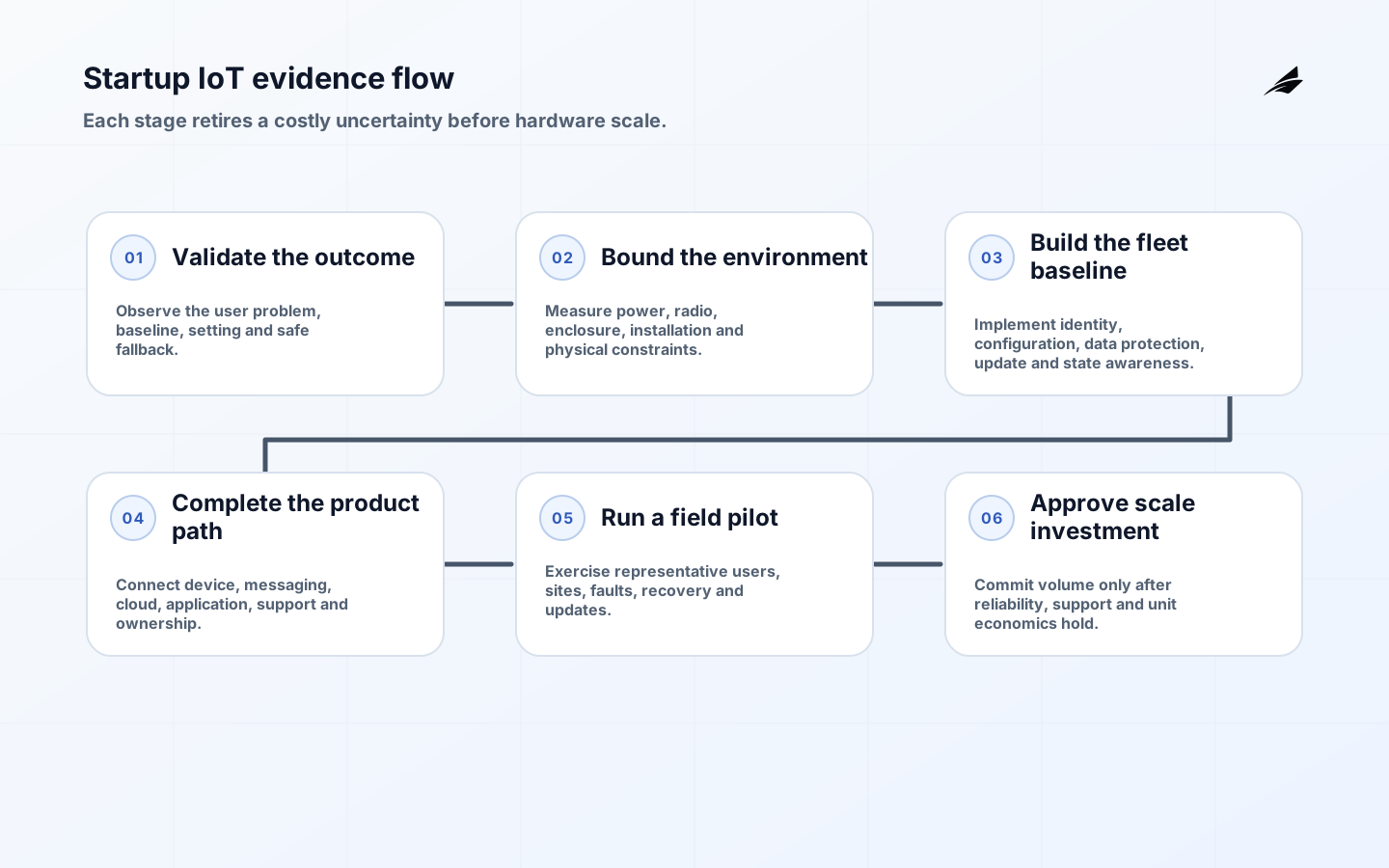
An IoT software development company for startups must connect a physical product, embedded software, communications, cloud services and user workflows under severe time and cash constraints. A polished dashboard can hide weak device identity, unsafe updates or impossible support economics. Founders should select a partner by the uncertainties it can retire before hardware volume is committed. This FAQ explains how to scope that work and judge the resulting evidence.
The startup IoT delivery plan covers commercial scope and risk, while the production implementation checklist provides release gates. Products with financial workflows can also consult the finance IoT delivery guide and finance implementation checklist.
What belongs in an IoT MVP?
An IoT MVP is the smallest end-to-end product that can test the riskiest business and technical assumptions in its real environment. It needs a representative device, provisioning, connectivity, data path, user action, support signal and safe failure behavior. It does not need every report or automation. State the hypothesis, target user, setting, measurable outcome, safety boundary and decision that follows the pilot. A prototype without a decision criterion tends to accumulate features instead of evidence.
Describe the physical environment before choosing hardware: temperature, moisture, vibration, power, radio conditions, installation skill, enclosure, expected life and consequences of an incorrect command. Measure the manual baseline and identify offline behavior. If connectivity disappears, decide what the device may continue doing, what it must stop, how much data it buffers and how the user knows. Physical fallback is part of product design, not an operations detail.
| MVP question | Evidence to collect | Scale decision |
|---|---|---|
| Does the problem merit hardware? | Observed workflow, baseline cost and user outcome | Continue, change use case or stop |
| Can the device survive the setting? | Power, thermal, radio and fault test results | Revise components or enclosure |
| Is the data trustworthy? | Sensor calibration, timestamps, loss and duplicate analysis | Approve measurement limits |
| Can the fleet be controlled? | Provision, update, revoke and recovery demonstrations | Approve pilot expansion |
| Can support be afforded? | Installation time, contact rate and remote resolution | Set price, support model and margin |
How should the architecture be divided?
Separate device, gateway or mobile companion, network, cloud control plane, product application and enterprise integration. For each layer, record data, command authority, identity, update ownership, failure mode and replacement path. Keep product rules out of firmware where remote configuration can safely hold them; keep safety-critical behavior local where a cloud round trip would be fragile. Define message schema, units, timestamp source, sequence, retry and duplicate handling before building analytics.
Use device shadows or desired-versus-reported state carefully. A command request is not proof of physical execution. Record request, authorization, delivery, device acknowledgement and observed result separately. Commands should expire, be idempotent where possible and reject stale sequence. The cloud service must not infer success merely because a broker accepted a message. These distinctions become essential during support, safety review and customer disputes.
What security capabilities should exist from the first pilot?
NIST's April 2026 foundational activities for IoT manufacturers recommends identifying customer cybersecurity needs, determining how to address them and planning adequate support before sale. Apply that work during product definition. Maintain a threat model, component inventory, vulnerability intake, support period and disclosure contact. Security postponed until hardware certification or volume production becomes expensive to retrofit.
The NIST IoT technical baseline covers device identification, configuration, data protection, logical interface access, software update, cybersecurity state awareness and device security. Translate it into testable product requirements. Give each unit a unique identity, protect credentials against extraction, authenticate control messages, minimize interfaces, restrict configuration and expose enough state to investigate compromise. Do not ship one fleet-wide password or secret.
Security also needs a support organization. The NIST non-technical baseline covers documentation, receiving questions and vulnerability reports, disseminating information, and education. Publish supported versions, update instructions, known limitations, secure configuration and end-of-support policy. A startup can use a simple monitored disclosure channel and response workflow; it cannot responsibly rely on customers discovering fixes by chance.
How should provisioning and firmware updates work?
Provisioning should bind a physical unit to a logical identity and authorized owner without exposing a reusable bootstrap secret. Record manufacturer, model, hardware revision, software version, certificates, tenant, installation and lifecycle state. Support transfer, replacement and revocation. Factory records and cloud registry must reconcile; otherwise a returned or stolen unit may retain access. Test interrupted activation and duplicate scanning in the actual installer workflow.
The IETF's IoT firmware update architecture separates roles such as author, distributor and device and describes authenticated manifests, update status and secure transport considerations. For a startup, sign update metadata and image, verify compatibility and version, prevent unauthorized rollback, stage rollout and preserve a recovery path. Exercise power loss, insufficient storage, corrupted download and incompatible configuration before field deployment.
What makes a field pilot representative?
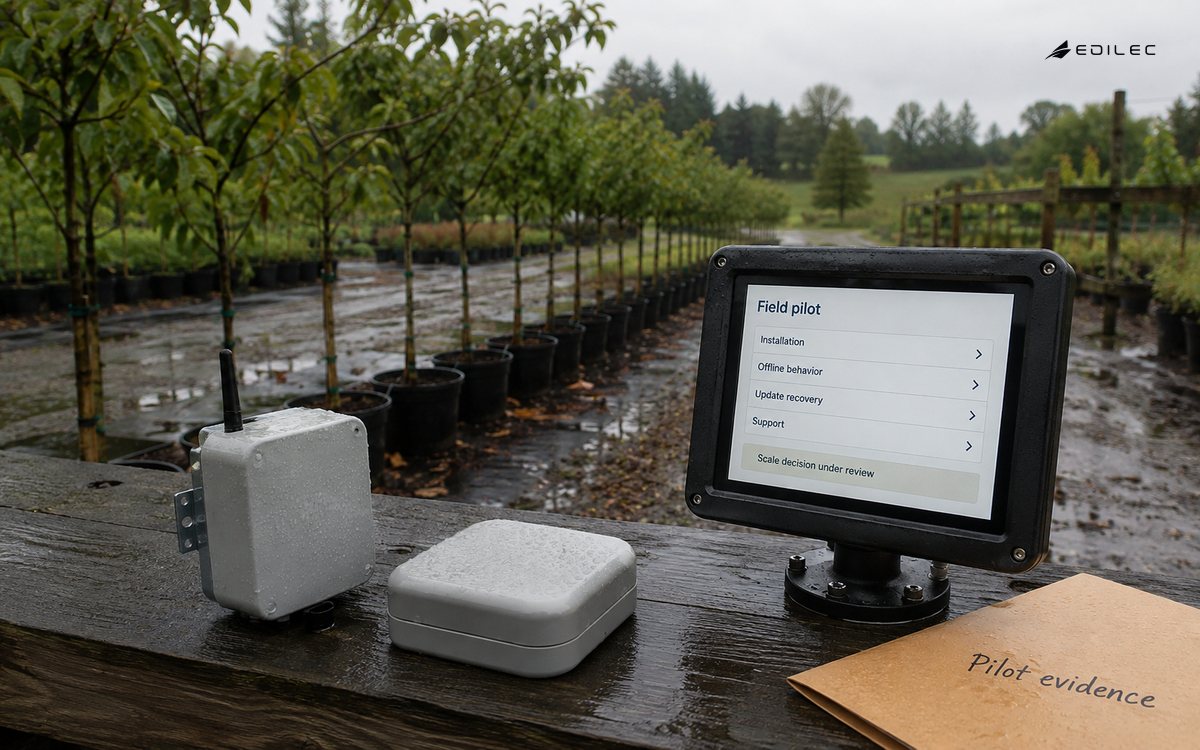
Select sites that expose expected variation in radio, power, users, installation and environment. A lab bench proves engineering basics, not product operation. Define cohort, duration, success thresholds and stop conditions. Instrument provisioning time, connectivity gaps, battery or energy, sensor quality, command success, firmware version, resets, support contacts and user outcome. Preserve privacy by collecting only what the decision requires and documenting consent where applicable.
Run fault drills deliberately: remove connectivity, restart the gateway, rotate a credential, corrupt a message, interrupt an update and restore the cloud service. Confirm that the device enters the designed safe state and recovers without duplicate action. Observe installation rather than relying only on a survey. A pilot should reveal which failures can be diagnosed remotely and which require a visit, replacement or user instruction.
| Pilot gate | Pass evidence | Stop or revise trigger |
|---|---|---|
| Installation | Target users complete setup within the allowed time | High expert intervention or ambiguous ownership |
| Data quality | Known accuracy, completeness and time behavior | Unexplained drift, loss or unit mismatch |
| Resilience | Offline, restart and retry behavior match design | Unsafe state or unrecoverable local corruption |
| Update | Staged signed release and rollback work in field conditions | Unbounded failed devices or no recovery route |
| Support | Cases correlate with device state and remote remedy | Frequent truck roll or missing diagnostic evidence |
How should founders select and contract a development company?
Evaluate the actual embedded, cloud, mobile, security, quality and hardware-integration team. Ask candidates to explain a field failure, interrupted update, manufacturing handoff and fleet migration. Inspect redacted architecture decisions, automated tests, device simulators, telemetry and release records. Confirm ownership of source, build definitions, signing keys, cloud accounts, domain names, test fixtures and manufacturing data. A demonstration built entirely in a vendor account creates avoidable exit risk.
Contract in evidence-bearing stages: architecture and risk reduction, engineering prototype, representative pilot, production readiness and scale support. Each stage needs working acceptance, assumptions and an exit. Fixed price suits a bounded deliverable; time and materials suits discovery with visible backlog and burn. Include component lead times, certification, test hardware, cloud consumption, connectivity, field work, security maintenance and post-launch support in the cost model.
CISA's Secure by Design guidance asks manufacturers to own customer security outcomes, embrace transparency and accountability, and organize leadership around those goals. Test that posture in supplier discussions. Who receives vulnerability reports? How quickly can the company identify affected firmware? Can customers update without paid specialist work? What happens after the engagement ends? Product security must survive beyond initial delivery.
Which economics should be proven before scale?
Model bill of materials, manufacturing test, yield, freight, duties, connectivity, cloud ingestion and storage, third-party services, installation, warranty, replacements, support, returns, certification and eventual disposal. Express variable cost per active device and per useful customer outcome. Include failed and dormant units. Hardware gross margin can disappear when manual onboarding and field visits are ignored.
Commit volume only after demand, design stability, test yield and support evidence justify it. Use alternate components carefully because radio, power, timing and firmware behavior can change. Maintain a qualified component list and regression plan. Negotiate ownership and access to manufacturing test software and device credentials. End-of-life planning should define support duration, final update, credential revocation, data retention and safe physical retirement.
Key takeaways
- Define the MVP as an end-to-end evidence test in the real physical environment.
- Separate device, connectivity, cloud, product and integration responsibilities.
- Build unique identity, secure update and diagnostic state before the first field pilot.
- Test installation, offline behavior, faults and recovery with representative users and sites.
- Contract through decision gates and retain source, accounts, keys and manufacturing evidence.
- Prove support and fleet economics before committing to hardware volume.
Additional startup IoT FAQ
Should a startup build custom hardware immediately? Usually not before validating the outcome and physical constraints with development hardware or a reference design. Custom boards make sense when size, power, unit cost, sensing or certification requires them.
Is cellular better than Wi-Fi? Neither is universally better. Decide from coverage, provisioning, power, bandwidth, recurring cost, ownership and offline behavior. Test the intended locations.
Who should control signing keys? The product company should own governance and recovery for production signing, using protected key infrastructure and separated roles. A partner may operate parts under explicit access and handover rules.
When is the product production ready? When manufacturing, provisioning, security, update, observability, support, recovery, privacy, certification and unit economics are proven for the intended market, not merely when the feature demonstration works.
Conclusion
A strong IoT development partner helps a startup remove its most expensive uncertainties in the right order. Begin with the user and environment, prove the complete product path, secure the fleet lifecycle, and learn from representative field operation. Scale hardware only when reliability, support and economics are credible. That sequence protects runway while building a connected product customers can trust. Preserve pilot evidence and assumptions so each new market, device revision or manufacturing change receives a deliberate investment decision.