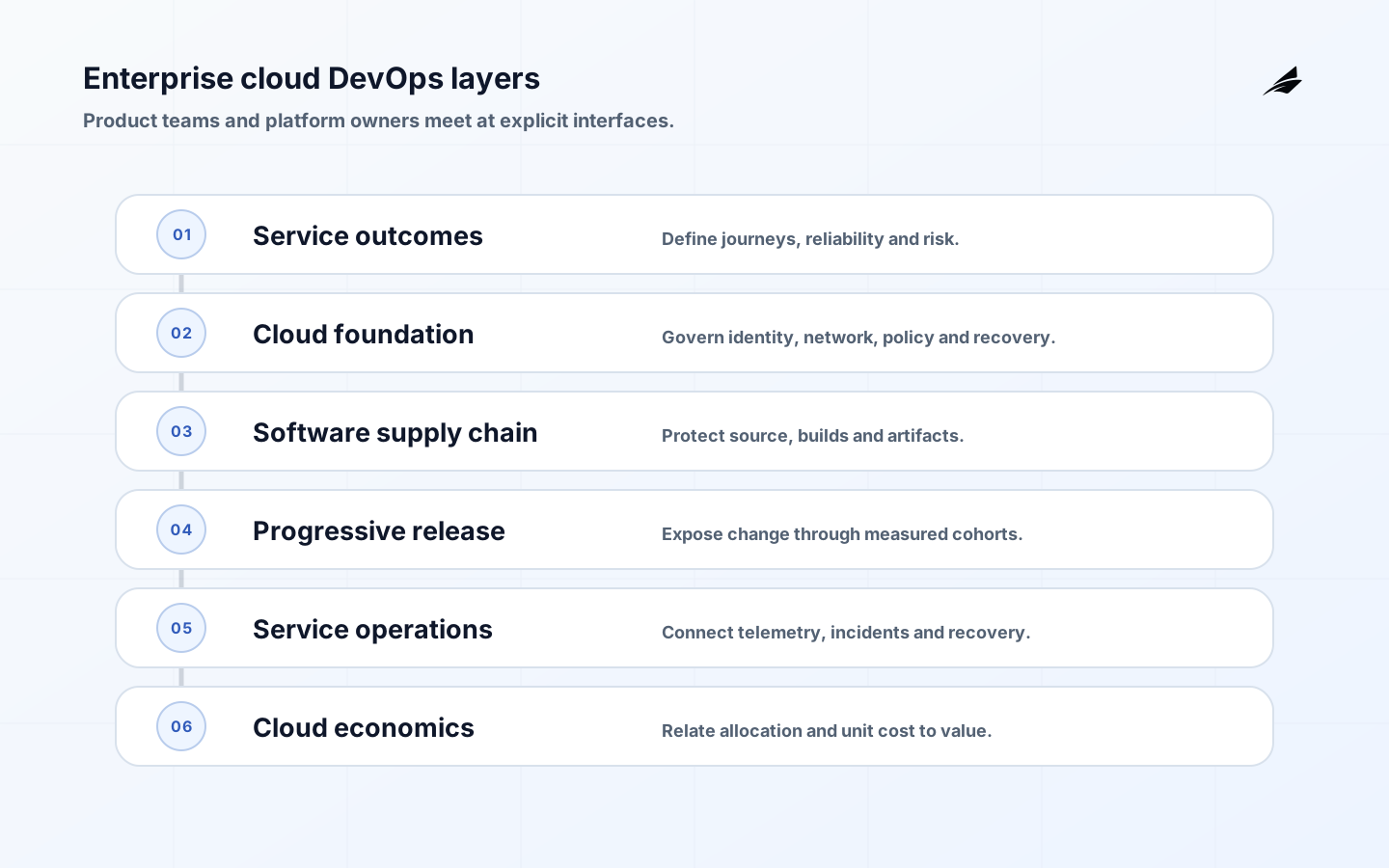
Cloud DevOps services for enterprise teams combine a governed cloud foundation, secure software delivery, service operations and cost accountability. The service is not merely a hosted CI tool or a team that responds to infrastructure tickets. It creates a repeatable route from reviewed change to a measured, recoverable production release while preserving enterprise requirements for identity, data protection, resilience, audit and supplier control.
This FAQ answers the questions buyers and platform leaders should settle before scaling the model across a portfolio. The enterprise cloud DevOps scope guide covers commercial planning, and the enterprise implementation checklist provides acceptance gates. The aim here is to make the operating choices clear enough for architecture, security, engineering, finance and procurement to reach one decision.
What should enterprise cloud DevOps services include?
A complete boundary usually covers account or subscription structure, workforce and workload identity, networking, policy, encryption, keys, secrets, logging, infrastructure modules, build and deployment paths, artifact storage, observability, backup, recovery, vulnerability response and cost allocation. It also names retained application-team duties. NIST SP 800-145 defines cloud characteristics such as on-demand self-service, resource pooling, rapid elasticity and measured service; governance must preserve those benefits without turning every request into a central ticket.
Publish the platform as a product with supported patterns, interfaces, service expectations and a feedback route. Application teams should know what is mandatory, configurable or unsupported. Central teams should not own every application deployment; they should provide safe defaults and policy-backed paths that product teams can use independently. Exceptions need a reason, compensating control, owner and expiry rather than a permanent parallel platform.
| Capability | Platform team owns | Application team retains |
|---|---|---|
| Cloud foundation | Account structure, identity integration, network patterns and policy | Workload classification and approved use |
| Delivery path | Build service, artifact controls, templates and promotion policy | Application tests, dependencies and release decision |
| Runtime | Approved compute, secrets, telemetry and resilience patterns | Service configuration, scaling behavior and runbook |
| Security | Control implementation, evidence interfaces and exception process | Threats, data handling and remediation |
| Operations | Shared observability, incident route and platform recovery | Customer journey, service objectives and on-call response |
| Economics | Allocation data, commitments and anomaly capability | Demand, architecture and unit-cost decisions |
How is security integrated without stopping delivery?
Translate security requirements into platform controls and understandable pipeline checks. Federate identity, remove routine shared credentials, use short-lived workload credentials, protect source and pipeline administration, isolate builds, verify dependencies, create immutable artifacts and preserve deployment evidence. NIST's SSDF provides practices that can fit different development lifecycles; it is a common vocabulary for producers and purchasers, not a prescribed tool chain.
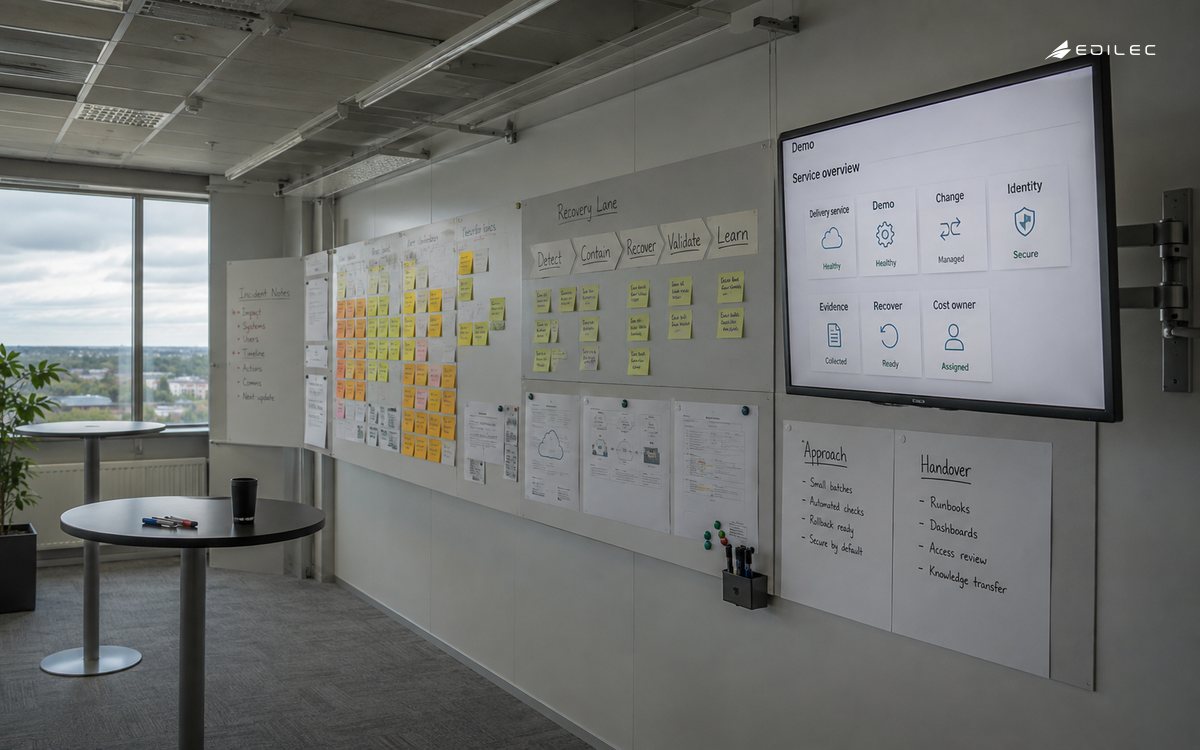
NIST SP 800-204D applies software supply-chain security to CI/CD components and flows. For each production artifact, retain its source revision, build inputs, dependency inventory, test and policy results, digest, approver and deployment target. Separate the authority to change a pipeline from the authority to approve a consequential release. Emergency access should be time bounded, monitored and reviewed after use.
How should an enterprise migrate existing applications?
Start with a portfolio inventory and segment by business criticality, architecture, data, compliance, deployment method and support readiness. Do not force unlike systems through one migration factory. Choose one representative but recoverable service, build its end-to-end path, and use the evidence to revise the platform contract. A mainframe release, packaged enterprise application and cloud-native API may share governance outcomes while needing different implementation patterns.
Run old and new paths only for a defined comparison window. Reconcile configuration and artifacts, test production-like permissions, and establish cutover, rollback or roll-forward criteria. Data changes require compatibility across versions and a tested recovery path; infrastructure rollback alone cannot undo an irreversible schema operation. Retire old credentials, workers, artifact stores and manual runbooks when the new path is accepted, or they will remain an ungoverned release route.
Who owns reliability and incident response?
The service owner owns the customer promise. Platform teams own platform behavior; application teams own application behavior; both participate when the fault boundary is unclear. Define service level indicators around critical journeys, set objectives and an escalation route, and make dependencies visible. The managed-service contract should say who declares an incident, who can stop a rollout, who communicates with customers and who restores each layer.
Observability must connect symptoms to changes. OpenTelemetry signals include traces, metrics and logs, with baggage as contextual information propagated between signals. Instrument service, environment and version consistently, but avoid placing secrets or unnecessary personal data in telemetry. Test an unavailable collector, delayed log pipeline and missing trace context so monitoring failure does not silently become service blindness.
Recovery objectives require exercises. Restore representative data into an isolated environment, recreate infrastructure and configuration, and complete a critical user journey. Exercise identity-provider, region, artifact-store and key-dependency loss according to business risk. Record actual recovery time and recovered data point, then repair the system or the stated objective. A backup-success dashboard is not proof that the application can resume.
Which DevOps metrics are useful at enterprise scale?
DORA's current five software delivery performance metrics cover change lead time, deployment frequency, failed-deployment recovery time, change fail rate and deployment rework rate. Apply them to an application or service in context and review movement over time. Aggregating unlike workloads into one enterprise score or setting individual targets invites distorted behavior. Pair delivery measures with reliability, customer outcomes, security findings and cost.
| Signal | Question it answers | Misuse to avoid |
|---|---|---|
| Change lead time | Where does a committed change wait? | Treating every waiting period as developer delay |
| Deployment frequency | Can a service release in useful small batches? | Setting one target for all workloads |
| Change fail rate | How often does change impair the service? | Hiding incidents through narrow definitions |
| Recovery time | How quickly is failed deployment service restored? | Substituting ticket closure for recovery |
| Deployment rework | How much unplanned repair follows release? | Counting planned iteration as failure |
| Journey objective | Did users receive the intended service? | Reporting infrastructure health alone |
How should cloud cost and provider dependence be managed?
Make ownership and allocation part of provisioning, not a spreadsheet cleanup. Report unallocated spend, anomalies and commitment coverage, then relate cost to a useful unit such as transaction, active tenant or processed order. The FinOps Framework describes collaboration among engineering, finance and business roles so decisions connect cost with value. Include support, observability, data transfer, resilience and people in total operating cost.
Provider dependence is a design decision, not automatically a defect. Managed databases, identity and serverless services can remove substantial operating work. Document the business benefit, data export, configuration ownership, replacement effort and conditions that would trigger exit. Avoid costly theoretical portability for every component, but retain source, data, keys, architecture records and the ability to restore service without a consulting supplier's private account.
What belongs in a managed-service agreement?
Define supported hours, severity, response and restoration expectations, change authority, maintenance communication, subcontractors, data locations, privileged access, incident notification, evidence retention, vulnerability handling and exit assistance. Separate service response from service outcome: an acknowledgement in 15 minutes does not restore checkout. Include capacity for planned improvement so the agreement does not reward keeping a fragile system barely within ticket targets.
Acceptance should include a customer-led release and an injected failure. Enterprise staff should change source and infrastructure, promote one artifact, observe it, stop or recover a bad release, restore data, review access and attribute cost. The general cloud DevOps implementation checklist provides a smaller-team view, while the cloud DevOps FAQ covers foundational questions without the portfolio layer.
How should the platform be reviewed after launch?
Run a monthly service review around product-team friction, policy exceptions, failed releases, recovery exercises, platform reliability and unallocated cost. Look for repeated manual steps and unsupported patterns that indicate a missing platform capability. Separate demand the platform should absorb from application-specific work that remains with the service team. Publish decisions and owners so feedback does not become an unprioritized queue.
Quarterly, review the supported catalog and supplier dependencies. Retire obsolete modules, credentials and base images; rehearse a provider or tooling failure; and confirm that emergency access and restore routes still work. Expansion should follow evidence that an existing pattern is understood and operable. A platform with more templates but unresolved ownership and recovery gaps has grown its maintenance surface, not its enterprise capability.

Key takeaways
- Define cloud DevOps as an owned platform and operating model, not a pipeline purchase.
- Publish mandatory controls, supported patterns, application duties and exception paths.
- Protect source, builds, artifacts and deployment authority as production assets.
- Migrate representative services end to end and retire the old release route after acceptance.
- Measure each service in context across delivery, reliability, security, cost and customer outcomes.
- Prove handover through a customer-led release, incident and recovery exercise.
Additional enterprise cloud DevOps FAQ
Does DevOps eliminate change approval? No. It automates repeatable evidence and low-risk policy decisions while preserving explicit authority for exceptional or consequential change. Approval should be proportionate to risk.
Should every team use one tool chain? Standardize interfaces, evidence and the paved path where that reduces cognitive load. Permit justified alternatives for materially different workloads, with equivalent controls and ownership.
Can cloud DevOps be fully outsourced? Execution can be contracted, but business risk, service outcomes and supplier governance remain enterprise responsibilities. Keep enough internal authority and knowledge to direct, verify and exit the service.
What should be modernized first? Select an important, recoverable service that exercises identity, data, deployment, telemetry and operations. The first slice should reveal the real platform constraints without concentrating unacceptable risk.
Conclusion: operate one dependable delivery system
Cloud DevOps services for enterprise teams succeed when product teams can deliver safely through a platform whose controls, ownership, recovery and economics are visible. Establish one complete path, test it under failure, learn from service-level evidence and expand through supported patterns. Scale the capability, not a collection of disconnected tools and supplier tickets.