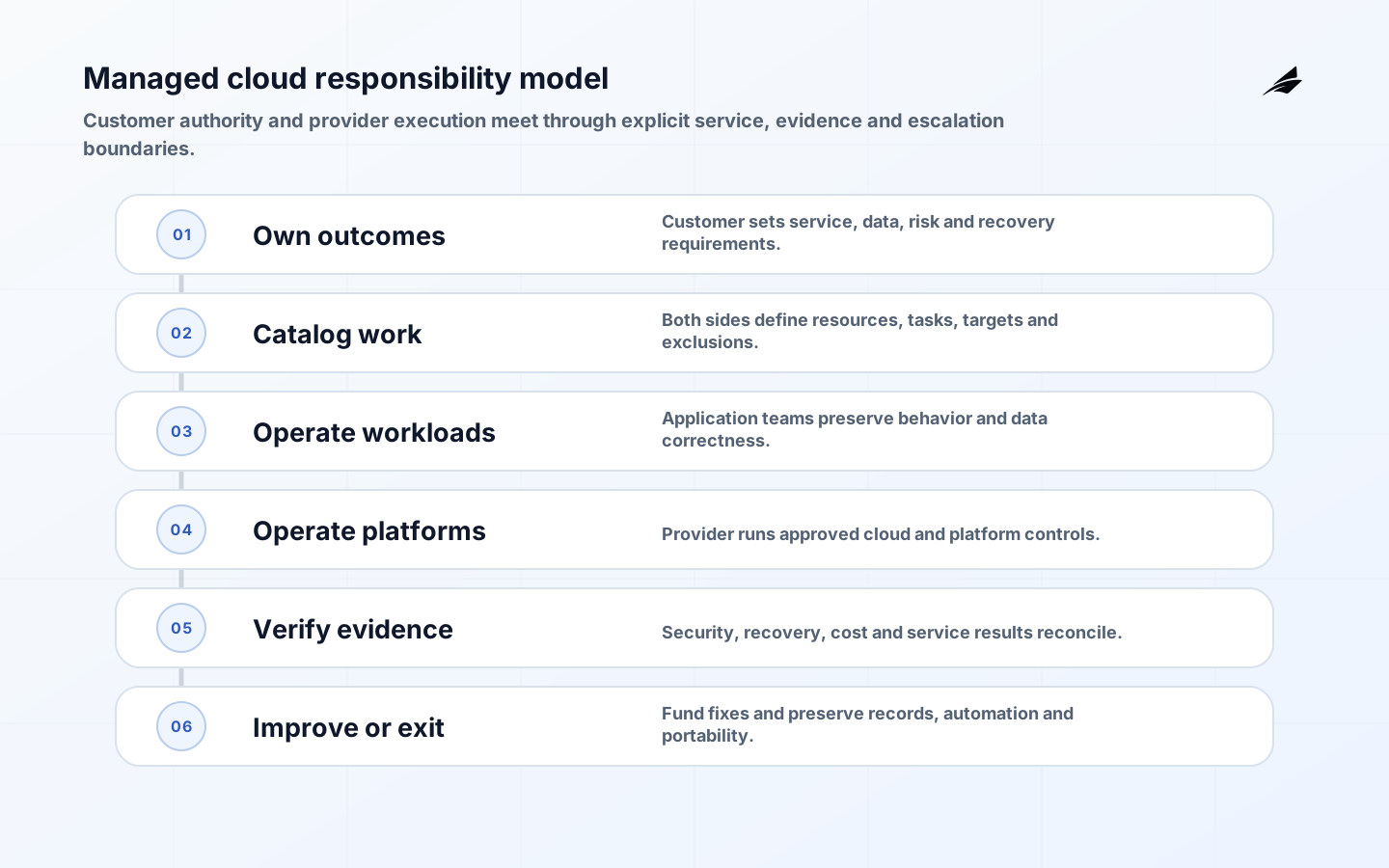
Managed cloud services transfer defined operational activities to a provider; they do not transfer accountability for the business service. A useful arrangement specifies which accounts, resources, events and decisions the provider owns, what internal teams retain, and how both sides prove completion. The label can cover monitoring, patching, backup, platform operation, security workflows, cost management and support, but no universal package exists. Buyers should evaluate the operating model rather than assuming that the word managed resolves every boundary.
This managed cloud services FAQ addresses the questions that matter during selection and operation. It complements the scope and pricing guide and implementation checklist. NIST’s service models explain how technical control changes across infrastructure, platform and software services. A managed provider adds another responsibility layer, so contracts, runbooks, access and evidence must state who acts at each layer.
What should managed cloud services include?
The service catalog should define outcomes, eligible resources, hours, request paths, response targets, dependencies and exclusions. Backup management, for example, needs protected assets, schedule, retention, failed-job handling, restore testing and recovery authority. Monitoring needs telemetry sources, alert ownership, triage rules and escalation. Patching needs asset coverage, severity policy, maintenance windows, exception handling and verification. Broad activity labels invite disputes because they do not reveal the complete operational result.
Map catalog entries to business services and internal owners. A provider may operate Kubernetes while a product team owns application correctness; security may approve policy while the provider applies configuration; finance may own commitments while engineering controls usage. Include decision authority: who may isolate an account, approve emergency change, accept residual risk or declare disaster. The catalog should distinguish recurring operations, standard requests, chargeable changes and projects so ordinary lifecycle work is not renegotiated after launch.
How is shared responsibility documented?
Create a layered matrix from the cloud provider through tenant, platform, workload, data and business process. For each control, identify who designs, implements, approves, verifies, monitors and responds. These roles can differ. The managed provider may implement access policy, the customer security owner may approve it and internal assurance may test evidence. Conditional ownership is valid: the provider may patch a managed database while an application team patches a virtual machine image.

Pair the matrix with operational interfaces. Define how inventories synchronize, vulnerabilities enter queues, releases announce dependency changes, incidents cross organizations and evidence is retained. Use stable identifiers for accounts, resources, services and owners. Run a scenario through the documents: expired certificate, failed backup, privileged request or sudden traffic surge. If participants need informal contacts or hidden knowledge to complete it, the responsibility model is incomplete.
| Service area | Provider responsibility | Customer authority |
|---|---|---|
| Identity | Operate approved roles and privileged access workflow | Define policy and approve exceptional authority |
| Recovery | Run backups, restores and evidence collection | Set recovery objectives and declare business recovery |
| Security response | Detect, triage and perform authorized containment | Own risk, notification and external communication |
| Cost | Allocate spend, forecast and surface anomalies | Approve budgets, commitments and product trade-offs |
Which service levels matter beyond availability?
Availability targets matter, but they rarely describe the whole customer outcome. Define targets for incident acknowledgement, restoration, backup success, tested recovery, patch completion, change success, alert delivery and request fulfilment. Specify measurement source, reporting window, maintenance and exclusions. A monthly average can hide one long disruption or repeated short failures. Pair aggregate values with maximum event duration where the business consequence warrants it.
Connect targets to decisions. Repeated misses require corrective work, not only service credits. Review queue age, certificate expiry, capacity headroom and unresolved high-risk findings as leading indicators. Service credits allocate commercial consequence but do not recover data or customer trust. Use error budgets or equivalent rules to change release and improvement priorities when reliability tolerance is consumed. Ensure the provider cannot improve a metric by suppressing alerts or reclassifying incidents.
Who owns security, compliance and cloud cost?
The customer retains authority over data classification, lawful use, risk acceptance and access policy. A provider can operate baselines, vulnerability workflows, logging, keys and privileged access. Require individual attribution, least privilege, time-bound elevation and customer visibility into material actions. Define incident notification thresholds, evidence preservation and containment authority before an event. Provider certifications are useful assurance inputs, not proof that the customer workload is configured or used correctly.
For cost, require billing-data access, allocation rules, anomaly handling, forecasts and named budget owners. Separate provider fee, cloud consumption, licenses, transfer, support and transition work. Track useful unit measures when the product model supports them, but do not force artificial unit economics. Give the provider bounded optimization authority: scheduling nonproduction may be safe, while downsizing production or purchasing a long commitment requires customer approval. Verify realized savings after resilience and labor effects.
How should transition and exit work?
Transition starts with a reconciled inventory of resources, dependencies, owners, access, open risks, commitments and tools. Shadow operations should complete representative alerts, requests, deployments and restores before authority moves. Use entry gates per service rather than one ceremonial handover. Knowledge transfer is proven when the receiving team resolves real scenarios with current access and runbooks, not when a document repository has been delivered.
Design exit at contract start. Specify export formats and ownership for infrastructure definitions, configuration, logs, tickets, cost history, runbooks and repositories. Define access return, credential rotation, data deletion evidence, subcontractor obligations and transition support. Periodically test a bounded handback. Provider-native services may limit portability, but retaining authoritative records, automation source and internal decision capability reduces operational dependence.
| Lifecycle gate | Evidence | Reason to stop |
|---|---|---|
| Inventory | Resources, dependencies and owners reconcile | Unknown critical assets |
| Access | Least-privilege and emergency paths tested | Shared or missing identities |
| Operations | Representative incidents and requests completed | Unavailable runbooks or telemetry |
| Exit | Exports and access return exercised | Customer cannot recover authoritative records |
How is provider performance governed after go-live?
Use operational, service and executive cadences. Operational reviews cover incidents, changes, vulnerabilities, requests and anomalies. Service reviews examine objectives, recurring failure, capacity, roadmap and improvement work. Executive reviews address business outcomes, material risk and strategic dependence. All levels should use reconciled evidence and produce named decisions with dates. Persistent exceptions belong in a risk register with consequence, compensating control and expiry.
Measure improvements in the work system: faster safe restoration, fewer repeated incidents, stronger restore evidence, lower manual access and clearer allocation. Ticket count and alert closure can reward noise. Sample closed work for quality and customer outcome. Maintain a shared backlog for reliability, security, developer experience and cost, with reserved capacity. A service that handles today’s tickets but never reduces recurring failure becomes progressively more expensive.
Provider selection should test the proposed operating model rather than reward the longest service list. Give shortlisted providers the same representative scenarios and ask them to identify required access, customer decisions, evidence, escalation and excluded work. Inspect sample incident records, restore results, cost reports and runbooks with sensitive details removed. Verify subcontractors, support locations, personnel controls, automation ownership and the process for changing the service. References are most useful when the buyer asks about difficult transitions and failures, not only satisfaction with routine support.
Commercial review should connect fees to the actual estate and demand. Clarify how new accounts, regions, workloads, data volumes and support tiers change price; how projects are distinguished from recurring work; and whether service credits are the only remedy for repeated failure. Preserve audit and termination rights appropriate to the risk. A transparent provider will explain assumptions and customer dependencies before signature. That clarity is more valuable than a low headline fee that later expands through change requests for normal cloud lifecycle activities.
During due diligence, confirm how the provider handles unsupported resources, urgent vulnerabilities, cloud-provider outages and customer-caused incidents. The answer should identify the first diagnostic action, communication channel, decision authority and evidence retained. Ask the proposed delivery team to walk through the scenario rather than relying only on sales staff. This reveals whether the supplier's tooling, staffing and escalation model match the service described in the contract.
Key takeaways
- Define managed work as measurable outcomes with explicit exclusions.
- Assign design, implementation, approval, verification and response separately.
- Use reliability, security, recovery and cost evidence together.
- Prove transition through scenarios and make exit artifacts contractual.
- Fund a shared improvement backlog rather than measuring ticket volume.
Frequently asked questions
Does a provider replace the internal cloud team?
Usually not. The customer still needs service ownership, architecture, security authority, financial accountability and supplier governance. Internal roles may shift toward platform and product decisions, but outsourcing all informed authority creates dependence and weak assurance.
Should the provider have production administrator access?
Only where a cataloged service requires it. Use individual, time-bound, approved and logged access with narrow roles. Emergency access needs a trigger, strong authentication, review and revocation. Routine operations should prefer constrained automation identities.
Is multicloud automatically safer?
No. Multiple providers can reduce selected dependencies but increase identity, network, data, skill and governance complexity. Use multicloud where a specific business or resilience requirement justifies it, and test the complete recovery path rather than assuming provider diversity equals portability.
Conclusion
Managed cloud services work when responsibility is observable. A customer should be able to trace a business service through technical layers, identify who may decide and act, inspect evidence and understand cost. If an answer depends on a sales label or a few informal relationships, the service is not yet ready for dependable operation.
Before scaling, execute four tests: a service failure, a security event, a cost anomaly and an exit request. Close access, data, authority and evidence gaps that appear. This converts a provider contract from a promise of reduced burden into a tested operating model.