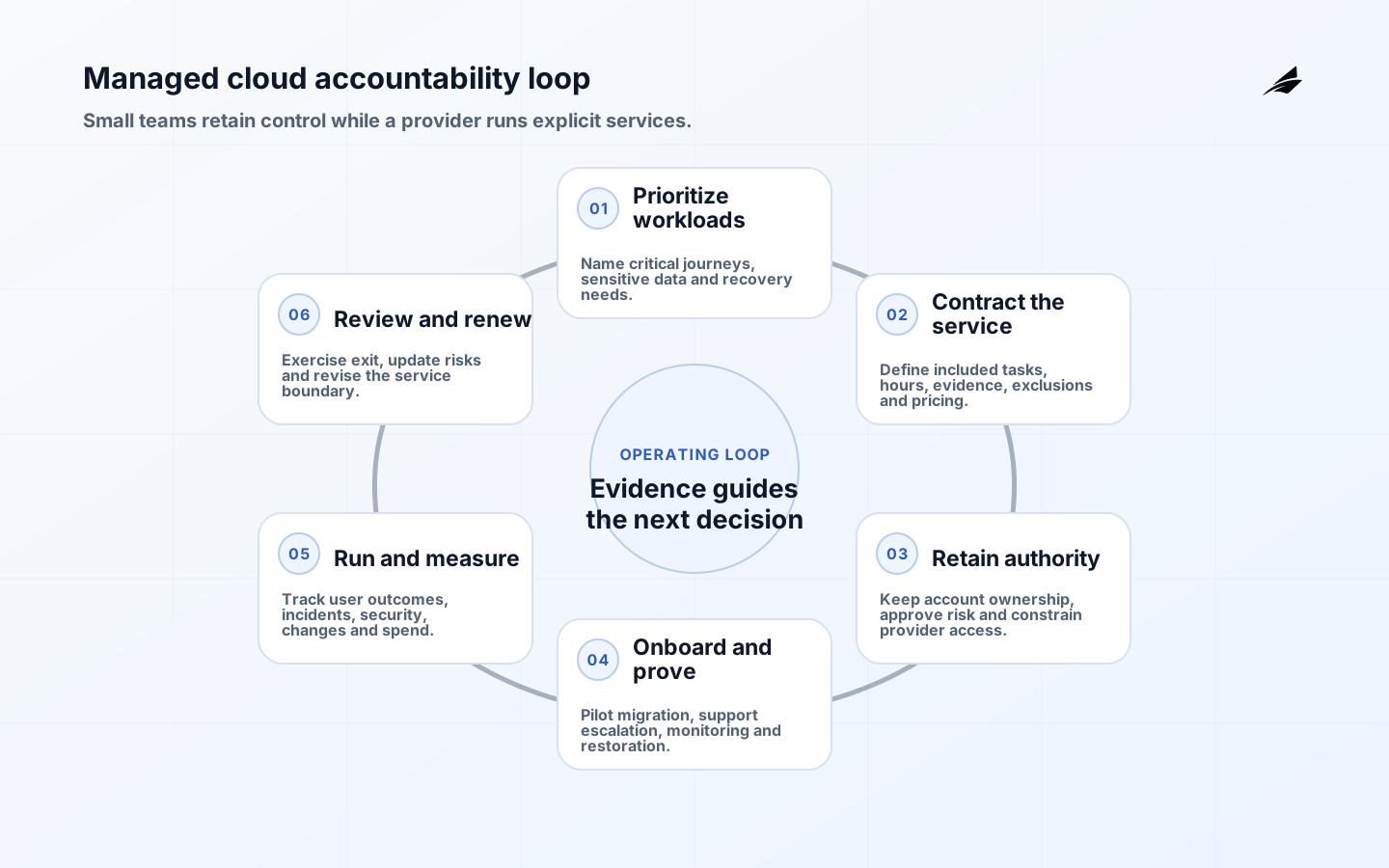
Managed cloud services for small business combine platform administration, security, reliability, cost oversight and support under an agreed operating boundary. The right arrangement gives a small team dependable capability it cannot sensibly staff around the clock. The wrong one hides responsibilities behind a help desk and turns every change into an extra fee. This FAQ helps owners and technical leads compare providers using workload outcomes, evidence and exit terms rather than badges alone.
For a full buying sequence, read the managed cloud scope and cost plan and the small-business implementation checklist. Teams comparing a broader operating model can use the managed cloud services buyer FAQ. Before requesting proposals, list the applications that generate revenue, hold sensitive data or stop staff from working when unavailable.
What should a managed cloud service include?
At minimum, define onboarding, account structure, identity, network, backup, patching, monitoring, incident response, change management, cost reporting, documentation and offboarding. Each activity needs service hours, response expectations, approval authority and evidence. Application support, database administration, user devices, SaaS administration and compliance work are often separate. Ask for a service catalog with included volumes and explicit exclusions. The phrase fully managed has no reliable meaning without that detail.
Architecture frameworks are useful due-diligence prompts. The Google Cloud Well-Architected Framework organizes guidance around operational excellence, security, reliability, cost, performance and sustainability. A provider need not follow one vendor's framework, but it should explain how it reviews these concerns for each workload and records trade-offs. Require a named service owner who can connect tickets, changes, risks and spending to business priorities.
| Service area | Questions to ask | Evidence each month |
|---|---|---|
| Reliability | Which journeys and recovery targets are covered? | SLO and restore-test results |
| Security | Who controls identities, keys and findings? | Access review and remediation age |
| Support | Who responds, when and through which channel? | Response and restoration by severity |
| Cost | How are spend and recommendations attributed? | Invoice reconciliation and owner actions |
| Change | Which work is included and who approves it? | Change success and rollback records |
Does management transfer cloud responsibility?
No. Cloud responsibility is layered. The AWS shared responsibility model distinguishes security of the cloud from customer responsibilities that vary by service. A managed provider may perform some customer tasks, but the small business still chooses data use, grants authority, approves risk and oversees the contract. Document responsibilities for every critical task, including the cloud platform, provider, software vendor and customer. Gaps commonly appear around application vulnerabilities, identity joiners and leavers, and restore validation.

Keep the cloud account and billing relationship in the customer's name when practical. Use federated, role-based provider access rather than shared owner credentials. Require individual attribution, multifactor authentication, emergency-access procedures and prompt access removal. The customer should retain read access to configuration, logs, costs and backups. If the provider alone can see or export the environment, oversight and exit become needlessly risky.
How should a small business assess security?
Begin with a simple data and workload risk assessment. Confirm baseline controls for identity, encryption, logging, vulnerability remediation, endpoint protection where relevant, backups, secure configuration and incident handling. Ask the provider to demonstrate how controls are monitored and exceptions age. Certifications can support diligence, but inspect scope, period, qualifications and customer responsibilities. A certificate covering a provider's corporate support system may say little about the configuration of your production account.
Agree the incident process before an emergency. NIST SP 800-61 Revision 3 places incident response within cybersecurity risk management rather than treating it as an isolated technical procedure. Define severity from business impact, who may contain systems, who contacts customers or authorities, where evidence is preserved, and how lessons become funded improvements. Run a tabletop with the actual contact list and a scenario such as stolen administrator credentials or destructive malware.
How should migration and onboarding work?
The provider should discover applications, dependencies, identities, data, licenses, certificates, integrations, backups, current costs and support commitments. Prioritize remediation that blocks safe operation before moving workloads. Microsoft's Cloud Adoption Framework covers strategy, planning, readiness, adoption, governance, security and management; the useful lesson for a small firm is that migration is one part of an operating change, not the finish line.
Pilot a representative workload and test monitoring, support escalation, deployment, restore and cost allocation. For each cutover, name the authoritative system, synchronization method, validation checks and rollback trigger. Protect staff availability during business peaks. At handover, require current architecture, inventory, credentials ownership, runbooks, known risks, open incidents and a 30-day stabilization plan. Do not accept a migration solely because infrastructure is running if users cannot complete the business process.
| Commercial model | Best fit | Watch for |
|---|---|---|
| Fixed monthly tier | Stable, clearly bounded environment | Low included change volume |
| Per-resource fee | Estate size tracks operating effort | Incentive to retain idle resources |
| Percentage of spend | Cost governance plus broad management | Fee rises when spend rises |
| Capacity retainer | Variable roadmap and specialist access | Unused hours and priority ambiguity |
| Hybrid | Baseline operations plus projects | Unclear border between included and extra |
What should managed cloud services cost?
Price depends on service hours, workload criticality, cloud complexity, compliance needs, change volume, support skills and provider liability. Compare three-year total cost: onboarding, platform consumption, provider fee, software tools, projects, incident work, data transfer and exit. Ask bidders to price the same workload inventory and assumptions. A low monthly fee can be expensive when patching, restore tests, architecture changes and after-hours response are excluded.
Require transparent billing data and owner-level allocation. The FinOps Framework treats cloud financial management as collaboration among engineering, finance, procurement and business stakeholders. For a small company, that can be a monthly review of material changes, idle resources, commitments, forecast and unit cost. Optimization recommendations should state performance and resilience impact. The provider should never buy a long commitment without the customer's informed approval and an exit analysis.
How can a business limit provider lock-in?
Lock-in comes from missing knowledge and inaccessible control as much as proprietary technology. Keep infrastructure definitions, runbooks, inventories and decisions in a customer-accessible repository. Specify data export formats, configuration handover, assistance hours, credential transfer, backup ownership and secure deletion. Test an export before renewal. Avoid bespoke management layers unless they create enough value to justify migration cost, and record which services could be replaced, how long replacement would take and what functionality would change.
Contract for an orderly transition on termination, including provider failure. Name minimum notice, cooperation with the successor, continuity during dispute and treatment of prepaid commitments. Maintain a current break-glass contact outside the provider's normal identity path. An annual exit tabletop is inexpensive: ask whether the company could reach its accounts, understand dependencies, restore critical data and operate for the first week after provider access ends.
How should success be measured?
Use a small balanced scorecard: user-facing availability, high-severity incident restoration, restore success, critical finding age, change failure, support satisfaction, forecast variance and unit cost for a meaningful transaction. Report trends and exceptions, not just averages. Ticket closure is an activity measure, not a business outcome. For each missed target, document impact, cause, corrective action and owner. Review whether targets still match business hours, growth and customer promises.
Schedule monthly service review and quarterly risk review. The monthly meeting resolves operational actions; the quarterly review revisits architecture, suppliers, recovery, data, capacity and contract fit. Give one customer owner authority to prioritize work and one provider owner accountability for coordination. Small teams benefit from simplicity: a short decision log and five maintained runbooks are better than a large portal of stale documents.
Test provider performance with one end-to-end service exercise each quarter. Choose a realistic event such as a failed certificate renewal, accidental data deletion or sudden traffic increase. Start through the normal support channel, observe triage and escalation, require business-facing communication, and validate restoration or containment. Review elapsed time, authority, evidence and follow-up actions. This reveals whether the provider's tools, people and contract work together, and it gives a small business stronger evidence than a report containing only ticket averages. Track the corrective actions to closure.
Key takeaways
- Buy an explicit service catalog, responsibility matrix and evidence set, not a vague promise.
- Retain account ownership, visibility and authority over material risk.
- Test incident response and restoration during onboarding and at regular intervals.
- Compare lifecycle cost and commercial incentives, not only the monthly provider fee.
- Keep documentation and an exercised exit route in customer-controlled locations.
Frequently asked questions
Does a small business need multi-cloud?
Usually not for its own sake. Multi-cloud adds identity, networking, security, skills and cost complexity. Use another provider when a workload has a specific capability, customer or resilience requirement that justifies it. Portability through backups, documented architecture and replaceable interfaces is often more valuable than operating every workload twice.
Should we keep any cloud skills in-house?
Yes. Retain enough knowledge to own priorities, approve access and risk, interpret service reports and lead an exit. This may be a technically capable employee or fractional adviser rather than a full platform team. Outsourcing execution without informed ownership makes both oversight and procurement weak.
Are service credits enough protection?
No. Credits cap a small portion of fees and cannot restore customers, data or reputation. Use them as one accountability mechanism alongside incident duties, recovery targets, security terms, insurance, liability, cooperation and termination rights. Operational rehearsals provide more protection than an ambitious number that has never been tested.
Conclusion
Managed cloud services can give a small business disciplined operations and access to scarce skills, but only when the boundary is visible. Define workloads and responsibilities, retain control of accounts and evidence, test recovery, inspect full cost and keep an exit route. A provider relationship built this way expands capability without asking the business to surrender understanding.