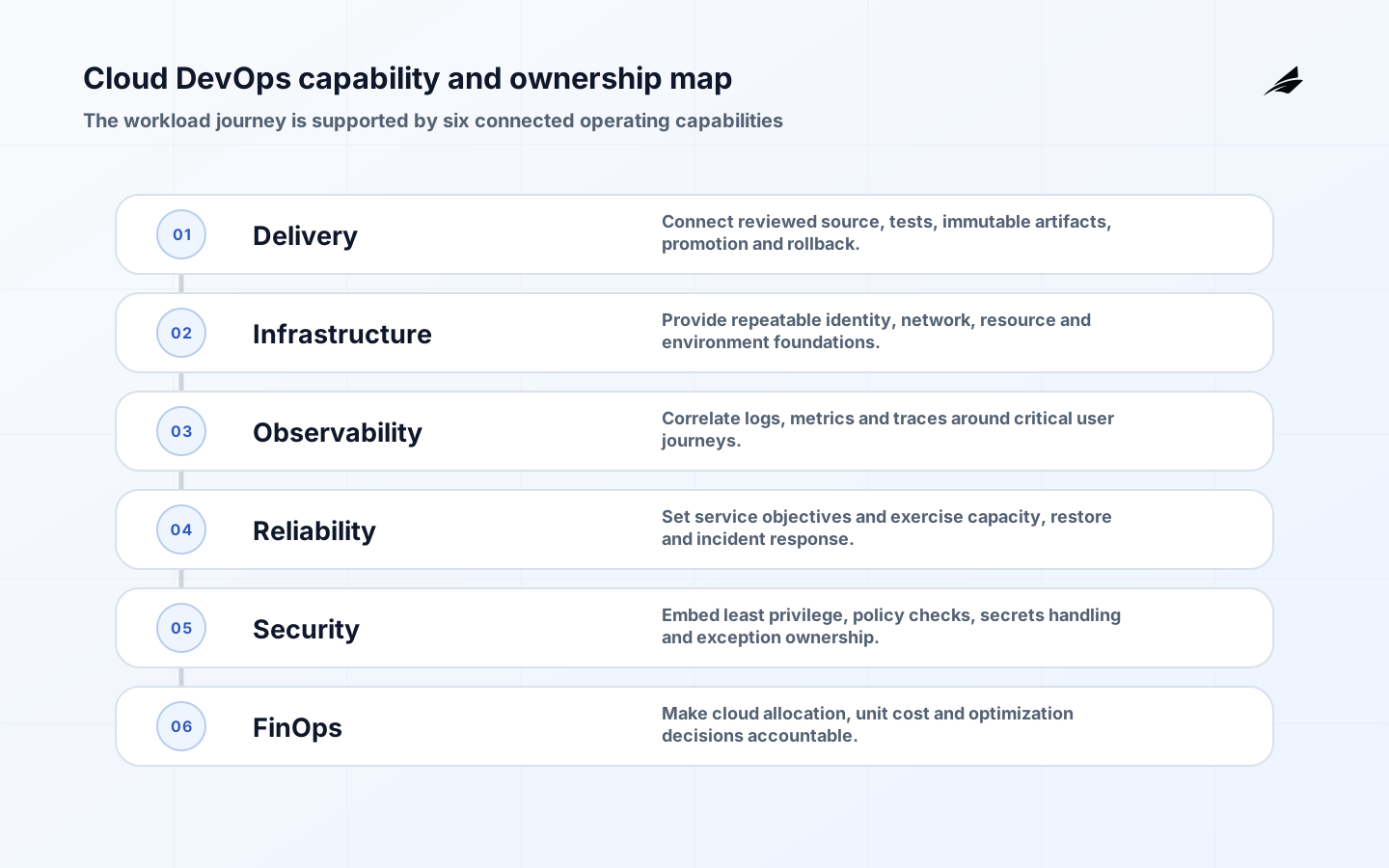
Cloud DevOps services should create a repeatable way to provision, change, observe and recover a cloud workload. The deliverable is not simply an account, Kubernetes cluster, Terraform repository or pipeline. It is an operating capability with clear ownership, secure defaults, measurable reliability, cost visibility and a team that can sustain the system after the engagement.
This guide helps technology leaders define and compare cloud DevOps proposals. It separates foundation engineering, developer enablement, reliability and managed operations; explains cost drivers and shared responsibilities; and provides rollout and acceptance criteria. The right scope depends on the workload and organization, not on how many fashionable platform components a provider can list.
What a buyer is really selecting
The phrase cloud DevOps services covers several different purchases. A company may need a secure landing zone, infrastructure automation, release pipelines, Kubernetes or serverless operations, observability, reliability engineering, incident response, cloud cost governance or ongoing platform support. Buying an undifferentiated bundle makes ownership hard to test and proposals difficult to compare. Start with business outcomes and workload constraints, then select capabilities.
- Which customer journeys or internal operations depend on the platform?
- What cloud, regions, data classifications, availability needs and recovery objectives constrain the design?
- Which capabilities must the provider build, which must it operate, and which remain with internal product teams?
- What is the expected balance between standardization and product-team autonomy?
- How will reliability, delivery flow, security, cost and handover be accepted?
Cloud, cloud native, DevOps and SRE are related, not interchangeable
NIST defines cloud computing through on-demand access to a shared pool of configurable resources that can be rapidly provisioned and released, with essential characteristics and service and deployment models. That definition does not require microservices or Kubernetes. CNCF's cloud-native definition emphasizes programmatic, repeatable operation of loosely coupled systems that are secure, resilient, manageable, sustainable and observable. A well-designed virtual-machine platform or serverless product can therefore be a better fit than a container orchestration layer the team cannot support.
DevOps describes collaboration and delivery practices across development and operations. Platform engineering turns common infrastructure and delivery needs into supported internal products. Site reliability engineering applies software engineering to operations and uses service objectives to guide reliability tradeoffs. A provider may supply all three, but the proposal should name which responsibilities and artifacts belong to each.
| Capability | Typical outcomes | Core deliverables | Owner after launch |
|---|---|---|---|
| Cloud foundation | Governed accounts, identity, network, logging and policy | Landing-zone code, decision records, access model and controls | Cloud platform owner |
| Delivery platform | Repeatable build, test, artifact and deployment paths | Versioned workflows, runner model, environments and telemetry | Platform team with product-team participation |
| Observability and SRE | User-centered reliability signals and actionable response | Instrumentation, SLOs, alerts, dashboards, runbooks and reviews | Service owner and on-call function |
| Security engineering | Preventive guardrails and traceable exceptions | Threat model, policy as code, secret handling and evidence | Shared platform, security and application ownership |
| FinOps | Cost ownership, forecast and optimization workflow | Allocation model, reports, budgets and action register | Engineering, finance and FinOps |
| Managed operations | Defined support, incident, maintenance and improvement service | Service levels, escalation, patching, capacity and reporting | Provider and customer under a responsibility matrix |
Scope from workload outcomes and constraints
For each workload, record users, critical journeys, dependencies, data class, traffic shape, deployment unit, existing environments, compliance obligations, tolerance for disruption, recovery needs, support window and change cadence. Add organizational constraints: team skills, procurement, cloud commitments, approved regions, identity source and current tools. Then create a responsibility matrix across product, platform, security, data, finance, service desk and provider teams.
The scope should state exclusions. Application refactoring, test automation, database migration, end-user support, security incident response, third-party licensing and around-the-clock operations are often assumed but not included. Define dependencies and acceptance owner for each workstream. When a provider needs internal decisions or access, include response times and escalation; otherwise the timeline hides customer-side critical paths.
What the technical foundation should contain
| Domain | Decisions to record | Minimum operational proof |
|---|---|---|
| Identity and access | Human and workload identity, federation, privilege boundaries and emergency access | Joiner, mover, leaver and break-glass exercises produce auditable results |
| Network and edge | Ingress, egress, private connectivity, DNS, certificates, segmentation and inspection | A dependency and failure-path test confirms intended reach and denial |
| Resource lifecycle | Infrastructure as code, state, modules, environments, policy and drift handling | A clean environment can be recreated and unauthorized drift is detected |
| Software delivery | Source controls, runners, tests, artifacts, promotion, approvals and rollback | One immutable artifact is traced from reviewed source through production and recovery |
| Data protection | Encryption, key ownership, backup, retention, replication and deletion | Restore and deletion workflows meet the agreed scope and evidence requirements |
| Observability | Logs, metrics, traces, profiles where justified, retention and access | A critical journey can be followed and a known failure can be diagnosed |
| Operations | SLOs, alerts, on-call, incidents, changes, maintenance and capacity | A game day exercises detection, escalation, communication and recovery |
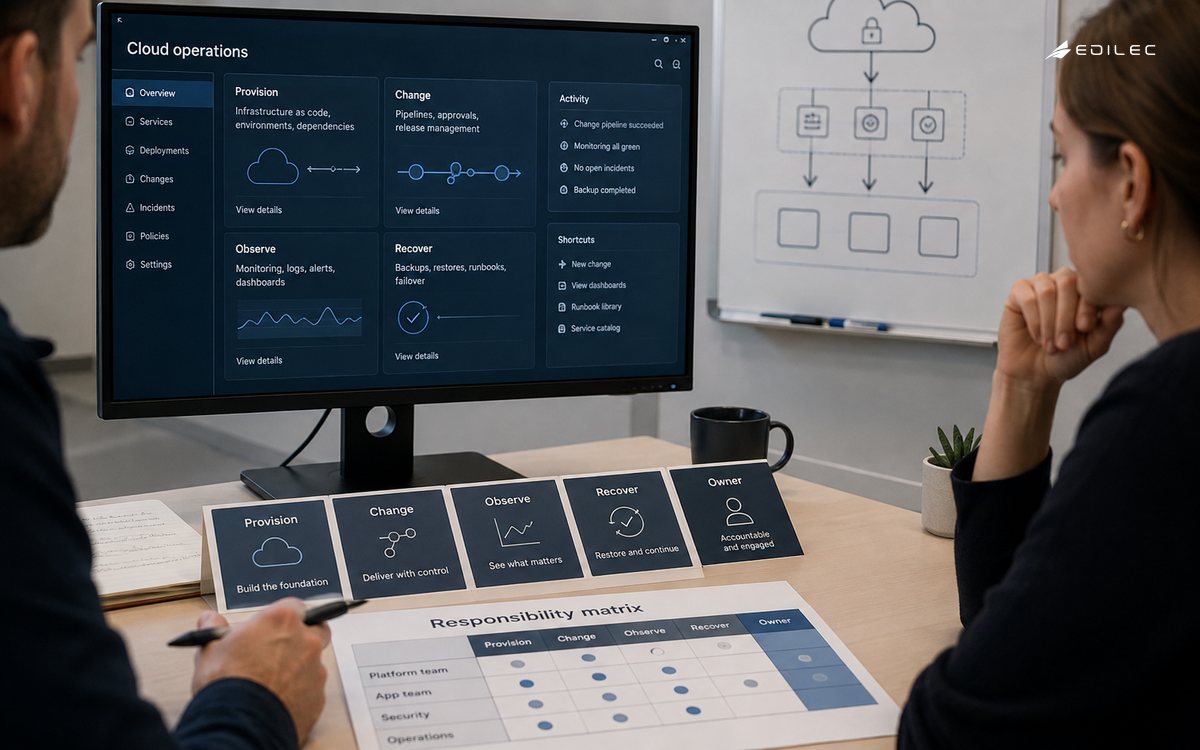
AWS and Google Cloud operational-excellence guidance both emphasize organization, automation, observability, controlled change, incident learning and continuous improvement. Use provider frameworks as review inputs, but keep requirements portable: frequent small reversible changes, actionable telemetry and owned procedures matter regardless of cloud. The CNCF definition likewise treats security, resilience, manageability, sustainability and observability as characteristics of the system, not optional add-ons.
Make reliability a product decision
Start SLOs with the user and critical interaction, not infrastructure uptime. Google SRE defines an SLO as a target for service reliability and uses error budgets to balance reliability with other engineering work. Select a small set of service-level indicators that reflect outcomes such as success, latency, freshness, correctness or durability. Establish how they are measured, their window, exclusions and owner. An API can have healthy CPU and still fail a checkout journey; host metrics alone are not service objectives.
Observability must support investigation, not merely collect data. OpenTelemetry describes metrics, logs and traces as complementary signals and explains how distributed traces follow a request across services. Define instrumentation conventions, service identity, correlation, sampling, retention and sensitive-data controls. Alerts should correspond to a user or operational consequence and have an owner and response. Review noisy or unused telemetry because collection also carries cost and privacy risk.
Pair SLOs with capacity, backup and recovery tests. A recovery time objective on paper is not proof that dependencies, credentials, data and people can restore the service. Schedule restore drills and game days, then turn findings into owned backlog items. The Production Incident Response guide provides a deeper operating workflow.
Integrate security into daily delivery
Use NIST SSDF to map secure development practices into the lifecycle, then define concrete cloud controls. Prefer federated, short-lived workload identity; least-privilege roles; centralized secret management; reviewed infrastructure modules; policy checks; protected environments; immutable artifacts; vulnerability ownership; audit logging and time-bound exceptions. Security findings need severity, responsible service owner, remediation expectation and an approved exception path. A scanner without operating decisions is not a control system.
Clarify the cloud shared-responsibility model at the service level. Managed databases reduce operating burden but do not choose data classification, access, backup retention or safe schema changes for the customer. Serverless removes server management but leaves application security, identity, observability and cost behavior. Put customer, provider and cloud-vendor responsibilities in one matrix and test the handoffs during incidents.
Use a thin platform and expand through demand
- Discover: map workloads, critical journeys, constraints, current toil, risk, cloud spend and ownership.
- Prioritize: choose one product outcome and a representative workload; define baseline and acceptance tests.
- Foundation: implement the smallest identity, network, infrastructure, delivery and telemetry path needed by the pilot.
- Pilot: deploy a real service, operate normal changes and exercise failure, rollback, restore and escalation.
- Productize: version reusable modules and workflows; publish documentation, support, service levels and exceptions.
- Migrate in waves: group workloads by architecture and risk, with readiness and exit gates for each wave.
- Operate and improve: review SLOs, delivery flow, incidents, security exceptions, platform adoption and cost; fund the resulting backlog.
Understand cost and commercial models
Implementation cost depends on workload diversity, controls, network topology, data migration, recovery needs, test readiness, support hours and internal decision capacity. Managed services can reduce operations while increasing usage charges or provider dependence. Kubernetes can suit a portfolio that benefits from its scheduling and ecosystem, but its platform and on-call burden is hard to justify for a few simple services. Architecture should follow total operating value, not a single infrastructure price.
| Commercial model | Strength | Risk | Contract control |
|---|---|---|---|
| Fixed discovery | Clear decision artifact and bounded initial spend | Becomes generic if access and stakeholder participation are weak | Name interviews, inventories, diagrams, risks and estimate outputs |
| Milestone delivery | Payment aligns with foundation, pilot and migration outcomes | Milestones can reward artifact completion over operability | Use production exercises and owner acceptance as exit gates |
| Capacity team | Flexible for evolving backlog and close collaboration | Scope and priority can drift without product governance | Set objectives, cadence, decision owner and outcome review |
| Managed service | Ongoing ownership, maintenance and response are explicit | Hidden exclusions and ticket-volume incentives | Define service hours, severity, response, resolution, maintenance and improvement |
A proposal should separate one-time foundation work, per-workload migration, cloud consumption, third-party licenses, support and optional improvement capacity. It should also state customer effort for decisions, access, application changes and acceptance. Avoid a single total that assumes unknown application remediation. Use discovery to classify archetypes, estimate waves and maintain a risk allowance that has explicit draw-down rules.
Common risks and mitigations
| Risk | Early signal | Mitigation |
|---|---|---|
| Over-engineered platform | Many components exist before a production workload uses them | Build a thin path around a representative service and add capabilities from demand |
| Provider dependency | Only the provider understands modules, alerts or release recovery | Use pairing, decision records, runbooks, repository access and staged handover |
| Unclear on-call boundary | Incidents bounce between application, provider and cloud support | Document severity, escalation and responsibility; exercise it in a game day |
| Security bypass | Teams create parallel accounts, credentials or pipelines | Improve the paved path, expose exception workflow and monitor unmanaged routes |
| Cost surprise | Logging, egress, idle capacity or managed services grow without an owner | Allocate costs, set forecast review and connect architecture changes to unit economics |
| Migration stall | Dual platforms persist and exceptions have no expiry | Fund application remediation, set wave gates and decommission credentials and infrastructure |
Acceptance criteria that test operability
- A named internal owner accepts each platform capability, its backlog and support route.
- Infrastructure and configuration can recreate the agreed environment without undocumented manual steps.
- A normal release and a failed release demonstrate traceability, health evaluation and recovery.
- A user-centered SLO has an approved measurement, target, owner and review process.
- A restore drill demonstrates the agreed scope, dependencies and evidence rather than only a successful backup job.
- Access, policy exception, incident escalation and cost-allocation workflows have been exercised.
- Documentation enables a target product team to onboard with measured, bounded support.
- Handover includes repositories, access, architecture decisions, known risks, licenses, maintenance calendar and training.
Measure outcomes in context. Delivery teams can track lead time, deployment frequency, failed deployment recovery, change fail rate and rework. Reliability owners track SLO compliance and error-budget decisions. Platform teams track adoption, onboarding time, support demand and exceptions. Security teams track control coverage, exception age and remediation. Finance and engineering track allocation and unit-cost trends. No single metric should become a provider score detached from workload demand and risk.
Key takeaways
- Separate cloud foundation, delivery, reliability, security, FinOps and managed operations in the scope.
- Choose architecture from workload outcomes, constraints and team capability rather than a default technology stack.
- Define provider, cloud-vendor and customer responsibilities at service level.
- Pilot a thin production path and exercise release, failure, restore and incident handoffs.
- Fund documentation, support, upgrades and continuous improvement as platform work.
- Accept operability and ownership, not only deployed resources.
Frequently asked questions
What are cloud DevOps services? They are engineering and operating services that make cloud resources and software changes repeatable, secure, observable and supportable. Scope can include foundations, infrastructure as code, CI/CD, observability, reliability, security, cost governance and managed operations.
Do cloud DevOps services require Kubernetes? No. NIST's cloud model and CNCF's cloud-native characteristics do not make Kubernetes mandatory. Containers, serverless, managed platforms or virtual machines can all be valid when they meet workload and operating needs.
What should remain in-house? The customer should retain business priorities, product ownership, risk acceptance, data classification and enough technical ownership to direct and govern the platform. A provider can operate components, but accountability for customer outcomes cannot be fully outsourced.
How do DevOps and SRE differ? DevOps is a broad set of collaborative delivery and operations practices. SRE is an implementation approach that applies software engineering to operations and uses SLOs and error budgets to guide reliability work. They can coexist in one operating model.
Should we buy a project or a managed service? Use a project when internal owners can operate the delivered capability. Use managed service scope when ongoing monitoring, maintenance, incident response or platform improvement needs external capacity. Many programs use milestone implementation followed by a clearly bounded operating period.
How should providers be compared? Compare discovery depth, responsibility model, target controls, pilot method, production acceptance tests, handover, support boundaries, decommissioning and cost transparency. Tool lists and certification counts are useful context but do not replace evidence of operable delivery.
Conclusion
The best cloud DevOps engagement leaves behind more than infrastructure. It establishes a supported path for change, user-centered reliability targets, diagnosable systems, tested recovery, constrained access and visible cost ownership. Define the service boundaries before selecting tools, prove the model with a real workload and make internal ownership an acceptance condition from the first milestone.