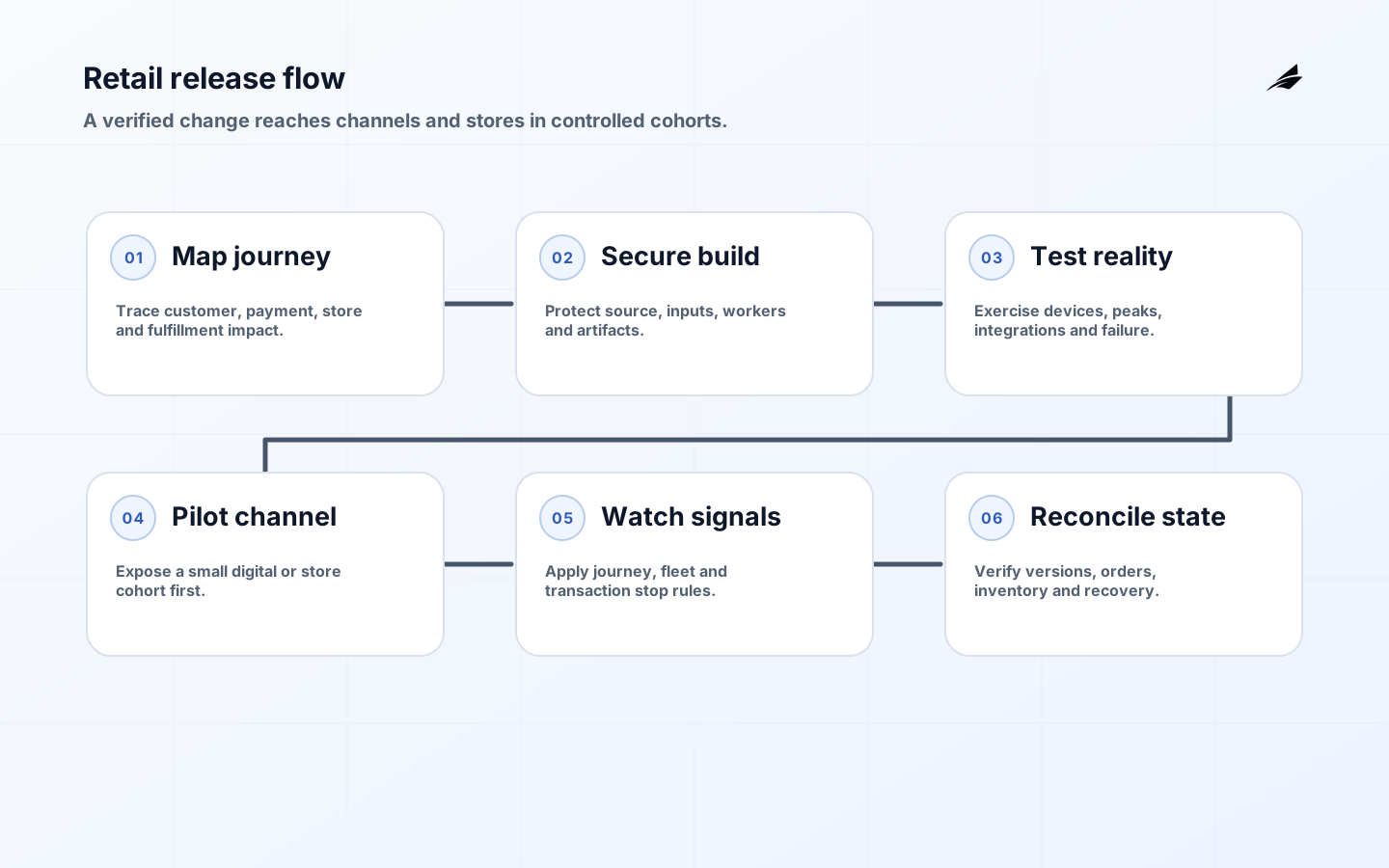
CI/CD modernization services for retail must support more than a web application. A retail release can touch checkout, pricing, promotions, inventory, fulfillment, loyalty, mobile apps, point-of-sale devices and integrations that continue operating through intermittent store connectivity. Modernization should shorten safe feedback while respecting payment-data boundaries, trading peaks, physical rollout constraints and the need to reconcile transactions after failure.
Retail technology leaders can use this guide to compare engagement scope, cost, risk, and rollout, then define what to buy and how to accept it. The retail CI/CD implementation checklist supports execution, while the retail CI/CD FAQ addresses narrower procurement questions.
Scope modernization around retail journeys
Map changes through real journeys: browse to payment, click-and-collect, return, price update, store opening and offline sale. Identify systems, data, devices, suppliers and manual fallbacks at each step. Baseline release lead time, handoff delay, failed deployment, recovery, escaped defect and coordination effort. Segment channels and locations because a successful cloud deployment does not prove that every store received, activated and reconciled the correct version.
Choose representative applications rather than beginning with the easiest repository. Include one customer channel, one store or edge component and one integration-heavy service if they are material to the estate. Record retained platforms, supported operating systems, device fleet constraints, change windows, data residency, payment scope and supplier release dependencies. Use the general CI/CD modernization scope guide for toolchain-wide contract decisions.
| Retail surface | Delivery concern | Required test or control | Release evidence |
|---|---|---|---|
| Digital storefront | Traffic variation and third-party scripts | Journey, performance and script-change checks | Cohort health and conversion guardrail |
| Checkout and payments | Account-data scope and failure consequence | Authorization, segmentation and provider sandbox tests | Approved artifact and transaction reconciliation |
| Store application | Intermittent network and device diversity | Offline, upgrade, rollback and hardware compatibility | Store cohort, version and activation result |
| Pricing and promotion | Time-bound rules across channels | Contract, boundary-time and cross-channel tests | Effective rule version and sampled prices |
| Inventory and fulfillment | Delayed and duplicate events | Idempotency, ordering and reconciliation | Lag, conflict and inventory delta |
| Loyalty and identity | Privacy and account misuse | Access, consent and abuse-path checks | Identity policy result and audit event |
Design the target delivery path
Create reusable paths by workload pattern: web service, mobile app, store package, data pipeline and infrastructure. Each path should define source policy, build environment, dependency resolution, test layers, artifact repository, promotion, release strategy and telemetry. Build once and promote the same immutable artifact. Keep environment configuration separate and controlled. A store package needs signed manifests and fleet targeting; a cloud service needs deployment identity and health thresholds.
NIST's SSDF helps organize secure-development responsibilities across preparation, software protection, secure production and vulnerability response. Translate those practices into evidence that the retailer can operate: attributable changes, isolated builds, dependency records, protected artifacts, risk-based checks and a supported remediation process. Avoid a single giant pipeline template whose conditional branches become harder to reason about than the systems it replaces.
Build representative retail test evidence
Put fast deterministic checks near the author: unit tests, static analysis, contract checks and policy. Run service integration and authorization tests against controlled dependencies. Use production-like performance shapes before peak periods, including promotion starts, inventory contention and payment-provider slowdown. Maintain a small set of critical synthetic journeys after release. Test failure paths such as lost connectivity, duplicate orders, expired offers and a timeout after payment authorization.
The OWASP Application Security Verification Standard can help teams define verifiable application-security requirements, but select the controls relevant to architecture and risk. For environments handling payment account data, determine scope with qualified compliance and security stakeholders and use the current PCI DSS resources. Pipeline automation supports evidence; it does not declare compliance or remove merchant responsibilities.
Release by channel, cohort and consequence
Separate deployment from exposure where possible. A commerce service can progress through internal traffic and customer cohorts. Mobile releases depend on app-store processes and client adoption, so maintain compatibility across supported versions. Store software should progress through lab devices, employee or pilot locations, representative regions and the wider fleet. Define stop conditions in advance: customer journey failure, payment errors, device health, queue growth, inventory divergence or support volume.
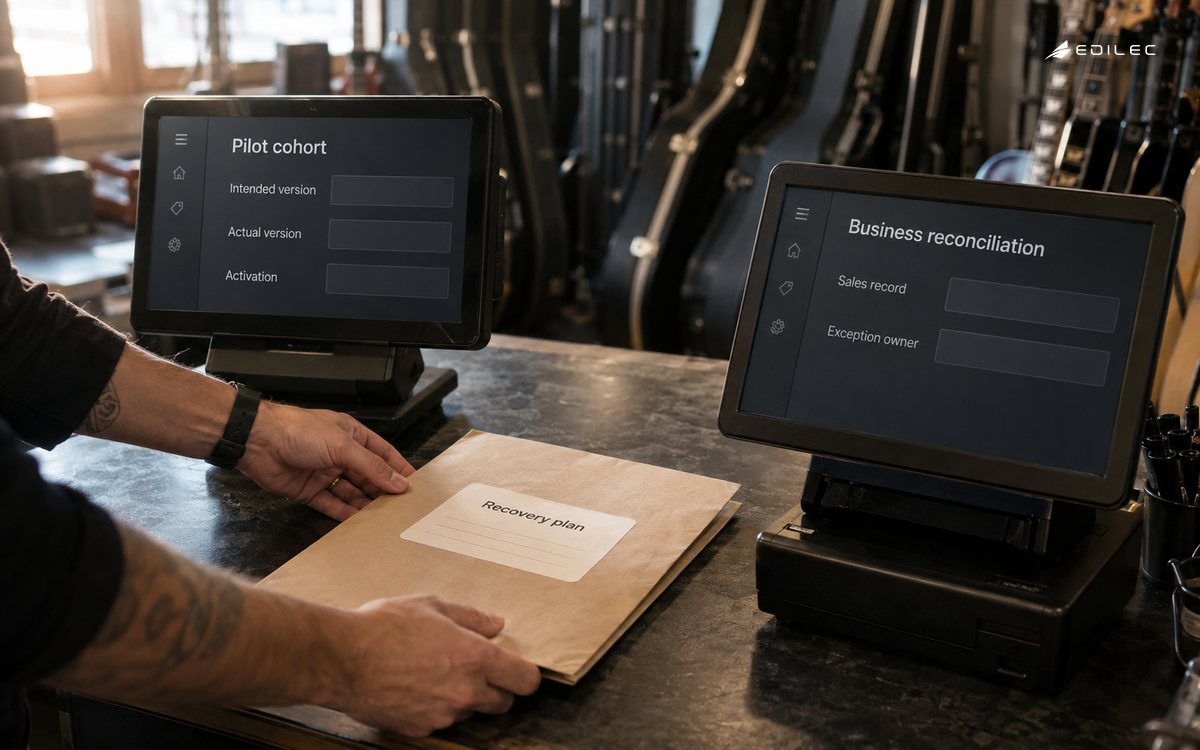
Rollback is not always safe. An application artifact may reverse cleanly while a schema, promotion state or completed transaction cannot. Use backward-compatible interfaces and expand-and-contract data changes, then define when to roll forward. Store devices may need local recovery when disconnected. Preserve the intended version, actual version, activation result and reconciliation status for each target so operators know whether a mixed fleet is expected or failed.
| Modernization risk | Control in the plan | Acceptance scenario | Measure |
|---|---|---|---|
| Peak-period disruption | Calendar guardrails and rehearsed freeze exceptions | Urgent fix follows controlled expedited path | Recovery time and rework |
| Nonrepresentative tests | Production-shaped data and device cohorts | Promotion and offline sale complete correctly | Escaped journey defects |
| Payment scope expansion | Documented data flow and isolated components | Release evidence maps to scoped systems | Unowned scope changes |
| Fleet fragmentation | Signed package, inventory and cohort targeting | Operator identifies and repairs missed devices | Version convergence time |
| Supplier dependency | Contract tests and degraded behavior | Provider timeout does not duplicate transaction | Integration incident rate |
| Legacy coexistence | Compatibility and retirement milestones | Old and new paths reconcile during transition | Dual-running cost and age |
Estimate cost from estate and transition complexity
Cost drivers include repository and build diversity, proprietary store platforms, device lab coverage, test-data preparation, payment and identity integration, release orchestration, security evidence, telemetry volume and the duration of old-tool overlap. Application remediation often costs more than installing a new orchestrator. Discovery should identify pipelines that can move mechanically and those requiring code, test or architecture work, then attach assumptions to each estimate.
Use commercial milestones tied to accepted workload patterns and migrated services. Include licenses, hosted runners, artifact retention, test devices, observability, support and internal retail staff. Price peak-readiness exercises and aftercare explicitly. Require export of pipeline definitions, artifacts, evidence and fleet state, plus a plan to remove legacy credentials and infrastructure. Apparent savings are not realized while duplicate platforms and support contracts remain active.
Use a phased delivery and cutover plan
In discovery, map journeys, pipelines, controls, environments and release calendars. In the pilot, build reusable components and migrate representative workloads end to end. In expansion, onboard cohorts, train teams and measure exceptions. In retirement, preserve required records, revoke identities, archive artifacts according to policy and close old services. Schedule work around real retail periods, but maintain an emergency route that remains secure and tested during freezes.
Make client engineers the operators during acceptance. They should diagnose a failed build, approve an exception, release to a pilot cohort, observe the version, stop rollout, recover and reconcile business transactions. Keep architecture decisions and runbooks beside the owned configuration. The CI/CD modernization implementation checklist provides additional supply-chain and handover gates.
Measure delivery and retail outcomes together
Use DORA's five delivery metrics at service level and interpret them with context. Add cohort rollout duration, version convergence, critical-journey success, transaction reconciliation, defect escape, emergency-change evidence and release coordination hours. Do not reward deployment frequency without checking customer and store stability. A useful program improves both throughput and the organization's ability to limit and recover from failure.
Correlate release identifiers with service, channel, store cohort and customer-journey telemetry. OpenTelemetry signals provide a common model for traces, metrics and logs, but device and business events need their own governed contracts. Review results after representative releases and peak exercises. Select improvement work from observed constraints, not a maturity score detached from daily retail operation.
Include merchandising, store operations, customer support and fraud or payment specialists in release reviews when their journeys are affected. Their evidence can reveal failures that infrastructure measures miss: incorrect offer application, abandoned assisted checkout, delayed pickup readiness or duplicate customer contact. Establish one route for these signals to become reproducible scenarios, then decide whether the fix belongs in application code, test data, rollout policy, supplier integration or the delivery platform. Review accessibility and localization on representative channels because a technically healthy release can still block customers through changed focus, labels, currency, tax or address behavior. Include receipt and tax-rule checks.
Key takeaways
- Scope CI/CD modernization around customer, store and fulfillment journeys.
- Create supported delivery paths for distinct retail workload and device patterns.
- Treat payment boundaries, third-party scripts and build infrastructure as security concerns.
- Release through representative channel and location cohorts with explicit stop conditions.
- Reconcile transactions and fleet state; infrastructure health alone is insufficient.
- Retire legacy tools and access to realize the operating and cost benefits.
CI/CD modernization services for retail FAQ
Can retail teams deploy during a change freeze? A freeze should have a documented, risk-based emergency path. That path still needs attributable change, focused tests, authorization, observation and recovery; urgency is not evidence that controls are unnecessary.
Should store and ecommerce delivery use the same pipeline? They can share components and evidence conventions, but their packaging, connectivity, rollout and recovery differ. Use supported patterns rather than forcing identical execution.
Does PCI DSS require a particular CI/CD tool? No. Applicability depends on the payment environment and current standard. Select and verify controls with qualified stakeholders; do not infer compliance from a product name.
What is the best first pilot? Choose an important but recoverable journey that crosses enough of the real path to expose constraints, with a representative store cohort if devices are in scope.
Conclusion: modernize the whole retail release
CI/CD modernization services for retail deliver value when verified software reaches the intended digital channel or physical location, behaves safely under realistic load and failure, and leaves business state reconcilable. Build one complete path, secure its supply chain, test retail consequences, release in cohorts and prove client-operated recovery. Scale from that evidence rather than from pipeline counts.