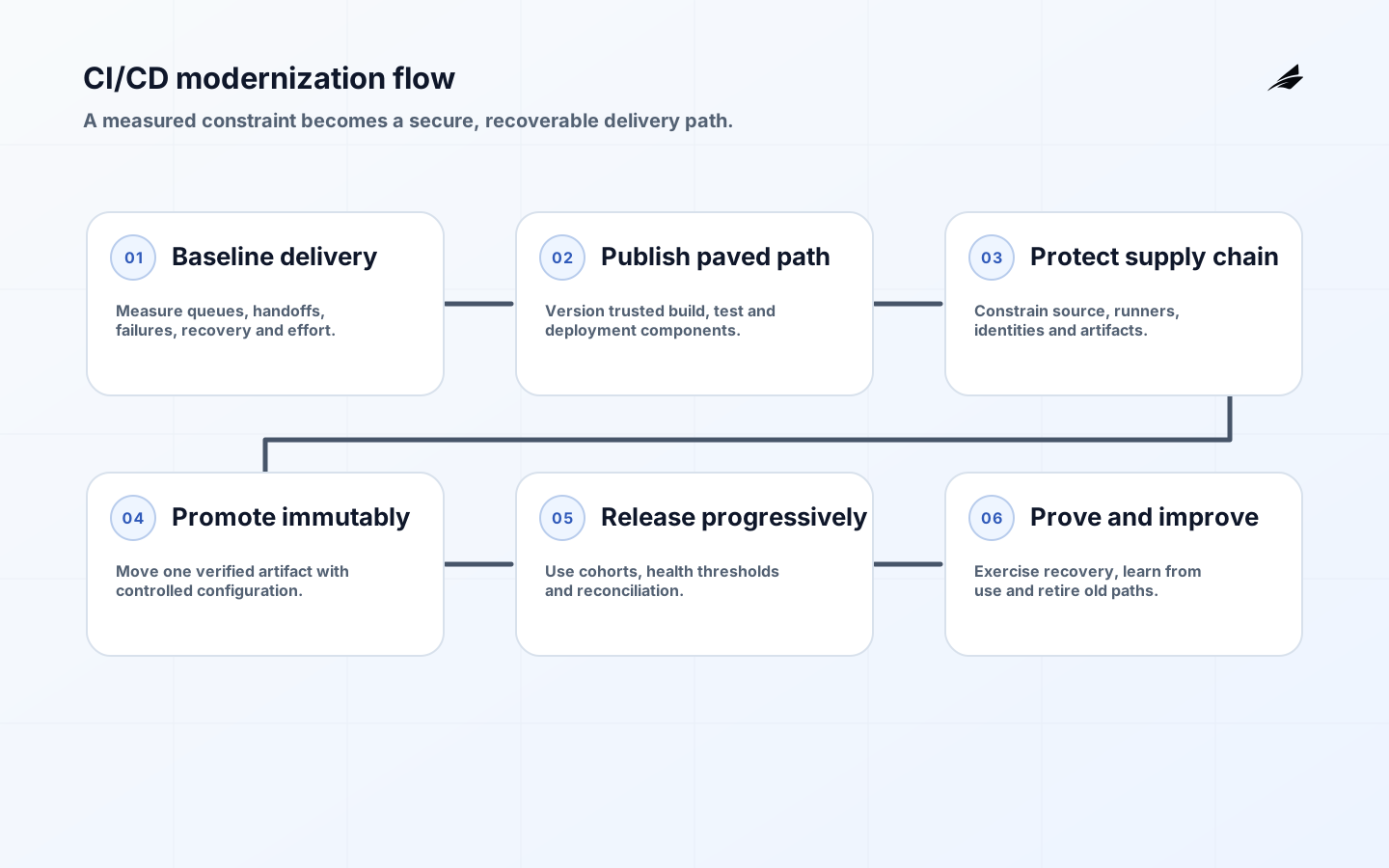
CI/CD modernization services should make software changes safer, faster and easier to recover across the actual path from commit to customer. Replacing one build server with another is not enough. The implementation must address repository rules, build provenance, tests, artifacts, environments, approvals, deployment, telemetry and operating ownership. This checklist gives buyers and delivery teams concrete gates for modernizing that system without interrupting every product at once.
Review the CI/CD modernization services FAQ before selecting a delivery model. Coordinate application changes with the modernization implementation checklist and the software modernization FAQ. Retail teams can compare sector-specific constraints in the retail CI/CD modernization plan.
1. Baseline the delivery value stream
Map a representative change from request through code review, build, test, security review, artifact storage, environment promotion, production verification and recovery. Measure active work and queue time separately. Record manual handoffs, rework, duplicate builds, credential use, environment drift and the evidence people assemble for approval. Segment by product and change type; a global average can hide one regulated service that waits days for a shared environment.
Use DORA’s software delivery performance metrics to observe throughput and instability, including change lead time, deployment frequency, failed deployment recovery and change fail rate. Add local service outcomes such as availability, escaped defects, security exposure and cost. Metrics diagnose the system; they should not rank individual engineers. Approve a baseline, a target range and guardrails before a vendor promises speed.
| Current symptom | Evidence to gather | Modernization hypothesis | Guardrail |
|---|---|---|---|
| Builds wait for shared workers | Queue, duration and utilization by job | Right-size pools and separate workload classes | No untrusted job reaches privileged network |
| Releases require manual assembly | Artifact hashes, steps and error history | Build once and promote an immutable artifact | Provenance remains verifiable |
| Staging differs from production | Configuration and infrastructure drift | Version environment definitions | Production secrets stay isolated |
| Approvals repeat evidence collection | Decision inputs and wait time | Generate an evidence bundle automatically | Risk owner retains meaningful authority |
| Rollback is slow | Recovery attempts and dependency sequence | Automate rollback or forward repair | Data changes remain reconcilable |
| Pipeline changes break teams | Template versions and consumer overrides | Publish versioned paved paths | Teams retain an exception route |
2. Define the modernization slice and responsibility model
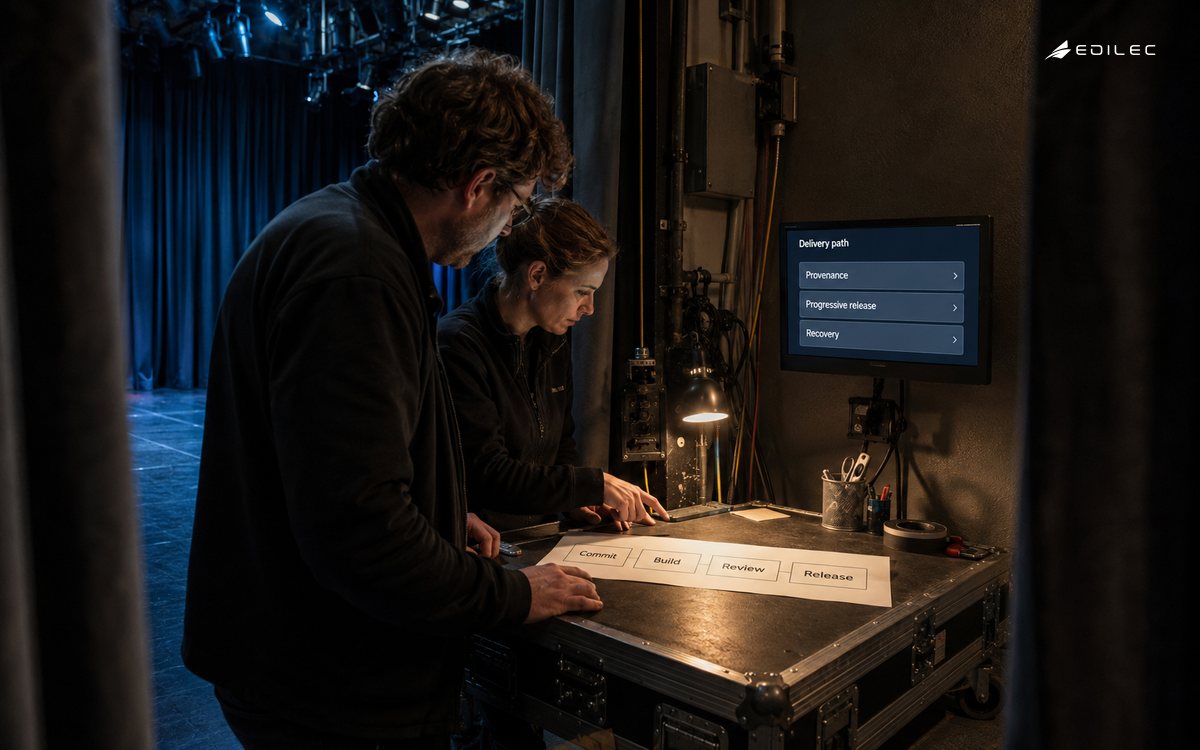
Choose one or two services that represent important patterns without combining every exception. Define repositories, branches, build types, target environments, data changes, deployment frequency, critical dependencies and compliance requirements. Name what remains on the old platform during the pilot. The acceptance boundary should include a production change and recovery, not stop when a demonstration deploys to an empty environment.
Publish a responsibility matrix for platform team, product team, security, operations and provider. The platform owns shared runners, templates, artifact services and support objectives; product teams own code, tests, service configuration and release readiness; risk owners approve exceptions. Define who can change pipeline policy, access production, approve a release, pause the platform and remove a credential. Include off-hours escalation and supplier access removal.
3. Design a versioned paved path
Create reusable, versioned pipeline components for build, test, scan, package, sign, publish, deploy and verify. Keep product configuration separate from trusted template logic. Consumers should see inputs, outputs, supported versions, change notices and failure behavior. Avoid copying a large YAML file into every repository; it drifts immediately. Also avoid one opaque central pipeline that teams cannot test or extend. Provide documented extension points and a governed exception mechanism.
DORA’s guidance on deployment automation describes using packages produced by continuous integration, version-controlled deployment scripts and environment-specific configuration. Implement the build-once principle: create one immutable candidate, store it in a controlled artifact repository and promote the same digest. Environment configuration changes separately under review. Generate a release record that joins source revision, builder, artifact, tests, approvals, configuration and deployment result.
4. Secure repositories, runners and artifact provenance
Federate human access, use short-lived workload identities and separate build, deployment and production roles. Protect branches and template repositories with review. Isolate untrusted pull-request jobs from secrets and privileged networks. Harden runner images, remove state between jobs and restrict outbound destinations where feasible. Pin third-party actions and dependencies according to risk. Store secrets in an approved service, rotate them and prevent them from appearing in logs or artifacts.
NIST’s Secure Software Development Framework provides practices for protecting software, producing well-secured releases and responding to vulnerabilities. Use it to assign preparation, build protection, verification and response activities. The SLSA Version 1.2 specification provides a framework for reasoning about artifact build provenance and increasing assurance. Select an appropriate assurance target from threat and customer need; do not claim a level without verifying every requirement.
5. Move quality and policy checks to useful feedback points
Run fast deterministic checks close to the change: formatting, static analysis, unit tests, secret detection and targeted component tests. Place integration, browser, performance, accessibility and security scenarios where representative dependencies exist. Use change impact selection only when its logic and fallback are understood. A pipeline that skips most tests is fast but not necessarily safe. Define which failures block, warn or create a time-bounded exception, with an owner for each result.
Parallelize independent checks and cache only inputs that can be validated. Track queue, execution, failure diagnosis and rerun time. Quarantine a flaky check only with risk assessment, issue, owner and expiry; retain its first failure. Generate concise evidence for the approver rather than requiring screenshots from many tools. The approval should evaluate current risk, not repeat a mechanical click after every automated control has already passed.
6. Reconcile environments, configuration and database change
Define infrastructure, policy and service configuration in version control where appropriate, then detect drift in running environments. Keep secrets and dynamic operational state outside ordinary source repositories. Test the same deployment mechanism in lower environments while preserving production separation. Use ephemeral environments for isolated review when their dependencies and data can be reproduced; maintain a stable integrated environment for cross-service scenarios that need it.
Treat database and message-schema changes as deployment design. Prefer backward-compatible expansion before application cutover and removal after old consumers retire. Test mixed versions, long-running jobs, retry and rollback. Record migration position and reconciliation evidence. An application rollback may be unsafe after an irreversible schema or data change, so define forward repair and restore options. Include feature flags and configuration in the release inventory; stale flags are operational debt.
7. Implement progressive delivery and recovery
Choose deployment strategy from service architecture and risk: rolling, blue-green, canary or feature-based exposure each has prerequisites. Define the population, duration, health signals and stop thresholds for each stage. Automate smoke tests and compare service-level indicators, errors, business events and resource saturation. Preserve a manual stop with strong authentication and clear authority. Never rely on a dashboard that the new release itself can corrupt as the only health source.
Rehearse rollback, roll-forward, traffic restoration and dependency failure. Verify that operators can find the artifact, configuration, change owner and affected customers from the release record. For example, a payments service can expose a new version to internal traffic, then one low-risk merchant cohort, while comparing authorization success, duplicate attempts and latency. It advances only when both technical and financial reconciliation pass; otherwise traffic returns to the known version and queued events reconcile.
| Acceptance gate | Required evidence | Pass condition | Accountable role |
|---|---|---|---|
| Source | Reviewed revision and protected branch result | Only approved source enters trusted build | Product engineering lead |
| Build | Artifact digest, dependency record and provenance | Candidate is reproducible or traceably built | Platform security owner |
| Quality | Risk-based tests and exception register | Critical scenarios pass; exceptions are approved and current | Product owner |
| Environment | Configuration revision and drift result | Target matches approved state without exposed secrets | Platform operations |
| Release | Progressive signals and business reconciliation | Thresholds hold for approved population and duration | Service owner |
| Recovery | Exercise record and data reconciliation | Service restores within objectives without silent loss | Incident owner |
8. Instrument the pipeline and production handoff
Observe the delivery system itself: queue time, job duration, failure stage, runner saturation, artifact availability, policy exceptions, deployment duration and recovery. Correlate change, pipeline, artifact, deployment and service telemetry with stable identifiers. The OpenTelemetry observability primer explains the roles of traces, metrics and logs. Use common concepts without putting sensitive build output or secrets into telemetry.
Give the platform a service owner, support objective, status communication, change policy and recovery plan. Product teams need a documented route for failed templates, runner shortages and urgent production repair. Review incidents and near misses across product and platform teams. Feed the result into template changes and migration priorities. Measure adoption through successful production use of the paved path, not the number of repositories that contain a configuration file.
9. Pilot, migrate and retire old delivery paths
Run the selected service through ordinary changes, an urgent fix, a dependency update and a recovery exercise. Compare lead time, first-run success, manual effort, failed change, diagnosis time and security exceptions with the baseline. Interview engineers and approvers about workarounds. Fix platform gaps before onboarding the next pattern. Expand by cohorts with migration readiness and named product owners, rather than forcing a date without support capacity.
Retire old jobs, credentials, runners, plugins and artifact copies after validated cutover. Preserve required audit records and release history in a readable form. Remove network access and contracts, and confirm no scheduled process still depends on the former system. A modernization is economically and operationally complete only when the old risk and support burden leave the estate. Keep a temporary reversal plan during the approved transition window, then close it deliberately.
Key takeaways
- Baseline the complete commit-to-customer value stream before choosing tools.
- Modernize one representative production path with explicit responsibilities.
- Build once, promote immutable artifacts and preserve release provenance.
- Protect repositories, templates, runners, secrets and production identities together.
- Design database change, progressive exposure and recovery as one release system.
- Scale on measured delivery and service evidence, then retire old paths and credentials.
CI/CD modernization implementation FAQ
Must modernization replace the CI/CD platform?
No. The largest constraint may be pipeline design, environments, ownership or testing. Improve those on the current platform when it remains supportable. Replace tooling when security, scale, integration, support or portability evidence justifies the transition.
Does continuous delivery eliminate approvals?
No. It automates repeatable evidence and places meaningful decisions at the right risk boundary. Low-risk changes may follow preapproved policy, while sensitive releases retain authorized review. Every exception should be explicit, time-bounded and auditable.
Should one pipeline deploy to every environment and cloud?
Share trusted concepts and components, but keep environment-specific identities, configuration and failure behavior explicit. Standardization is useful when it reduces cognitive load; forced uniformity can hide material platform differences and expand privilege.
Conclusion
A successful CI/CD modernization creates a controlled, observable route from reviewed source to recoverable customer change. Measure the current constraint, publish a secure paved path, promote immutable artifacts and verify the service through progressive release. Prove operator recovery and remove the old delivery system after migration. Those steps make faster delivery a consequence of better engineering evidence rather than a risky race through a newer interface.