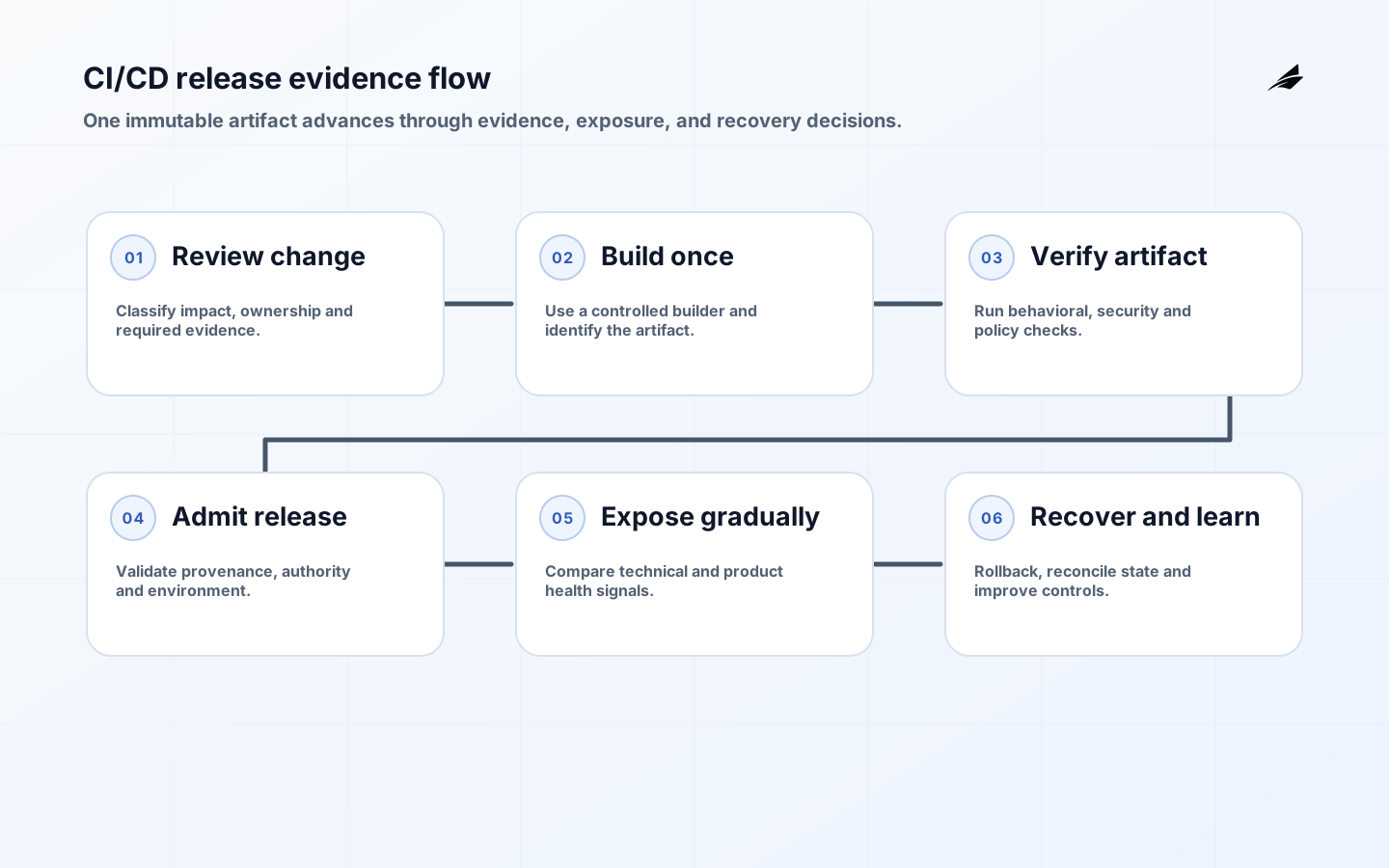
CI/CD pipelines for growing products should reduce the uncertainty of change, not merely reduce the number of clicks before production. A dependable pipeline answers five questions for every release: what changed, who reviewed it, which immutable artifact was tested, which policy allowed it to advance, and how the team will detect and recover from harm. Speed follows when those answers are automated and repeatable.
The right design evolves with risk. A small service may need a compact pipeline; a shared platform or regulated workload needs stronger separation and retained evidence. The invariant is a clear release contract. Edilec's guides to canary releases, deployment rollbacks, and incident response cover those practices in depth.
Key takeaways
- Build an artifact once, identify it by digest, and promote that exact artifact across environments.
- Apply fast deterministic checks early and risk-sensitive integration, security, and policy checks before exposure.
- Keep credentials short-lived and scoped; protect pipeline configuration and runners as production assets.
- Separate deployment from full release so exposure can increase gradually against explicit health criteria.
- Rehearse rollback and forward repair with database, queue, cache, and compatibility effects included.
Define the release contract
Write down the unit that moves through the pipeline: container digest, signed package, mobile build, or versioned function bundle. Define the environments it crosses, required evidence, approval authority, exposure strategy, health window, and recovery objective. Google's release engineering chapter frames releases as a disciplined engineering problem involving consistency, repeatability, and automation. That discipline matters more as services and contributors multiply.
Classify changes by consequence without letting authors self-declare risk unchecked. A documentation-only update, a stateless API patch, a schema migration, and an identity-policy change should not share an identical path. Use observable attributes such as affected component, data migration, privilege, public interface, dependency change, and rollback difficulty. The policy can then add checks or human authority while preserving a common path and audit model.
| Change class | Required evidence | Release treatment |
|---|---|---|
| Low-risk isolated change | Review, unit tests, artifact identity | Automated deployment with normal monitoring |
| Shared API or dependency | Contract and integration tests | Progressive exposure with owner watch |
| Data migration | Compatibility, backup, restore, rehearsal | Phased migration and explicit approval |
| Identity or policy | Security review and negative tests | Restricted approver and audit window |
| Emergency correction | Incident link and focused tests | Expedited authority plus retrospective |
Create one trusted build artifact
A commit should enter a controlled build environment with pinned tools and dependencies. The pipeline compiles or packages once, runs tests against the resulting artifact, records dependency and build metadata, and publishes it to an immutable repository. Rebuilding separately for staging and production weakens the claim that production received what was tested. Configuration that must vary belongs in a controlled runtime mechanism, not a new compilation.
The SLSA specification provides a vocabulary for provenance and increasing assurance against software supply-chain tampering. Use it pragmatically: associate the artifact digest with source revision, builder identity, invocation, and attestations; restrict who can alter build definitions; and verify evidence at admission. An SBOM helps incident investigation, but it does not by itself establish that a trustworthy process produced the artifact.
Order checks for fast, useful feedback
Put formatting, static analysis, unit tests, secret detection, and configuration validation close to the commit because they are fast and deterministic. Run contract and integration tests against realistic boundaries without depending on a fragile shared environment for every branch. Reserve expensive performance, resilience, and broad end-to-end suites for changes or stages where they materially reduce risk. Parallelise independent checks, cache only inputs with safe keys, and make flaky tests visible work rather than teaching developers to rerun until green.
NIST's Secure Software Development Framework covers preparing the organisation, protecting software, producing well-secured releases, and responding to vulnerabilities. Translate those outcomes into pipeline gates: protected source, reviewed changes, dependency policy, isolated builders, security testing, vulnerability triage, evidence retention, and a patch route. A scanner result needs severity, exploitability context, ownership, and an exception expiry; an unowned report is not a control.
| Pipeline stage | Question answered | Useful failure output |
|---|---|---|
| Pre-merge | Is the change reviewable and internally consistent? | Exact file, rule, owner, and remediation |
| Build | Can a controlled builder reproduce the artifact? | Dependency, toolchain, and provenance details |
| Verification | Does the artifact satisfy behavioral and security contracts? | Failed scenario and retained evidence |
| Admission | Is this artifact allowed in this environment? | Policy decision and missing attestation |
| Release | Does limited exposure remain healthy? | Compared signals and stop reason |
| Recovery | Can service return within objective? | Rollback result and residual data work |
Secure pipeline identities and execution
A delivery pipeline is a privileged production system. Use workload identity federation or another short-lived credential mechanism instead of static cloud keys. Scope each stage to the environment and action it needs. Separate build from deployment identities, protect branch and tag rules, and require review for pipeline definitions. Hosted and self-managed runners need patching, isolation, controlled egress, and cleanup; do not let untrusted pull requests share a runner that retains secrets or production network access.
Protect logs and artifacts from both tampering and accidental disclosure. Masking is a last line of defence, not permission to print tokens. Retain approval, policy, artifact, and deployment events according to investigative and compliance needs. Test denied paths: an unsigned artifact, an expired exception, a forked contribution requesting secrets, and a deployment identity targeting the wrong account should all fail clearly.
Separate deployment from release exposure
Deployment places the artifact in an environment; release exposes users or traffic. Feature flags, canaries, rings, and blue-green strategies let teams separate those moments. Choose cohorts that reveal risk without concentrating harm. Compare errors, latency, saturation, and a product-specific success signal against a valid baseline. Google's canary guidance emphasises selecting meaningful metrics and accounting for natural variation rather than trusting one raw threshold.
For example, release a checkout service to 5% of traffic. The new version's error rate remains normal, but payment authorisation success drops 1.8 percentage points for one provider. A technically narrow health gate would advance; a decision gate that includes the business transaction stops exposure and preserves evidence. The release owner can roll back application traffic while investigating whether any queued or partially completed operations need reconciliation.
Rehearse recovery across data boundaries
Rollback is not simply redeploying the previous binary. A release may change schemas, produce events old consumers cannot parse, warm incompatible caches, or start an irreversible external action. Prefer backward-compatible expand-and-contract migrations: add compatible structures, deploy dual-capable code, migrate or backfill, shift reads, and remove old structures only after the rollback window. Version events and APIs so producers and consumers can overlap safely.

- Define the rollback trigger and the person or automation authorised to invoke it.
- Keep the previous known-good artifact and configuration reference readily deployable.
- Test restoration of schema, state, queues, flags, and external side effects, not only compute.
- Measure detection, decision, execution, and validation time separately.
- After recovery, reconcile affected records and feed the failure mode into tests and release policy.
Measure flow, stability, and evidence quality
Track lead time, deployment frequency, change failure, and recovery alongside queue time, flaky-test rate, failed release reasons, exception age, and provenance verification. Instrument pipeline and runtime correlation so a deployment marker appears in traces, metrics, and logs; the OpenTelemetry documentation provides vendor-neutral observability conventions. Segment by service and change class. One organisation-wide average can hide a critical service with slow, failure-prone releases.
Review the pipeline as a product. Interview developers about confusing failures, remove checks that no longer support a risk, and move repeated manual judgments into transparent policy only after their inputs are stable. Keep a manual, audited recovery route for control-plane outages. Automation should make the normal path easier and the exceptional path deliberate, not make delivery impossible when one central service fails.
Run a pipeline readiness review
Select one routine change and one high-risk change, then walk their evidence from commit through production. Verify that a reviewer can identify the artifact digest, dependency and provenance records, test results, policy decision, deployment identity, exposure cohort, health comparison, and rollback result without asking the author to reconstruct history. Exercise a blocked artifact and an expired exception. The failure should name the missing evidence and owner rather than produce an unactionable red job.
Test continuity as well as normal automation. Disable the primary runner pool, artifact repository, or deployment control plane in a rehearsal and confirm the team knows whether to wait, fail over, or use an audited emergency route. Restore the service and prove queued work cannot leapfrog review or deploy twice. Capture recovery time and remaining manual reconciliation. A pipeline is ready when its exceptional paths preserve release authority, not merely when the happy path is fast.
Frequently asked questions
Must every successful build deploy automatically?
No. Continuous integration and automated evidence are valuable even when deployment or exposure requires a schedule or approval. The important design is that the decision is explicit, timely, and attached to the tested artifact rather than recreated through a manual release checklist.
Do approvals necessarily slow delivery?
Poorly designed approvals do. Use them for consequential judgment, not as a substitute for automated checks. Give the approver a concise evidence bundle, define response expectations, and review whether the gate catches material risk. Pre-authorised low-risk paths can remain automatic.
What is the best first CI/CD investment?
Create a reproducible build that produces one identified artifact, then add fast tests and a dependable deployment to one non-production environment. Next establish production observability and rollback. That sequence creates a foundation on which stronger supply-chain and progressive-delivery controls can be added.
Conclusion
A mature CI/CD pipeline is a release decision system. It connects reviewed source to a verifiable artifact, proportionate evidence, controlled exposure, and tested recovery. Build that chain clearly, then improve speed by removing waiting and ambiguity without discarding the controls that let the team change production confidently.