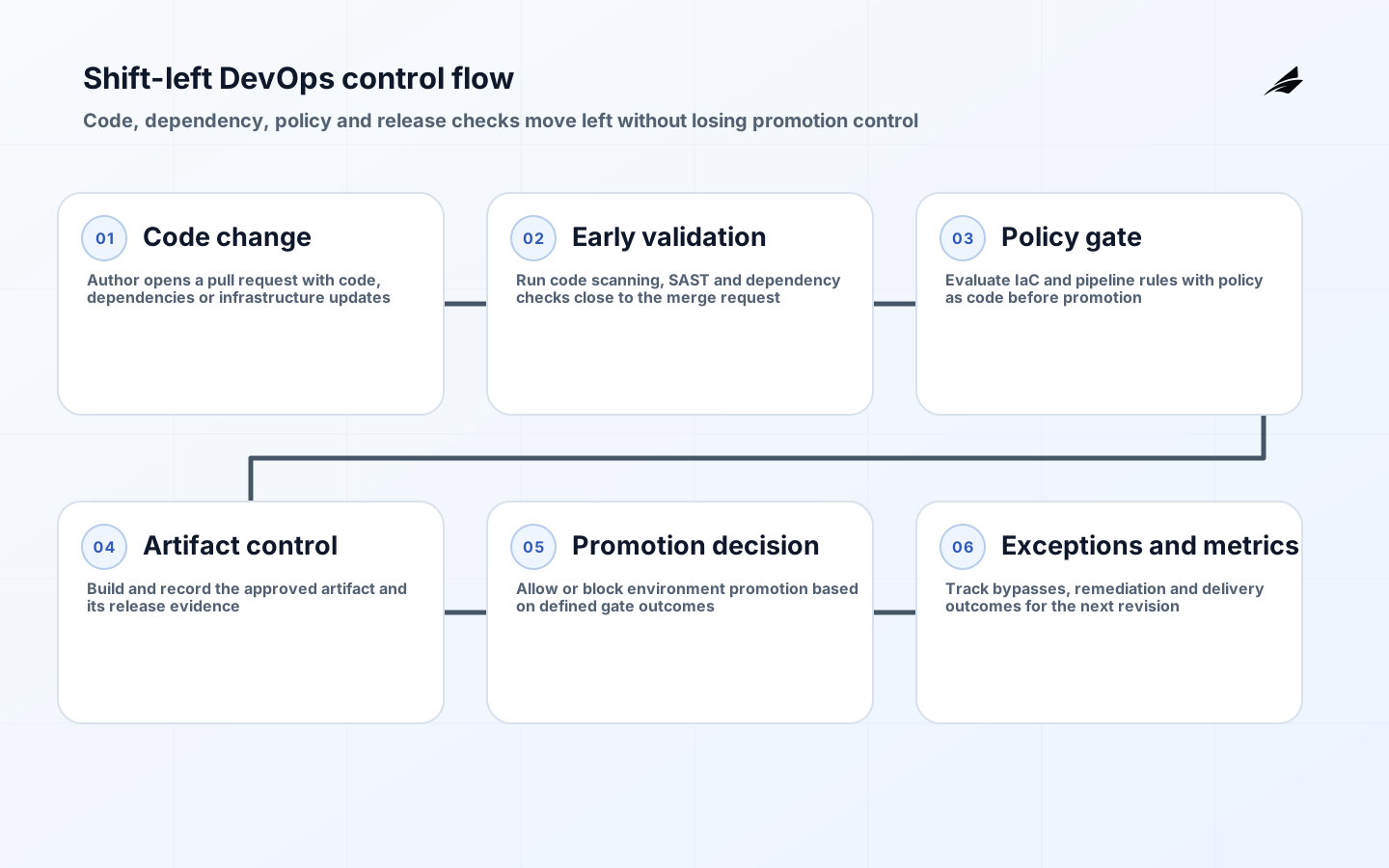
Shift-left DevOps solutions work when they move the right controls earlier in delivery without forcing engineers to stop and wait for a separate security department at every commit. The point is not to attach more scanners to a pipeline and hope the results create discipline. The point is to decide which checks belong in design, which belong in merge requests, which belong in artifact promotion, and which still require human judgment because the impact is too large or the context is too specific.
A useful plan starts with scope, evidence and ownership. Teams need to know which repositories, dependencies, containers and deployment workflows are in the first release, and what the pipeline must prove before code moves forward: secure defaults, policy compliance, test coverage or release traceability. When those expectations are explicit, shift-left DevOps becomes safer delivery. When they are vague, it becomes a noisy tool stack that slows work without reducing meaningful risk.
Define the shift-left boundary
Start with one delivery path and one class of risk. A product team might focus first on pull request controls for application code and dependencies. A platform team might focus first on infrastructure as code guardrails for Terraform, Kubernetes manifests or release templates. A regulated team might start with auditability, approval evidence and repeatable release records. All three are reasonable, but they should not be mixed into one large promise on day one. The first boundary should describe the code path, the deployment environments, the control objectives and the teams that own the exceptions.
This boundary needs operational language, not slogans. State which changes are in scope, which repositories or templates are authoritative, what the merge request or build must prove, and which unresolved findings may proceed under exception. Teams that skip this step discover too late that different pipelines enforce different rules and nobody can explain why a release was delayed.
| Decision | What to settle early | Failure if left vague |
|---|---|---|
| Scope | Which repositories, environments and deployment workflows are in the first release | Teams argue about ownership after findings appear |
| Control objective | Whether the priority is code security, dependency hygiene, IaC compliance or release traceability | The pipeline accumulates checks without a clear purpose |
| Blocking rule | Which findings stop merges or promotions and which remain advisory | Developers lose trust because every alert looks equally urgent |
| Exception path | Who can approve a temporary bypass and how it expires | Risk decisions move into chat threads and are lost |
| Evidence | What records must remain visible after the release | Audit and incident review depend on manual reconstruction |
Map controls to the delivery path
The most important design step is to place each control where it creates the earliest useful signal. Repository governance belongs close to the pull request. SAST, dependency review and basic secret detection belong close to code changes. IaC policy checks belong near the infrastructure definitions they evaluate, not after a deployment request has already been approved. Artifact signing, promotion rules and environment segregation belong later because they govern what is allowed to move from build to release. The phrase shift left does not mean everything moves to the first step. It means every control should sit as early as it can while still having the context to make a reliable decision.

This mapping also clarifies what humans should review. A merge request is the right place for code scanning findings, dependency alerts and policy violations because the author still has context. A promotion gate is better for checks that need release metadata and environment state. If every question goes to a central security queue, the team has only relocated the bottleneck.
| Delivery step | Best early control | Evidence of a healthy implementation |
|---|---|---|
| Pull request | Repository rules, code scanning and dependency checks | Authors see actionable findings before merge |
| CI build | SAST, test execution and policy validation on build inputs | The build records exactly which checks ran and why |
| Artifact creation | Image or package validation and provenance capture | Promotion refers to a known artifact rather than a rebuild |
| Infrastructure plan | IaC policy checks and environment-specific rule evaluation | Policy results point to the exact manifest or configuration line |
| Release promotion | Approval, change evidence and environment guardrails | The release can be explained after the fact without searching several tools |
Choose automation for code, infrastructure and dependencies
Shift-left DevOps needs different automation for different change surfaces. Application code benefits from SAST and repository-native code scanning because the result stays attached to the change that introduced it. Package ecosystems benefit from dependency alerts because supply chain issues often enter through transitive or stale packages rather than handwritten logic. Infrastructure definitions benefit from policy-as-code because environment constraints, tagging rules, network restrictions and deployment sequencing are hard to enforce consistently by human review alone. Treating these as one blended signal usually creates either too much noise or too little context.
Automation should also distinguish between informative and blocking outcomes. A policy engine can enforce non-negotiable controls such as required encryption settings, forbidden public exposure or missing approval metadata. Scanners can raise advisory alerts when the team needs investigation before deciding whether the risk is real, reachable or already mitigated elsewhere. Mature shift-left DevOps solutions reduce manual triage by tuning defaults, suppressing clearly irrelevant findings, versioning the policy set and retiring controls that are expensive but not decision-useful. The objective is not maximum alert volume. It is a pipeline that produces high-confidence signals the team can act on at the speed of normal delivery.
| Change surface | Useful automation | Human follow-up that still matters |
|---|---|---|
| Application code | Code scanning and SAST in pull requests and pipelines | Review exploitability, false positives and remediation priority |
| Dependencies | Dependency alerts and upgrade workflows | Decide upgrade timing, compatibility and compensating controls |
| Infrastructure as code | Policy-as-code validation against manifests and plans | Approve exceptions when business context justifies deviation |
| Containers and artifacts | Artifact validation and promotion checks | Confirm the release candidate matches the approved build |
| Pipeline definitions | Rules that verify sequencing, approvals and required tests | Review whether the control set is still aligned with risk |
Plan the platform and team operating model
Shift-left DevOps scales poorly if every product team assembles its own runners, templates, policy bundles and exception format. The platform team should provide the paved road: approved pipeline templates, consistent secret handling, standard policy libraries, shared scan configuration and traceable artifact promotion. That reduces variance and makes it possible to compare results across repositories. Developers still own code changes, but they work inside a delivery path with predictable control points rather than starting from a blank page.
Security ownership changes as well. Instead of reviewing every change manually, security specialists define reusable rules, triage patterns and escalation criteria. Platform engineers make those controls operable in the pipeline. Application teams fix findings in the same flow where they review tests, code quality and release readiness. This is the real organizational shift. Security stops being an external stage near the end of delivery and becomes a set of maintained product capabilities inside the engineering system.
Price the work and control the hidden cost
The visible cost of shift-left DevOps is often the least important one. Tool licenses, runners and storage are easy to see. The harder costs are policy authoring, baseline cleanup, developer retraining, slower feedback from overgrown pipelines, repeated false-positive triage and the labor required to keep exceptions current. A team that blocks merges on day one without clearing the historical finding backlog usually pays for the rollout twice: once in platform work and again in developer time spent fighting signals that were never tuned for real use.
A practical cost model has three layers: enablement, signal quality and operations. If leadership only prices templates, runners and licenses, the program appears cheap until policy maintenance, exception review and release delays show up as operating burden.
| Cost driver | How to contain it | Hidden loss if ignored |
|---|---|---|
| Historical backlog | Separate baseline cleanup from new-change enforcement | Teams are punished for debt they did not create this week |
| False-positive triage | Tune scanners and retire low-value rules quickly | Developers learn to ignore security output |
| Pipeline latency | Keep fast checks early and defer expensive analysis when possible | Shift-left becomes a throughput tax |
| Policy sprawl | Version and centralize policy libraries | Different repos enforce incompatible standards |
| Exception drift | Give every bypass an owner and expiry | Temporary risk acceptance becomes permanent |
Stage rollout and exceptions
A staged rollout gives the team time to prove that a control is accurate before it is authoritative. Start in observe mode on a representative set of repositories. Confirm that the findings are understandable, stable and attached to the correct change surfaces. Then move selected controls to soft gates, where the pipeline requires acknowledgement or issue creation but does not yet stop the merge. Only after the team has measured signal quality and response behavior should the most reliable controls become hard blockers.
Exception handling should be as deliberate as the controls themselves. Every bypass needs a reason, an owner, a deadline and a review path. It should keep delivery moving when necessary while also showing where a rule, tool or workflow still needs improvement.
| Rollout phase | Gate behavior | Evidence needed to proceed |
|---|---|---|
| Observe | Record findings without blocking | Teams can explain the results and identify obvious noise |
| Soft gate | Require acknowledgement or tracked follow-up | The signal is stable enough to guide behavior |
| Hard gate | Block merges or promotion on defined failures | False positives and exception rules are under control |
| Steady state | Review metrics, backlog and exceptions on a cadence | The operating cost remains acceptable |
| Revision | Retune or remove weak controls | The team can prove whether the control still adds value |
Measure delivery and security outcomes
Teams need both security and delivery measures to judge whether shift-left DevOps is working. Delivery metrics such as lead time, deployment frequency, failed deployment recovery time and change failure rate show whether the pipeline still supports healthy throughput and stability. Security metrics such as time to triage, time to remediate, percentage of new changes covered by required checks, policy violation recurrence and exception age show whether the control system is actually reducing unmanaged risk. One side without the other tells only half the story.
Interpretation matters as much as collection. Lower lead time is not a win if teams are bypassing checks. A falling vulnerability backlog is not automatically good if the program suppressed rules instead of fixing code. The useful metric set is the one that ties release decisions to evidence the team can inspect.
| Metric | Why it matters | Bad interpretation to avoid |
|---|---|---|
| Lead time for changes | Shows whether control placement keeps delivery moving | Assuming faster is better even when reviews are bypassed |
| Change failure rate | Shows whether safer releases are reaching production | Attributing every production issue to pipeline controls |
| Time to remediate critical findings | Shows whether the team can act on urgent risk | Treating backlog closure alone as security improvement |
| Exception age | Shows whether temporary bypasses are actually temporary | Ignoring old exceptions because delivery did not stop |
| Coverage of required checks | Shows whether the paved road is being adopted | Assuming enabled tooling equals meaningful enforcement |
Key takeaways
- Define shift-left DevOps by one delivery path, one control objective and one operating owner before broad rollout.
- Place controls at the earliest step where they have enough context to make a dependable decision.
- Use different automation for code, dependencies, infrastructure and promotion instead of treating every finding as the same kind of risk.
- Price policy maintenance, triage, pipeline latency and exception governance as part of the real operating cost.
- Measure both delivery performance and security outcomes so the program improves release quality without hiding its own friction.
Frequently asked questions
Does shift-left mean everything should block the build?
No. Blocking should be reserved for checks that are accurate, explainable and tied to a meaningful policy decision. Advisory signals are still valuable when they help the team learn, tune rules or schedule remediation without freezing ordinary delivery.
Which controls should usually become hard gates first?
Start with rules that have low ambiguity and high consequence, such as missing required approvals, forbidden infrastructure exposure, absent required tests or policy breaches with clear pass-fail logic. Leave noisier findings, such as exploratory scanner output, in review mode until the signal quality is proven.
How much policy as code is enough?
Enough to encode repeated, reviewable rules that the organization wants enforced consistently across repositories and environments. If a rule is rare, highly contextual or unstable, document it and keep a human decision path instead of forcing a brittle automation.
How do teams start when legacy pipelines are already messy?
Start by observing one representative pipeline, separating historical debt from new change controls and establishing a paved-road template for the next repositories that migrate. Trying to normalize every legacy path at once usually produces more disruption than control.
Conclusion
Shift-left DevOps solutions work best when they convert security, policy and release expectations into routine engineering evidence. Define the boundary, place controls where they belong, keep exceptions honest and measure whether the system improves both delivery and risk posture. The goal is a delivery path where safer software is the normal output rather than a last-minute negotiation.