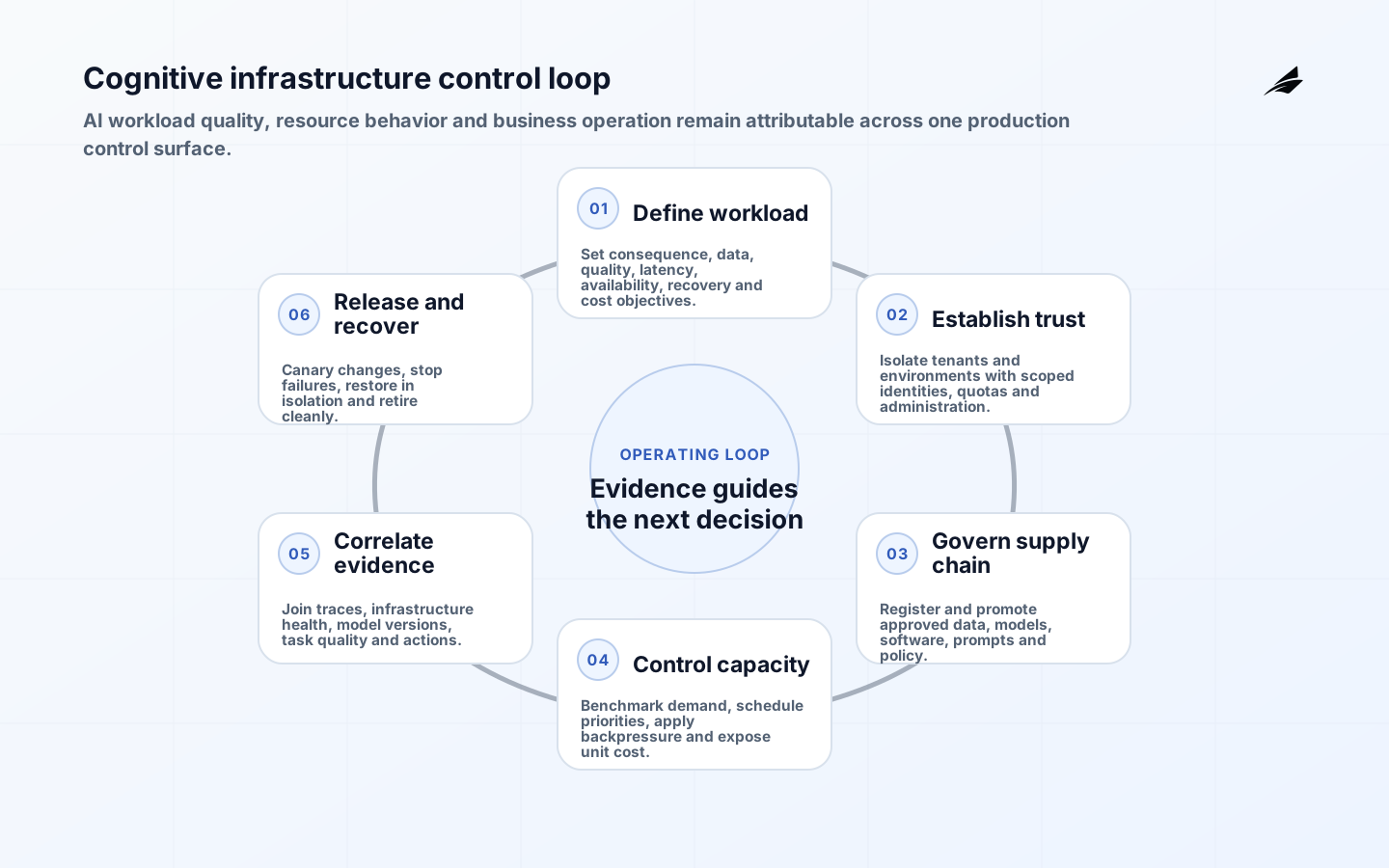
Cognitive infrastructure services offerings provide the compute, data, model, orchestration, observability and control capabilities used by AI-enabled workloads. The phrase does not imply that infrastructure understands the business or can operate itself without accountable people. A useful platform makes workload identity, data lineage, model versions, capacity, cost, quality and incidents visible from request to outcome. This checklist focuses on that production control surface rather than a catalog of accelerators or model endpoints.
Use it with the cognitive infrastructure scope and cost plan, the cognitive infrastructure FAQ, the core implementation checklist and the service operations FAQ. Assign a platform product owner, service owner, security and data owners, cloud finance partner and accountable owners for every AI workload that consumes the platform.
1. Define supported workloads and objectives
Inventory training, batch inference, online inference, retrieval, agents, feature pipelines and human review. For each, capture users, consequence, data classes, model source, latency, throughput, quality, availability, recovery, retention, geography and cost objective. Define what the platform supplies and what workload teams retain. Establish minimum service during model or accelerator shortage. Avoid one generic availability target: an offline experiment, customer support assistant and safety-related decision require different controls and evidence.
| Capability | Platform evidence | Workload evidence |
|---|---|---|
| Identity | Federation, service identities and scoped roles | User, tenant and resource authorization |
| Data | Catalog, lineage, encryption and governed access | Purpose, quality, consent and retention |
| Model | Registry, provenance, signature and promotion | Task evaluation and approved limitations |
| Compute | Quotas, isolation, scheduling and capacity | Demand, performance and fallback |
| Observability | Correlated logs, metrics and traces | Outcome, quality and severe-failure signals |
| Recovery | Artifact, configuration and data restoration | Business resumption and reconciliation |
2. Build identity, network and tenancy boundaries
Separate development, evaluation and production; isolate tenants and high-consequence workloads according to risk. Use short-lived identities, least privilege, private paths where justified, managed secrets and controlled administration. Enforce quotas at project and workload boundaries so one experiment cannot exhaust production capacity. Record asset owner, environment, data class, model and expiry in resource metadata. Apply NIST CSF 2.0 outcomes across governance, identification, protection, detection, response and recovery, with evidence connected to enterprise risk.
3. Govern data, model and software supply chains
Register datasets, transformations, embeddings, models, prompts, policies, containers, libraries and hardware dependencies with provenance and approved use. Scan software and images, verify artifact signatures, protect build systems and preserve reproducibility. A model registry entry should identify source, license, intended tasks, evaluation, limitations, owner and deployment history. Gate promotions through tests and approvals appropriate to consequence. Prevent production systems from fetching unreviewed models or executable code dynamically. Define removal and notification when a dataset, license or component becomes unacceptable.
4. Engineer capacity, performance and cost
Benchmark representative request shapes, model sizes, batch patterns and hardware rather than relying on peak vendor specifications. Model queueing, cold starts, memory, storage, network transfer, accelerator availability and fallback quality. Set concurrency, token, time and spend budgets; apply backpressure and admission control. Attribute shared and dedicated cost to workload and useful outcome. Test degraded modes such as smaller models, delayed batch work or retrieval-only responses. Purchase commitments only after stable measured demand supports the term and concentration risk is understood.
| Failure | Detection | Required response |
|---|---|---|
| Accelerator exhaustion | Queue age and admission rejection | Protect priority workloads and degrade explicitly |
| Model regression | Task and severe-failure monitoring | Stop promotion and route to approved version |
| Data pipeline drift | Freshness, schema and quality checks | Quarantine input and preserve last trusted state |
| Cross-tenant access | Authorization and anomaly events | Contain identity, investigate and notify |
| Cost surge | Unit cost and budget anomaly | Throttle, identify driver and approve exception |
| Provider outage | Dependency objective and synthetic journey | Fail over or invoke minimum-service mode |
5. Correlate infrastructure and AI behavior
Use logs, metrics and traces with a request correlation identifier across gateway, retrieval, model, tools and downstream systems. Capture versions, latency, token or compute use, policy result and tool outcome while minimizing sensitive content. Infrastructure health cannot prove answer quality, so join technical telemetry with sampled task success, human correction, user complaints and business outcomes. Define actionable alerts with owners and runbooks. Monitor telemetry loss and dashboard freshness because an apparently healthy service may simply be unobserved.

6. Release and recover by evidence
Promote infrastructure, model, prompt, retrieval and policy changes independently but test combinations. Use immutable artifacts, canaries and bounded cohorts with halt thresholds for severe failure, latency, saturation, cost and user outcome. Preserve an approved fallback and reconcile writes when reverting. Exercise compromised credentials, poisoned data, registry outage, model-provider change, capacity shortage and regional loss. Restore data, configuration, indexes, models and keys into isolation, then prove representative business journeys before declaring recovery.
Operate the platform as a product. Review service objectives, capacity, vulnerabilities, access, supplier changes, exceptions, restore evidence, workload adoption and unit economics. Give consumers documentation, templates, support and a transparent roadmap. Deprecate with compatibility windows and migration evidence. At workload retirement remove endpoints, identities, datasets, indexes, models, jobs, logs and reservations according to policy. Keep only required audit records and confirm the platform inventory and cost views reconcile.
Run a cognitive infrastructure readiness exercise
Choose two materially different workloads, such as latency-sensitive retrieval for support agents and a scheduled batch-classification job. For each, document consequence, data class, model and dataset provenance, quality threshold, latency, throughput, availability, recovery, geography and unit-cost objective. Create separate service identities, quotas and resource metadata, then deploy only approved artifacts from the registry. Confirm that the platform rejects an unregistered model, an expired workload and a cross-tenant data request. The exercise should make the contract visible: the platform enforces identity, promotion and resource boundaries, while each workload owner supplies task evaluation, business fallback and outcome accountability.
Generate representative demand and observe queue age, cold starts, memory pressure, network transfer, accelerator allocation and end-to-end task quality together. Exhaust the lower-priority workload’s quota and verify admission control preserves the priority service without allowing hidden unbounded retries. Invoke documented degraded modes, such as a smaller approved model, retrieval-only response or delayed batch completion, and show users or downstream systems the changed service state. Compare cost per accepted task across hardware and execution options. Capacity acceptance should use measured request shapes and include headroom, procurement lead time and provider concentration, not a peak benchmark copied from a specification sheet.
Introduce a supply-chain event by marking a dataset, container or model version unapproved. Inventory queries should identify every affected deployment, owner and derived artifact. Block new promotion, quarantine where necessary and preserve the last trusted state. Then rotate a service credential and model-provider key without broad outage. Validate signatures and provenance on replacement artifacts, rerun workload evaluation and release by canary. This exercise reveals whether the registry is an operational control or just a catalog. It also tests whether license, vulnerability or data-quality findings can be translated into bounded remediation without deleting evidence needed for investigation.
Finally, simulate a regional or provider loss and restore into isolation. Recover configuration, data references, indexes, models, policies and keys in the required order, then run representative business journeys before reconnecting production traffic. Correlation identifiers should link gateway, retrieval, model, tool and downstream events without logging unnecessary sensitive content. Confirm dashboards detect telemetry loss rather than reporting false health. After the exercise, retire one workload: disable endpoints and jobs, revoke identities, remove data and reservations according to policy, retain required audit evidence and reconcile inventory and billing. Record recovery time, lost work, manual steps and residual risks as product backlog.
Convert the exercise into service objectives that consumers can understand. Publish queue, availability and recovery measures together with exclusions, measurement points and the behavior of degraded modes. Add a quality handoff stating which task signals the platform exposes and which labels the workload must supply. Review objectives against actual incidents and capacity each quarter. When a workload repeatedly violates its demand or data contract, address it through product support and governance rather than silently overprovisioning shared infrastructure. That preserves fair service and makes the cost of exceptional behavior visible. Pair every objective with an owner, alert and response decision. A percentage with no action threshold cannot protect priority workloads during scarcity or guide investment before capacity becomes an incident.
- Exercise contrasting workloads with explicit platform and consumer responsibilities.
- Prove tenant isolation, registry enforcement, quotas and workload expiry.
- Test backpressure and user-visible degradation under scarce capacity.
- Trace an unacceptable artifact to deployments and execute bounded replacement.
- Restore the complete dependency order and validate business journeys.
- Retire one workload and reconcile identities, artifacts, data, capacity and cost.
Key takeaways
- Define platform and workload responsibility for every AI service class.
- Make data, model, software and configuration provenance part of promotion.
- Control scarce capacity with priorities, quotas, backpressure and explicit degradation.
- Correlate infrastructure telemetry with task quality and business outcomes.
- Test stop, restore, supplier loss and retirement as production capabilities.
Frequently asked questions
Is cognitive infrastructure the same as AIOps?
No. AIOps applies analytics or AI to operations. Cognitive infrastructure is broader here: the production foundation and controls that support AI workloads, potentially including AIOps.
Does every workload need a GPU?
No. Choose hardware from measured latency, throughput, model and cost needs. CPU, specialized accelerator, managed API or batch execution may be better fits.
Should the platform span multiple clouds?
Only when workload, resilience, commercial or regulatory evidence justifies the additional identity, network, data, observability and operating complexity.
Can model quality be monitored automatically?
Some signals can. Reliable assurance also needs representative labeled samples, human corrections, incident review and periodic evaluation against changing use contexts.
Conclusion
Cognitive infrastructure is dependable when every AI outcome can be traced to an authorized workload, governed data, approved model, measured resource path and accountable operation. Building those controls as a usable platform lets teams scale experimentation into service without losing provenance, recovery or financial discipline.