Incident response plans for web platforms should help people make sound decisions when customer impact, uncertainty and time pressure arrive together. The plan is more than a contact list. It connects readiness, detection, severity, command, technical response, business continuity, communication, evidence and learning. NIST SP 800-61 Revision 3 integrates incident response across cybersecurity risk management rather than treating it as an isolated final phase, which suits web platforms where product, cloud, identity and suppliers are tightly connected.
Use this guide with related practices such as secrets management across environments and operational release notes. Tailor it to the organization’s legal, contractual and regulatory duties. The plan should identify who determines materiality and external notification, but technical responders should not improvise those decisions while simultaneously restoring service.
Prepare around critical customer journeys
Inventory business services, owners, dependencies, data, regions, suppliers and recovery requirements. Map customer journeys such as sign-in, checkout, API processing or reporting to services and telemetry. Define backup communications and documentation that remain available if the affected platform is unavailable. Validate on-call contact, access, emergency credentials, diagnostic tools, status-page control and supplier escalation. Readiness expires when teams, systems or contracts change, so review it through releases and exercises.
Create scenario-specific runbooks for likely high-consequence events: regional outage, credential compromise, destructive deployment, data exposure, dependency failure, traffic abuse and corrupted queue. A runbook should state detection evidence, immediate safety actions, authority, diagnostics, rollback or containment choices, communication triggers and recovery validation. Avoid scripts that assume a single root cause. Give responders checkpoints for reassessing the situation and requesting more help.
| Role | Primary responsibility | Should not be combined when scale demands separation |
|---|---|---|
| Incident commander | Priorities, roles, decisions and overall state | Deep technical investigation |
| Operations lead | Coordinates diagnosis and restoration | Stakeholder messaging |
| Communications lead | Internal and external updates | Unverified technical conclusions |
| Scribe | Timeline, decisions and evidence references | Command authority |
| Business or security lead | Risk, continuity and notification decisions | Routine remediation tasks |
Use impact-based severity and explicit command
Define severity from customer impact, data risk, safety, financial consequence, duration and scope, not from which monitoring system fired. Include examples and escalation clocks, while allowing responders to raise severity under uncertainty. Establish one incident commander who sets priorities and delegates operations, communications and documentation. The commander maintains the shared state and creates space for technical specialists to investigate. Transfer command explicitly with a briefing and recorded time.
Open a durable incident record with start time, observed impact, affected services, current hypothesis, actions, owners, decisions and next update. Separate facts from hypotheses. Track changes and results rather than copying unfiltered chat. Use a dedicated channel and bridge where appropriate, but preserve important decisions in the record. Establish an update cadence early; silence creates parallel investigations and avoidable customer anxiety.
Triage from user impact to technical evidence
Begin by confirming customer-visible symptoms and blast radius. Compare regions, tenants, versions, request classes and dependencies. Correlate traces, metrics and logs through stable service and release identifiers. OpenTelemetry provides signal conventions, but telemetry must be designed and tested before the incident. Check recent changes and external status without assuming correlation is causation. Preserve logs and volatile evidence where a security event may be involved.
Prioritize stopping harm and restoring a safe service over finding the final root cause. Options include disabling a feature, shifting traffic, reducing load, revoking credentials, isolating an account, rolling back or entering read-only mode. Every action needs an owner, expected signal, time box and reversal condition. Avoid simultaneous uncontrolled changes that make results impossible to interpret. If evidence suggests compromise, coordinate containment with security and evidence-preservation requirements.
Contain, recover and verify the business outcome
Containment limits impact while preserving a route to recovery. Short-term containment may trade functionality for safety; long-term remediation removes the weakness. For availability incidents, rollback or traffic shift can restore service. For security incidents, those actions may erase evidence or leave access intact, so use the applicable security plan. Record who authorized consequential containment and what customer or data effects it creates.
Recovery is not complete when servers are green. Validate representative customer journeys, data correctness, queues, scheduled work, integrations, access and monitoring. Reconcile actions that may have been accepted twice or lost during uncertain outcomes. Watch the service through a defined stabilization window and keep rollback capability until confidence is justified. Communicate restored functionality, remaining limitations and next update without claiming a root cause before evidence supports it.
Communicate with accuracy and a predictable cadence
Prepare templates for acknowledgement, investigation, mitigation, recovery and follow-up. State observed impact, affected users or functions, current action, workarounds and next update. Avoid speculative causes, defensive language and unnecessary sensitive detail. Coordinate customer support, status page, account teams, leadership, security, legal and privacy. A single source of approved facts prevents contradictory messages while allowing channels to use audience-appropriate language.
Define notification decision paths before an incident. Some events may trigger contractual, legal, regulatory, insurance or law-enforcement requirements with specific clocks and content. Technical severity and reportability are related but not identical. Preserve the facts needed by accountable decision makers: nature, scope, timing, systems, data, containment and likely impact. Record the decision and authority even when notification is not required.
| Recovery evidence | Why it matters | Owner |
|---|---|---|
| Synthetic customer journey | Confirms usable external behavior | Product or SRE |
| Data reconciliation | Finds missing or duplicate effects | Data or domain owner |
| Access review | Confirms containment and necessary privilege | Security |
| Queue and schedule check | Restores delayed background work | Operations |
| Customer update | Resets expectations and workarounds | Communications |
Turn incidents into owned improvements
Hold a blameless review after evidence stabilizes. Reconstruct contributing technical and organizational conditions, detection, decisions, communication and recovery. Distinguish trigger from systemic causes. Identify what made the response easier and harder. Actions should change code, configuration, tests, observability, access, runbooks or organizational interfaces; “be more careful” is not a durable control. Give each action an owner, due date and priority based on recurrence and consequence.
Track response quality with care. Time to detect, acknowledge, mitigate and recover can reveal trends, but definitions and incident mix matter. Review customer impact, repeat causes, action completion, exercise findings and responder load. Practice the plan through tabletop and technical exercises, including supplier and communication paths. Rotate roles so command capability is not concentrated in one person. Update plans when exercises expose missing authority or access.
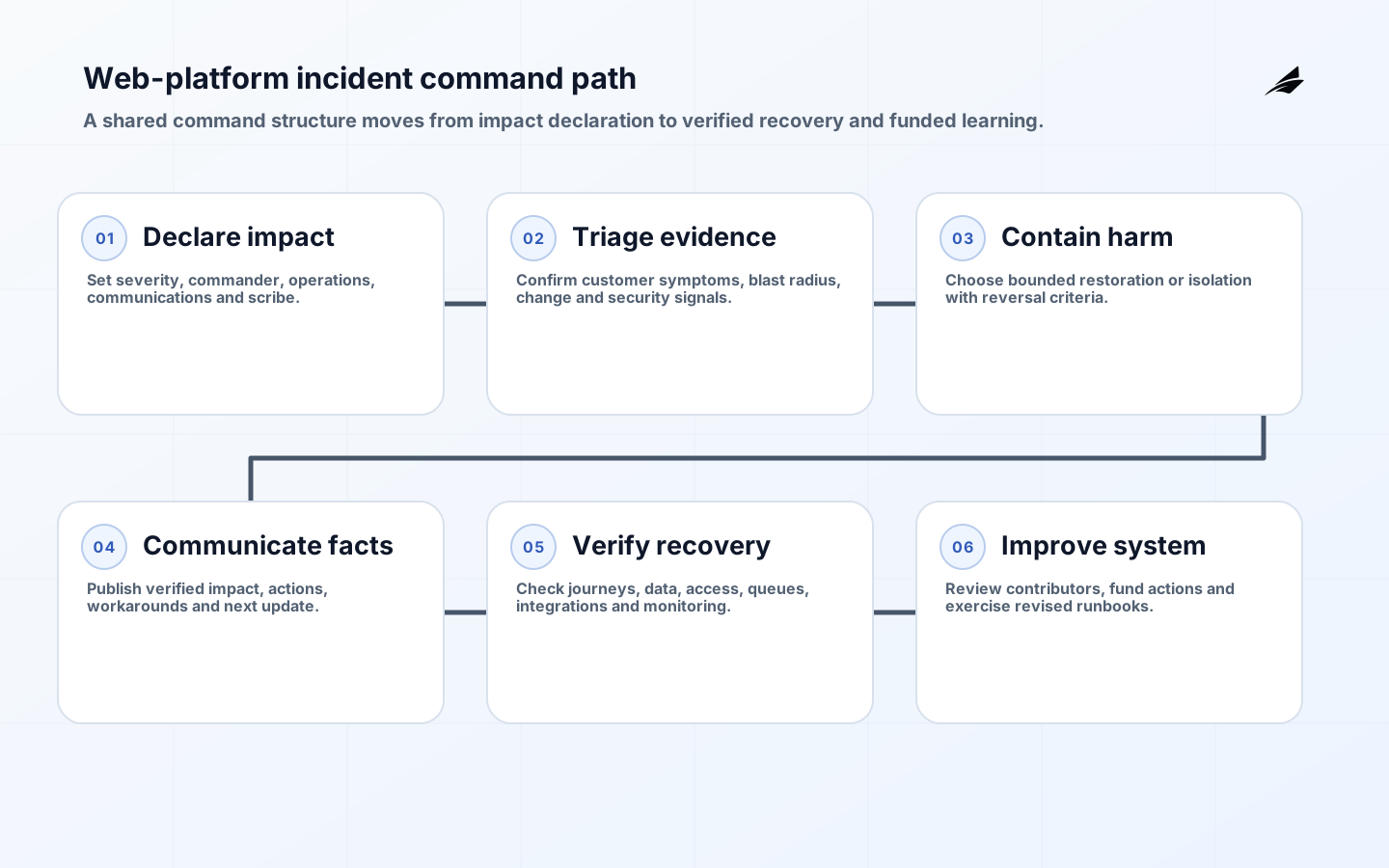
Web-platform incident response sequence
- Declare impact and severity; assign commander, operations, communications and scribe.
- Confirm customer symptoms, blast radius, recent changes and security indicators.
- Choose containment or restoration actions with owners and reversal rules.
- Communicate verified facts on a published cadence.
- Validate customer journeys, data, access and delayed work before closure.
- Review causes and fund specific preventive and response improvements.
Key takeaways
- Prepare from customer journeys and critical dependencies.
- Use impact-based severity and one explicit command structure.
- Restore safely while preserving evidence and business correctness.
- Communicate verified facts through a predictable cadence.
- Turn reviews and exercises into owned system improvements.
Frequently asked questions
Who can declare an incident?
Permit on-call and service owners to declare when criteria may be met; it is safer to mobilize and downgrade than to delay. Define who may set the highest severities and who determines security, legal or external notification consequences.
Should root cause be found before service restoration?
Usually not. Restore or contain safely first when doing so does not destroy necessary evidence or worsen risk. Continue investigation after stabilization and do not present an early hypothesis as final cause.
How often should the plan be exercised?
Use a risk-based cadence and re-test after material changes in architecture, suppliers, people or obligations. Exercise individual runbooks more often than full cross-company simulations, and track whether findings are actually closed.
Plan for responder sustainability. Establish shift length, backup coverage, handoff format and authority to call additional help. Long incidents degrade judgment and documentation, especially when one specialist becomes a bottleneck. A handoff should cover impact, current state, confirmed facts, hypotheses, actions in progress, risks, communication commitments and the next decision. Preserve an overlap period when consequence warrants it.
Connect incidents to change and supplier records. A release identifier, configuration change, certificate renewal or provider event should be retrievable from the incident timeline. Conversely, high-risk releases should reference relevant past incidents and their safeguards. This feedback makes operational history part of design review instead of an archive consulted only after recurrence.
Customer support needs an incident-specific operating view. Give agents approved impact language, affected functions, safe workarounds, status links and escalation criteria. Avoid exposing internal speculation or asking customers to repeat diagnostics already available in telemetry. After recovery, identify cases needing proactive correction, credit, notification or data reconciliation and assign their completion.
Maintain a small catalogue of pre-approved emergency changes, such as disabling a feature, rotating a credential, increasing safe capacity or switching a dependency. Each needs prerequisites, command, validation, rollback and authority. Review the catalogue after use and after platform changes. This gives responders speed without creating an uncontrolled alternative deployment process precisely when scrutiny and attribution matter most.
Keep an incident open until temporary mitigations have owners and expiry dates. Traffic blocks, elevated access, disabled controls and manual reconciliation can reduce immediate impact while creating new risk. Track them in the shared record, verify removal and escalate any mitigation that must become a designed long-term control.
Conclusion
A web-platform incident plan succeeds when people can coordinate reliable decisions under pressure. Prepare access and evidence, assign command, prioritize safe restoration, communicate facts and verify the complete customer outcome. Rehearsal turns the document into organizational memory; post-incident improvements make the next event less harmful rather than merely better documented.