Release notes that improve operations are not a prettier commit log. They are a control surface for people who must deploy, support, secure, audit or depend on a changed service. A useful note states what changed, who may notice, what action is required, how the rollout will be observed and where to look if reality differs from the plan. That makes the note part of the release itself rather than documentation written after the consequential decisions are over.
GitHub defines a release as a deployable software iteration associated with a tag, notes and optional assets. That packaging is useful, but an operational note needs more context than a repository can infer. Generated notes can assemble pull requests and contributors; a service owner still has to translate technical deltas into effects on users, dependencies, data, controls and support. Teams strengthening this practice can pair it with observability architecture for small teams and explicit access evidence from secure admin panel design.
Treat release notes as an operational contract
Start by naming the release unit. A versioned library, mobile application, internal API, configuration bundle and continuously deployed web service have different consumers and adoption paths. Record the production identifier, deployment window, affected environments and immutable reference such as a tag, image digest or change record. If several components move together, state whether they form one atomic release or independently reversible changes. Operators should never have to infer the running version from a marketing label.
Next classify the change by consequence, not by engineering effort. A one-line default change can be operationally larger than a month-long refactor with no observable behavior difference. Identify compatibility, data migration, access, performance, reliability, observability and cost effects. Semantic Versioning gives public APIs a vocabulary for major, minor and patch increments, but version numbers do not replace a plain-language impact statement. Internal services also need an explicit compatibility promise, even if their version scheme differs.
| Reader | Question the note must answer | Useful evidence |
|---|---|---|
| Service operator | What changes during rollout and how can it be reversed? | Deployment ID, health gates, rollback or roll-forward procedure |
| Support team | What might customers report and what should support check first? | Visible symptoms, account scope, diagnostic query, escalation owner |
| API or platform consumer | Must I change configuration, code or timing? | Compatibility matrix, deadline, tested migration example |
| Security or compliance owner | Did access, data handling or audit behavior change? | Control delta, approval, log event and retention impact |
| Business owner | Which outcome or risk does this release alter? | Affected journey, expected result and review date |
Build notes from structured release evidence
Do not ask an author to reconstruct a release from memory. Capture note fragments when a change is designed and reviewed. A pull-request template can require impact class, affected service, configuration or migration action, observability delta, security relevance and rollback method. Labels can group changes, while ownership metadata routes them to the right reviewer. GitHub supports generated release notes and category configuration; use that automation to assemble facts, then require a human owner to resolve ambiguity and write the audience guidance.
Define completion rules for the underlying change record. A release candidate should not be eligible for publication while its owner, affected services, migration requirement or observability plan is unknown. Validate links and version references automatically, and fail publication when a mandatory field is empty. This keeps the note synchronized with delivery evidence and makes missing operational preparation visible before production rather than during an incident.
Keep one source of release truth and publish views from it. The same structured record can feed repository notes, a status page, an internal change calendar and support briefing without copying conflicting prose. Include machine-readable identifiers so incidents and telemetry can link back to the release. Secrets, exploit details, personal data and sensitive customer names do not belong in a broadly visible note. Publish a bounded security advisory through the appropriate channel when disclosure requires coordination.
Write for decisions, not activity
Lead with outcome and impact: who experiences what, beginning when. Follow with required action, compatibility, rollout scope and recovery information. Put implementation detail after the decision-critical information. Replace phrases such as improved performance with a bounded statement such as reduced report generation latency for exports above a stated size, and link to the measurement definition. If evidence is preliminary, say so. A release note should not convert a benchmark into a universal customer promise.
Use a consistent entry pattern: Change, Impact, Action, Evidence and Owner. For example: Change: API requests now reject an obsolete field. Impact: integrations sending that field receive a validation response after the stated date. Action: remove the field and test against the preview endpoint. Evidence: compatibility test and dashboard link. Owner: named service team and support route. This is brief enough to scan yet complete enough to guide behavior.
| Weak wording | Operational rewrite | Why the rewrite helps |
|---|---|---|
| Updated dependencies | Updated the HTTP client to address a named advisory; no API change expected | Separates security purpose from consumer impact |
| Improved database performance | Changed the invoice index; p95 read latency is the rollout gate | Names the path and measurable condition |
| Minor authentication fix | Sessions created before deployment are invalidated; users may need to sign in again | Makes a support-visible effect explicit |
| New dashboard | Added queue age and failed-job panels; on-call owns the associated alerts | Connects a screen to operational action |
| Bug fixes and improvements | Lists each user-visible correction and links internal-only details separately | Prevents a catch-all category from hiding risk |
Connect every note to rollout and observability
A note written before deployment should contain expected rollout stages and decision gates. State whether exposure is canary, regional, tenant-based or immediate, and identify the metric and owner for each pause. Google SRE recommends user-centered service indicators and error budgets to balance reliability with release pace. A release note can point to the relevant objective, but it should also state the specific failure signal for this change, such as elevated authorization denials, stale reads or restore errors.
OpenTelemetry describes traces, metrics and logs as signals that help teams understand system behavior. Add a release identifier consistently to those signals so an operator can compare before and after. Monitor technical health and the affected user journey. A successful container rollout does not prove that invoices reconcile or that an accessibility flow still works. Record the observation window and final decision: expanded, paused, rolled back or accepted with follow-up work.
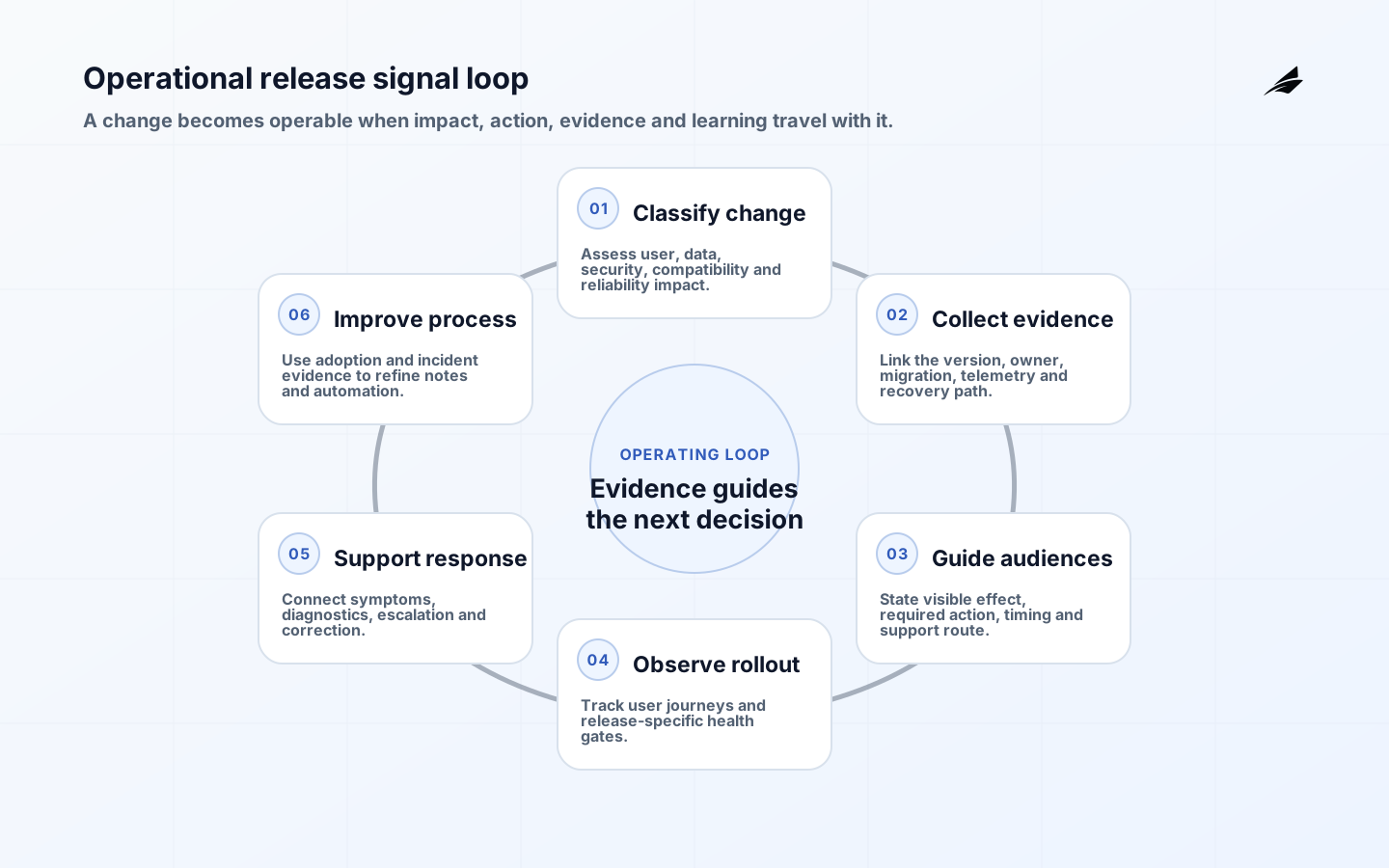
Run a six-step release communication procedure
- Classify the change by user, compatibility, data, security, reliability and cost impact while it is being designed.
- Collect structured evidence from reviewed changes and assign one accountable release editor.
- Draft audience-specific impact and action statements; verify links, versions, dates and owners.
- Review the note with operations and support for consequential releases, including rollback and escalation paths.
- Publish at the agreed point before or during rollout, then attach the production identifier to telemetry and incidents.
- Close the release after its observation window by recording outcome, support themes and corrections to the template or automation.

Time publication to the action readers must take. Breaking consumer changes need advance notice and a migration window; an incident-driven patch may require coordinated disclosure; a routine internal deployment can publish at rollout. Correct factual errors visibly rather than silently rewriting history. Keep the original release identifier and an amendment timestamp. If the release is withdrawn, mark it withdrawn and explain the supported replacement so automation and humans reach the same conclusion.
Measure whether notes change operational outcomes
DORA’s current delivery model measures throughput and instability through change lead time, deployment frequency, failed deployment recovery time, change fail rate and deployment rework rate. Release-note quality should not be gamed as a document count. Examine whether consumers complete migrations before deadlines, support identifies the affected version quickly, incidents correlate to changes, and rollback decisions use the published gates. Pair those indicators with short qualitative reviews after high-impact releases.
Audit a sample each month. Can an on-call engineer identify the running artifact, affected journey, expected telemetry and recovery route without contacting the author? Can support distinguish expected behavior from a defect? Can a consumer find every action due in the next release? Missing answers become template or pipeline improvements. The goal is a smaller information gap during change, not longer notes.
Key takeaways
- Describe consequence and required action before implementation detail.
- Generate factual inventory from change records, then apply accountable human editing.
- Link the release identifier to deployment evidence, telemetry, incidents and recovery decisions.
- Provide different readers with the information needed for their decisions without exposing sensitive detail.
- Review adoption, support and recovery outcomes to improve the release process itself.
Frequently asked questions
Who should own operational release notes?
The service or product team should own accuracy, with one named editor for each release. Engineering supplies change evidence; operations validates rollout and recovery; support validates customer-facing symptoms and actions. Communications may improve language, but accountability should remain with the team able to verify production behavior.
Should release notes be fully automated?
Automate collection, categorization, version links and publication mechanics. Keep human review for impact, action, uncertainty, security disclosure and audience relevance. Generated commit lists are valuable input, but they cannot reliably determine what a customer, operator or regulator needs to do.
Do small continuous deployments need notes?
Not every internal change needs a public announcement. Every production change still needs traceable evidence. Aggregate low-impact changes into a digest when that matches reader needs, while publishing breaking, security-relevant or action-requiring changes separately and early.
Conclusion
Release notes that improve operations make change legible at the moment people must act. A structured evidence trail, consequence-led writing, monitored rollout and closed feedback loop turn notes into a reliable part of service delivery. Teams evaluating platform choices can also use Kubernetes decisions for growing products to keep the release process proportionate to the system they actually operate.