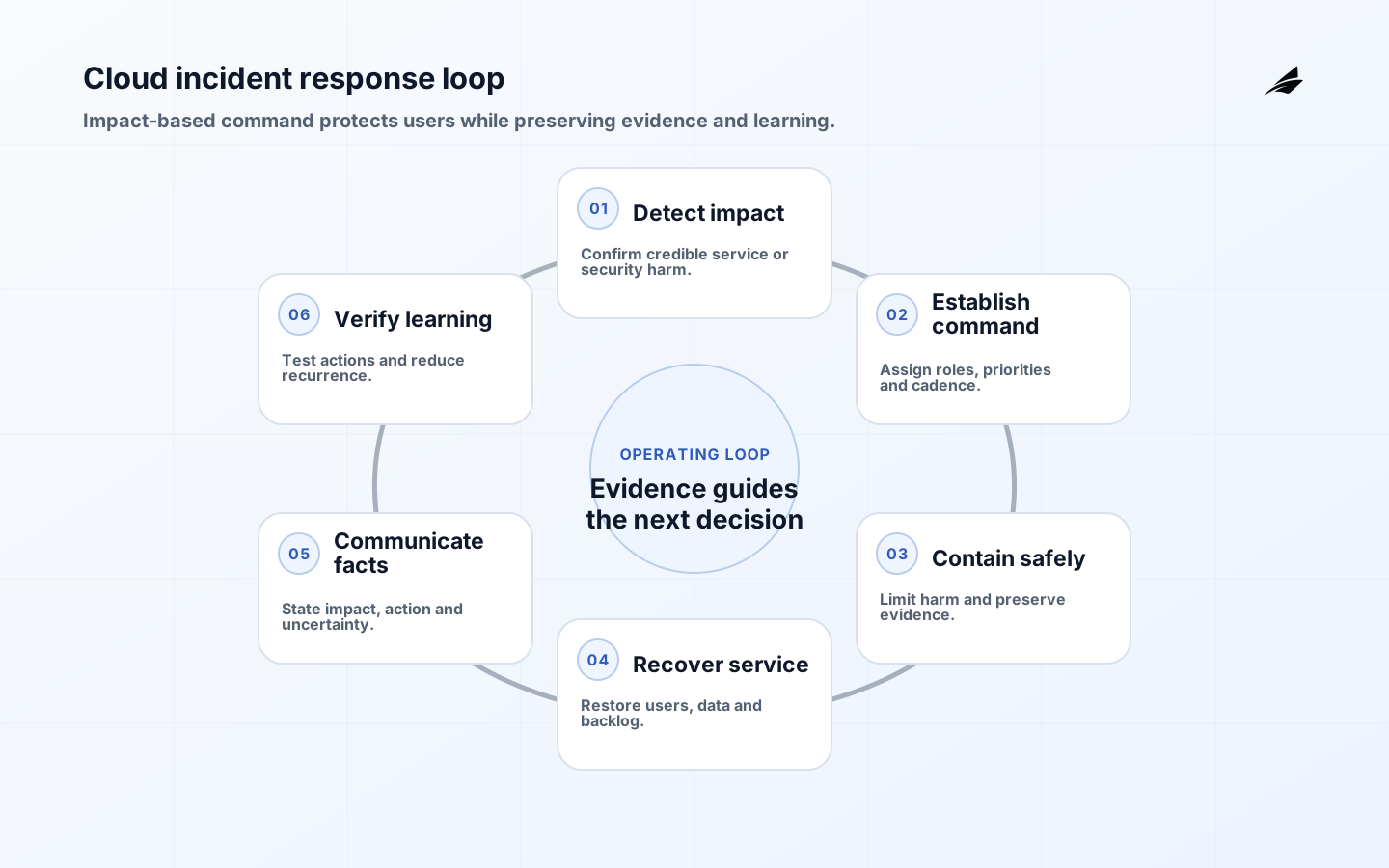
Cloud incident response is the coordinated work of detecting harmful service behavior, understanding impact, containing the cause, restoring a safe service, communicating clearly, and reducing recurrence. In DevOps environments, availability incidents, security events, failed releases, data integrity problems, and third-party outages often overlap. The response model must preserve both speed and evidence without forcing responders to decide which organizational queue owns the problem before they protect users.
This playbook complements Edilec's cloud incident planning guide, deployment rollback architecture, and distributed tracing production guide. It follows the current NIST SP 800-61 Rev. 3, published in 2025, which integrates incident response recommendations into cybersecurity risk management rather than treating response as an isolated emergency procedure.
Key takeaways
- Declare from observed or credible impact; refine classification after a response structure exists.
- Separate incident command, technical operations, communications, and subject expertise so coordination remains clear.
- Containment should be scoped, reversible where possible, and paired with evidence preservation and business continuity.
- Recovery means verified user journeys, reconciled data, controlled backlog, and heightened monitoring, not merely green infrastructure.
- Postmortems should change systems, defaults, ownership, or practice and verify that actions worked.
Prepare around services and credible scenarios
Maintain a service inventory with owner, users, critical journeys, data classification, dependencies, objectives, dashboards, logs, runbooks, deployment history, access path, backup and restore route, and vendor contacts. Map scenarios that cross cloud layers: leaked credentials, destructive automation, region failure, certificate expiry, dependency throttling, corrupted messages, runaway cost, data exposure, and failed schema change. Preparation should answer who may declare, who may contain, and how work continues when the usual identity, chat, CI, or observability platform is unavailable.
| Preparation asset | Minimum content | Exercise evidence |
|---|---|---|
| Service brief | Owner, objectives, journeys, dependencies, data, and fallback | Responder can orient within minutes |
| Contact and authority map | Primary, backup, executive, legal, privacy, vendor, and customer roles | Escalation works outside business hours |
| Containment runbook | Scope, command, expected effect, evidence, rollback, and approval | Tabletop or controlled execution result |
| Recovery plan | Restore source, integrity checks, dependency order, and reconciliation | Measured restore and business verification |
| Communication templates | Known facts, impact, action, next update, and channel | Draft produced without speculation |
| Responder access | Break-glass identity, logging, expiry, and review | Access works and leaves evidence |
Exercise decisions, not just documents. A tabletop should introduce uncertain alerts, conflicting dashboards, unavailable owners, a vendor delay, and a containment action with customer cost. A technical game day should test a bounded failure and recovery in a safe environment. The CISA cloud security technical reference architecture is useful for reviewing cloud security responsibilities and capabilities, but local exercises must reflect the organization's actual providers, identities, pipelines, and data paths.
Declare impact and establish command
Make declaration easy when there is credible customer, security, data, financial, or compliance impact. The first responder creates an incident record, starts a time-ordered log, names an incident commander, and opens the approved coordination channels. Severity is provisional. Record what is known, what is inferred, affected services and populations, first observed time, current risk, actions underway, and the next update time. Do not delay declaration while searching for root cause.
| Role | Owns | Does not own |
|---|---|---|
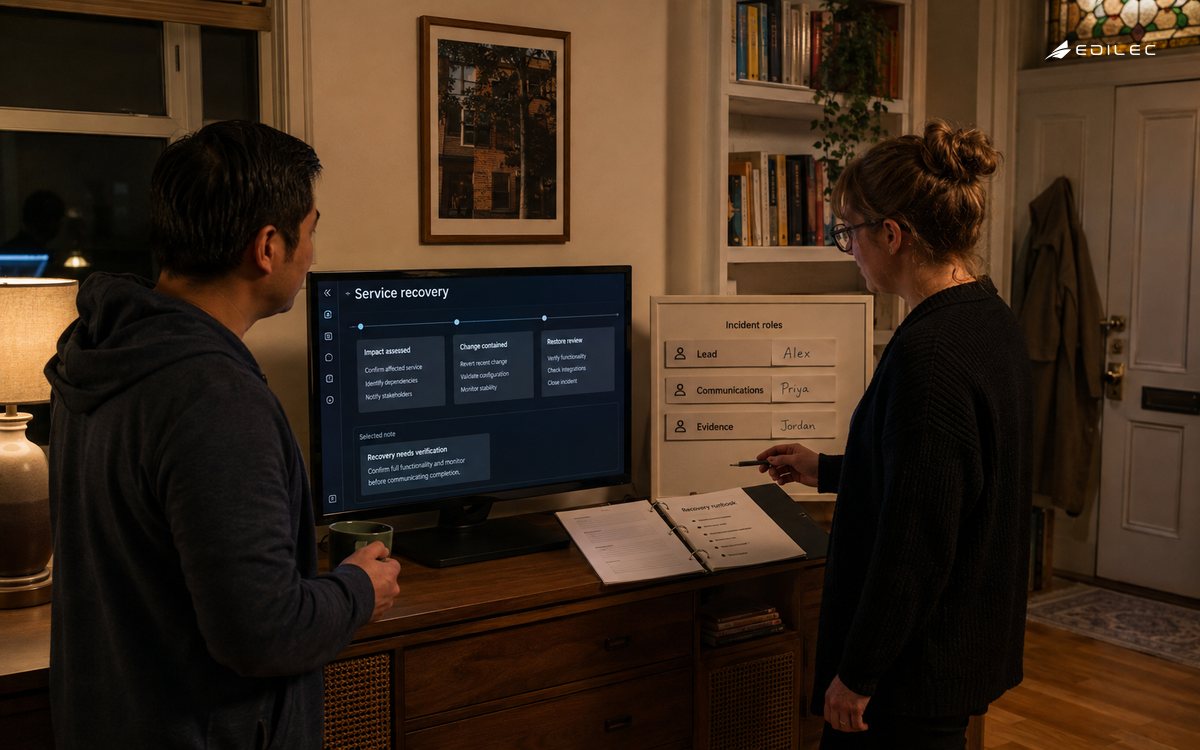
| Incident commander | Objectives, priorities, roles, cadence, decisions, and escalation | Every technical command |
| Operations lead | Diagnosis, containment, mitigation, recovery, and technical tasking | Public status wording |
| Communications lead | Audience-specific updates and feedback into command | Unverified technical conclusions |
| Scribe | Timeline, hypotheses, decisions, actions, and evidence links | Judging responder performance |
| Subject expert | Focused investigation or execution in an assigned area | Overall incident coordination |
| Business or security authority | Consequential approvals, obligations, and risk acceptance | Replacing the incident commander |
The Google SRE incident management guidance advocates a clear command structure and separation of responsibilities. Small teams can combine roles, but name the combinations aloud. Hand off command explicitly with a summary. Keep tactical work out of the main coordination channel where possible. The commander should continually ask: what user harm is occurring, what decision is blocked, what evidence would change our plan, and when will we communicate again?
Contain harm without losing the trail
Containment may revoke credentials, disable a feature, block traffic, isolate a workload, freeze a deployment, rotate a secret, fail over, or return to a manual process. Choose the smallest action that materially reduces harm, but do not let elegance delay a necessary broad stop. Record the command, actor, time, scope, expected result, actual result, and reversal. Preserve logs, snapshots, audit events, configuration, build provenance, identity events, and relevant volatile evidence according to policy and legal guidance.
Cloud control planes make sweeping changes easy. Use two-person review for destructive or high-blast-radius actions when time permits, and prepare bounded emergency commands in advance. Do not paste sensitive evidence into broad chat channels. If compromise is plausible, assume normal credentials or telemetry could be untrustworthy until checked. The NIST Cybersecurity Framework 2.0 connects Govern, Identify, Protect, Detect, Respond, and Recover, helping teams see why identity, asset knowledge, backup quality, and supplier governance determine response outcomes.
Recover the service and communicate uncertainty
Recovery has technical and business acceptance. Restore components in dependency order, validate configuration and data integrity, reintroduce traffic gradually, and watch leading indicators. Then verify critical user journeys, reconcile queued or duplicated transactions, identify records requiring correction, and account for customers who remained affected after aggregate metrics improved. Keep heightened monitoring and a clear rollback threshold until the service demonstrates stability across a representative period.
| Recovery check | Evidence | Reason to stay in incident mode |
|---|---|---|
| Technical health | Capacity, errors, latency, saturation, and dependency state | Metrics are unstable or only one zone is healthy |
| Security state | Compromised path removed, credentials controlled, monitoring active | Attacker persistence or exposure scope remains uncertain |
| Data integrity | Counts, checksums, invariants, and system-of-record reconciliation | Missing, duplicated, or inconsistent transactions |
| User journey | Synthetic and real completion for critical cohorts | A material segment still cannot complete work |
| Backlog | Queue age, retry safety, and processing rate | Recovery traffic can overload dependencies |
| Communication | Affected audiences know status, workaround, and next step | Material impact is not yet accurately described |
Communicate on a promised cadence even when there is no resolution. State confirmed impact, scope, actions, workaround, and next update; label hypotheses as hypotheses. Avoid premature root-cause claims and optimistic restoration times without evidence. Internal updates should help support, sales, leadership, legal, privacy, and vendors make decisions. External updates should be understandable to the affected audience and consistent across status pages and direct outreach. Regulatory or contractual notifications require qualified owners, preserved facts, and jurisdiction-specific judgment.
Turn the incident into verified improvement
Hold a review after immediate recovery while evidence is available. Reconstruct the user impact and timeline, identify contributing technical and organizational conditions, evaluate what helped or hindered response, and record unresolved uncertainty. The Google SRE postmortem guidance explains the value of blameless analysis: people acted within the information, incentives, interfaces, and safeguards present. Accountability still matters, but the useful question is what system change makes the desired action easier and the hazardous action harder.
- Assign each corrective action one owner, due date, measurable result, and link to the condition it addresses.
- Prefer eliminating a failure mode, adding a guardrail, or improving detection over writing another reminder.
- Include backlog reconciliation, customer remediation, supplier follow-up, and control evidence alongside code changes.
- Test the action through an automated check, restore exercise, game day, or sampled operational review.
- Review recurrence and action effectiveness with service leadership; close actions only when evidence shows the risk changed.
Measure response capability over time with care. Time to declare, contain, restore, and communicate can reveal friction, but medians alone reward premature declarations of recovery and hide severe events. Pair duration with user-impact minutes, data correction, repeat incidents, alert usefulness, escalation success, action completion, and exercise findings. Segment by service and scenario. The goal is not to make the timeline look fast; it is to reduce harm while preserving accurate decisions and sustainable responder practice.
First-hour incident checklist
- Declare, record first observed impact, and create a durable timeline.
- Name command, operations, communications, scribe, and required business or security authority.
- Confirm the coordination channel and an out-of-band alternative.
- Bound affected users, data, services, regions, versions, and identities; state uncertainty.
- Stop active harm with a scoped action and record expected and actual effects.
- Preserve relevant evidence and protect access to it.
- Set technical objectives, owners, and the next decision point.
- Publish an audience-appropriate update with the next update time.
- Plan recovery checks for security, data, service, backlog, and critical user journeys.
Frequently asked questions
Are reliability and security incidents separate processes?
They need shared declaration, command, evidence, communication, and recovery mechanics, with specialist security, privacy, legal, or forensic work added when needed. Early symptoms often do not reveal the category, so separate intake paths can waste critical time.
When should an incident be closed?
Close active response after harm is contained, the service and security state are stable, critical journeys work, data and backlog have an owned reconciliation plan, communications are complete for the phase, and follow-up work has accountable owners. Root cause need not be fully proven, but uncertainty must be explicit.
Does blameless mean nobody is accountable?
No. It means the review seeks conditions and decisions without hindsight punishment, so evidence remains candid. Owners are still accountable for risk decisions and corrective work. Deliberate misconduct can be handled through an appropriate process without turning every operational mistake into personal blame.
Conclusion
A mature cloud incident response capability is visible on ordinary days: service maps are current, authority is clear, access works, recovery is rehearsed, and learning actions are verified. During an incident, impact-based declaration and disciplined command create room for technical judgment. Afterward, honest analysis and tested improvements make the next event less harmful. That full loop, not a heroic late-night recovery, is the operating standard.