Retrieval Pipelines for Regulated Records are not ordinary search indexes with a chat box added. When records influence healthcare, finance, employment, legal work, public services, or other controlled processes, an answer must be traceable to an authorized source at a particular point in time. The pipeline needs to preserve record identity, source ownership, version, effective date, access policy, transformation history, and citation. A fluent response without those properties can create false confidence and make correction difficult. The NIST AI Risk Management Framework provides a useful lens: manage the specific context in which an answer is relied upon, rather than assuming that retrieval itself makes a system trustworthy.
Define a contract for every source record
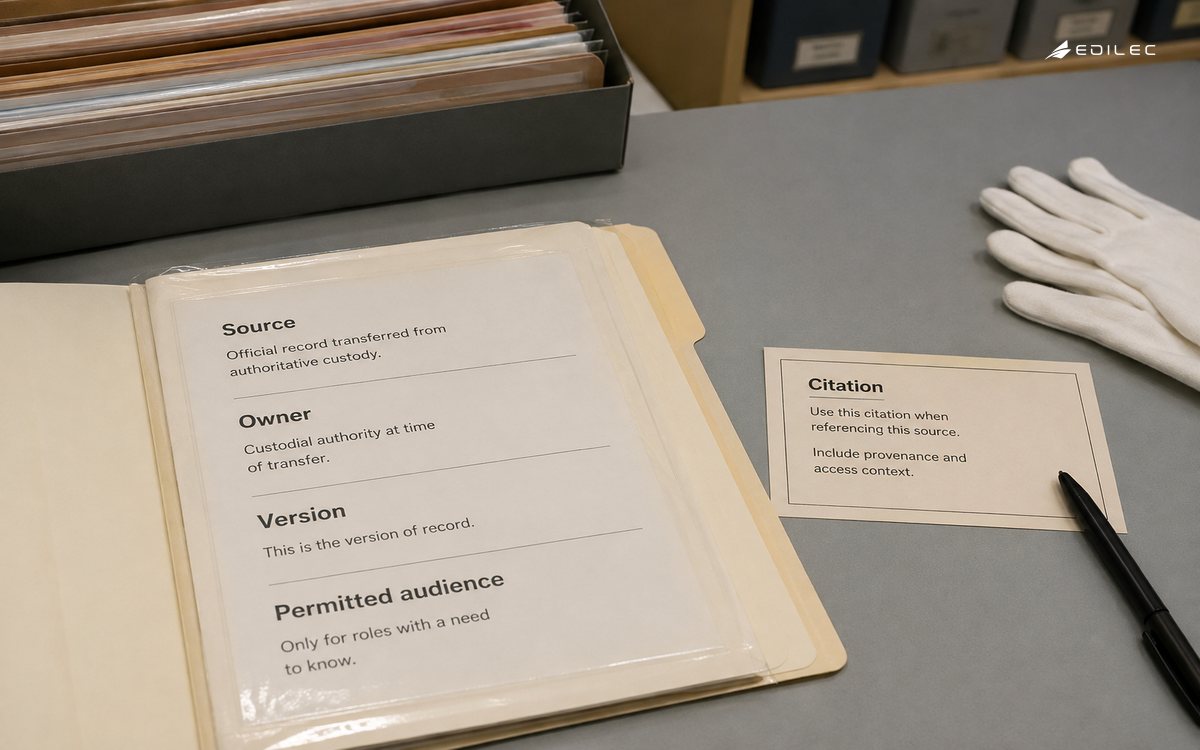
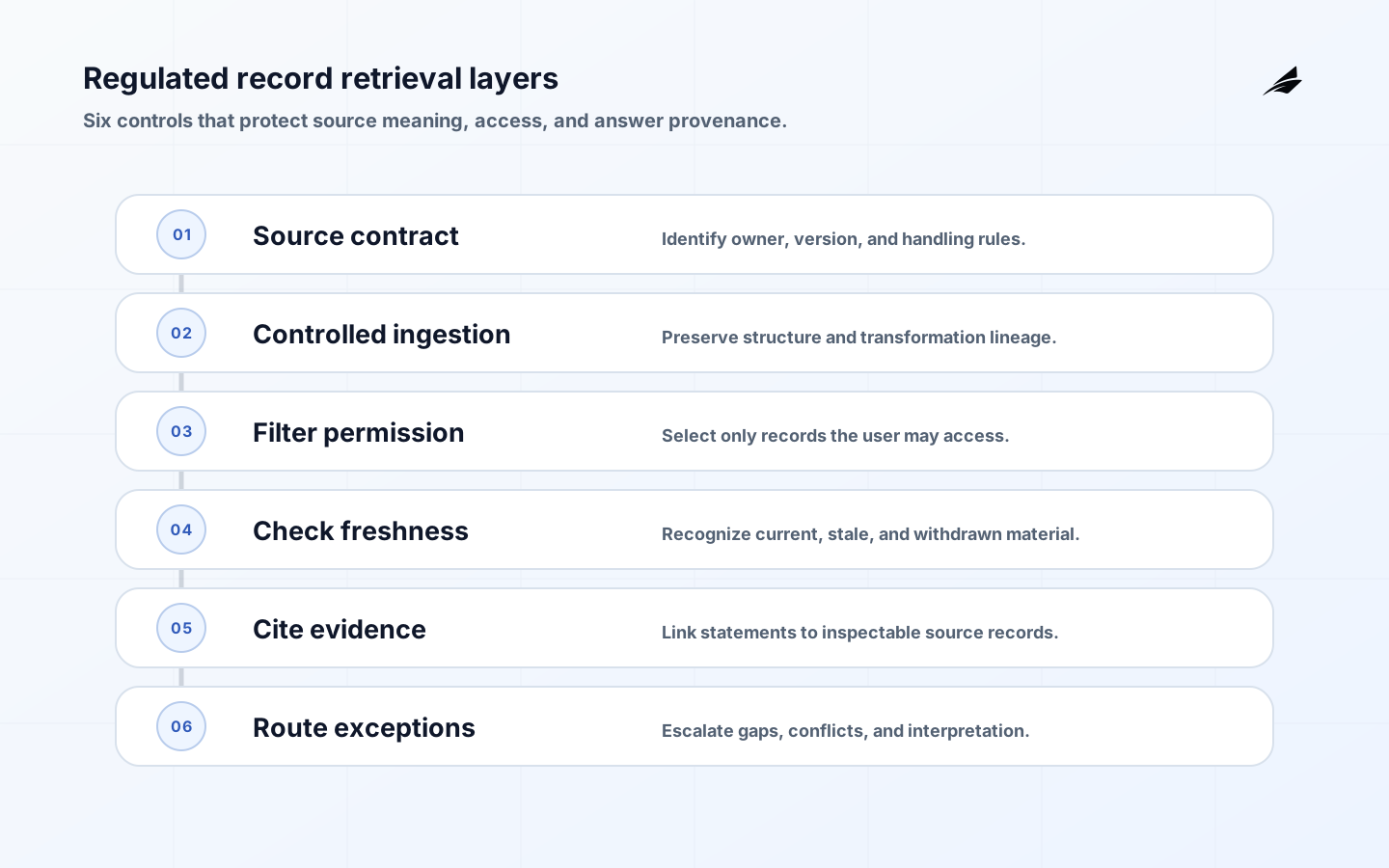
Before ingestion, identify the system of record, data steward, record type, jurisdiction or retention rule where relevant, sensitivity classification, permitted audience, update signal, and authoritative version. Preserve a stable source reference and a content fingerprint so an indexed chunk can be traced back after reprocessing. Do not flatten a policy, case file, or contract into unlabelled text that loses headings, dates, tables, attachments, and supersession information. The contract should also state what the pipeline must do when a record is deleted, corrected, access-restricted, or temporarily unavailable.
| Record property | Pipeline treatment | Why it matters |
|---|---|---|
| Source and version | Store immutable reference and ingest version. | Lets a reviewer verify the cited material. |
| Access policy | Enforce before retrieval and before answer display. | Prevents context from crossing a user boundary. |
| Effective date | Index and display temporal status. | Stops obsolete guidance from appearing current. |
| Deletion or correction | Propagate invalidation and reindex event. | Makes withdrawal and remediation possible. |
Apply permissions before context reaches the model
Permission filtering belongs at query time against the current user and record policy, not only when a document is first ingested. A user may lose access, change role, or move to another tenant after an index is built. Filter candidate records before they enter the prompt, and apply field-level masking when a record contains mixed sensitivity. The OWASP Top 10 for LLM applications highlights risks around sensitive information disclosure; the practical response is to make authorization an enforceable retrieval condition rather than a request the model is expected to honor.
Design freshness and citations as product behavior
Every answer that relies on regulated records should state the source references in a form the user can inspect, along with useful temporal context such as effective date or last verified time. When the system cannot find an authorized, current source, it should say so and route the work appropriately. Avoid fabricated citations by generating them from retrieved identifiers rather than trusting free-form text. The NIST Generative AI Profile calls attention to confabulation and information integrity concerns; visible provenance makes those concerns easier for users to detect and challenge.
| Answer condition | Expected response | Operational follow-up |
|---|---|---|
| Current authorized source found | Answer with inspectable citations and scope. | Log source versions and query policy. |
| Source is stale or superseded | Flag status and avoid presenting it as current. | Request refresh or direct user to owner. |
| No permitted source | Explain the limit without guessing. | Offer authorized workflow or escalation. |
| Sources conflict | Present conflict and defer material interpretation. | Route to qualified reviewer with both records. |
Evaluate retrieval and exception handling separately
Test whether the right source is retrieved, whether the source is currently applicable, whether unauthorized records are excluded, and whether the answer represents evidence faithfully. These are different questions. Build cases around revocations, duplicate names, conflicting versions, scanned tables, partial documents, and queries that invite a conclusion beyond the record. Inspect negative cases as well as successful retrieval. The NIST Secure Software Development Framework supports a disciplined release process for changes to parsers, embeddings, indexes, and access-control code, all of which can alter system behavior.
- Assign a steward and access policy to each source collection.
- Preserve source, version, effective date, and transformation lineage.
- Filter by current permission before assembling model context.
- Generate citations from retrieved record identifiers, not invented prose.
- Route missing, stale, conflicting, and high-impact questions to a defined owner.
Operate retrieval as a controlled information service
Give users a way to flag a citation that is unavailable, stale, or misleading. The report should capture the answer reference, source identifier, and reason without asking users to duplicate sensitive content. Route it to both the information steward and the technical owner, then communicate whether the source, index, permission mapping, or answer behavior was corrected. This closes the accountability loop for the people who rely on the service in real work.
Include disaster recovery in the design. Know how to rebuild an index from authoritative sources, how to validate permission mappings after restoration, and how to tell users that a service is temporarily degraded. A backup that restores vectors without source lineage, current access rules, or deletion history can recreate an unsafe state. Practice a bounded restoration with non-production data so the team knows which dependencies and approvals are required before an emergency makes the sequence harder to reason about.
Treat observability records themselves as controlled data. Query text, result identifiers, access decisions, and user feedback can reveal sensitive business activity even when the source document is protected. Define who may inspect logs, how long they are retained, which fields are redacted, and how an investigation can obtain necessary detail under authorization. A secure pipeline needs this balance: too little evidence prevents correction, while indiscriminate logging creates another uncontrolled copy of regulated information. Review the logging design whenever a new source, user group, or tool path is introduced.
Make the source steward part of operational review. Technical teams can see connector errors and index lag, but stewards understand whether a changed clause, withdrawn form, or revised procedure changes the meaning of an answer. Give them a lightweight way to announce material updates, review a sample of cited answers, and confirm that retirement or correction completed. This collaboration is especially important for tables, scans, attachments, and policies whose effective date depends on a formal approval. It prevents a pipeline from treating document arrival as proof that the document is ready to guide a decision.
Use a formal exception class for questions that require interpretation rather than retrieval. A regulated record may establish facts but leave a professional judgment, legal conclusion, or customer-specific exception unresolved. The answer experience should make that boundary clear, preserve the relevant references, and route the user to an authorized reviewer. Measure how often this occurs and whether the route is timely. Trying to eliminate every escalation by broadening the model's language is a poor substitute for a workflow that respects the difference between finding evidence and making an accountable decision.
Monitor ingestion lag, parsing failures, stale-source rate, permission denials, citation coverage, retrieval misses, and the age of exception queues. Review samples with the people who own the records, because relevance judgments often depend on policy language and operational context that a technical metric cannot capture. Keep a change log for source connectors, chunking rules, embedding models, ranking logic, and access policy changes. When users report a wrong answer, the team should be able to reconstruct which record version, filters, and transformations were involved.
Design deletion, correction, and legal-hold behavior
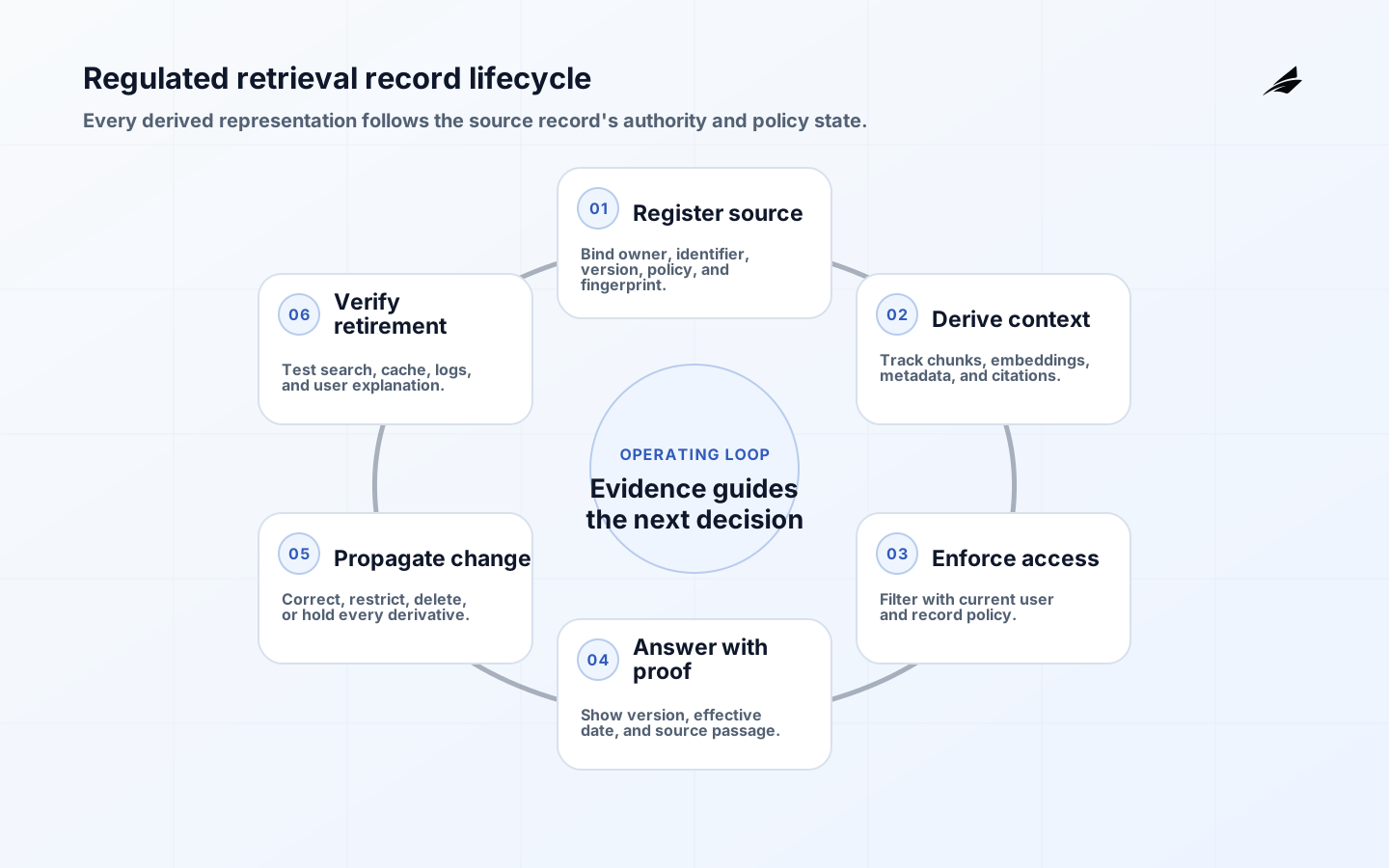
Regulated retrieval is incomplete until the team can explain what happens when source authority changes. Model deletion as a propagation event, not a future full rebuild. The source connector should emit or detect a stable record identifier, version, and policy state; the pipeline should locate derived chunks, embeddings, caches, summaries, and evaluation fixtures that inherit that record. A correction may supersede an earlier version while retaining access-controlled history. A deletion may require removal from active search while a legal hold preserves evidence in a separate, restricted store. The answer layer must never cite a retired version merely because a cache has not expired. NIST defines provenance as the chronology of origin and changes, which is precisely the chain an investigation needs.
Test these states with a controlled record: publish version one, retrieve it, restrict one role, issue a correction, delete it from active use, and place the evidence under hold. Confirm at each step that authorized search, citations, caches, audit logs, and user-visible explanations agree. Record propagation time as an operational objective. If the pipeline cannot establish freshness or policy state, it should refuse with a useful reason and route the request to a steward. This behavior is more trustworthy than silently falling back to an older passage. Teams extending RAG knowledge bases for support teams should make lifecycle tests part of every connector release.
Key takeaways
- Regulated retrieval begins with source ownership and a record contract.
- Authorization must govern context selection before a model sees content.
- Freshness, version, and provenance should be visible in the answer experience.
- Evaluate source selection, permission filtering, and answer faithfulness independently.
- Exception handling is essential when sources are missing, stale, or in conflict.
Frequently asked questions
Can embeddings replace record governance?
No. Embeddings can help find semantically related material, but they do not establish the owner, current status, permission, or legal applicability of a record. Treat them as a retrieval mechanism within a governed pipeline, with deterministic references and policy checks around their use.
When should the system refuse to answer?
It should refuse or escalate when it lacks an authorized current source, when sources conflict on a material point, when a request exceeds the record’s evidence, or when the decision requires qualified judgment. A clear limit with a route to the record owner is safer and more useful than an unsupported synthesis.
Conclusion
A regulated retrieval pipeline is an information-control system before it is an AI feature. Preserve the record contract, enforce permissions early, show provenance and freshness, and make exceptions visible. Those foundations let users gain speed without losing the ability to verify what an answer means and where it came from.