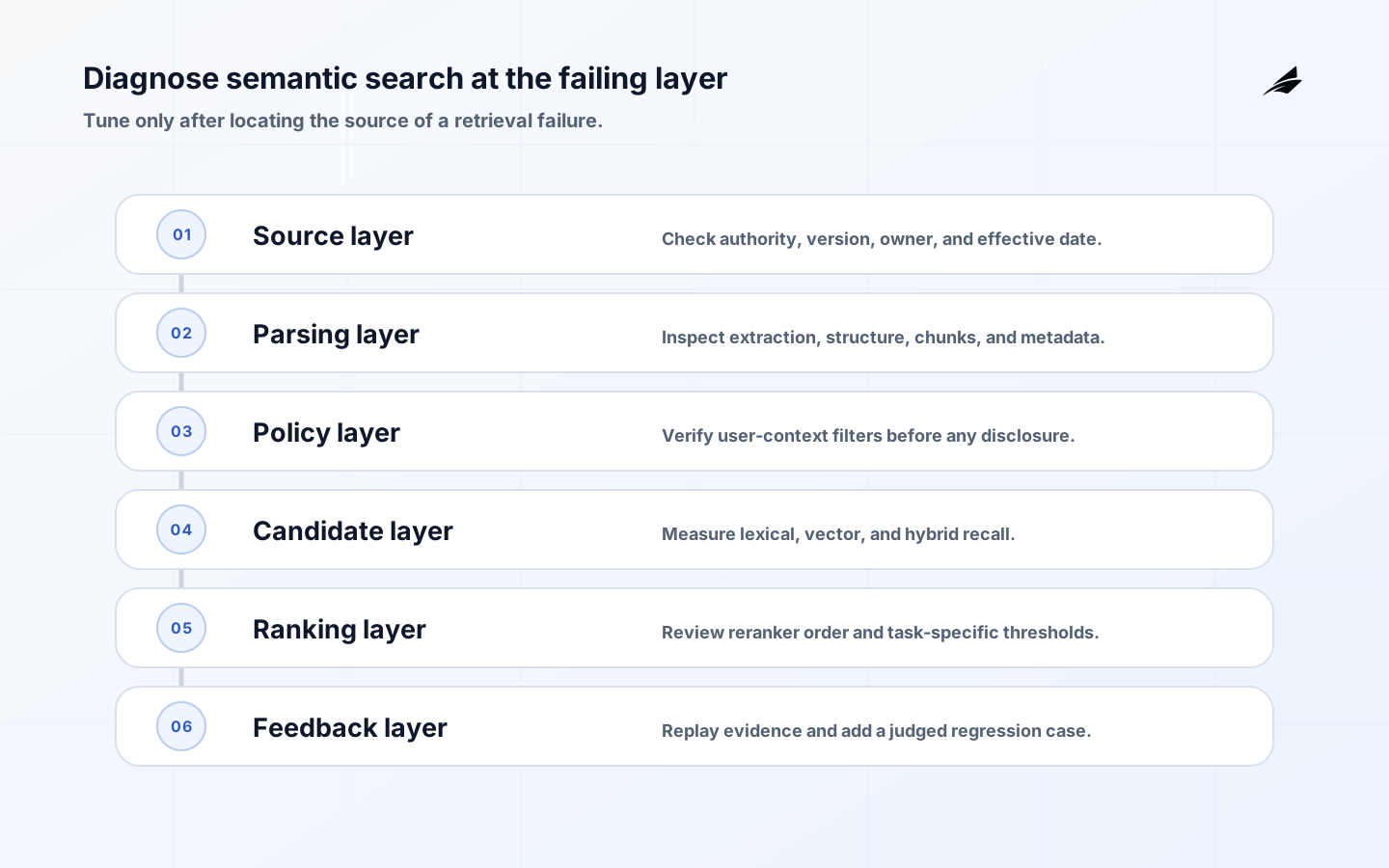
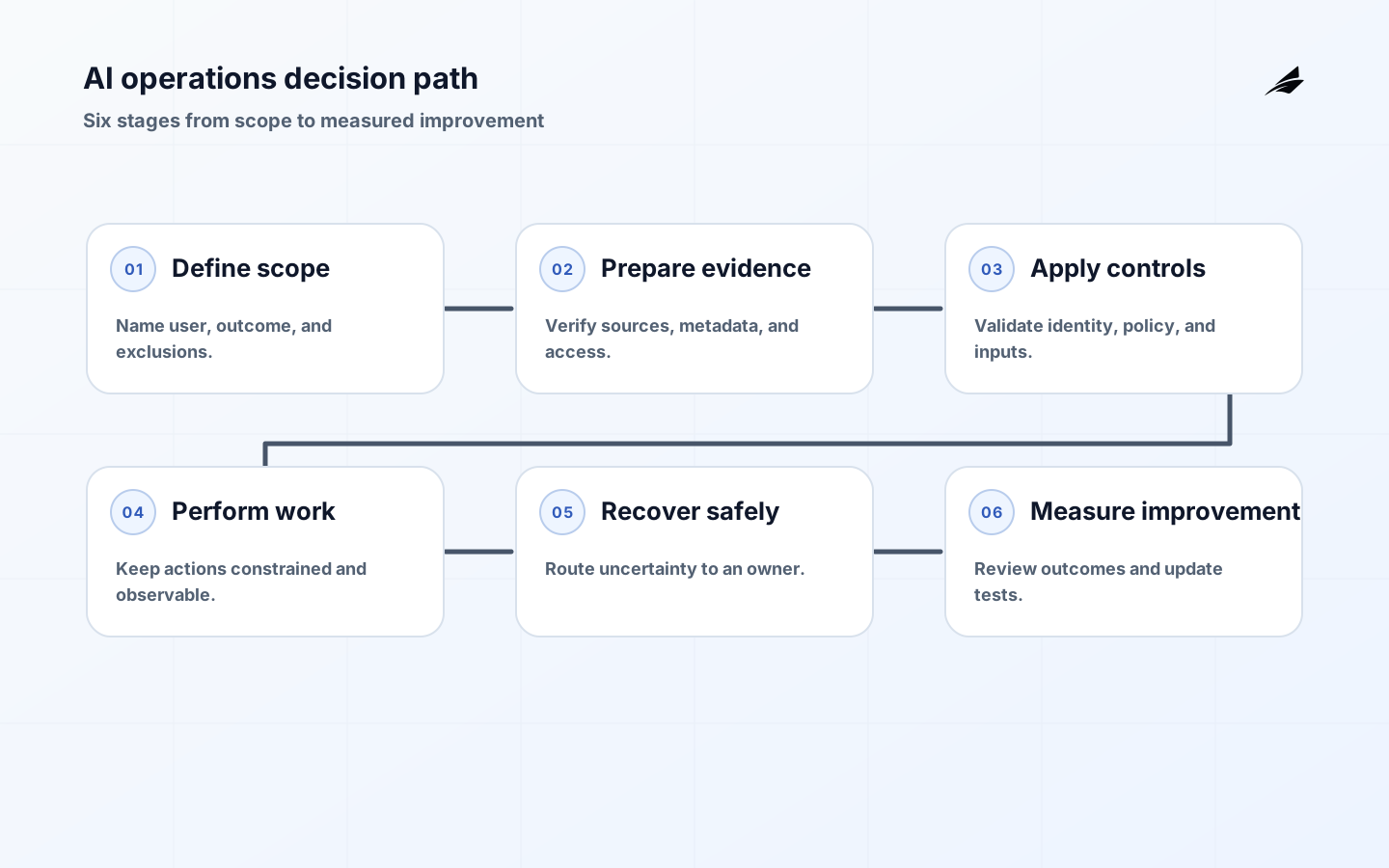
The most damaging semantic search mistakes rarely come from choosing the wrong vector database. They come from an undefined retrieval job, weak content ownership, permissions applied after retrieval, evaluation sets that contain only easy questions, and production feedback that no one owns. Semantic similarity is one signal, not proof that a result is current, authoritative, complete, or permitted. The practical fix is to diagnose each stage separately—source, parsing, chunking, metadata, authorization, candidate retrieval, ranking, presentation, and repair—using judged queries from real work.
Define the Retrieval Job
Name one user, one question class, and one decision that search may support. A support agent asking for a returns exception is different from a compliance analyst looking for policy evidence. Each has different authority, corpus, and tolerance for ambiguity. State what the system must never answer, whether it may summarise, and how it signals that evidence is absent. This boundary turns a vague relevance discussion into observable tests. It also makes a sensible connection to the plain-language semantic search guide: retrieval should assist a decision with sources, not quietly become the system of record.
| Common mistake | Why it fails in live work | Practical correction |
|---|---|---|
| Indexing every available file | Conflicting drafts and private notes look equally useful, so relevance can amplify obsolete or unauthorised material. | Admit source collections deliberately; retain owner, effective date, sensitivity, and deletion behaviour with each item. |
| Judging only polished demonstrations | Prepared questions rarely include shorthand, missing facts, or the conflicting vocabulary that makes real search difficult. | Build a judged query set from support, operations, and security cases, including queries that should return nothing. |
| Treating a vector score as confidence | Similarity is a ranking signal, not evidence that a passage is current, complete, or authorised for this requester. | Combine filters, lexical evidence, source presentation, and abstention rules before exposing a result. |
| Ignoring retrieval changes | A new embedding model, chunker, or source feed can alter results while dashboards still show healthy uptime. | Version the index path and compare a stable evaluation set before and after each material change. |
Prepare Evidence Before Embeddings
Document preparation is where many semantic search failures are born. Preserve headings, document identifiers, section boundaries, and links back to the authoritative record; do not reduce a policy to anonymous fragments. Chunking should reflect how a reviewer would use the material. A price exception rule may need its eligibility conditions and approval limits together, while a long troubleshooting manual can be split by procedure. Record the source owner and refresh expectations. When a source is replaced or a person loses access, the index must change promptly enough that the search result does not create a second, invisible copy of the truth.
- Inventory the collections that answer the selected question and obtain an accountable owner for each collection before ingestion begins.
- Normalize dates, document versions, language, business unit, confidentiality classification, and durable source links as searchable metadata.
- Use access filters at query time as well as ingestion controls, because membership and entitlements change after documents are indexed.
- Keep a deletion and correction path that can remove a bad passage, identify affected queries, and document when the repair completed.
- Test abbreviations, product names, negations, and closely related policies; these are the cases in which semantic matching can feel persuasive but be wrong.
Evaluate Retrieval, Not Just Answers
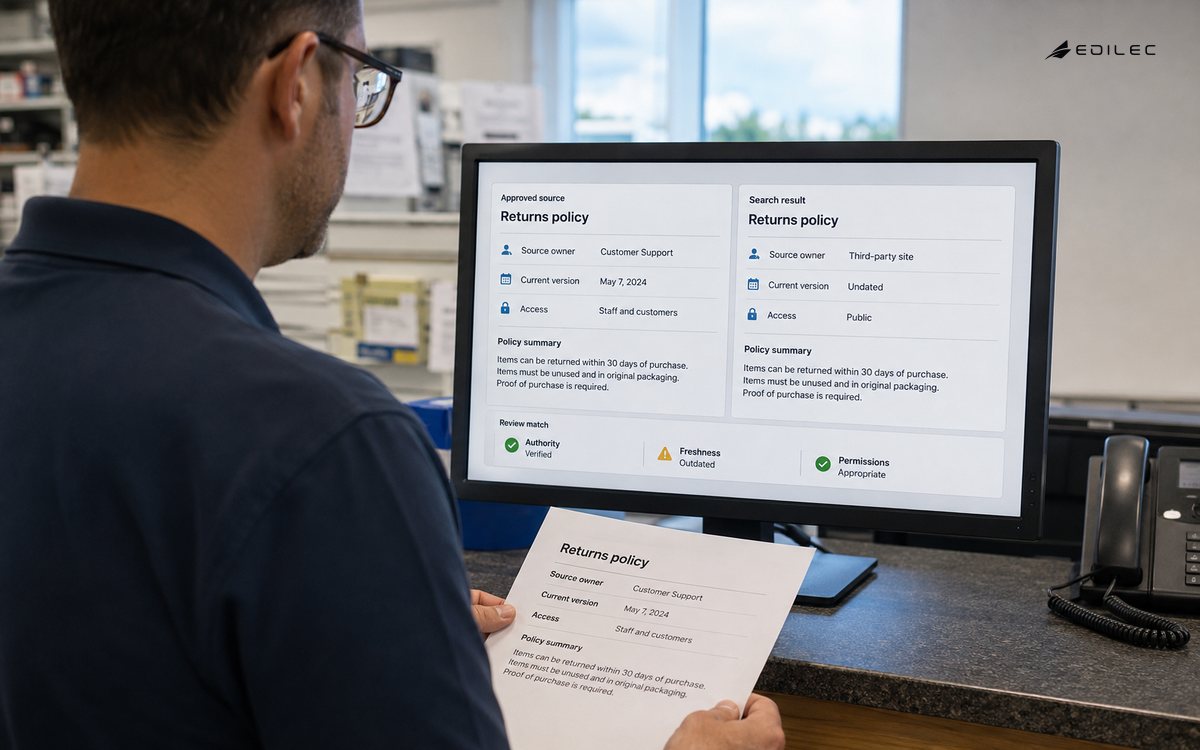
A generated answer can sound convincing when the retrieval step has missed the governing passage. Evaluate semantic search in layers: did it retrieve the target record, rank it high enough to be used, apply requester permissions, and present enough context for a human to judge it? The original RAG research explains why retrieved evidence can improve knowledge-intensive generation, but it does not remove the need for local evaluation. Reviewers should label expected passages and acceptable alternatives, then inspect failures by source gap, chunking, vocabulary, filtering, or interface design rather than collapsing every problem into a model score.
| Signal | Question it answers | Action when it degrades |
|---|---|---|
| Target passage in top results | Can the service find the authoritative evidence for a known query? | Review queries by source and language; repair ingestion or ranking before adding more documents. |
| Permission-filter test | Does a result remain unavailable when the requester lacks access? | Treat exposure as a security incident, inspect every filter boundary, and retest with changed memberships. |
| Zero-result quality | Does the system avoid inventing a match when evidence is absent or outside scope? | Improve the empty-state explanation and route the requester to an owner or approved channel. |
| Freshness lag | How long can a published change take to influence a search result? | Set a source-specific objective and alert on missed feeds, failed parsing, and incomplete deletes. |
Keep Security Outside the Ranking Model
Search permissions belong to the application and source systems, not to an instruction asking a model to behave. Authenticate the user, derive entitlements from a trusted identity service, apply filters before passages enter a prompt, and audit the result set without storing unnecessary sensitive text. OWASP guidance for LLM applications is particularly relevant when retrieved material includes untrusted content that might try to redirect an assistant. Treat retrieved text as data, not as authority to change the system's instructions or call a tool. A result should lead to a reviewed action path, not bypass the policy that governs the action.
Release With a Repair Path
Start with a limited corpus and a small group whose work produces clear feedback. Give them a way to report a missing, stale, unsafe, or misleading result with the query and source context attached. A search owner should classify each report: source stewardship, access control, index operations, relevance, or user education. This avoids the familiar loop in which users lose trust but no team owns the reason. The UK secure AI development guidance supports this lifecycle mindset: secure design, deployment, and operation are connected responsibilities.
Relevance Review in Practice
Run a weekly relevance review with the people who use the corpus. Select queries that returned a result, selected nothing, or triggered a correction. For each, compare the visible ranking with the governing record and ask whether the failure arose from vocabulary, chunk boundaries, metadata, access filtering, or an outdated source. This is more informative than a single aggregate relevance number. It shows whether a new source feed has made a reliable collection noisier and whether a business term has changed without being reflected in documents. Keep the reviewed query, expected passage, actual result, decision, and owner together so that an index adjustment is traceable to an observed operational need.
A mature search service also distinguishes a useful answer from a useful retrieval experience. A result may be technically relevant but unusable if the user cannot see its effective date, source section, or a route to the owning team. Design the result view to make those checks quick. When the evidence is weak, describe the limitation and offer a precise next step. That combination protects user trust while providing the feedback needed to improve the corpus.
Diagnose the failure before tuning the model
If the correct passage never enters the candidate set, changing a reranker threshold cannot repair recall. If a stale policy ranks first, chunk size may be irrelevant; status metadata and content governance are missing. If a result leaks a title from a denied document, the authorization filter is too late. Azure’s semantic ranking overview clarifies that a semantic ranker only reranks the candidates it receives. Vector relevance guidance explains approximate search, similarity metrics, and hybrid retrieval. Instrument each stage so a failed query can be replayed with corpus version, filters, candidate IDs, scores, reranker output, and the result actually shown.
Keep a small adjudicated set that represents high-value work and known failure classes. Record relevance at passage level, not merely whether the final generated answer sounded useful. The Azure retrieval-quality guide recommends establishing reproducible evaluation before optimization. The NIST Generative AI Profile provides broader governance and measurement context where retrieval feeds generation. Compare this diagnostic view with Edilec’s operations leader guide, first-build decisions, and AI automation guide.
| Mistake | What it looks like | Practical fix |
|---|---|---|
| No defined retrieval job | Teams disagree whether the system should find a document, passage, or answer | Write task, user, corpus, latency, authority, and abstention criteria |
| Vector-only retrieval | Exact codes and names disappear while broad themes rank well | Combine lexical and vector candidates, then evaluate fusion |
| Arbitrary chunking | Critical condition and exception land in separate passages | Chunk by document structure and test answer-bearing continuity |
| Missing document status | Superseded policies outrank current material | Index owner, effective date, version, and authoritative status |
| Permissions after ranking | Denied titles or snippets leak and authorized recall is distorted | Filter candidates with user-context authorization before display |
| Easy evaluation set | Demo questions pass while real abbreviations and no-answer cases fail | Sample query logs and label difficult, denied, stale, and ambiguous cases |
| Global score threshold | One number behaves differently across query classes | Calibrate by task and use explicit no-result behavior |
| Feedback without diagnosis | Thumbs-down events do not reveal which stage failed | Capture query, candidates, filters, corpus version, and reason category |
| Unowned source content | Index refreshes stale documents perfectly | Assign content stewards and enforce review or expiry |
| Silent ranking change | Model or index update changes results without evidence | Version components and compare regression set before rollout |
Key Takeaways
- Semantic search quality starts with a bounded question and owned source material, not an embedding choice alone.
- Keep permissions, freshness, and action authority in deterministic systems that can be inspected and changed.
- Measure retrieval against judged queries, including queries that should fail safely, before relying on answer fluency.
- Version data preparation and index changes so a relevance regression can be reproduced rather than guessed at.
- Give operations a visible repair path for stale results, missing evidence, and disputed rankings.
Frequently Asked Questions
Is semantic search better than keyword search? It solves different failures: semantic matching can bridge wording differences, while lexical matching remains valuable for codes, names, and exact policy terms. Many systems combine both. What is a good first metric? Measure whether a judged query retrieves an authoritative, permitted passage high enough for the user to act on it. Can it answer from the public web? Only if that is explicitly in scope and sources are evaluated; internal operational questions usually need controlled, owned collections. When should search abstain? When evidence is missing, conflicting, stale, unauthorised, or too weak to support the requested decision.
Conclusion: Make Relevance Accountable
Semantic search becomes dependable when a team can show what was searched, why a result was allowed, which evidence supports it, and who repairs a failure. Build that operating discipline before widening the corpus or attaching an assistant. The result is less theatrical than a broad demonstration, but much more useful when a real customer case depends on it.