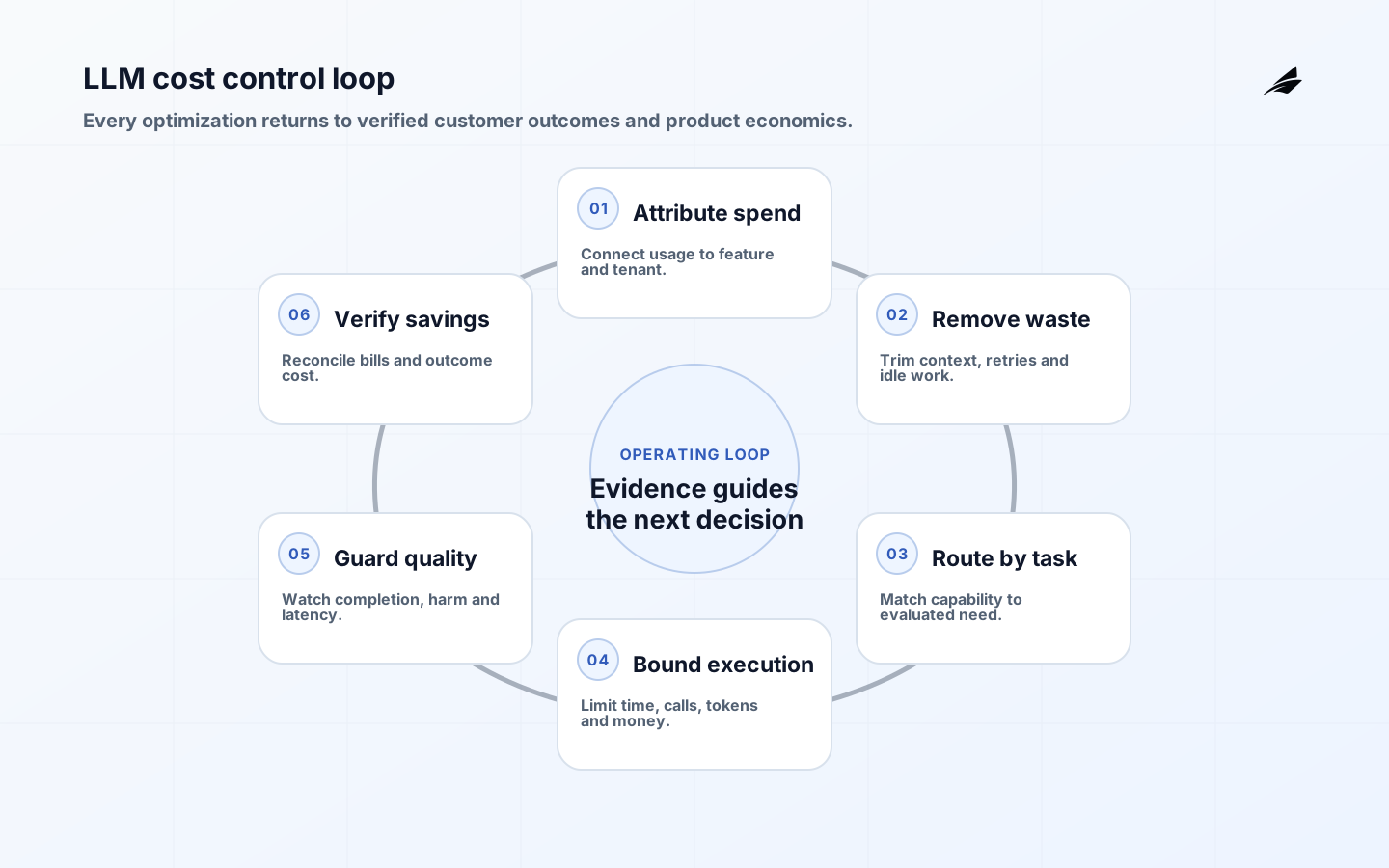
LLM cost controls are product controls. A growing application can multiply spend through longer context, more turns, retries, tool loops, richer outputs and broader traffic even when per-token prices fall. Cutting cost without observing answer quality, customer effort and downstream rework can move expense off the inference bill and into support or risk. The right unit is therefore cost per verified outcome at an agreed service level.
This guide builds on Edilec's AI implementation checklist, AI platform buying FAQ and AI search architecture guide. Cost controls work best when request contracts, retrieval and evaluation are already visible. Otherwise, teams optimize whichever usage field is easiest to export.
Key takeaways
- Attribute spend to a product, feature, tenant and verified outcome rather than a provider invoice alone.
- Remove unnecessary model work before negotiating rates or switching models.
- Route by evaluated task requirements, with deterministic fallbacks and hard loop limits.
- Treat caching, batching and reserved throughput as workload-specific economic decisions.
- Join cost alerts to quality, latency and customer impact so savings do not conceal regression.
Start with LLM unit economics
Create a request ledger at the application boundary. Record feature, tenant or customer segment, task type, model route, input and output usage, cache reads and writes, retrieval operations, tool calls, retries, latency, final status and evaluation outcome. Do not put sensitive prompt content into financial telemetry. A trace identifier can join protected operational records to aggregated cost data when investigation is authorized.
The FinOps Framework treats unit economics, budgeting and optimization as connected capabilities. For an LLM product, useful units might be a resolved support case, accepted document extraction, approved draft, qualified lead or completed workflow. Pick a unit that reflects customer value and cannot be manufactured by generating more text. Track distribution and cohort differences rather than one portfolio average.
| Cost component | Driver | Control signal | Quality guardrail |
|---|---|---|---|
| Input inference | Prompt and retrieved context | Tokens per eligible task | Evidence coverage |
| Output inference | Response length and reasoning | Tokens per accepted result | Task completeness |
| Retrieval | Queries, reranking and index | Cost per grounded answer | Recall and authorization |
| Tools | Calls, retries and external APIs | Calls per successful action | Transaction accuracy |
| Human review | Sampling and escalation | Review minutes per outcome | Critical failure detection |
Reduce avoidable demand before changing models
Inspect the most expensive request classes. Remove duplicated system instructions, stale conversation history, irrelevant retrieved passages, verbose schemas and repeated tool results. Summarize or externalize durable state instead of replaying every turn. Set output limits from the task, not a global maximum. Use conventional code for validation, arithmetic, filtering and formatting. A model should not spend tokens rediscovering data the application already knows.
Fix retries and loops before prompt phrasing. Distinguish transport retry, provider throttling, invalid output repair and agent replanning; each needs a separate limit and idempotency behavior. Record the reason for every repeated inference. Add total token, tool-call, elapsed-time and monetary ceilings per request. When a ceiling is reached, return a safe partial result or route to a person rather than letting the system continue invisibly.
Route work by evaluated requirements
Create a task taxonomy and test candidate routes on the same cases. A small model may handle classification, extraction or query rewriting, while a more capable model handles difficult synthesis. Rules may bypass a model entirely. Define confidence or policy conditions for escalation and evaluate the router itself. A cheap first attempt is not cheaper when the fallback repeats the full context and customers wait through two failures.

Keep model selection behind a versioned internal contract. Enforce allowed tasks, regions, data classes, context limits and fallback order outside the prompt. Release routing changes through the same evaluations as model changes. Compare accepted-outcome cost, latency percentiles, unsupported claims and escalation, not only average request price. Reserve manual review for significant slice changes and high-consequence tasks.
| Technique | Works when | Can backfire when | Test before release |
|---|---|---|---|
| Smaller model | Task boundary is narrow | Error creates rework | Outcome and slice parity |
| Prompt caching | Long stable prefixes repeat | Writes or misses dominate | Hit rate and net request cost |
| Batching | Work is asynchronous | Queue delay harms outcome | End-to-end completion time |
| Reserved throughput | Demand is predictable | Utilization is low | Load profile and commitment scenario |
| Shorter output | Response has a clear format | Necessary explanation is lost | Completeness and user effort |
Use caching and capacity commitments deliberately
Prompt caching can reduce repeated computation when a long prefix stays identical, but economics depend on provider rules, minimum sizes, write charges, time-to-live and hit rate. Amazon Bedrock's prompt caching documentation explicitly distinguishes cache reads, writes and uncached input. Instrument those categories and place stable instructions before variable content. Do not cache user-specific material across an unsafe boundary.
Choose pay-as-you-go or reserved throughput from measured demand. Google Cloud's generative AI throughput guidance describes shared pay-as-you-go capacity and provisioned throughput as different cost and predictability choices. Model hourly and daily peaks, acceptable throttling, regional needs, growth uncertainty and commitment term. A reservation is a reliability purchase as well as a rate decision.
Set budgets that preserve useful exceptions
Use layered budgets: an advisory forecast for product planning, a feature or tenant alert for investigation, and a hard request ceiling for uncontrolled work. Avoid a single monthly kill switch that disables the service for every customer. Rate limits should reflect identity and business flow, not only IP address. Keep separate emergency capacity for incident analysis or contractual workloads, with explicit approval and expiration.
Review anomalies by explaining the usage change: traffic growth, context expansion, model migration, cache misses, retry storms, abuse or a newly successful feature. The AWS Well-Architected Cost Optimization Pillar emphasizes ownership, budgets, proactive monitoring and optimization over time. Assign an engineer and product owner to every material LLM cost center so an alert reaches people who can change behavior.
Join cost, quality and reliability telemetry
Use traces to connect the model call to retrieval, tools and the final product event. OpenTelemetry provides a vendor-neutral foundation for traces, metrics and logs. Keep a stable internal cost schema because provider usage fields differ. Reconcile application estimates against billing exports, account for delayed adjustments and flag unattributed spend. Sampling should preserve expensive and failed requests even if routine success is downsampled.
Every cost experiment needs a quality guardrail and an observation window. For a new route, compare verified completion, correction, repeat contact, harmful failures and latency by slice. Use a holdout when behavior may change gradually. Roll back when a critical outcome degrades even if total spend improves. Publish savings as a range with traffic and price assumptions rather than a universal percentage.
Design product behavior for constrained capacity
Cost control is partly a product-design problem. Decide which work must be synchronous, which can wait in a queue and which can reuse a previously verified result. A document review may show an immediate receipt and complete asynchronously; an interactive support suggestion may need a strict latency budget; a periodic classification job may run in batches. Expose progress and cancellation for long-running work. Preserve idempotency so a user refresh or client retry does not start another expensive job. When demand exceeds safe capacity, degrade deliberately by limiting optional enrichment, postponing low-priority work or offering a human route instead of returning unpredictable timeouts.
Entitlements should map to understandable customer value. A plan may include a number of processed documents, monitored records or completed analyses rather than an opaque token allowance. Define how failed, cancelled and retried work is counted, and make administrative overrides time-bound. Protect shared capacity from a single tenant with fair scheduling and per-workload concurrency. Test the experience at quota boundaries: users should know what completed, what did not, when capacity returns and whether an alternative is available.
Forecast from product drivers rather than multiplying last month's tokens. Model active tenants, task frequency, input-size distribution, route mix, cache reuse, success rate and seasonal peaks. Attach a range to uncertain assumptions and compare forecast to actual usage each review. This makes a cost increase explainable: the team can distinguish healthy adoption from longer contexts, routing regression, lower cache hits or runaway loops, then choose the correct response. Include provider price changes and currency exposure as separate assumptions so engineering efficiency is not confused with commercial movement. Reforecast after a major model, feature or customer-contract change, and keep the prior forecast to improve future estimates.
Run a monthly LLM cost review
- Reconcile provider bills to product, feature and unattributed usage.
- Review cost per verified outcome and its volume, quality and latency context.
- Inspect the most expensive and fastest-growing request classes.
- Retest routes, cache behavior, loop limits and fallback economics.
- Expire unused capacity, stale experiments and temporary budget exceptions.
- Record decisions, owners, expected effect and a date for verification.
Frequently asked questions
What should a team measure first?
Start with request count, input and output distribution, retries, model route and one verified product outcome. This is enough to identify major drivers without waiting for a perfect cost warehouse.
Is prompt caching always cheaper?
No. Low reuse, frequent prefix changes, write charges or sensitive isolation requirements can erase the benefit. Measure actual reads, writes, misses and net cost for the workload.
Should customers see usage limits?
When limits affect service, explain them in useful product terms and show recovery options. Internal token mechanics rarely help customers; remaining tasks, file size or reset time often do.
Conclusion
Sustainable LLM cost controls begin with unit economics and end with a release decision backed by quality evidence. Remove unnecessary work, route bounded tasks, measure caching and capacity honestly, and stop runaway execution at the application boundary. The goal is not the smallest model bill. It is a growing product whose cost, reliability and customer value remain understandable together.