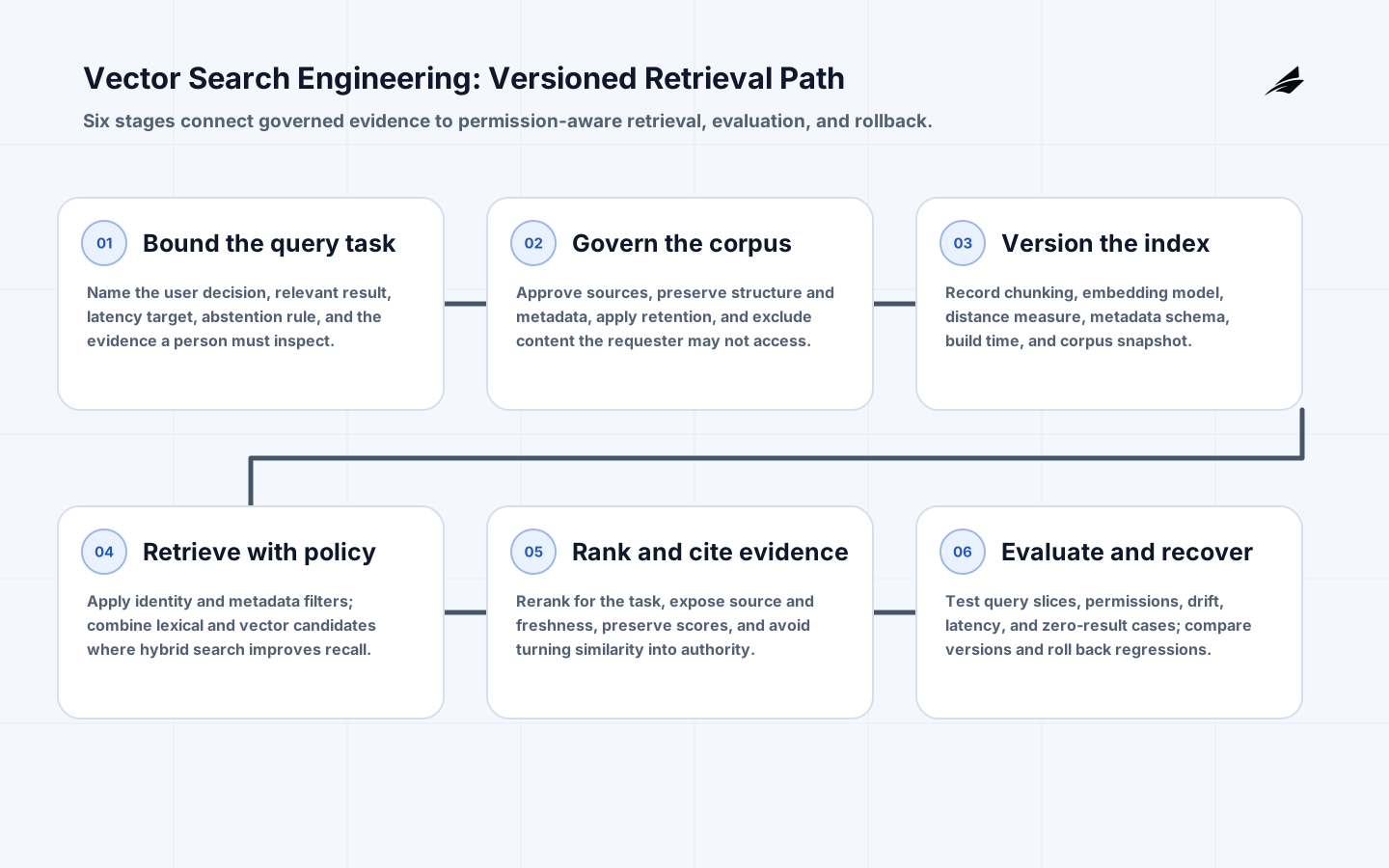
Vector search is a way to find records by representing queries and content in a numeric space where related meanings are close. That makes it useful for paraphrases, concepts, and vocabulary variation, but proximity is not the same as authority, permission, freshness, or correctness. Engineering teams get durable value when they treat vector search as one stage in a retrieval service: preserve document structure and metadata, combine semantic and exact signals where the task needs both, enforce filters before protected results are exposed, and measure the complete user workflow. The companion RAG systems guide explains how this retrieval layer fits into a grounded application.
Start With the Retrieval Unit
Do not begin with a preferred database or embedding model. Begin with the thing a user needs to retrieve and the consequence of missing it. A support answer may need a policy clause plus its exception. An incident responder may need a runbook step plus the service and version it applies to. A sales analyst may need an account record that must remain separated by tenant. The retrieval unit should preserve enough context to be useful while remaining specific enough to rank and cite.
| Retrieval concern | Implementation choice | Failure to watch |
|---|---|---|
| Structure | Chunk by heading, procedure, clause, table, or record boundary and retain the parent path | A relevant sentence loses the condition or scope that makes it safe to use. |
| Identity | Keep source ID, version, effective date, owner, and canonical URL with every chunk | The result cannot be cited, refreshed, compared, or removed reliably. |
| Eligibility | Index tenant, role, product, region, lifecycle, and sensitivity attributes for trusted filtering | A semantically close result is returned even though the user cannot access or apply it. |
| Task relevance | Define judgments by query class and downstream success, not by similarity score alone | A benchmark improves while users still receive the wrong version or wrong action. |
Make Ingestion Reproducible
Ingestion is part of search quality. Record the parser version, normalization rules, chunking method, embedding model, metadata schema, and source snapshot for each index build. Preserve headings, list order, table relationships, code identifiers, and negations. Avoid stripping the very tokens users search for: product codes, ticket IDs, legal references, and field names often need exact matching. When a source changes, emit an update event that can be traced through parsing, embedding, indexing, and deletion.
Define lifecycle behavior before launch. A document that is deleted from the source should not remain discoverable through an old vector. A superseded product manual should not outrank the current one because it contains more familiar language. Keep historical versions for audit only when policy permits, and make their status explicit. The NCSC secure AI guidance is useful here because it treats secure design, development, deployment, and operation as one lifecycle rather than a final checklist.
Combine Semantic and Exact Retrieval
Dense vectors are good at paraphrase: “reset a forgotten password” can find a passage titled “credential recovery.” They can be weak on exact identifiers, negation, short queries, rare names, and version strings. Lexical retrieval is often stronger for those cases. A practical pipeline can generate lexical and vector candidates, apply mandatory eligibility filters, deduplicate by parent document, and rerank a bounded set using task-specific judgments. Keep the fusion logic versioned so a ranking change can be explained and rolled back.
Approximate nearest-neighbor indexes trade recall, latency, and memory. Tune their parameters at the corpus size and filter selectivity you expect in production. A fast query that drops the only applicable safety procedure is not an optimization. Reranking may improve ordering but adds a dependency and a model version; prove its value on the actual task. Context assembly should merge adjacent passages when needed, remove redundant chunks, preserve source boundaries, and respect a hard budget.
Put Authorization Before Ranking
A vector score must never grant access. Carry the caller's identity and policy attributes into a trusted retrieval boundary, then filter candidates before content reaches a model or a user. Test row-level and tenant-level permissions, role changes, revoked access, legal holds, deleted records, and queries that deliberately mix allowed and denied material. Be careful with post-filtering: an ineligible item can still affect rank, counts, or timing even if its text is removed later. Log the filter decision and index version without creating a new sensitive data store. OWASP's LLM application guidance also highlights sensitive information disclosure, supply-chain vulnerabilities, and insecure output handling as application risks around AI components.
Filtering also needs a clear owner and failure behavior. If the policy service is unavailable, do not silently fall back to an unfiltered index. If a user's group membership is stale, prefer a safe denial or a review route over a best-effort guess. Cache authorization decisions only with a documented expiry and key that includes the relevant identity and policy version. For multi-tenant systems, test not only returned text but also result counts, latency differences, error messages, and cache isolation. Security review should cover the retrieval service, index snapshots, backups, admin tools, and observability data, not just the search query.
Make relevance failures easy to report. A reviewer should be able to mark a result as stale, wrong scope, incomplete, unauthorized, duplicate, or useful but poorly ranked, with the query and index build attached automatically. Those labels lead to different repairs: source correction, metadata fix, chunk reconstruction, filter change, fusion adjustment, or a new judgment. Avoid a single thumbs-up score that hides the reason a result failed. The goal of feedback is a smaller, more informative repair queue.
Scenario: Searching Incident Runbooks
Suppose an on-call engineer asks, “How do we drain the queue for checkout in the EU cluster?” The useful result is not simply the nearest paragraph about queue draining. The search service should recognize the service, environment, region, and operational intent; prefer the current runbook; preserve the warning about traffic and data loss; and return the procedure with its owner and last review date. If the engineer lacks access to production procedures, the service should return an approved escalation path rather than a partial excerpt.
Build judgments for shorthand, misspellings, exact service names, old cluster names, and requests that should produce no result. Compare vector-only, lexical-only, and hybrid candidates. Have responders judge whether the first useful result is actionable, current, authorized, and complete enough for the step at hand. A better cosine score is irrelevant if the procedure omits a rollback condition or belongs to another deployment generation.
The scenario also shows why metadata can be more valuable than another ranking tweak. The region and environment filters narrow applicability before similarity is calculated; the service and deployment generation help resolve near-duplicate runbooks; the review date and owner tell the responder whether the document is still maintained. Preserve those fields through candidate generation and display them with the result. A ranking explanation need not expose proprietary model internals, but it should make the practical reasons for selection inspectable: matched identifiers, applied filters, source version, and any warning that requires attention.

Evaluate Search by Query Class
Create a judgment set from the real workload: short and long questions, exact identifiers, paraphrases, ambiguous terms, multilingual requests, denied records, changed policies, and true no-answer cases. Label the relevant source set and the minimum context required to act. Measure candidate recall when missing a result is costly, precision when irrelevant context creates risk, ranking quality at the positions users inspect, and coverage of each query class. Then measure downstream citation support, correction, resolution, and harmful confident results. Retrieval metrics are diagnostic; they are not the product outcome.
| Change under test | Compare | Keep if |
|---|---|---|
| Chunking | Structural boundaries, overlap, parent context, and table handling | Required evidence stays together without flooding the candidate set with duplicates. |
| Embedding model | Paraphrase, multilingual, rare-term, and no-answer slices | Task-level gains hold across important segments and do not weaken exact lookup. |
| Index settings | Recall, latency, memory, and selective-filter behavior at expected scale | The service meets the latency budget without losing applicable results. |
| Hybrid fusion or reranking | First-useful-result rate, citation support, cost, and tail latency | Users resolve more work with acceptable operating cost and explainable ranking. |
| Metadata or policy change | Allowed, denied, revoked, deleted, and cross-tenant cases | Authorization remains correct before and after the index update. |
Operate the Index as a Versioned Service
A rebuild can change neighbors even when the source documents are unchanged. Give every index a build ID linked to the source snapshot, parser, embedding model, dimensions, metadata schema, filters, fusion method, and evaluation result. Run a stable query set against the current and candidate indexes before promotion. Use a blue-green or otherwise reversible rollout when the search service is important enough to need fast rollback.
Plan maintenance around the source lifecycle, not only around infrastructure capacity. Schedule re-embedding when the representation model changes, but also support targeted updates for edited documents and immediate removal for revoked material. Reconcile source counts with index counts and sample deleted, replaced, and newly published records. Keep rebuild jobs resumable and observable; a half-complete index should be clearly marked and kept out of production traffic. These checks turn a silent relevance regression into a visible release or data-quality issue.
- Monitor source-to-index delay, parse and embedding failures, document counts, deleted-vector lag, empty results, filter selectivity, candidate counts, latency percentiles, and cost.
- Track index health by collection and partition; a responsive endpoint can still serve stale or incomplete content.
- Keep a lexical or curated fallback for exact lookup when vector infrastructure is unavailable, and label degraded behavior to operators.
- Fail closed when authorization cannot be evaluated for protected records; do not trade access control for availability.
- Bound query length, candidate count, reranking work, and context size to protect latency and spend.
- Route repeated misses, bad rankings, and stale results to owners who can repair source content, metadata, judgments, or code.
Use a Search Release Checklist
- The retrieval unit and acceptable evidence are documented for each task.
- Source identity, structure, ownership, lifecycle, sensitivity, and permissions survive ingestion.
- A representative query set includes exact, semantic, ambiguous, denied, changed, and no-answer cases.
- Authorization is enforced at a trusted boundary before content is returned or reranked.
- Candidate and end-to-end results are compared with the previous version by query class.
- Rollback, rebuild, deletion propagation, dependency failure, and incident ownership have been exercised.
Key Takeaways
- Choose the retrieval unit from the user's decision and preserve the context that makes it applicable.
- Treat vector similarity as one signal alongside exact terms, authority, freshness, permissions, and task judgments.
- Make ingestion, index builds, filters, fusion, reranking, and deletions reproducible and reversible.
- Evaluate by query class and downstream usefulness, not by a single global score.
- Monitor the corpus and authorization path as carefully as the search endpoint.
Frequently Asked Questions
Do we need a dedicated vector database?
Not necessarily. An existing search engine or relational platform may already provide the filtering, backup, operational ownership, and hybrid retrieval the workload needs. Decide from measured corpus size, query shape, permissions, latency, migration effort, and failure handling.
What is the best chunk size?
There is no universal size. Start with document structure and the evidence a user must see, then compare alternatives on real judgments. Keep parent and neighboring context available, and do not split a table, exception, or procedure in a way that changes its meaning.
Is a high similarity score proof of relevance?
No. It indicates closeness in one representation space. Relevance still depends on the query's intent, source authority, version, permissions, completeness, and the action a person will take.
Conclusion
Reliable vector search is governed retrieval, not nearest-neighbor magic. Preserve structure and provenance, combine semantic and exact signals deliberately, enforce authorization before results travel, test the cases users actually bring, and operate every index as a versioned service. That discipline lets engineering teams use semantic matching without mistaking a mathematically close result for an answer that is current, permitted, or safe. Edilec's AI automation services can help teams turn that retrieval design into a measured implementation and operating model.