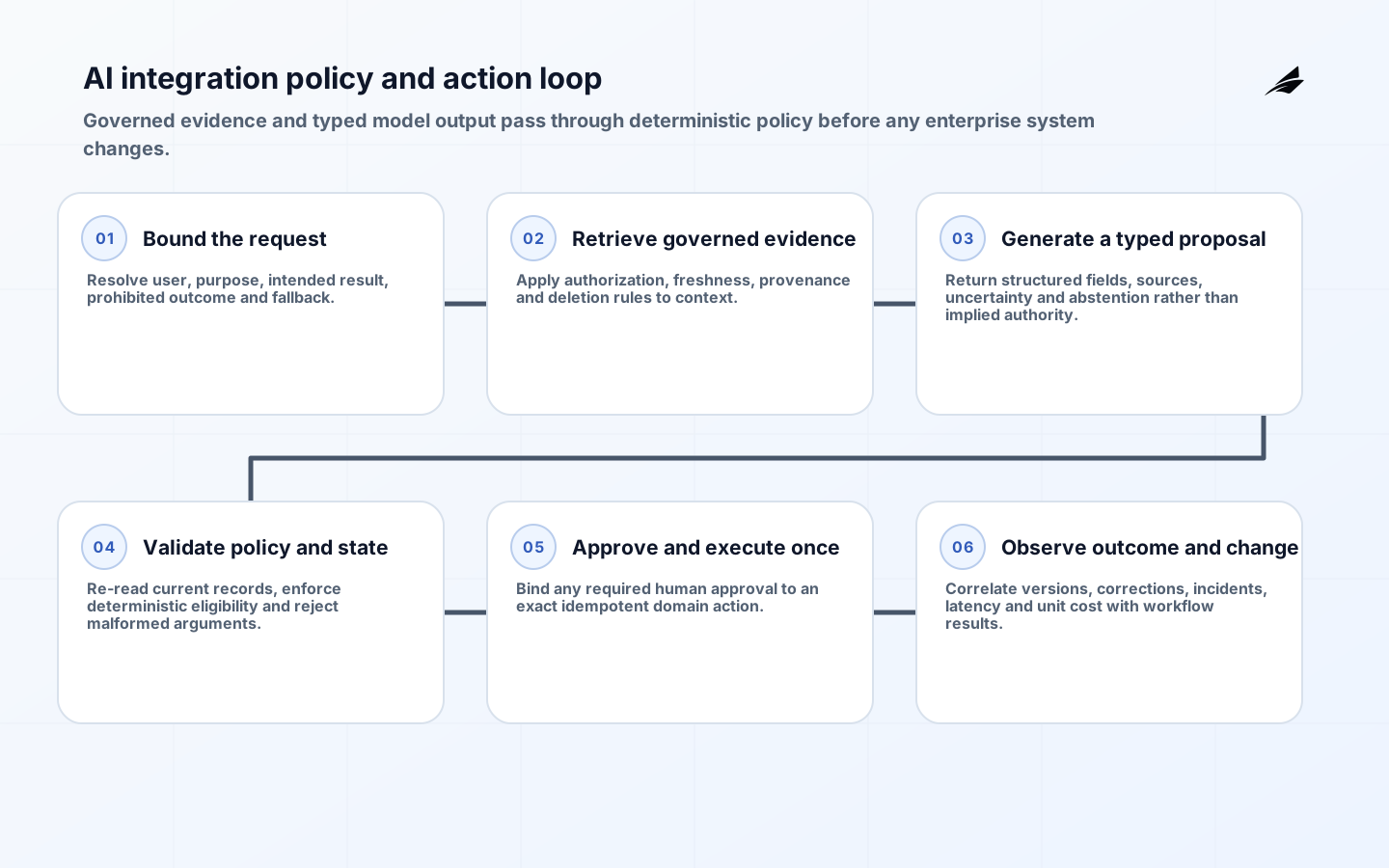
AI solutions integration places a probabilistic capability inside a real workflow without surrendering control of identity, data, policy or side effects. A model may classify, extract, summarize, retrieve or propose, but the application must decide what it may see, what constitutes a valid result and whether an action is allowed. Scope the delivery as a complete service, not a model endpoint.
This guide covers use-case selection, data, integration contracts, tools, evaluation, security, human review, cost and operations. Teams building model pipelines should also read the MLOps implementation checklist and MLOps FAQ.
Define workflow and authority
Describe user, trigger, current process, desired output, consuming system and accountable decision maker. Separate advisory output from consequential action. State prohibited outcomes, required evidence, acceptable abstention and fallback. If success cannot be measured without subjective enthusiasm, the use case is not ready.
Map the state transition from identity through context, model result, validation and system-of-record change. Keep deterministic business rules outside prompts. This boundary lets a model change without rewriting authority and makes failures attributable to data, model, policy, integration or interface.
| Boundary | Decision | Evidence |
|---|---|---|
| Intended use | User and task supported. | Scenarios match deployment. |
| Output | Fields, evidence and abstention. | Schema rejects malformed results. |
| Authority | Advisory, automatic or approved. | Policy tests prove limits. |
| Fallback | Outage and low-confidence path. | Work completes safely without model. |
| Ownership | Product, risk and system owners. | Routes reach named responders. |
Govern data and retrieval
Inventory source systems, owners, freshness, retention and purpose. Retrieve under the user’s authorization rather than an all-powerful model account. Preserve identifiers, effective time and access decision. For retrieval systems, define indexing, deletion and refresh objectives. An answer from unauthorized data is a security failure.
Treat documents, email, websites and tool results as untrusted content, not control instructions. Label origin and prevent retrieved text from redefining tool authority. Test stale, contradictory and missing sources. Read current transactional status immediately before action rather than trusting an earlier summary.
Design typed integration and policy layers
Use a host to coordinate identity, context, model calls, policy, tools and state. MCP can standardize focused connections, but the host still controls consent and permissions. Define schemas at every boundary and correlate request, retrieval, decision and action. Timeouts, cancellation and retries are explicit.

Expose narrow domain functions instead of generic database or browser access. Validate model output before forming tool arguments, re-read state, enforce eligibility and include idempotency. Separate read and write credentials. Record proposed and executed arguments; when a dependency fails, keep a visible recoverable task.
| Cost driver | Cause | Control |
|---|---|---|
| Inference | Context, model class and retries. | Budgets and routing. |
| Retrieval | Index size and query fan-out. | Measured freshness and tiers. |
| Integration | Systems and contract volatility. | Stable owned adapters. |
| Evaluation | Scenarios and expert review. | Risk-tier sampling. |
| Human review | Ambiguity and consequence. | Evidence-rich interface. |
| Operations | Telemetry and incidents. | Objectives and runbooks. |
Evaluate deployment scenarios
Build scenarios before final model choice: routine cases, boundaries, underrepresented language, missing evidence, prompt injection, malformed tools and known incidents. Score correctness, groundedness, abstention, policy compliance, unsafe attempts, correction effort, latency and cost. Break results down by risk family.
Evaluate model, prompt, retrieval, policy, adapters and interface as one release. A model upgrade can change structured output or refusal despite better benchmarks. Use domain experts and independent reviewers for consequential workflows. Continue sampled adjudication in production; simple ratings do not reveal silent errors.
Control security and privacy risks
Threat-model instruction injection, sensitive disclosure, excessive agency, insecure output handling, supply chain and resource exhaustion. Apply size and rate limits, minimization, output encoding and least-privilege tools. Never use model text directly as SQL, HTML, code or commands. Retain investigation evidence without unnecessary private content.
Review providers for data use, retention, location, deletion, access and change notice. Protect service identities and monitor abnormal cost. Define correction propagation into indexes and memory. For high-impact applications, involve domain, legal, privacy and security stakeholders throughout the NIST-style risk lifecycle.
Make human review meaningful
Route cases to people when evidence is incomplete, impact is material, policy requires judgment or conditions lie outside testing. Present original request, cited sources, proposal, uncertainty, policy checks and alternatives. Reviewers must be able to reject, edit, request evidence or escalate within a realistic workload.
Tie approval to the exact action version; invalidate it when state or arguments change. Capture useful reason codes and analyze overrides and appeals as product evidence. Emergency bypass needs stronger authentication, narrow scope and retrospective review. A nominal person in the loop is not a control.
Deliver a thin end-to-end slice
Build the smallest workflow that exercises real identity, governed data, model output, policy, interface, telemetry and fallback. Use shadow or advisory mode where consequence warrants. Avoid a broad assistant with access to many systems but no completion rule. A thin slice reveals integration constraints while change remains affordable.
Expand by risk tier and workflow family. Version components and use progressive rollout with stop conditions. Train users on limitations and recovery rather than prompt tricks. If a deterministic rule or conventional search works better for a subtask, use it; the service can combine methods.
Operate the integrated service
Monitor completion, abstention, correction, escalation, unsafe proposals, retrieval failures, tool errors, latency and unit cost by workflow. Correlate outcomes with model, prompt, index, policy and adapter versions. Protect telemetry from tenant leakage and avoid collecting private reasoning.
Prepare runbooks for provider outage, regression, compromised credentials, poisoned retrieval, runaway calls and wrong actions. Provide layered kill switches and preserve event history without repeating side effects during replay. Assign corrective work to the failing control rather than blaming AI generically.
Define interface change control for internal and external dependencies. Model providers can alter behavior behind a stable endpoint, source systems can change semantics and policy owners can revise eligibility rules. Keep contract tests for schemas and representative behavior, subscribe to provider notices and establish a compatibility window. A release inventory should show which model, retrieval corpus, adapter and policy combinations remain supported so an incident does not become an archaeology exercise.
Use explicit data-quality stops. Missing identifiers, impossible dates, contradictory status or an expired source should not be smoothed into a fluent answer. Identify the defect, preserve the case and route it to a data owner or reviewer. Measure how often the model is asked to compensate for broken records; that volume often reveals a source-system problem whose repair creates more value than prompt tuning.
Commercial estimates should separate discovery, connectors, retrieval, evaluation, user experience, security review, rollout and recurring inference. Vendor token price is only one line. Include expert adjudication, correction work, observability, retained evidence, red-team exercises and provider deprecation changes. Present cost ranges by transaction volume and context size, with assumptions that would move the service into a higher tier.
For regulated or high-impact workflows, maintain a decision record explaining why AI is used, which alternatives were considered, what conditions were tested and which residual risks were accepted. Connect that record to the deployed release and review it when the population, policy, model or workflow changes. Continued operation should remain contingent on the assumptions that justified deployment.
Plan supplier exit before production data accumulates. Preserve portable prompt and policy definitions where possible, keep evaluation scenarios independent of one vendor and document data export or deletion. Test a fallback path for critical work, even if it offers reduced capability. Portability means knowing the time, evidence and application changes needed during commercial or technical disruption.
Define service objectives for the non-model layers as well. Retrieval freshness, policy response, tool completion, review queue age and event persistence can fail while the model endpoint remains available. Instrument each boundary and expose a single case timeline to operators. This prevents teams from attributing every slow or incorrect result to inference when the real defect is stale context or a blocked transaction.
Acceptance should include a controlled comparison with the current process. Measure quality, handling time, correction effort, escalation, user trust and total unit cost over a representative period. Segment by request family and consequence. If the service shifts work from one team to another, include that labor rather than declaring efficiency from the first interface alone.
Record a named owner for every production assumption, including source freshness, provider availability, review capacity and policy maintenance. An assumption without monitoring or ownership becomes invisible technical debt and usually surfaces only when a customer challenges an outcome.
AI integration planning takeaways
- Scope one measurable workflow with explicit authority and fallback.
- Retrieve current evidence under user permissions.
- Place schemas, policy and side-effect validation outside the model.
- Evaluate the complete application under realistic failure.
- Design review around exact action approval.
- Track quality, risk, latency and unit cost.
Frequently asked questions
Should an AI integration call databases directly? Prefer narrow governed APIs that enforce authorization, schemas and policy. Generic database access expands blast radius.
When is retrieval useful? When answers depend on changing governed material and citations matter. It still requires access filtering, freshness, deletion and evaluation.
How long does integration take? Duration depends more on workflow, data, interfaces, evaluation and approval than the model call. Consequential integrations require more control work.
Conclusion
AI solutions integration succeeds when probabilistic capability is surrounded by dependable software and accountable operations. Governed evidence, typed interfaces, deterministic authorization, meaningful review, rigorous evaluation and recoverable production behavior let models contribute without becoming the source of authority.