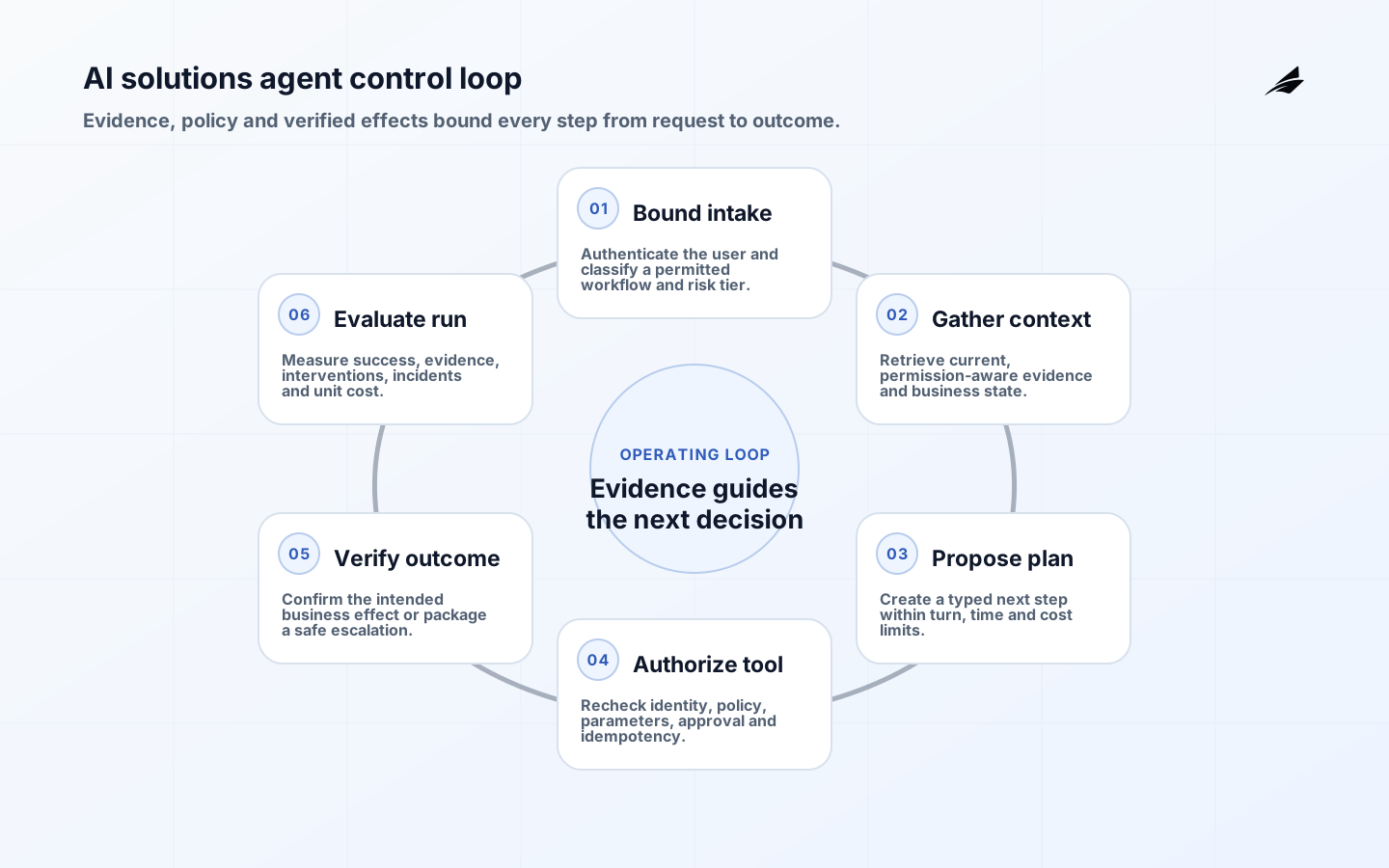
An AI solutions agent is software that uses a model to interpret a goal, select permitted tools, gather context and advance a workflow under defined controls. Its value is not autonomous conversation; it is reliable completion of a business outcome such as preparing a service case, reconciling an invoice exception or assembling an approval package. The implementation plan must therefore specify authority, evidence, failure behavior and ownership as carefully as prompts and model choice.
This guide covers the decisions needed before funding and during delivery. Teams ready to turn the plan into gates can use the AI solutions agent implementation checklist, while stakeholders seeking concise answers can read the AI solutions agent FAQ. Broader automation programs should compare the business process solutions delivery plan and AI services planning guide.
Define the outcome before the agent
Choose one workflow with observable demand, a known responsible owner and enough historical cases to evaluate. Map the trigger, inputs, systems, policies, decisions, approvals, exceptions and final record. Write a baseline for cycle time, manual touches, rework, loss, customer impact and operating cost. A useful scope statement says what successful work looks like and what the agent must never do; naming a department-wide assistant or digital worker does neither.
Separate recommendation from authority. An agent may classify a request, retrieve policy, draft a response, prepare a transaction, execute a reversible transaction, or initiate an irreversible commitment. Each step needs a risk tier and accountable human or deterministic policy. Begin with work where evidence is available and errors are detectable. High-volume does not automatically mean suitable: an ambiguous eligibility decision may be frequent but harmful when context is incomplete.
Set an explicit authority matrix
| Level | Agent responsibility | Required control |
|---|---|---|
| Observe | Summarize records and identify missing information | Permission-aware retrieval and source citation |
| Recommend | Propose a decision or next action | Structured rationale, uncertainty and human review |
| Prepare | Populate a draft transaction | Schema validation and preview of business effect |
| Execute | Call an allowlisted reversible tool | Identity, policy check, confirmation, idempotency and audit |
| Escalate | Stop and route the complete case | Reason code, preserved evidence and named queue |
Tool permissions should be narrower than the user's general application access when the agent does not need all of that authority. Give each tool a clear description, typed inputs, server-side validation, timeout, retry policy and safe error response. Never let model text become a database query, shell command or approval without mediation. Authorization must occur at execution time because identity, account state, policy and prior actions may have changed since the plan was produced.
Design the production architecture
A practical architecture has an authenticated channel, workflow controller, model gateway, permission-aware retrieval, policy service, tool adapters, state store, review interface and telemetry. The controller owns maximum turns, budgets, timeouts and completion states. Retrieval returns small, current evidence with identifiers and validity. Tool adapters translate a typed intent into domain operations. The model can propose, but deterministic code enforces identity, limits, required fields and transaction rules.
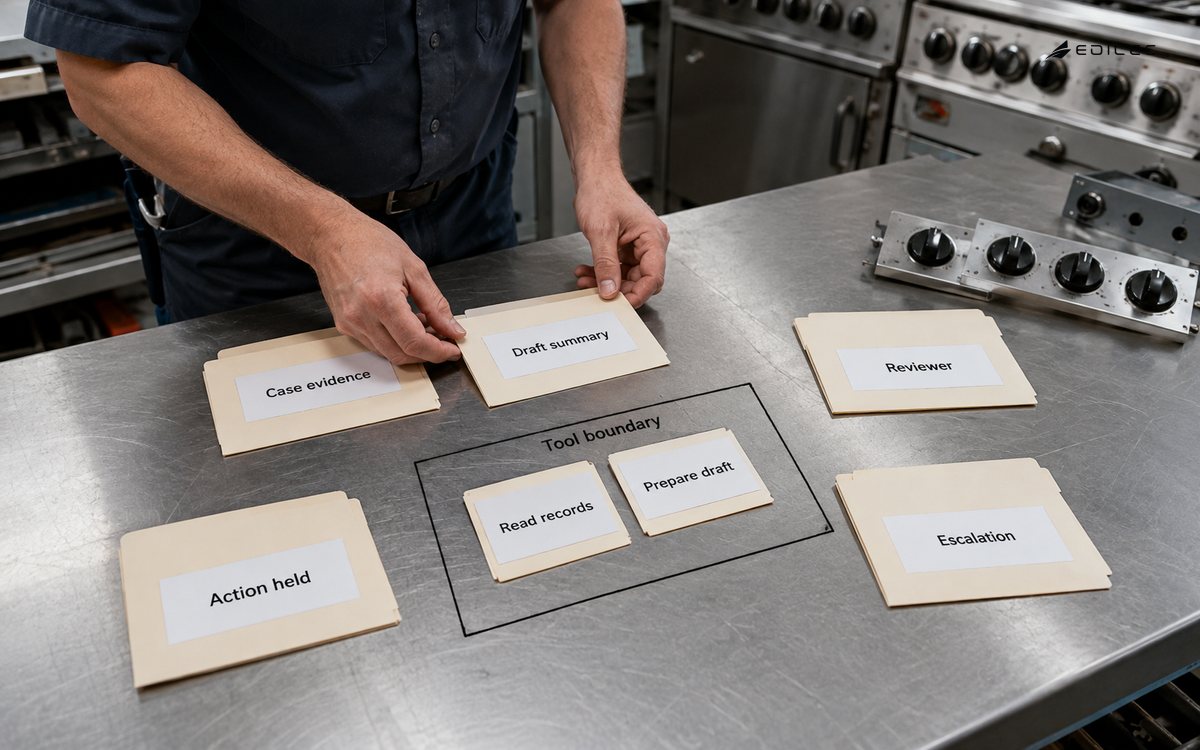
Keep durable business state outside the conversation. A chat transcript is useful evidence but a weak source of truth for approvals, balances, entitlements or fulfillment. Store workflow state in a versioned schema with correlation IDs, action status and provenance. Redact secrets and unnecessary personal data before model calls and traces. Decide retention separately for user messages, retrieved passages, tool arguments, model outputs and evaluation examples; they have different operational and privacy purposes.
Deliver in six evidence gates
- Frame the workflow, baseline, risk tier, owner and prohibited outcomes.
- Build a representative evaluation set from approved, de-identified cases, including ambiguous and adversarial examples.
- Prototype the smallest end-to-end path with read-only or simulated tools and visible evidence.
- Add authorization, structured outputs, transaction controls, audit records, escalation and support diagnostics.
- Run in shadow mode, then with assisted users, and compare results with the accepted business outcome.
- Release progressively with limits, live quality review, incident response and a rollback or disable mechanism.
Every gate should answer a decision. Discovery decides whether the workflow is agent-suitable. Offline evaluation decides whether the design is promising. Shadow operation decides whether production context changes performance. An assisted pilot decides whether people can supervise efficiently. Progressive release decides whether benefits survive real demand and exceptions. A demonstration is not a gate because it rarely samples failure distribution, malicious input, changing policy or tool side effects.
Evaluate decisions, actions and outcomes
| Measure | Definition | Why it matters |
|---|---|---|
| Task success | Cases reaching the verified correct business outcome | Prevents fluency from substituting for completion |
| Evidence fidelity | Material claims supported by approved current sources | Finds unsupported or stale reasoning |
| Action precision | Tool calls with correct target, parameters and policy | Measures operational safety |
| Escalation quality | Unsafe or uncertain cases routed with usable context | Tests whether stopping behavior works |
| Intervention rate | Cases requiring correction by a reviewer | Shows supervision burden |
| Unit cost | Model, retrieval, tool, review and platform cost per success | Connects architecture to economics |
Evaluation sets need ordinary cases, rare high-impact cases, missing evidence, conflicting instructions, prompt injection, repeated requests, tool failures and policy changes. Score components and the final outcome. A correct answer reached through an unauthorized lookup is still a failed run. A safe escalation can be a success when evidence is insufficient. Review disagreement among human raters rather than hiding it in an average; disagreement often reveals that business policy needs clarification.
Model cost and operating capacity
AI agent cost includes discovery, workflow redesign, integration, data preparation, evaluation, security review, model and retrieval usage, observability, human review, support and change management. Estimate by successful outcome, not token. A cheaper model that triggers more retries and corrections can cost more per completed case. Model volume by intent, context size, tool rounds, escalation rate and peak concurrency. Include storage and analysis of traces, but minimize sensitive content rather than retaining everything by default.
A sensible commercial structure funds a short evidence phase, a controlled pilot and production expansion separately. Tie expansion to task success, action safety, user impact and unit economics. Avoid fixed enterprise-wide automation claims before the first workflow exposes integration and review effort. Reusable platform components can reduce later cost, but only build them after two or three workflows demonstrate a recurring need; premature platforms often generalize assumptions from one prototype.
Control the risks that change the decision
Material risks include unsupported output, prompt injection through retrieved content, excessive agency, confused identity, sensitive-data leakage, brittle tool use, runaway loops, automation bias and silent model change. NIST's AI RMF provides the Govern, Map, Measure and Manage functions for organizing responsibility, context, assessment and response. The generative AI profile and OWASP guidance help translate those functions into tests and controls, but workflow-specific harm analysis remains necessary.
Example: controlled invoice-exception agent
Consider an accounts-payable agent handling duplicate-invoice warnings. The agent may retrieve the purchase order, receipt, supplier terms and prior invoices, then explain likely duplication and prepare a hold. It cannot release payment, change supplier bank details or delete a record. A reviewer sees source identifiers, matched fields, confidence and the exact hold transaction. Server-side logic checks tenant, amount, invoice state and idempotency before execution. Cases with conflicting receipts or privileged suppliers route to a specialist queue with the collected evidence.
The pilot evaluation samples ordinary duplicates, legitimate recurring invoices, altered invoice numbers, missing purchase orders, cross-currency amounts, prompt injection inside attachments and tool outages. Success requires a correct final disposition and authorized handling, not simply accurate duplicate classification. Operations tracks prevented duplicate value, incorrect holds, reviewer time, escalation usefulness, tool errors and cost per verified case. This bounded example shows how workflow, authority, evaluation and economics fit together in a delivery plan.
Key takeaways
- Scope one measurable workflow and define prohibited outcomes before choosing a model.
- Give the agent typed, allowlisted tools and enforce authorization at execution time.
- Keep business state in governed systems rather than relying on conversation memory.
- Evaluate evidence, tool behavior, escalation and final outcomes on representative cases.
- Price the complete operating system and calculate cost per verified success.
- Expand authority only after production evidence shows that controls and support work.
Frequently asked questions
How is an AI agent different from a chatbot?
A chatbot is an interface pattern. An agent has a controlled loop that can select tools, manage state and advance work toward a completion condition. A chat interface can host an agent, and an agent can run without chat. The distinction that matters operationally is whether the system can change business state and how that authority is governed.
Should the most capable model handle every step?
Usually not. Deterministic code should handle known validation and policy. Smaller models may suit routing or extraction, while a more capable model handles ambiguous synthesis. Select components through task evaluation, latency, privacy, availability and cost. Keep model access behind a gateway so versions can be evaluated and changed without redesigning every tool.
How long should an agent pilot run?
Run long enough to encounter representative volume, operators, peaks and exception types. Calendar duration alone is a poor criterion. Define the number and composition of cases, minimum quality thresholds, allowed incidents and evidence required to expand. Continue shadow or assisted operation when rare high-impact cases have not yet been exercised.
Conclusion
A production AI solutions agent is a governed workflow system with a model inside it. Start from a bounded outcome, constrain authority, mediate every tool, preserve durable state, and evaluate real decisions and effects. Fund delivery in evidence gates and treat escalation, observability and incident response as product features. This turns agent capability into dependable business capacity while keeping people accountable for the rules and consequences that matter.