An AI services MLOps implementation checklist connects model experimentation to a production service that can be reproduced, evaluated, authorized, monitored, recovered and retired. MLOps is not a model registry plus a deployment script. Production machine learning adds changing data, feature logic, labels, training code, model artifacts, serving infrastructure and feedback loops to normal software delivery. Each can alter behavior and needs ownership and evidence.
Google Cloud’s MLOps guidance distinguishes continuous integration, delivery and training, and emphasizes data validation, model validation, metadata and monitoring around the small fraction of a system that is model code. NIST’s AI RMF adds lifecycle governance through Govern, Map, Measure and Manage. Before implementation, use the AI services MLOps scope and cost plan; the MLOps FAQ helps settle platform and operating choices.
1. Define the use-case and model contract
Name the decision, recommendation or content the system supports; affected users; business owner; prediction consumer; permitted automation; human review; and fallback. Specify valid inputs, output semantics, latency, throughput, availability and cost boundaries. For consequential uses, define who can challenge or override an output. Separate model quality from service success: a classifier metric does not prove that the downstream workflow improves.
Create offline and online acceptance criteria before training. Include a simple baseline, overall and relevant group performance, calibration where needed, robustness, privacy, security and resource use. State minimum sample sizes and uncertainty. Decide which errors are more costly and who approves that tradeoff. Record prohibited uses and expected degradation. A model card or system record should explain scope and evidence without becoming a substitute for tests.
| Contract area | Question | Release evidence |
|---|---|---|
| Purpose | Which outcome and workflow does the model support? | Named owner, baseline and prohibited uses |
| Input | What schema, provenance and freshness are valid? | Versioned data contract and validation report |
| Output | How is score or content interpreted and acted on? | Threshold, uncertainty and human-action specification |
| Service | What latency, throughput, availability and cost apply? | Load test and service-level objective |
| Safety | Which harms, groups and abuse paths require control? | Risk assessment, segmented tests and escalation plan |
2. Version data, features and lineage
Register dataset snapshots, source queries, schemas, labels, transformations, feature definitions, access rules, retention and quality results. A reproducible training run needs pointers to immutable or reconstructable data, not latest-table references. Separate training, validation and test data to prevent leakage and preserve a final independent set. Record consent, rights and permissible use where applicable. Restrict production data access and use de-identified or synthetic fixtures for pipeline tests when suitable.
Validate schema, missingness, ranges, duplicates, label consistency, temporal ordering and distribution before training. Compare training and serving feature logic to prevent skew. A feature store can improve reuse and consistency, but only when ownership, point-in-time correctness and version semantics are clear. Monitor source and transformation changes as first-class release events. If a data contract breaks, stop or quarantine the pipeline rather than automatically training on unknown input.
3. Make training reproducible and secure
Move production training from interactive notebooks into version-controlled components with pinned environments, explicit parameters and isolated execution. Record source commit, container or environment digest, dataset and feature versions, random seeds, framework and hardware details, parameters, metrics and artifacts. Exact numerical reproduction can vary by hardware or nondeterministic operations, so define the acceptable reproducibility level and compare behavior, not only hashes.
Apply secure software development controls to training code and infrastructure. Review dependencies, scan artifacts, protect build and orchestration credentials and separate development from production training authority. Treat serialized model artifacts as untrusted code-capable inputs where formats permit execution. Restrict who can register and promote models. Retain build provenance and signatures or checksums so serving retrieves the artifact that evaluation approved.
| Gate | Automatic checks | Human decision |
|---|---|---|
| Data ready | Schema, quality, leakage and policy assertions | Data owner accepts source and known limitations |
| Candidate trained | Reproducibility, dependency and artifact integrity | ML owner explains change and experiment result |
| Offline evaluation | Baseline, segments, robustness, safety and cost | Domain and risk owners accept residual risk |
| Pre-production | Interface, load, security, shadow or canary tests | Service owner approves exposure and rollback |
| Production promotion | Artifact identity, configuration and approvals | Authorized owner records release decision |
4. Register evidence and control promotion
Use a registry to connect each candidate to version, lineage, evaluation, status and intended environment. MLflow and Kubeflow provide model-registry capabilities, but a registry is not governance by itself. Define states such as experimental, validated, approved, deployed, suspended and retired; permissions and transition criteria; and who can promote. Do not use a mutable stage label as the only deployment reference. Pin the exact model and configuration.
Evaluate candidates against the existing production model and a simple baseline. Include slice performance, calibration, robustness to missing or shifted data, security abuse cases and downstream business simulations. For generative systems, test groundedness or source support, unsafe outputs, prompt injection, data extraction, tool use and refusal behavior as relevant. Keep evaluators and test sets versioned and review whether the same team that optimized the model has supplied all acceptance evidence.
5. Deploy progressively with recovery controls
Package preprocessing, model and postprocessing as one versioned serving contract. Validate feature availability and schema at runtime. Use shadow, canary, champion-challenger or A/B exposure where suitable, with privacy and experiment ethics considered. Define health and model-behavior gates, observation windows and decision owners. A successful endpoint health check cannot detect an inverted label mapping or harmful segment regression.
Prepare rollback to a known artifact and configuration, but recognize that rollback may not undo actions already taken from predictions. Preserve transaction or decision evidence and provide remediation procedures. Test loss of feature service, registry, model endpoint and external model provider. A deterministic fallback, cached result or human queue may be safer than an untested secondary model. Capacity plans should include traffic bursts, batch contention, accelerator quotas and cost ceilings.
6. Monitor service, data, model and outcomes
Instrument four layers: infrastructure and API health; input schema and distributions; prediction or output characteristics; and delayed ground-truth or business outcomes. OpenTelemetry’s traces, metrics and logs help correlate requests across services; add model version, feature version and decision route without exposing sensitive inputs. Define alerts with owners and actions. Drift is a diagnostic signal, not proof that a model is wrong or that automatic retraining is safe.
Monitor performance by relevant groups and operating conditions when lawful and statistically meaningful. Track abstention, override, appeal, support, harmful output and feedback quality. Account for label delay and selective labels: outcomes may only be observed for cases that received an intervention. Review cost per successful prediction or workflow outcome. Maintain privacy limits on prompts, features and outputs in telemetry, and restrict access to sampled records.
Control retraining, incidents and retirement
Trigger retraining from a justified event: sufficient new labeled data, performance degradation, distribution change, policy requirement or approved model improvement. Do not promote automatically just because training completed. Every candidate passes the same gates, with stricter review for material changes. Prevent feedback loops from treating model-influenced outcomes as independent truth. Record lineage from production observations back to the next training set.
Incident response should identify model, data, feature, code, configuration and provider versions; affected decisions; containment; notification; correction and learning. Practice suspension and fallback. Retire models by removing endpoints and credentials, preserving required evidence, handling artifacts and datasets under retention policy and updating consumers. A model left in a registry with active access is not retired.
Publish an ownership map for every production model: business outcome, data, feature pipeline, training workflow, registry, serving service, monitoring, on-call and risk acceptance. Set support hours and escalation targets. Shared platforms can operate infrastructure, but they cannot determine whether a prediction remains valid for a domain. Schedule periodic review even when alerts are quiet, because labels, policy and user behavior may change without an obvious outage.
Run the six-stage MLOps procedure
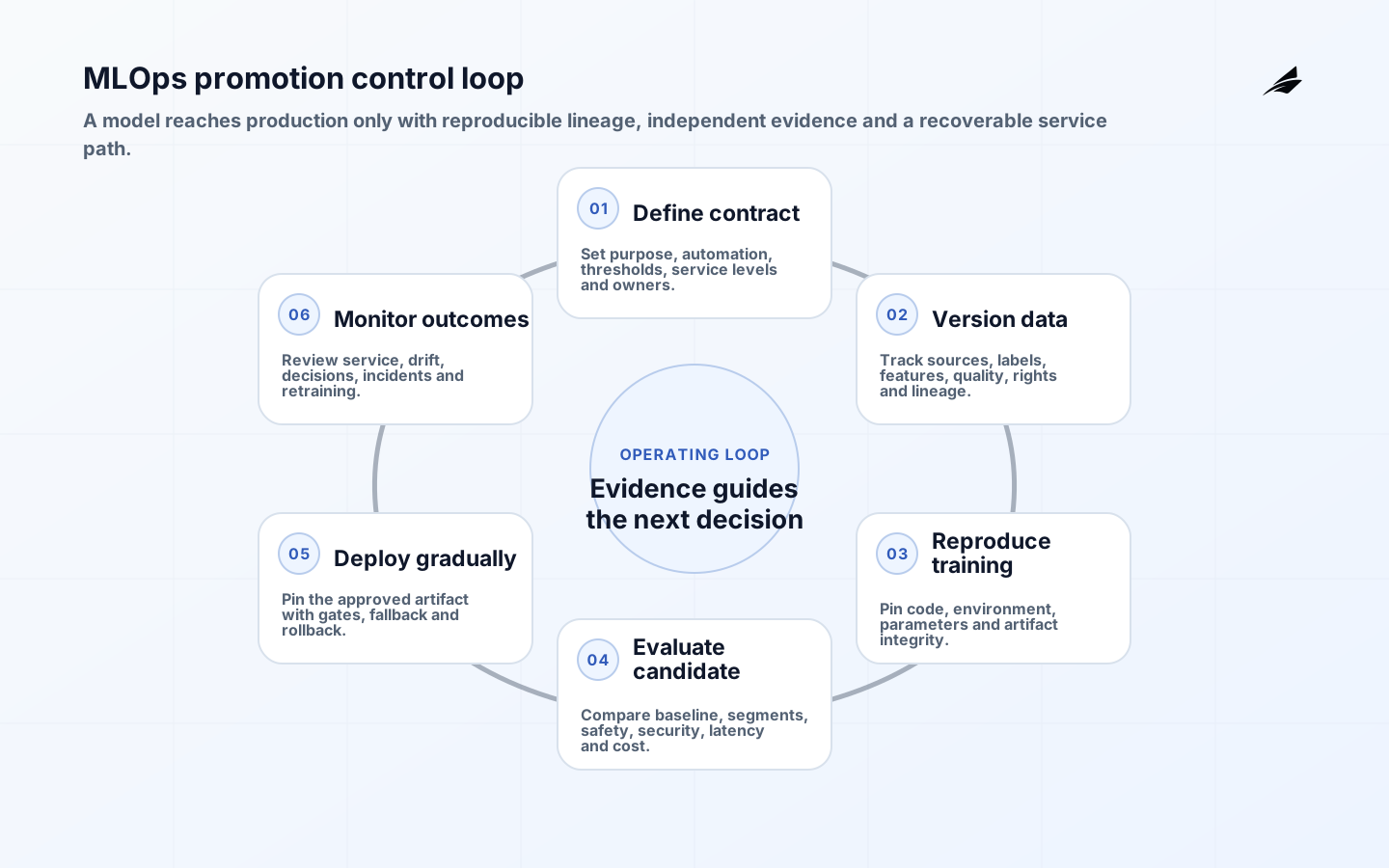
- Define the model-supported outcome, automation boundary, owners, offline thresholds and online service objectives.
- Version data, labels, features and transformations; validate quality, permissions, leakage and training-serving consistency.
- Train in a secured reproducible pipeline and preserve code, environment, parameters, lineage and artifact integrity.
- Evaluate against baseline and production across relevant segments, safety, security, robustness, latency and cost.
- Register and deploy the exact approved artifact progressively with observation gates, fallback and rollback authority.
- Monitor service, data, behavior and outcomes; govern retraining, incidents, material changes and retirement through evidence.

Key takeaways
- MLOps governs the complete data, feature, model, code and service system.
- Version lineage and acceptance evidence so a production decision can be reconstructed.
- Keep independent promotion gates even when training and evaluation are automated.
- Monitor user and business outcomes alongside infrastructure, drift and prediction statistics.
- Treat retraining as a controlled release and maintain tested suspension, fallback and retirement paths.
Frequently asked questions
Do we need a dedicated MLOps platform?
Not always. A small number of slowly changing models may use existing CI, artifact storage, orchestration and monitoring with clear conventions. Adopt platform capabilities when they reduce repeated risk or toil. Avoid building a large platform before a production use case establishes requirements.
Should drift automatically trigger deployment of a retrained model?
Usually no. Drift can reflect benign seasonality, pipeline breakage or a changed population. It should trigger investigation or a candidate run. Promotion still requires data and model validation, risk review and the approved deployment gate.
Does MLOps apply to large language model applications?
Yes, but the versioned system also includes prompts, retrieval indexes, policies, tools and external model configuration. Evaluation and monitoring must cover source support, unsafe behavior, injection, tool actions and provider change in addition to standard service health.
Conclusion
Reliable AI services MLOps turns a promising experiment into an inspectable production lifecycle. Versioned lineage, reproducible pipelines, independent evaluation, controlled promotion and outcome monitoring allow teams to improve models without losing accountability. For business-workflow deployment patterns, continue with the AI workflow automation checklist and AI workflow operations FAQ.