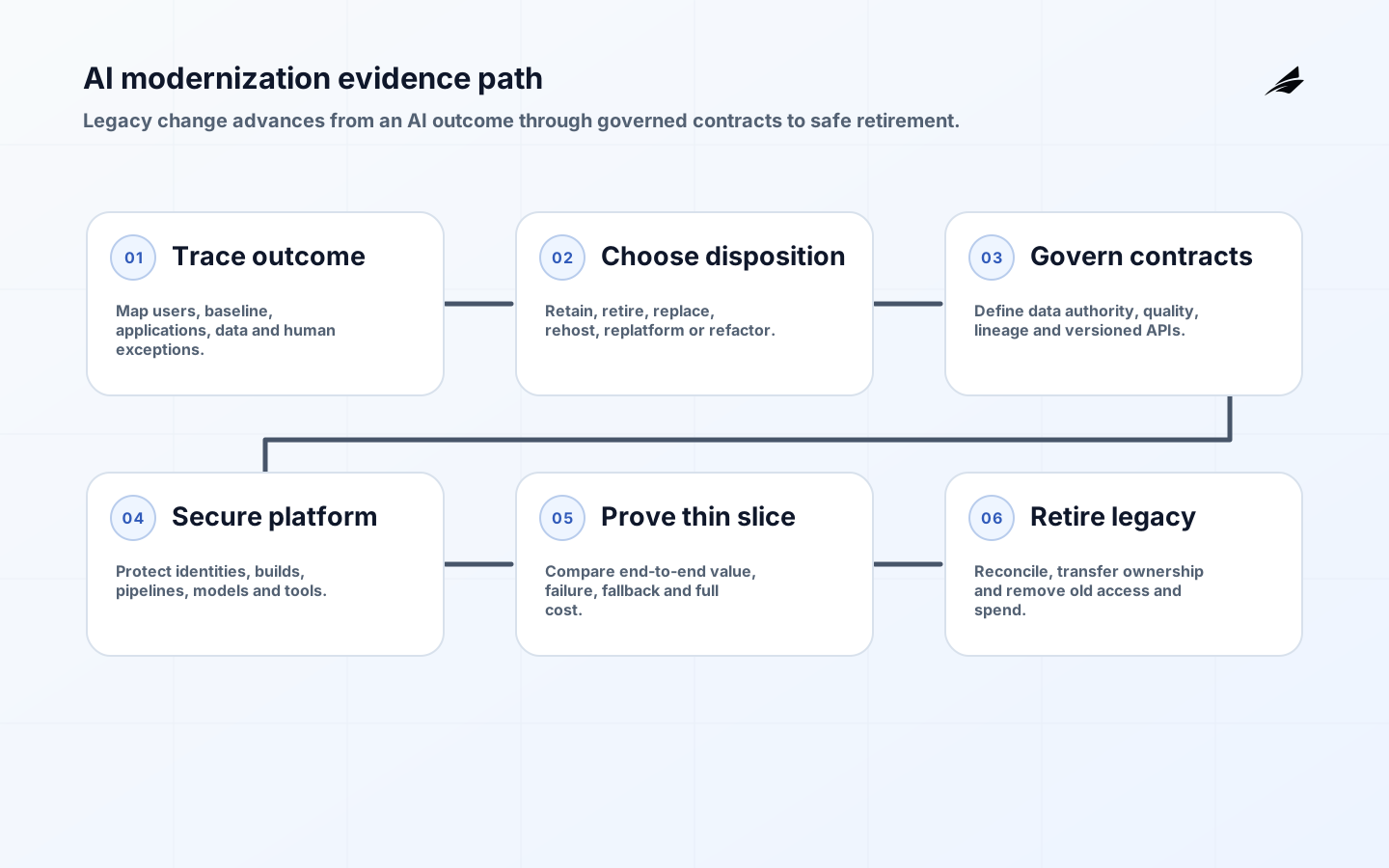
Modernization services for AI readiness improve the applications, data, interfaces, delivery practices and controls that an AI use case depends on. They do not require moving every workload to cloud or rewriting every legacy system. In many estates, the highest-value first move is to expose a governed data product, stabilize a brittle workflow or create an auditable API. The target is a maintainable business capability with evidence-quality data and safe integration points.
Use this checklist with the AI modernization scope, cost and risk plan and AI modernization FAQ. For a bounded automation use case, consult the AI workflow automation checklist. The modernization and AI workstreams should share outcome ownership but maintain separate acceptance evidence: a successful platform migration does not prove an AI system is useful or trustworthy.
1. Define the AI outcome and inventory its dependency chain
Describe the user decision or workflow, baseline performance, target outcome, affected people and risk level. Map backwards from that outcome through channels, applications, APIs, records, batch jobs, documents, identity, infrastructure and suppliers. Identify authoritative data and hidden human reconciliation. Include unsupported runtime versions, fragile schedules, undocumented rules and people who know how exceptions work. This reveals whether the constraint is model capability, data, integration, process design or basic reliability.
Profile each dependency for business criticality, change rate, support status, security exposure, data quality, recovery, operating cost and available expertise. Capture actual runtime and transaction evidence, not only repository contents. A system may look obsolete yet be stable and well isolated; another may use modern services while depending on unreliable manual data. Prioritize by outcome dependency and risk, not technology age alone.
| Readiness dimension | Question | Evidence |
|---|---|---|
| Business fit | Which measurable outcome needs AI? | Baseline and accountable owner |
| Data | Is authoritative, permitted and timely data available? | Provenance and quality profile |
| Interfaces | Can the workflow be invoked and observed safely? | Contract and failure tests |
| Operations | Can teams deploy, recover and support change? | Pipeline, telemetry and restore result |
| AI governance | Can outputs, overrides and harms be evaluated? | Risk map and evaluation plan |
2. Select a disposition per capability
Choose retain, retire, replace, rehost, replatform, refactor or rebuild at the level where the decision is meaningful. Microsoft describes replatforming, refactoring and rearchitecting as distinct modernization paths, while Shared Services Canada's guidance similarly starts with assessing applications and selecting a strategy. Taxonomies vary; the essential practice is to document rationale, expected outcome, dependencies, risk, cost range and reversal point. One program can legitimately use several dispositions.
Prefer incremental replacement when a core system contains valuable rules but cannot support the target pace. Put an interface around a stable boundary, move one capability and reconcile results before retiring old behavior. A full rewrite is justified only when incremental routes cannot meet the outcome or risk constraints and the organization can preserve required semantics. Do not let generated code create false confidence: undocumented behavior, data conversion and user exception paths remain the difficult work.
3. Modernize data and contracts before model integration
Assign owners to data products and define meaning, schema, quality thresholds, freshness, access, lineage, retention and permitted AI use. Preserve source identifiers and time semantics. Separate raw, curated, feature and model-output data with traceable transformations. Test missing, duplicated, delayed and corrected records. Historical data reflects past policy and operational choices; it is not automatically suitable ground truth.
Create versioned APIs or event contracts around business capabilities. Specify authentication, authorization, idempotency, rate limits, error behavior and service objectives. Consumers should not scrape application screens or directly query operational tables for production AI. Use contract testing and backward-compatible evolution. Where near-real-time data is unnecessary, a governed batch interface can be simpler, cheaper and safer than an elaborate streaming architecture.
4. Build secure delivery and AI platform controls
Establish separate environments, workload identity, secrets management, encryption, network policy, logging and protected build paths. Apply the NIST Secure Software Development Framework to modernization code, data pipelines and AI integration components. Inventory dependencies and generated artifacts. Scan and review infrastructure definitions. Restrict migration tools and AI agents because their broad read and write privileges can create a larger blast radius than the application itself.
Use NIST's AI Risk Management Framework to govern the AI lifecycle: identify context and affected parties, measure relevant risks and manage them through controls and monitoring. Maintain model, prompt, retrieval source and evaluation versions. Define human review and fallback for uncertain or consequential output. AI readiness means the platform can support evaluation, change control and incident response, not merely connect to a model endpoint.
5. Deliver a thin modernization and AI slice
Build one representative path from source data through modernized contract, AI component, human interaction, telemetry and fallback. Compare it with the existing process. Include normal, low-quality input, denied access, model or dependency outage, rollback and data correction scenarios. Keep the first slice small enough to reverse while large enough to reveal operating work. A prototype on exported data does not test integration, freshness, authority or support.

- Approve outcome, baseline, risk boundary and dependency inventory.
- Select and record a disposition for each critical capability.
- Create governed data and interface contracts with quality evidence.
- Deploy through secure, repeatable platform and software controls.
- Evaluate a thin end-to-end slice against the current process.
- Migrate by wave, reconcile behavior and retire superseded components.
For each wave, define data reconciliation, user acceptance, performance, security, continuity, cutover and rollback criteria. Train users on changed responsibilities and give support teams diagnostic access. Observe long enough to catch scheduled and exceptional processing. Decommission the old route after acceptance; keeping it indefinitely creates duplicate controls, data drift and a modernization program that never releases its budget.
6. Operate for value, reliability and cost
Monitor business outcome, model quality, data quality, interface reliability, human overrides, incidents, deployment flow and cost. Segment results where distribution matters. Correlate model and data versions with outcomes. Review rejected and corrected outputs to improve the entire workflow, not just prompts. Maintain a non-AI fallback for outages and cases outside the model's boundary, and test it at the expected scale.
Allocate cost across legacy run, migration, modern platform, data pipelines, model use, review and retirement. The FinOps Framework emphasizes value and collaboration across engineering, finance and business. Track cost per accepted business outcome rather than tokens or cloud spend alone. Account for temporary dual running and retained commitments. Stop or reshape work when benefit does not survive full operating cost and risk.
| Outcome signal | What it reveals | Weak proxy |
|---|---|---|
| Accepted task completion | End-to-end value with review included | Model response count |
| Correction by cause | Data, model, rule or process defects | Aggregate accuracy |
| Change lead time | Modernization effect on adaptability | Migration milestones |
| Recovery exercise | Operational resilience | Service uptime |
| Cost per accepted outcome | Sustainable economics | Cloud or token spend alone |
7. Govern the program with evidence and stop rules
Maintain a decision record per capability with baseline, disposition, assumptions, owner, dependencies, target state, migration evidence, cost range, residual risk and retirement status. Review it at architecture and funding gates. Demonstrate working behavior and reconciled data rather than reporting percent complete from task counts. Surface scope discovered from legacy analysis as forecast uncertainty; hiding it until a fixed milestone creates unsafe shortcuts.
Define stop or reshape triggers before each wave: inability to reconcile critical records, unacceptable service degradation, security controls that cannot be evidenced, adoption below threshold, operating cost beyond range or an alternative that provides better value. A stop decision should preserve learned artifacts and maintain the current service safely. Sunk cost is not evidence that the next migration wave will succeed.
Close the program only when ownership and financial changes are real. Transfer runbooks, dashboards, provider contacts, data-quality duties, model evaluation and incident procedures to receiving teams through rehearsals. Terminate unused licenses, infrastructure, service accounts, data copies and support agreements. Reconcile expected savings with actual budgets. Schedule a post-transition review because reliability, cost and user workarounds often emerge after project reporting has ended.
Maintain a modernization dependency map across waves. Shared identity, data, network and vendor changes can create a hidden critical path or cause two teams to modify the same interface differently. Assign an integration owner to each shared dependency and test consumers before release. Remove dependencies from the map only after runtime evidence shows that old callers and data flows are gone, not when a project declares its code complete.
Key takeaways
- Trace AI outcomes through their complete application, data and operating dependencies.
- Choose modernization disposition per capability instead of mandating one migration pattern.
- Create governed data products and versioned contracts before production model integration.
- Apply secure software and AI risk controls to the same end-to-end workflow.
- Measure accepted outcomes and retire legacy paths when evidence supports cutover.
Frequently asked questions
Must AI-ready applications move to public cloud?
No. Public cloud can provide managed data and model services, but placement should follow data, latency, security, resilience, cost and skill requirements. On-premises, edge and hybrid patterns can be appropriate if they provide the required controls and operating capability.
Should teams modernize first and add AI later?
Design them together around one thin outcome, but maintain distinct evidence. The AI use case clarifies which data and interfaces matter; the modernization work makes them dependable. A long platform program without a use case and an AI pilot without production foundations both carry avoidable risk.
Can generative AI automate the legacy rewrite?
It can assist analysis, translation, tests and documentation, subject to security and review. It cannot independently establish undocumented business intent, regulatory correctness or safe data migration. Verify generated changes against representative behavior and approved requirements.
Conclusion
Modernization for AI readiness is a business-capability program, not a blanket rewrite. Inventory the outcome chain, choose dispositions deliberately, improve data and contracts, build secure AI controls, prove one end-to-end slice and migrate recoverably. When the team measures production outcomes, reliability and full cost together, modernization becomes a practical route to trustworthy AI rather than an infrastructure promise.