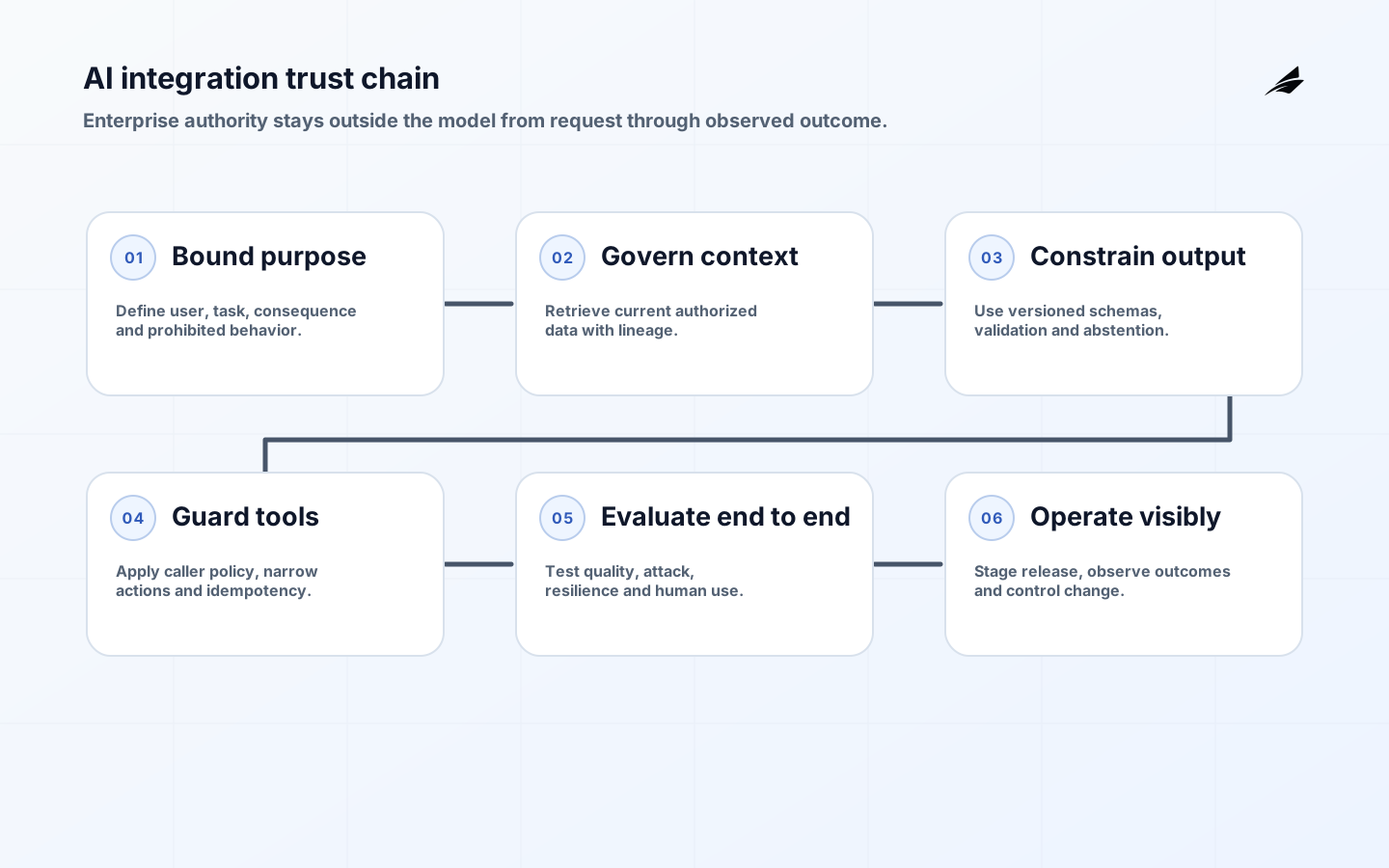
To integrate AI solutions safely, treat the model as one fallible component inside a governed application. The surrounding system owns identity, data authority, tool permissions, validation, audit, fallback and user experience. This AI solutions integration checklist covers the full trust chain from use-case boundary to production monitoring. It applies to predictive models, retrieval-augmented generation, assistants and agents connected to enterprise systems.
Use the AI integration scope and cost plan before architecture selection and the AI integration FAQ for design trade-offs. The business process implementation checklist helps when automation changes the underlying workflow.
1. Define purpose, users and prohibited behavior
Specify the task, affected users, decision consequence, baseline and accountable owner. Map whether AI retrieves, predicts, drafts, recommends or acts. List outputs the system must never produce and actions it must never take. NIST AI RMF asks teams to map context and risk before measurement; this prevents a broad “assistant” from becoming an uncontrolled route into unrelated records and tools.
Document legal, contractual, privacy, accessibility and records requirements with qualified owners. Establish human review where consequence warrants it and define what the reviewer needs to judge the result. Keep a supported alternative when users cannot or should not use the AI path. Set success, pause and rollback criteria before production exposure.
| Integration layer | Responsibility | Failure to test |
|---|---|---|
| Experience | Explain AI role, sources, review and recourse | User over-trust or inaccessible workflow |
| Identity and policy | Authorize data and actions for the caller | Cross-user disclosure or privilege escalation |
| Context | Retrieve current authoritative evidence | Grounded-looking answer from stale records |
| Model | Produce constrained structured output | Unsupported or malformed result |
| Tools and outcome | Validate, execute, observe and reconcile | Duplicate or unintended production change |
2. Govern data and retrieval
Inventory input, training, retrieval, evaluation and output data separately. Record source owner, purpose, sensitivity, retention, quality, freshness and geographic constraints. Use stable identifiers and metadata so the system can cite and filter evidence. Do not place secrets or unnecessary personal information into prompts. Apply permissions at query time and before presenting retrieved content.
Treat external content and user uploads as untrusted data. Prompt injection occurs when instructions embedded in content attempt to redirect the model; no prompt wording alone creates a security boundary. Keep system authority outside the model, sanitize active content where appropriate, limit retrieval scope and test poisoned or conflicting sources. Record index versions and deletion propagation.
3. Design model and tool contracts
Require structured schemas for model outputs that drive workflow. Validate type, range, identifiers and business rules. Give tools narrow verbs and arguments, such as create draft case rather than unrestricted database or shell access. Bind authorization to the authenticated caller, target and environment. Use separate approval for consequential tools and never place broad credentials in model-visible context.
Version models, prompts, policies, retrieval configuration and tool contracts. Set timeouts, quotas, retries and idempotency keys. A tool timeout after submission requires state reconciliation before retry. Define fallback behavior for unavailable models, stale indexes and provider rate limits. Preserve enough transaction evidence to reconstruct context, policy, output, approval, action and result without storing data longer than permitted.
4. Threat-model and secure the software supply chain
Threat-model sensitive disclosure, prompt injection, insecure output handling, excessive agency, model denial of service, poisoning, supply-chain compromise and overreliance. OWASP and MITRE ATLAS provide useful threat vocabularies, while NIST SSDF addresses the broader development lifecycle. Tailor controls to architecture and consequence rather than treating a top-ten list as proof of security.
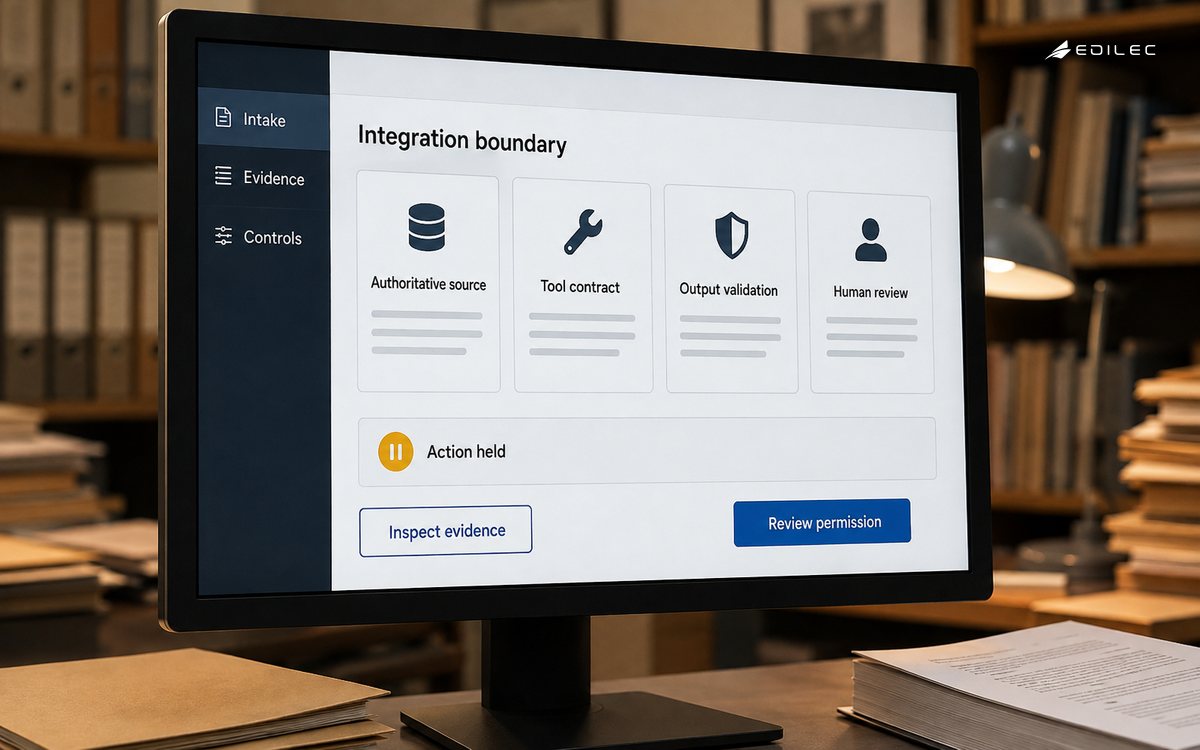
Protect repositories, pipelines, artifacts and deployment environments. Review dependencies, scan images and infrastructure, manage vulnerabilities and produce an inventory of components and model providers. Separate tenant data, log administrative actions and rehearse credential revocation. Test abuse through the integrated application, because model-only red teaming will not reveal failures in authorization, parsing or tool execution.
| Test family | Example | Release evidence |
|---|---|---|
| Task quality | Representative normal and edge cases | Versioned scores and reviewer rubric |
| Authorization | Cross-role data and tool requests | Denied-path traces |
| Adversarial | Injected documents and malformed output | Containment and safe refusal |
| Resilience | Timeout, stale retrieval and partial action | Fallback and reconciliation result |
| Operations | Provider change, incident and rollback | Runbook rehearsal and accountable owner |
5. Evaluate the end-to-end task
Build an evaluation set independent from tuning and include groups and contexts that can experience different outcomes. Measure factual or predictive quality, evidence support, unsafe output, abstention, human correction, latency and cost. Compare with the current process and a credible non-AI alternative. For generative systems, define what counts as a supported claim and how citations are verified.
Run load, concurrency and long-context tests. Evaluate user behavior: whether people notice uncertainty, inspect evidence and correct errors. Automate repeatable checks but retain expert review for context-dependent harm. Document residual risk and unmeasured characteristics. A high average score cannot compensate for an unacceptable failure on a consequential path.
6. Release, observe and change safely
Deploy to a bounded group with low authority. Use feature controls, canaries, rate limits and circuit breakers. Instrument request, retrieval, model, policy, tool and outcome spans with privacy-aware attributes. Alert on user impact, unsafe-output indicators, tool failure, cost anomalies and access denials. Make suspension possible without the AI component.
Define production ownership, support, model-provider review, evaluation cadence and change approval. Rerun proportionate tests after model, prompt, policy, data or tool changes. Sample traces and confirmed incidents to improve the evaluation set. Retire by removing credentials, tools, indexes and dependent routes, while preserving required records and communicating the supported replacement.
Applied example and assurance notes
A safe retrieval-and-action pattern separates four decisions: whether the caller may ask, which records may be retrieved, whether the proposed action is allowed and whether its observed result is acceptable. The model can assist with interpretation but should not collapse those decisions. For a procurement assistant, vendor documents are untrusted evidence, approved policy remains authoritative, purchase creation requires deterministic limits and final commitment may require a human approver.
Provider evaluation should cover more than model quality. Review data use and retention, regions, subprocessors, security evidence, availability, rate limits, version-change policy, incident notification, export and termination. Test the contractual assumptions in architecture: can logging be minimized, can a configured version be identified, and can the service fall back or move? A promise of enterprise security does not establish the organization’s specific data and action boundary.
User experience is a control surface. Clearly identify AI-generated material, show sources and material limitations, preserve editable drafts, and make correction or appeal reachable. Avoid interfaces that visually imply certainty or hide an automatic action behind a conversational turn. Accessibility testing should include dynamic updates, focus, keyboard operation and understandable error recovery. Observe whether users verify results rather than assuming that training text changes behavior.
- Record the accountable owner and the decision the evidence supports.
- Test a normal journey, a denied path and a realistic failure.
- Keep assumptions, versions and unresolved risks visible.
- Require acceptance evidence before expanding scope or authority.
- Review operating outcomes and close corrective actions.
Before approval, the application owner should convene product, data, identity, security, model, platform and support for a scenario review. Walk through ordinary use, a denied request, one unavailable dependency, a partial change and recovery. For each step, identify the authoritative record, person with decision rights, expected signal, time limit and safe alternative. Challenge prompt injection, data leakage, excessive agency and provider change. Record assumptions that could change after launch and assign each one a trigger for reassessment. The review is successful when participants can explain not only the preferred path but also how they recognize an unsafe state, who can stop progress, and how users continue while the issue is resolved. Preserve the authorized trace, adversarial evaluation and rollback exercise with the configured release rather than in a detached presentation.
For AI Solutions Integration Checklist: Architecture, Security and Production Readiness, conduct a review thirty days after release or completion. Compare actual demand, quality, exceptions, incidents, cost and user effort with the baseline. Separate design defects from training gaps and changed operating context. Sample complete cases because averages can conceal a rare path carrying most consequence. Confirm that temporary access, duplicate infrastructure, transitional policy and manual workarounds have closed or have an owner and expiry. Reforecast the next period and publish decisions to people who operate or depend on the capability. At each material change, refresh cases, assumptions and risk treatment; assurance is a maintained operating practice, not a certificate inherited from the first release.
AI Solutions Integration Checklist: Architecture, Security and Production Readiness also needs a concise evidence index that a new reviewer can navigate without oral history. Link the current boundary, named owners, architecture or workflow, decisions, tests, exceptions, operating signals and closure records. Mark superseded artifacts instead of silently replacing them, and protect sensitive material by role. During a review, select one claim from the summary and trace it to its source and observed result. If that trace is slow or ambiguous, improve the index before scale. Good evidence reduces repeated discovery, supports accountable challenge and makes future migration or retirement materially easier.
Key takeaways
- Put identity, authorization and business rules outside the model.
- Govern retrieval and treat embedded instructions as untrusted data.
- Expose narrow tools with validated schemas, approvals and idempotency.
- Evaluate security, resilience and human behavior across the integrated task.
- Release authority gradually and keep observable fallback, rollback and retirement.
Frequently asked questions
Does retrieval eliminate hallucination?
No. Retrieval can provide relevant evidence, but the model can misread, omit or invent claims. Test retrieval and generation separately, show sources and require abstention or review where support is insufficient.
When should an agent receive tool access?
After the task, identity, policy and rollback are proven with recommendation or approval-assisted use. Start with narrow reversible tools and a small target set.
Should every prompt be logged?
Not automatically. Log what is necessary for security, quality and accountability under a defined retention policy. Minimize sensitive content and protect logs as a valuable data store.
Conclusion
Reliable AI integration comes from the system around the model. Bound the purpose, govern evidence, mediate tools, secure the lifecycle, evaluate realistic failures and release authority in stages. Observability and change control then keep the application trustworthy as models and enterprise systems evolve.