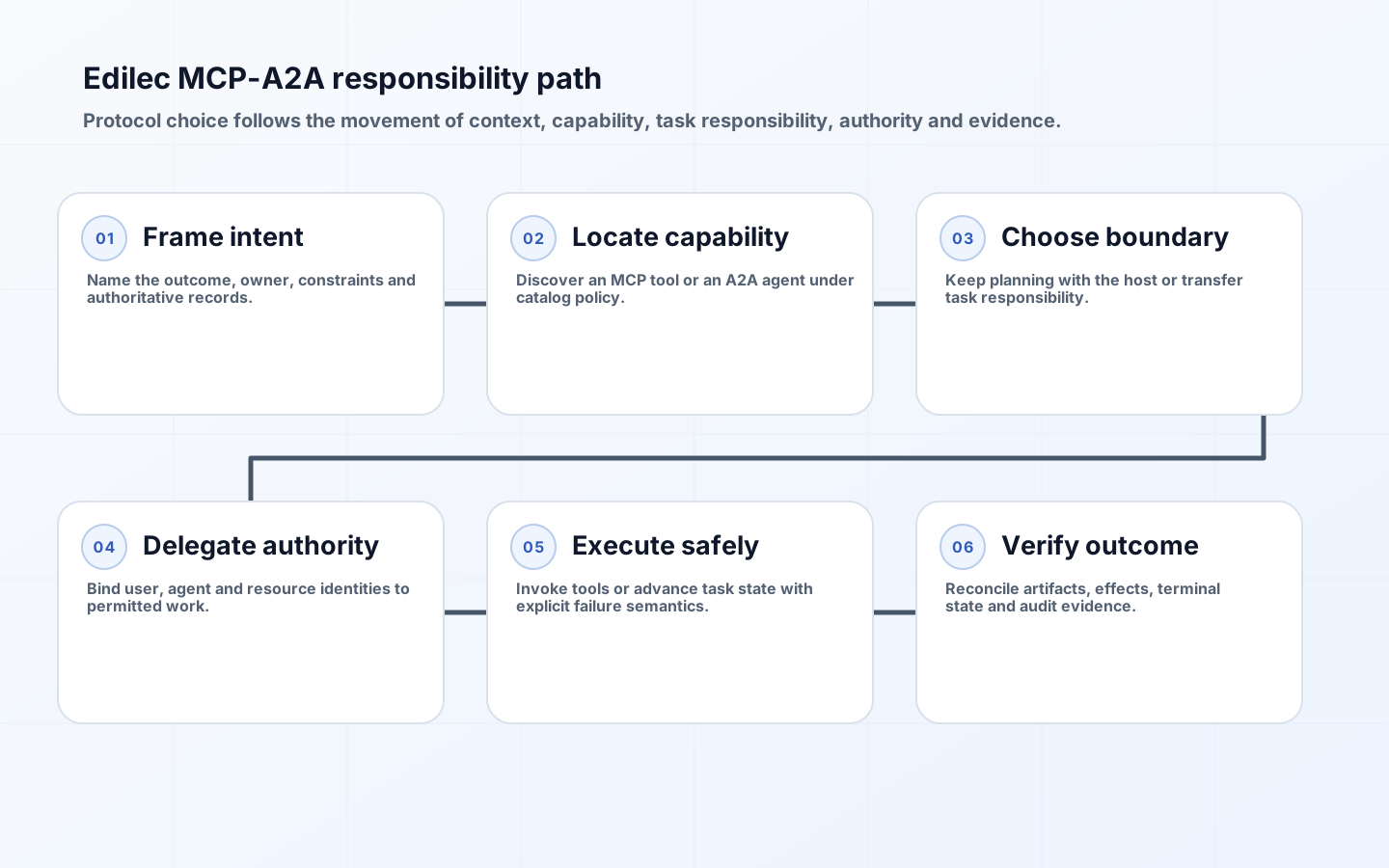
MCP vs A2A is not a contest for one universal agent protocol. Model Context Protocol standardizes how an AI application obtains context and invokes capabilities exposed by a server. Agent2Agent standardizes how one agent engages another agent around a task that may have its own identity, lifecycle, messages and artifacts. A platform can need neither, either or both. The architecture mistake is selecting by popularity and then forcing a tool call to behave like delegated work, or forcing every database lookup through a remote agent.
The practical decision begins with responsibility. If the remote party exposes a bounded capability that the calling host plans and controls, MCP is the natural boundary. If the remote party accepts a goal and retains discretion over how to complete it, A2A is the more accurate boundary. This guide builds on Edilec's MCP server architecture guide and business-system MCP design guide by comparing protocol roles rather than repeating server implementation basics.
MCP vs A2A starts with who owns the work
MCP follows a host-client-server architecture. A host manages the user experience and model interaction; an MCP client maintains a connection to a server; the server offers resources, prompts or tools. The MCP specification describes JSON-RPC messages, capability negotiation and stateful connections. The host remains the orchestration center. Even when a tool performs substantial work, its interface is presented as a capability the host can discover and invoke.
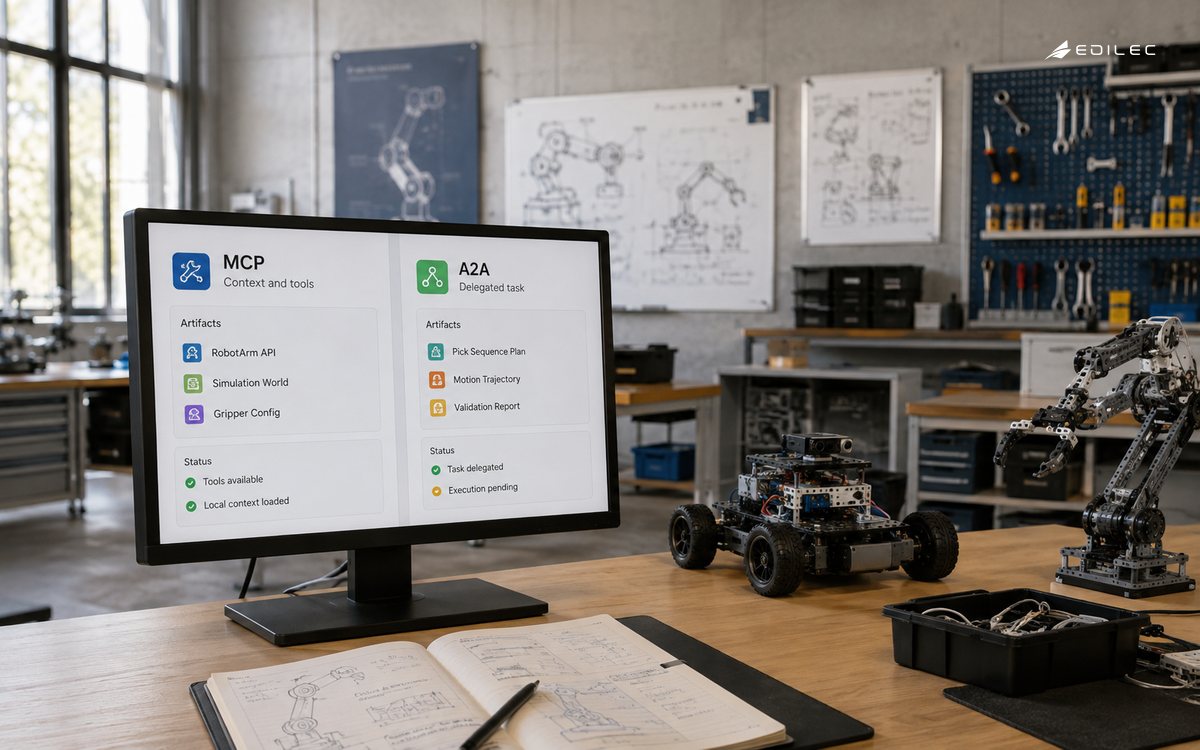
A2A treats the remote endpoint as an agent service. Its protocol specification defines Agent Cards, messages, tasks, status updates, artifacts and protocol bindings. The client asks an agent to advance a task, while the remote agent can keep its internal reasoning, tools and implementation opaque. That opacity is a feature when the provider owns a specialist capability; it is unnecessary overhead when the caller merely needs a deterministic record lookup.
| Decision question | Prefer MCP | Prefer A2A |
|---|---|---|
| What is discovered? | Tools, resources and prompts | An agent's skills, interfaces and capabilities |
| Who plans execution? | The host or calling agent | The remote agent within the accepted task |
| What state matters? | Session, request, progress and tool result | Durable task status, messages and artifacts |
| What is hidden? | Server implementation behind capability schemas | The collaborator's internal plan and tool chain |
| Typical example | Query inventory or create a ticket | Ask a logistics agent to resolve a shipment exception |
Compare the protocol data models, not just transports
Both protocols can travel over familiar web technologies, so an HTTP diagram does not reveal their semantic difference. MCP's important nouns are host, client, server, tool, resource and prompt. A tool call has named inputs and returns content or structured content. A2A's important nouns are client, server agent, Agent Card, message, task, status and artifact. A task can be submitted, worked, paused for input, completed, failed or canceled while artifacts accumulate independently of conversational messages.
Use those nouns in design reviews. If a proposed integration needs a task identifier, an independent status query, asynchronous notification and a result artifact, modeling it as a synchronous tool result will create home-grown lifecycle fields. If it needs a JSON schema for get_customer_balance and a prompt-time response, wrapping it in an autonomous agent adds discovery and lifecycle complexity without adding useful responsibility. Protocol fit is visible in the state the business must reconcile.
Draw separate trust and authorization boundaries
MCP authorization answers whether a client may access a protected MCP server on behalf of a resource owner. It does not automatically authorize every downstream system behind that server. A2A authentication establishes who may call an agent endpoint, but the receiving agent still needs policy for task acceptance, data access and any effects it causes. In both cases, enforce authority at the component that owns the protected resource; a protocol handshake is not a substitute for business authorization.
Cross-boundary delegation should preserve the actor and the intermediary. RFC 8693 distinguishes delegation from impersonation and describes token exchange for a service calling another service on a user's behalf. That model is useful when an A2A agent invokes an MCP tool: the user, remote agent and MCP executor should not collapse into one bearer credential. Edilec's agent control plan explains the complementary action tiers and approval evidence.
Treat discovery as a claim, not proof of trust
MCP servers negotiate protocol capabilities and expose lists such as tools and resources. A2A Agent Cards advertise identity, interfaces, skills, supported modes and optional capabilities. Both reduce hard-coded integration, but discovery metadata remains input to a trust decision. A catalog should verify publisher, endpoint ownership, schema version, data classification, permitted tenants, support status and review evidence before making a capability available to production agents.
Compatibility also has two levels. Wire compatibility means messages parse and required operations are supported. Behavioral compatibility means a changed tool schema, skill description or artifact format still satisfies callers. Pin tested protocol and capability versions, compare advertised metadata at deployment, and use consumer contract tests. A gateway may normalize transport details, but it cannot safely invent equivalent semantics between an MCP tool and an A2A task.
Use MCP and A2A together without blending their duties
A common enterprise stack has an application-facing coordinator, several domain agents and governed tool servers. The coordinator delegates a procurement exception to a procurement agent over A2A. That agent reads vendor records and submits an approved change through MCP servers. A2A carries task intent, status and artifacts across the agent ownership boundary; MCP exposes narrow enterprise capabilities inside the receiving domain. Each hop has its own policy and trace identity.
The reverse arrangement is also possible: an MCP tool can front a managed agent service when the host needs a simple bounded operation. That adapter must define timeout, cancellation and artifact handling rather than hiding a long-running task behind an indefinitely open request. The OpenAI Agents SDK MCP documentation illustrates multiple MCP server connection options and tool filtering, reinforcing that MCP connectivity is one part of the agent runtime rather than the runtime's entire collaboration model.
| Architecture pattern | Use when | Primary risk | Required control |
|---|---|---|---|
| Host directly calls MCP | One application owns planning and needs governed capabilities | Excess tool exposure | Per-agent tool filters and server-side authorization |
| Coordinator delegates by A2A | A specialist owns execution and may work asynchronously | Unclear task accountability | Task acceptance, status and terminal-state contract |
| A2A agent calls MCP | Remote specialist needs enterprise records or actions | Delegation chain is lost | Actor, agent and executor identities in every trace |
| MCP adapter fronts A2A | Caller needs a simple facade over delegated work | Hidden timeout or duplicate task | Durable mapping, cancellation and idempotency |
Run a protocol selection workshop around one real task
Choose a representative workflow with consequential data and at least one failure path. Name the party that owns the goal, the party that chooses steps, the systems that hold authority and the evidence required at completion. Then mark where work crosses organizational or product ownership. An agent boundary often belongs there. Mark deterministic capabilities needed within each ownership area. Tool boundaries often belong there. This exercise produces a compositional design instead of a blanket platform mandate.
Prototype the failure semantics before the happy path. Disconnect during execution, reject authorization, change a schema, request more user input and cancel the task. Confirm where status is persisted and which party reconciles an uncertain outcome. The broader guide to how AI agents work is useful for the surrounding loop; protocol selection becomes credible only when that loop survives failures across each integration boundary.
Include procurement and operations in the selection. A protocol endpoint creates a supported product dependency: name the publisher, conformance evidence, version policy, service objective, incident route, data locations and exit mechanism. For externally operated agents, confirm who retains task artifacts and how they can be exported or deleted. For tool servers, confirm how capability schemas and credentials are withdrawn. These obligations may determine whether a theoretically elegant boundary is operable in the enterprise.
Key takeaways
- Choose MCP when a host needs context or bounded capabilities; choose A2A when another agent accepts responsibility for a task.
- Compare semantic objects and lifecycle needs instead of assuming similar transports imply interchangeable protocols.
- Authorize every protected resource separately and preserve user, agent and executor identities across delegation.
- Use A2A between accountable agent domains and MCP for governed tools inside those domains when both are needed.
- Test cancellation, schema change, asynchronous completion and ambiguous outcomes before standardizing a pattern.
Frequently asked questions
Does A2A replace MCP?
No. A2A defines collaboration with another agent, while MCP defines access to context and capabilities. A remote agent may itself use multiple MCP servers. Replacing one with the other usually obscures whether the caller or provider owns planning and task state.
Can an MCP server contain an agent?
Yes, but the published tool contract should remain honest about duration, cancellation, retries and side effects. If callers need durable task status, intermediate input or independent artifact retrieval, exposing the underlying work as A2A may be clearer than extending a tool result with proprietary lifecycle fields.
Should an enterprise expose every internal agent through A2A?
No. Publish only capabilities with a stable owner, acceptance policy, support model and useful collaboration boundary. In-process specialists controlled by one application can remain framework-level components. Protocol exposure creates a product contract that must be secured, versioned, observed and operated.
Conclusion
The clean answer to MCP vs A2A is architectural, not tribal. MCP lets an AI host consume well-described context and tools. A2A lets one agent entrust work to another agent while retaining a shared task model. They solve different coordination problems and can form a disciplined stack when each boundary preserves responsibility, identity and state.
Start with one workflow and draw who decides, who acts, who owns the record and who confirms completion. The resulting boundaries will usually make the protocol choice unsurprising. Where the answer remains vague, adding a protocol will not fix it; clarify the operating contract first, then select the wire contract that expresses it.